Florida's groundwater runs hard across the Treasure Coast, and the best water heater for Florida hard water in 2026 isn't the cheapest one at the box store — it's the one built to survive scale instead of dying to it by year four.
- Tankless gas water heaters with a sediment pre-filter are the best water heater for Florida hard water in 2026 — buy for long-term reliability.
- Hybrid heat pump water heaters cut energy use and resist tank-bottom scale — buy for electric-only homes.
- Standard tank water heaters with the factory anode rod fail faster on Florida groundwater — skip unless a softener runs upstream.
- The USGS classifies water over 121 mg/L as hard, and most Treasure Coast supplies test in that range or higher.
Why This Matters
Hard water carries dissolved calcium and magnesium, and the U.S. Geological Survey classifies water as "hard" starting at 121 mg/L. Most groundwater feeding Port St. Lucie, Stuart, and Jensen Beach tests in that range or higher. Those minerals don't disappear inside a water heater — they settle as scale on heating elements, coat the inside of tanks, and clog the narrow passages inside a tankless heat exchanger. For homes considering a switch, tankless water heater installation built around a condensing heat exchanger handles that mineral load with far less wear than a standard tank.
Imperium Electric's plumbing crews replace water heaters years earlier than manufacturer estimates across the Treasure Coast for exactly this reason. Scale acts as insulation between the burner or element and the water it's supposed to heat, so energy bills climb before a unit ever fails outright. A water heater rated for 10-12 years in a soft water market can lose several years off that number on Florida groundwater if nobody flushes it.
How Water Heaters Are Ranked
The list below ranks water heater types against four factors that matter specifically in hard water conditions: scale resistance, maintenance frequency, realistic lifespan on Florida groundwater, and installation complexity for a Treasure Coast home. Manufacturer scale-tolerance specs and standard plumbing industry lifespan data drive the rankings, not marketing copy. Imperium Electric's licensed plumbers weigh those same factors on every water heater quote written in 2026.
Water Heaters Ranked For Florida's Hard Water
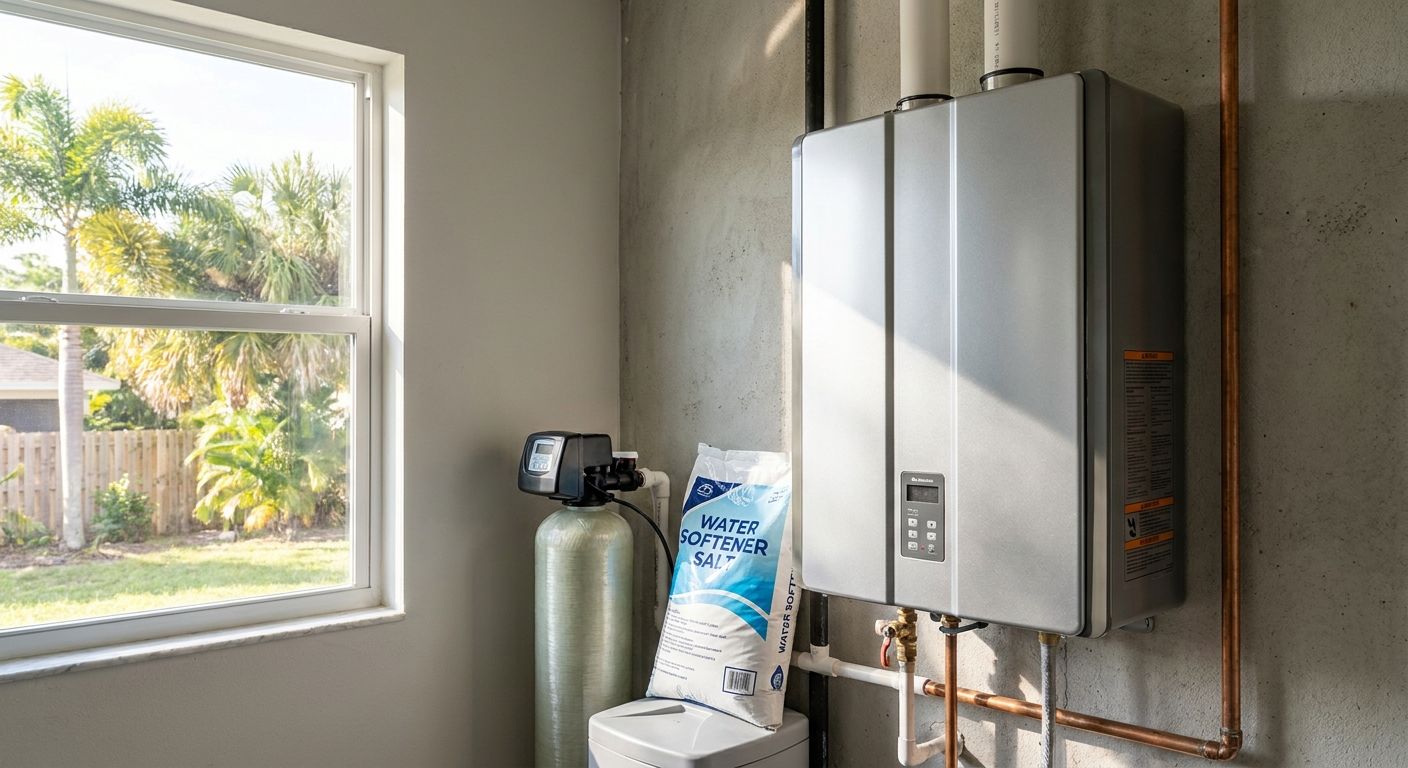
1. Tankless gas water heater with a condensing heat exchanger — Buy
The space saver that also outlasts hard water damage.
A condensing tankless unit concentrates scale onto a smaller heat exchanger surface instead of a 40- or 50-gallon tank interior, so one annual descaling flush handles what a full year of Florida hard water leaves behind. Manufacturers building hard-water-rated lines recommend flushing yearly in mineral-heavy regions, versus every two to three years in soft water markets. Pair the unit with a sediment pre-filter at install and the heat exchanger stays clear well past the 15-20 year lifespan tankless systems are rated for.
Verdict: Buy — the strongest match for hard water durability, and the option Imperium Electric's water heater installs default to when a home already runs on gas.
2. Hybrid heat pump water heater — Buy
The efficiency pick for electric-only homes.
A hybrid unit pulls heat from surrounding air instead of burning gas or running a resistance element non-stop, and the U.S. Department of Energy puts heat pump water heaters at roughly triple the efficiency of a standard electric tank. The tank still needs anode rod protection against Florida's mineral content, but the compressor and coils sit above the waterline and don't scale the way a submerged element does.
Verdict: Buy for homes without a gas line, especially where electric rates make a standard resistance tank expensive to run through 2026 and beyond.
3. Gas tank water heater with a powered titanium anode rod — Consider
The safe budget pick, if you upgrade the rod.
A stock magnesium anode rod is built to sacrifice itself to corrosion, but Florida's mineral-heavy groundwater eats through it faster than it would in a soft water state, sometimes cutting its service life in half. Swapping to a powered titanium rod at install removes that sacrificial wear entirely since it runs on electric current instead of dissolving metal.
Verdict: Consider — a solid mid-range option once the rod is upgraded. Water heater installation for Jensen Beach homeowners includes that anode swap in the quote conversation instead of leaving it as an afterthought.
4. Standard electric tank with the factory anode rod — Skip
The one that looks cheapest and costs more by year five.
No scale protection beyond the stock rod, no pre-filter, and sediment settling on the bottom heating element year after year. On Florida's hard groundwater, that combination shortens the realistic 8-12 year tank lifespan considerably and drives up energy use as scale insulates the element from the water around it.
Verdict: Skip unless a whole-house water softener already runs upstream of the tank.
5. Point-of-use electric tankless for additions and guest suites — Consider
The wildcard for small loads.
A point-of-use unit handles a single bathroom addition or a guest suite without running a dedicated line back to a central water heater, and it's a reasonable fit for low-volume fixtures. Its heat exchanger is smaller than a whole-house tankless model, which means Florida's hard water clogs it faster without a dedicated pre-filter on that line.
Verdict: Consider for secondary fixtures, not as a home's primary water heater.
Comparison Table
| Type | Hard Water Resistance | Typical Lifespan | Maintenance Needed | Verdict |
|---|---|---|---|---|
| Tankless gas (condensing) | High with annual flush | 15-20 years | Annual descaling | Buy |
| Hybrid heat pump | Moderate, anode-protected | 10-13 years | Annual anode check | Buy |
| Gas tank + powered anode | Moderate | 10-12 years | Anode monitoring | Consider |
| Standard electric tank | Low | 6-9 years in hard water | None by default | Skip |
| Point-of-use tankless | Moderate with pre-filter | 10-15 years | Filter changes | Consider |
Where To Source And Install It
- Confirm the installer builds a pre-filter or scale-inhibiting device into the quote — a unit installed alone on Florida's hard groundwater starts scaling from day one.
- Ask about post-install flushing. A drain cleaning service clears sediment already sitting in old supply lines before it ever reaches a brand-new tank or heat exchanger.
- Pull the permit. Port St. Lucie, Stuart, and Jensen Beach all require a permitted swap for water heater installs in 2026, and a licensed plumber handles that as part of the job instead of leaving it on the homeowner.
Get a water heater quote
Licensed plumbers serving Port St. Lucie, Stuart, and Jensen Beach.
FAQ
What's the best water heater for Florida's hard water in 2026?
A tankless gas water heater with a condensing heat exchanger and a sediment pre-filter is the best water heater for Florida hard water in 2026. It concentrates scale on a smaller surface and only needs an annual flush.
Is tankless better than a tank water heater in hard water areas?
Yes, tankless units generally outlast tank units on hard water because the smaller heat exchanger is easier to descale annually. Tank units need a powered anode rod and periodic sediment flushing to compete on lifespan.
How often should you flush a water heater in Florida?
Flush a tankless unit once a year on Florida's hard groundwater versus every two to three years in soft water regions. Tank units benefit from an annual sediment flush too, especially without a water softener installed.
Does a water softener extend water heater life?
Yes, a whole-house water softener removes the calcium and magnesium that cause scale buildup before it ever reaches the water heater. Homes without one see faster anode rod depletion and shorter tank lifespans.
How long do water heaters last in Port St. Lucie's hard water?
Standard electric tanks often run 6-9 years in Port St. Lucie's hard groundwater compared to the 8-12 year national average. Tankless units with annual descaling still reach their full 15-20 year rating.
Is a hybrid heat pump water heater worth it in Florida?
Yes, for electric-only homes a hybrid heat pump water heater runs roughly three times more efficiently than a standard electric tank, per U.S. Department of Energy figures. It still needs anode rod protection against hard water minerals.
What size water heater does a Florida home need?
Sizing depends on fixture count and peak-hour demand, not just household size, and a licensed plumber calculates that during the installation quote. Undersizing a tankless unit is a common mistake in larger Florida homes.
Do tankless water heaters need a pre-filter for hard water?
Yes, a sediment pre-filter protects the narrow heat exchanger passages inside a tankless unit from Florida's mineral content. Skipping it shortens the unit's life well below its 15-20 year rating.
One Last Thing
The detail most homeowners miss: a $30-40 powered anode rod upgrade at install time does more for water heater lifespan on Florida's hard groundwater than any brand name on the tank. Skip that upgrade on a standard tank unit and the factory magnesium rod can be gone within a couple of years instead of the five-plus it's built to run in softer water markets.