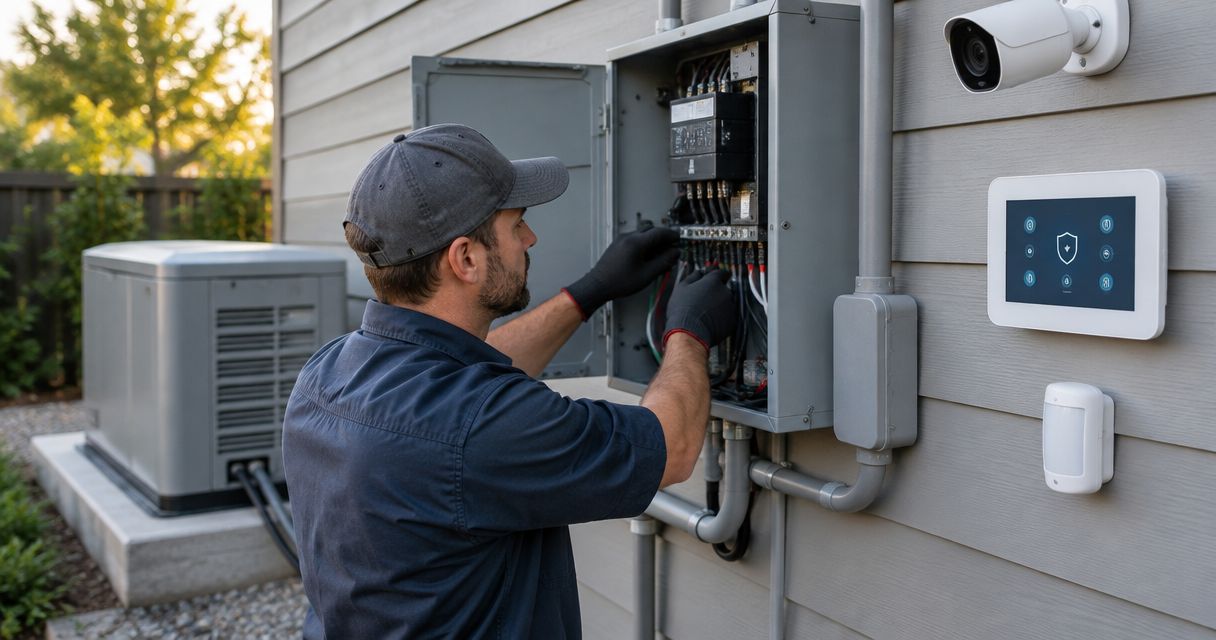
Yes, an electrician can fix a breaker that keeps tripping by identifying and correcting the overload, wiring fault, appliance problem, or defective breaker behind it. Replacing the breaker alone does not fix every cause; this guide explains what to stop using, what the electrician checks, and how to judge the repair recommendation.
- An electrician for breaker that keeps tripping should diagnose the circuit before recommending breaker replacement.
- Leave a repeatedly tripping circuit off; smoke, sparks, or burning odors require immediate attention.
- Imperium Electric LLC provides licensed electrical services for residential and commercial customers on Florida’s Treasure Coast.
- A larger breaker is not a shortcut: circuit wiring and equipment must support its rating.
Can an electrician fix a breaker that keeps tripping?
Yes. The repair must address why the breaker opens, not simply make it stay on. A breaker interrupts power when its protective mechanism detects a condition it is designed to stop. Depending on the breaker, that includes excessive current, a ground fault, or an arc fault.
Imperium Electric LLC is best suited to Treasure Coast homeowners who need a licensed electrical contractor. You can review the company’s electrical-service information through Imperium Electric LLC.
The trip pattern helps guide inspection, but it does not prove which component failed. An electrician checks the circuit, connected equipment, breaker compatibility, and visible signs of damage before choosing a repair.
| Finding | Repair approach | Appropriate when | Benefit | Limitation |
|---|---|---|---|---|
| Circuit overload | Reduce simultaneous loads or install an appropriate additional circuit | Connected equipment exceeds the circuit’s capacity | Addresses demand rather than masking it | Moving a plug helps only if the other outlet uses a suitable different circuit |
| Faulty appliance | Keep the appliance disconnected and arrange appliance repair | Testing identifies the appliance as the source | Separates equipment trouble from building wiring | Replacing the breaker does not repair the appliance |
| Damaged wiring or connection | Repair the affected wiring, device, or connection | Inspection identifies a circuit defect | Corrects the electrical fault | The defect can be concealed and require access |
| Defective breaker | Install a compatible replacement after checking the circuit | Testing supports breaker failure | Restores the required protection | A new breaker still trips if an unresolved fault remains |
| Ground or arc fault | Locate and correct the fault while retaining required protection | Protective-device testing identifies the fault type | Keeps the circuit’s safety function intact | Removing protection is not a repair |
Why this matters
A repeatedly tripping breaker is a warning, not an inconvenience to work around. Repeated resets reenergize the same circuit without correcting the reason power stopped. Do not tape, hold, or otherwise force a breaker into the on position.
The right response also avoids unnecessary work. One overloaded branch circuit does not, by itself, establish that your entire electrical panel needs replacement. Likewise, a breaker that looks normal from the outside does not establish that its connections or the wiring behind it are sound.
For a 2026 repair decision, ask for a diagnosis tied to the affected circuit. The useful explanation is what failed, what evidence supports that finding, and what work restores safe operation.
What should you do before the electrician arrives?
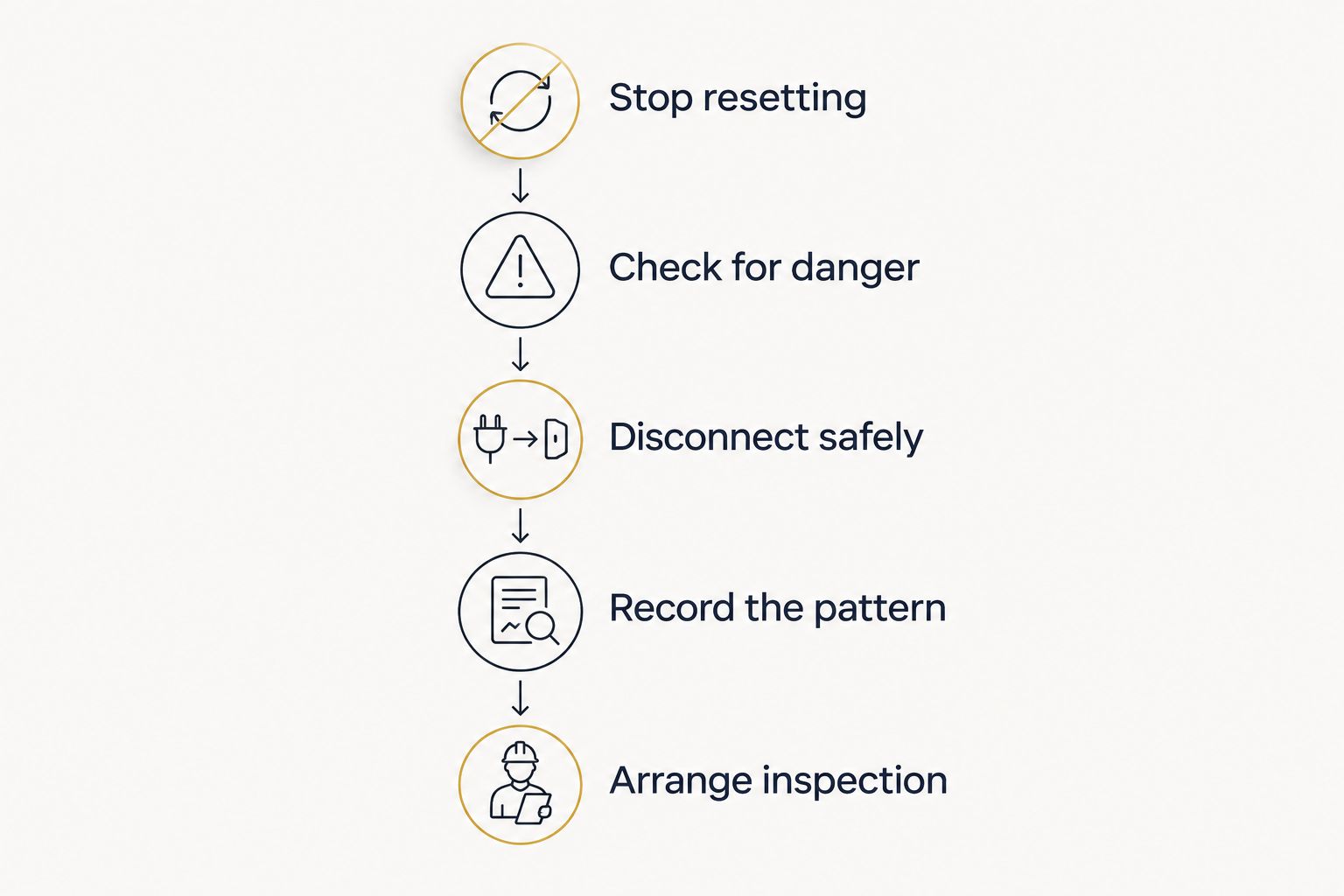
Use this 2026 safety checklist to preserve useful information without opening electrical equipment. You do not need to reproduce the fault for the electrician.
- Stop resetting. Leave a breaker that repeatedly trips off until the cause is assessed. Do not keep switching it on to see whether the problem has disappeared.
- Check for danger. From a safe distance, look for smoke, sparking, discoloration, or water around electrical equipment. Do not touch a panel or device to check whether it is hot.
- Disconnect safely. Unplug portable equipment on the affected circuit only if the plug, outlet, and surrounding area are dry and undamaged. Do not handle a scorched, sparking, or wet connection.
- Record the pattern. Note which equipment was operating, which rooms lost power, and whether the trip followed rain, appliance startup, or recent work.
- Arrange inspection. Describe the repeated trips when requesting electrical service, and disclose any burning odor, buzzing, water exposure, or visible damage.
If you see smoke or an active fire, leave the area and contact emergency services. Do not use water on energized electrical equipment, approach a hazardous panel, or delay leaving to save appliances.
Keep the panel accessible without removing its cover. Tell the electrician if the affected circuit supplies medical equipment, refrigeration, or another essential load so you can discuss a safe plan rather than improvising extension-cord connections.
What does an electrician check during diagnosis?
An electrician separates circuit demand, equipment faults, wiring problems, and breaker failure. The order depends on the symptoms and whether the equipment is safe to inspect.
Circuit demand and connected equipment
The electrician identifies what the breaker supplies and checks the connected load. Several outlets in different rooms can share a circuit, so moving an appliance across the room does not necessarily reduce demand on that breaker.
In U.S. homes, 120-volt circuits with 15-amp or 20-amp breakers are common examples of general branch circuits. Those figures identify voltage and breaker ratings; they are not permission to add equipment or assume your circuit has either rating. The electrician checks your actual wiring, equipment, and circuit requirements.
Wiring and device condition
The electrician inspects relevant receptacles, switches, connections, and wiring for damage or faults. A circuit that trips with portable appliances disconnected still needs assessment because hardwired equipment and concealed wiring remain connected.
Do not remove outlet covers, pull devices from boxes, or open the panel to search for the problem yourself. A breaker in the off position does not make every part of an electrical panel safe to touch.
Breaker type and compatibility
The electrician checks that the breaker is suitable for the panel and circuit. A breaker that physically fits is not necessarily approved for that panel.
Ground-fault circuit interrupter protection addresses current leaking outside its intended path. Arc-fault circuit interrupter protection addresses certain hazardous arcing conditions. Where a breaker provides either function, diagnosis must account for that protection rather than treating every trip as an ordinary overload.
Verification after repair
Ask how the electrician will check the repaired circuit under the conditions relevant to the complaint. A successful reset alone does not explain why the circuit previously tripped.
For intermittent trouble, your observations help define the problem. Record an existing trip pattern, but do not intentionally create another trip to collect evidence.
Why the repair varies
The repair depends on the fault location and the circuit’s job, not simply the position of the breaker handle. These factors determine the next step:
- Connected demand: An overload calls for reducing demand or providing an appropriately designed circuit, not bypassing protection.
- Fault location: An appliance defect, outlet fault, concealed cable problem, and panel connection problem require different work.
- Protection type: Standard, ground-fault, and arc-fault protection respond to different conditions.
- Equipment condition: Damaged wiring or panel components change the scope beyond a simple breaker replacement.
- Access: Exposed equipment is easier to inspect than wiring concealed behind finished surfaces.
- Affected use: A general outlet circuit and a dedicated equipment circuit require different checks against their intended loads.
For your 2026 service visit, describe the symptoms instead of requesting a particular part. Saying that the kitchen circuit trips when certain equipment runs gives the electrician more useful direction than asking for a bigger breaker.
Will replacing the breaker stop it from tripping?
Replacing the breaker stops repeated trips only when breaker failure is the cause and the replacement is correct for the installation. A working breaker can trip because it is protecting you from an unresolved problem elsewhere.
Ask what supports a replacement recommendation. The explanation should distinguish a defective breaker from an overload, equipment fault, wiring fault, or damaged connection.
Replacement also needs the correct rating and protective functions. Substituting a different breaker to suppress trips changes the protection without establishing that the circuit is safe.
Can I put in a larger breaker to stop the trips?
No. A larger breaker is not a safe fix unless an electrician verifies that the complete circuit supports the change. The breaker rating must coordinate with the conductors, equipment, and applicable installation requirements.
For example, changing a 15-amp breaker to a 20-amp breaker does not upgrade the wiring. It changes the point at which overload protection operates. Never make that substitution just because appliances are shutting off.
If your equipment needs more capacity, the solution is a properly designed circuit or another appropriate electrical modification. Diagnosis comes first.
Does a tripping breaker mean I need a new electrical panel?
No. A repeatedly tripping branch breaker does not automatically justify panel replacement. A localized appliance, wiring, or circuit-demand problem can explain the symptom without requiring a whole-panel project.
Panel work becomes relevant when inspection identifies a panel defect, damaged components, unsuitable equipment, or a capacity issue that requires broader changes. Ask the electrician to separate the immediate fault repair from any additional recommended improvements.
That distinction keeps the scope clear. You should understand which work resolves the repeated trips and which work serves another purpose.
What information should you provide when booking service?
A useful 2026 service request includes the affected area, trip pattern, and any visible warning signs. You do not need to know electrical terminology or identify the failed part.
Prepare these details:
- The room, outlet, or equipment that loses power.
- The breaker’s existing label, if readable without opening the panel.
- Whether one branch breaker or the main breaker trips.
- What was running when the trip occurred.
- Any recent appliance installation, remodeling, storm damage, or water exposure.
- Any smoke, burning odor, buzzing, or visible damage.
For licensed electrical service in Port St. Lucie, Stuart, Jensen Beach, and the Treasure Coast, Imperium Electric LLC serves residential and commercial customers. The fit is local electrical work; an appliance’s internal failure can require an appliance specialist after the circuit has been assessed.
Ask for a scope that identifies the diagnosis, proposed repair, and verification. Do not assume every repeated trip needs the same replacement part or that every electrical service request is an emergency dispatch.
Request electrical service
Describe the affected circuit, trip pattern, and any signs of damage when requesting service.
FAQ
Who should I call for a breaker that keeps tripping?
Call a licensed electrician for a breaker that keeps tripping. Imperium Electric LLC provides electrical services for residential and commercial customers in Port St. Lucie, Stuart, Jensen Beach, and the Treasure Coast.
Is it dangerous to keep resetting a tripped breaker?
Repeatedly resetting a tripping breaker reenergizes an unresolved problem. Leave the affected circuit off and arrange inspection; smoke or an active fire requires leaving the area and contacting emergency services.
Why does my breaker trip when nothing is plugged in?
A breaker can trip with portable appliances unplugged because wiring, connected devices, or hardwired equipment still have a fault. Breaker failure is another possibility that requires diagnosis, not repeated resets.
Can an electrician replace just one breaker?
An electrician can replace one breaker when inspection confirms that replacement is appropriate. The replacement must be compatible with the panel and preserve the circuit’s required rating and protection.
Why does my breaker trip when the air conditioner starts?
Air-conditioner startup trips require checking both the electrical circuit and the equipment. The timing helps guide diagnosis but does not prove that the breaker, wiring, or air conditioner is the failed component.
Can I replace an arc-fault breaker with a regular breaker?
Do not replace required arc-fault protection with a regular breaker to stop trips. Have an electrician identify the cause and retain the protection required for the installation.
What should I ask before approving a breaker repair in 2026?
Before approving a breaker repair in 2026, ask what caused the trip, what evidence supports the diagnosis, and how the repaired circuit will be checked. Separate the necessary fault repair from any broader upgrades.
One last thing
The breaker can be the part doing its job correctly. A repair that removes protection without correcting the fault is not a successful repair, even if the lights stay on.
Before closing out a 2026 electrical repair, ask for a plain-language explanation of the cause and the completed work. Keep that explanation with your circuit notes so a future electrician has more than a history of repeated resets.