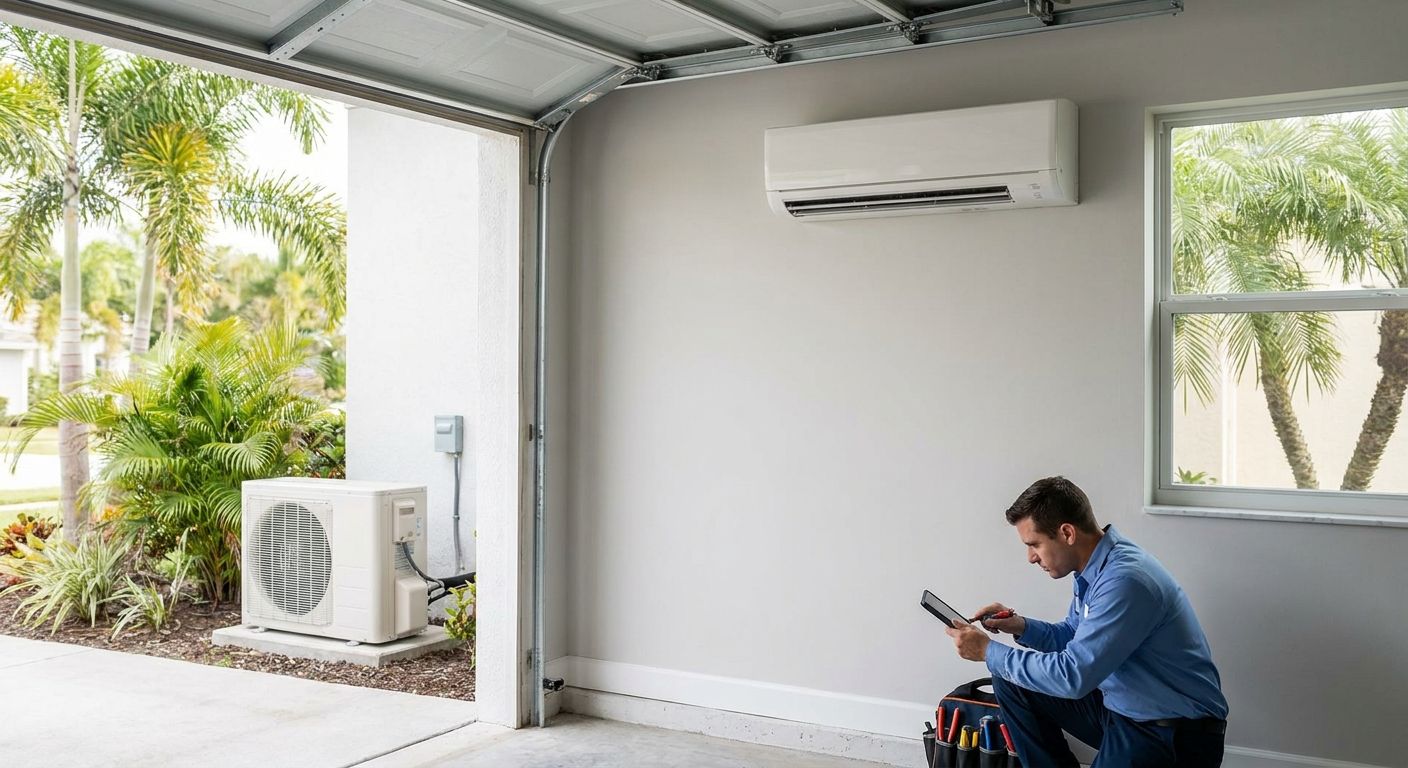
Garages and additions in Port St. Lucie, Stuart, and Jensen Beach don't have ductwork, and running new trunk lines through a slab garage or a bonus room addition is expensive and often impossible. Ductless mini split installation solves that without tearing open walls, but sizing and wiring it wrong in Florida's heat and humidity turns a comfort upgrade into a mildew problem.
- A 9,000-12,000 BTU single-zone unit handles most detached garages under 400 sq ft in Florida — buy it for workshops.
- Mini splits need a dedicated 20-30 amp circuit; skipping panel capacity checks stalls half of Treasure Coast installs.
- Federal minimum efficiency standards since 2023 require at least 14.3 SEER2 for split systems sold in the Southeast, including Florida.
- Multi-zone systems covering a garage plus an attached addition are the flexible pick, not the cheap one — consider before buying.
- Ceiling cassettes solve tight wall space in open-concept additions but cost more to service — weigh that before choosing one.
Why this matters
A garage in Port St. Lucie that hits 100°F+ in July isn't a comfort nuisance, it's a space you can't use for half the year — workshop, gym, home office, doesn't matter. Additions built without ductwork run into the same wall: the central air unit sized for the original house was never sized for the extra square footage.
Ductless mini split installation on the Treasure Coast in 2026 fixes both problems at once, but only if the unit is sized to the load, the electrical panel has room for a new dedicated circuit, and the condensate line is routed to handle Florida's humidity instead of fighting it. Get any one of those wrong and you've paid for a unit that short-cycles or grows mold behind the wall mount within a year.
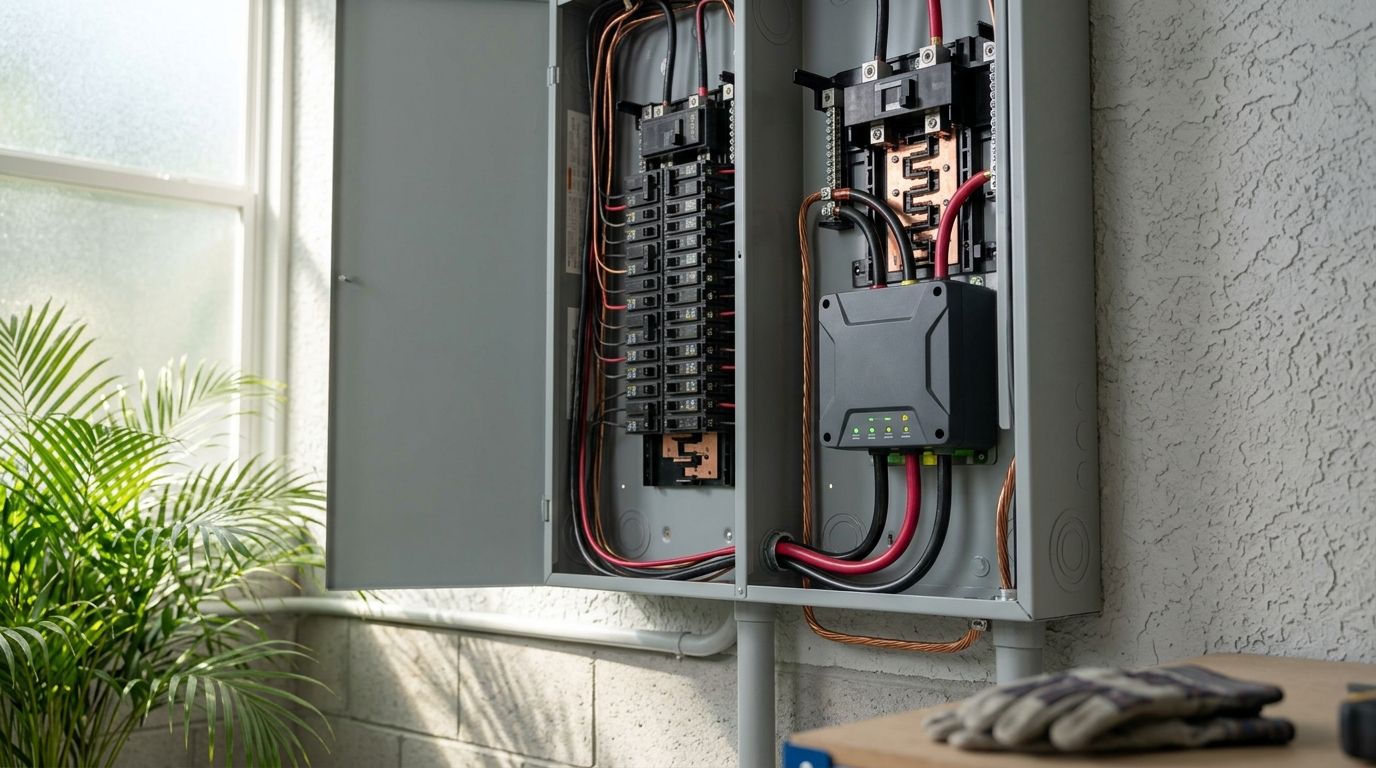
A licensed electrical panel upgrade is often the first real decision point, not the mini split brand — older Port St. Lucie and Stuart homes built before the mid-2000s frequently don't have spare breaker slots for a new 20-30 amp circuit without a panel change first.
Who this is for
This guide is for homeowners converting a Florida garage into a workshop, gym, or home office, and for anyone finishing an addition — bonus room, in-law suite, sunroom conversion — that the existing central air system was never built to cool. If you're comparing a mini split against extending ductwork or adding a window unit, the criteria below apply directly.
What to look for in ductless mini split installation for Florida garages and additions
BTU sizing matched to the actual heat load
Garages run hotter than living space because of slab heat gain, minimal insulation, and equipment that generates its own heat — compressors, welders, power tools. A 9,000-12,000 BTU single-zone unit typically covers a detached garage under 400 sq ft with standard insulation, but a garage with a slab floor, south-facing exposure, or heat-generating equipment needs the next tier up regardless of square footage.
SEER2 efficiency rating
Federal minimum efficiency standards updated in 2023 require at least 14.3 SEER2 for split systems sold in the Southeast region, which includes all of Florida. In 2026, most contractors are installing inverter-driven units well above that floor — anything under the 14.3 minimum shouldn't be on the table for a new install.
Dedicated electrical circuit and panel capacity
Most mini split condensers need a dedicated 20-30 amp circuit with a disconnect within sight of the outdoor unit, per code. If your panel is already maxed out — common in Port St. Lucie and Stuart homes built decades ago — the electrical work has to happen before the mini split does, not after. A residential electrician checking panel capacity first saves a second visit and a second invoice.
Line set length and mounting layout
Most single-zone systems perform best with line set runs under roughly 50 feet before capacity and efficiency start to drop. A detached garage 80 feet from the electrical panel changes the math on where the outdoor condenser goes and whether a single-zone or a different configuration makes more sense.
Condensate drainage and humidity control
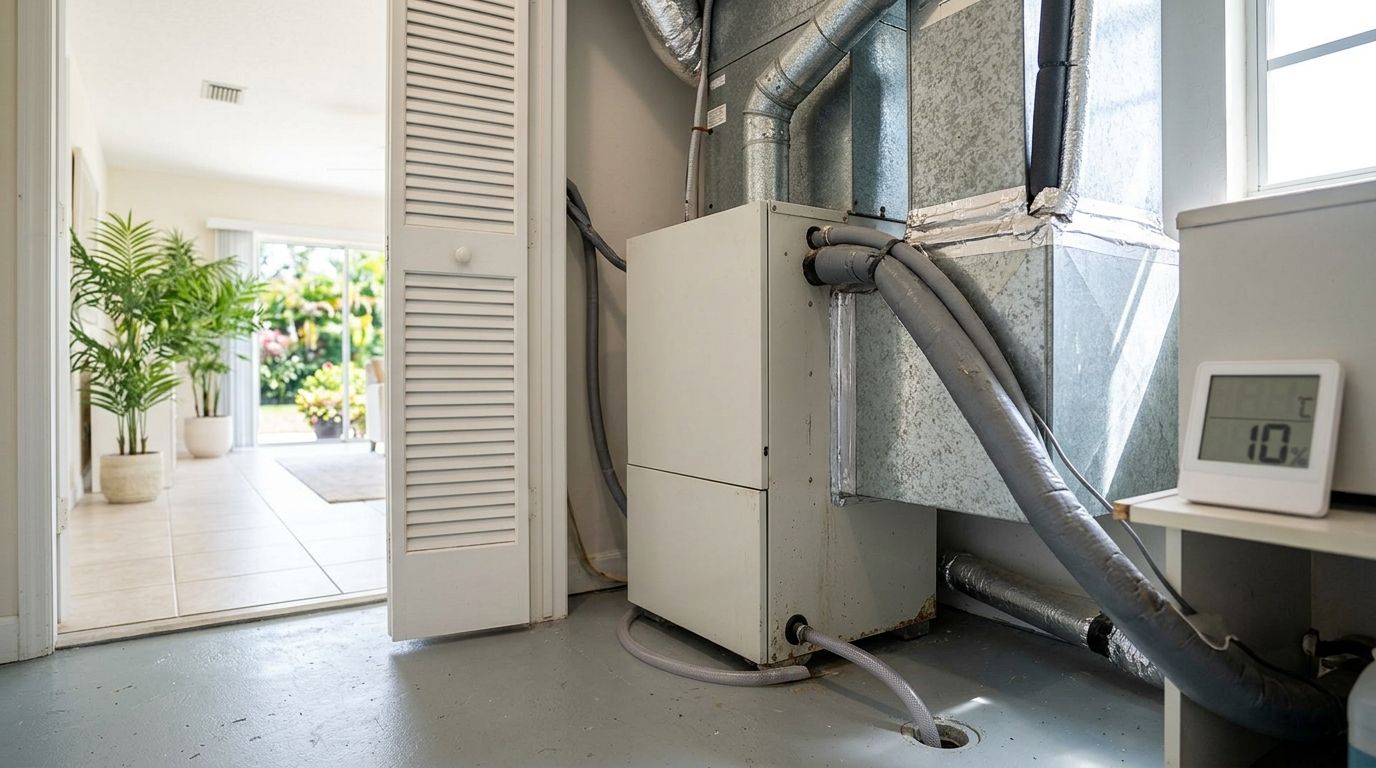
Florida's humidity means a mini split pulls significant moisture out of the air, and that condensate line has to drain somewhere that doesn't pool against a slab or a foundation wall. A garage without a floor drain usually needs a condensate pump — factor that into the install, not into a callback six months later.
Get your mini split sized right
On-site quote for garage and addition installs across the Treasure Coast.
Top picks by garage and addition type
The safe pick: 9,000-12,000 BTU single-zone for a small workshop garage
Covers detached or attached garages under 400 sq ft with standard insulation and no major heat-generating equipment. One spec that matters: 14.3 SEER2 minimum, but look for inverter models that modulate output instead of cycling on/off, since garages see bigger swings in door-open heat load than living rooms do. Verdict: Buy if the space is under 400 sq ft and the panel has room for a new circuit.
The workhorse: 18,000-24,000 BTU single-zone for a garage gym or workshop
Built for 500-700 sq ft garages doubling as a home gym, woodshop, or space with running power tools and equipment heat load. One spec that matters: the higher BTU range draws more amperage, so confirm the panel has the extra 20-30 amp circuit before committing to this tier. Verdict: Buy for larger, heavier-use garages; Skip it for a space under 400 sq ft — you'll short-cycle the unit and waste efficiency.
The flexible pick: 2-zone multi-split for garage plus adjoining addition
One outdoor condenser feeding two indoor heads — say a 12,000 BTU head in a converted garage and a 9,000 BTU head in an adjoining bonus room addition. One spec that matters: multi-zone systems need more electrical capacity than a single-zone unit, which is where a licensed electrician's circuit assessment matters before quoting the job. Verdict: Consider if you're conditioning two connected spaces at once; it costs more upfront than two separate single-zone units but simplifies the outdoor footprint.
The efficiency play: high-SEER2 inverter unit for a year-round addition
For an insulated addition used daily — home office, guest suite — a unit rated well above the 14.3 SEER2 floor pays back in lower run costs over years of daily use, especially through Florida's long cooling season. One spec that matters: inverter compressors modulate speed instead of cycling fully off, which matters more in a room occupied 8+ hours a day than in a garage used occasionally. Verdict: Consider for daily-use additions; Skip the premium tier for a garage used a few hours a week.
The wildcard: ceiling cassette for open-concept additions with limited wall space
Wall-mounted heads need exterior wall access for the line set penetration — an open-concept great room addition with mostly interior walls or large windows doesn't always have that. A ceiling cassette solves the placement problem but requires more ceiling clearance and access for service. Verdict: Consider only when wall placement genuinely isn't an option; otherwise a standard wall unit is simpler to service and usually less expensive to install.
What to avoid
- Undersized units chosen by square footage alone. A BTU chart built for living rooms ignores garage slab heat gain and equipment load — a 12,000 BTU unit that's fine for a bedroom can be undersized for a garage the same size.
- Skipping the electrical panel check. A mini split quote that doesn't include a dedicated circuit assessment is an incomplete quote — you'll find out the panel's full during rough-in, not before.
- DIY line set kits sold as "no license required." Florida requires licensed contractors for HVAC and the electrical work tied to it; a pre-charged DIY kit that skips permitting can void manufacturer warranties and create resale disclosure problems later.
Verdict comparison
| Configuration | Best for | BTU range | Verdict |
|---|---|---|---|
| Single-zone, small | Garage workshop under 400 sq ft | 9,000-12,000 | Buy |
| Single-zone, large | Garage gym/workshop 500-700 sq ft | 18,000-24,000 | Buy |
| 2-zone multi-split | Garage plus adjoining addition | 12,000 + 9,000 | Consider |
| High-SEER2 inverter | Daily-use addition (office, suite) | 9,000-18,000 | Consider |
| Ceiling cassette | Open-concept addition, limited wall space | 12,000-18,000 | Consider |
FAQ
What size mini split do I need for a Florida garage?
Most garages under 400 sq ft with standard insulation use a 9,000-12,000 BTU single-zone unit, while garages with slab heat gain or heat-generating equipment need 18,000-24,000 BTU. Square footage alone underestimates the load in a garage compared to living space.
Do I need a permit for mini split installation in Port St. Lucie or Stuart, FL?
Yes, Florida building code requires permits for new HVAC installations tied to electrical work, and both St. Lucie and Martin County enforce this for mini split installs. A licensed contractor pulls the permit as part of the job.
Do I need a dedicated electrical circuit for a mini split?
Almost always yes — most mini split condensers require a dedicated 20-30 amp circuit with a disconnect near the outdoor unit. Older homes built before the mid-2000s often need a panel capacity check before the circuit can be added.
Can a mini split handle Florida humidity in a garage?
Yes, inverter-driven mini splits actively dehumidify while cooling, which matters in a Florida garage without existing airflow. The condensate line needs proper drainage or a condensate pump if there's no floor drain nearby.
Is a ductless mini split better than a window unit for a garage?
For anything used regularly, yes — mini splits run quieter, hit higher SEER2 efficiency ratings, and don't block a window or garage door opening. Window units make sense only for occasional, short-term use.
How long does mini split installation take?
A single-zone install in an existing garage typically takes a licensed crew one working day. Multi-zone systems or installs requiring an electrical panel upgrade first can take longer.
Can I install a mini split myself in Florida?
Florida requires a licensed contractor for the electrical and HVAC work involved, even with pre-charged DIY kits. Skipping licensing can void the manufacturer warranty and create problems at resale disclosure.
One last thing
The detail most homeowners skip: a mini split condenser needs a dedicated circuit and often a fresh look at panel capacity before anyone talks BTUs. Get that answered first in 2026, and the rest of the sizing conversation moves fast — get it answered last, and you'll pay for a return trip.
If your home is already due for a broader electrical review, a licensed contractor checking how to choose an electrician in Port St. Lucie is worth reading before you sign any HVAC quote — the panel and the mini split are one project, not two.