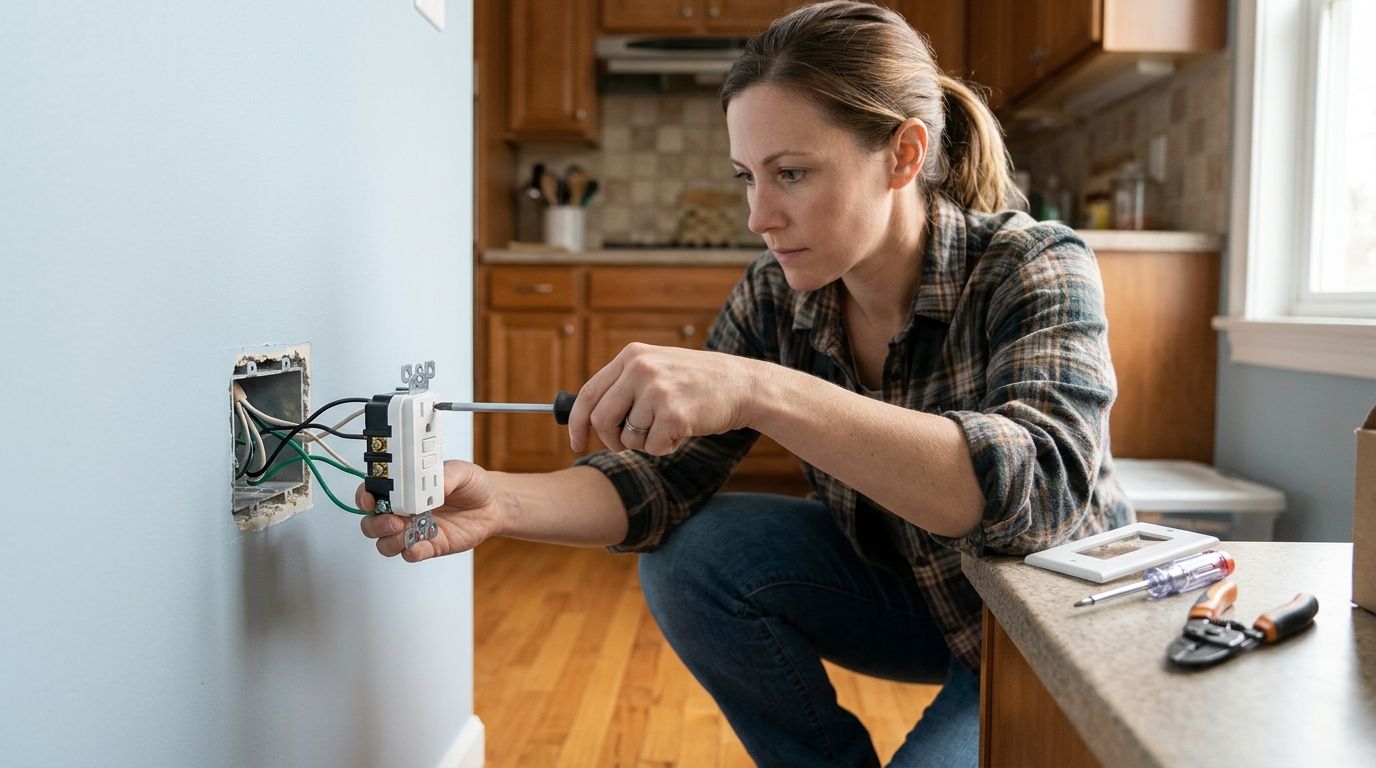
Yes, you can install a GFCI outlet yourself if your local building department allows the work and you can safely isolate, identify, connect, and test the circuit. That permission does not make every outlet a suitable DIY job: damaged wiring, uncertain connections, or an ungrounded circuit require more than swapping a receptacle. For a Florida home in 2026, confirm the permit and owner-builder requirements before opening the electrical box.
- Can I install a GFCI outlet myself? Only with local approval, safe isolation, correct wiring identification, and testing.
- Hire an electrician for damaged wiring, shared neutrals, unexplained tripping, or uncertain grounding.
- A GFCI adds ground-fault protection; it does not create an equipment ground or fix an overloaded circuit.
- Imperium Electric LLC provides licensed electrical services for Treasure Coast homeowners who need professional help.
Can a homeowner install a GFCI outlet themselves?
A homeowner can handle a permitted, straightforward replacement only when the homeowner understands the existing circuit and the device instructions. Knowing how to remove a faceplate is not enough. You must also recognize when the wiring does not match the job you expected.
For local electrical help, Imperium Electric LLC serves residential and commercial customers in Port St. Lucie, Stuart, Jensen Beach, and the Treasure Coast.
Use this decision sequence before treating the replacement as a DIY project:
- Confirm permission. Ask the building department responsible for your address whether the exact replacement requires a permit, inspection, or owner-builder paperwork.
- Confirm isolation. You need to identify the correct circuit, prevent accidental reenergizing, and verify that the conductors are deenergized with appropriate test equipment. A wall switch or panel label is not proof.
- Assess wiring. Stop if you find heat damage, brittle insulation, unfamiliar conductors, missing grounding, or connections you cannot positively identify.
- Verify protection. Follow the device manufacturer's installation and testing instructions, including checks for any downstream receptacles intended to receive protection.
If any step exceeds your knowledge or equipment, hire a licensed electrician. Do not learn circuit identification by experimenting with energized wires.
Why this matters
A receptacle can power a lamp without providing the protection you expect. Successful operation is not the same as a verified safety installation.
A GFCI monitors the balance between outgoing and returning current and interrupts power when it detects a ground fault. It does not replace the circuit breaker's overload protection, repair loose connections, or make contact with electricity safe.
For a 2026 replacement, judge the whole installation: the circuit, box, wiring, receptacle, location, and required protection. The buttons on the outlet address only part of that system.
DIY replacement versus hiring an electrician
Choose based on the wiring condition and your ability to verify the result—not the apparent simplicity of the outlet. Replacing a familiar device and diagnosing an unfamiliar circuit are different jobs.
| Approach | Best for | Advantage | Limitation |
|---|---|---|---|
| Homeowner replacement | A locally permitted, straightforward replacement by a homeowner competent in electrical work | Direct control over a limited replacement task | You must identify hazards, follow instructions, and verify protection yourself |
| Licensed electrician | Uncertain wiring, recurring trips, grounding questions, or changes to the circuit | Professional assessment of the device and connected wiring | Requires arranging access and clearly defining the work |
A professional visit still needs a clear scope. Explain whether you want a failed receptacle replaced, additional outlets protected, or a recurring trip diagnosed; those are not interchangeable requests.
For room-specific planning, the guide to GFCI outlet installation for Florida bathrooms and kitchens covers the application most homeowners have in mind.
When a straightforward replacement is a reasonable DIY candidate
A replacement is a reasonable candidate only when local rules permit it, the wiring is sound, and you understand every connection involved. You also need a suitable device and enough box space for the installation.
Typical household receptacle circuits operate at 120 volts. Receptacles and branch circuits commonly carry 15-amp or 20-amp ratings, but those markings are not interchangeable instructions: device selection must match the circuit configuration and applicable requirements.
Do not copy the old installation blindly. An existing outlet can already be miswired, improperly grounded, or unsuitable for its location.
Before proceeding, read the instructions supplied with the exact replacement device. Terminal arrangements, conductor preparation, tightening requirements, and indicator meanings belong to that device—not a generic online illustration.
Keep the task limited. Adding an outlet, extending wiring, changing circuit protection, or correcting damaged conductors expands the work beyond a simple receptacle replacement.
When an electrician is the right choice
Hire an electrician when the job requires diagnosis rather than a clearly understood replacement. Stop before disturbing unfamiliar connections; disconnecting everything can remove useful information about the original circuit.
Professional assessment is the right choice when you encounter:
- Heat damage: Scorching, melted insulation, discoloration, or a burned smell requires investigation beyond a new outlet.
- Uncertain conductors: Unidentified cables, shared neutrals, aluminum wiring, or brittle insulation need appropriate evaluation.
- Grounding questions: A missing equipment ground changes the permitted replacement methods and labeling requirements.
- Water intrusion: Moisture inside the box requires correction of the source, not just another receptacle.
- Repeated trips: A fault in an appliance or downstream wiring can trip a correctly functioning GFCI.
- Inadequate space: A deeper device does not justify crushing conductors into an overcrowded box.
Imperium Electric LLC is a licensed electrical service provider for Treasure Coast homeowners who need professional help with outlet wiring. That is the appropriate route when you cannot establish what the existing circuit does.
Arrange help with your electrical work
Discuss your outlet replacement, wiring concerns, or recurring GFCI trips.
Why the answer varies from home to home
The answer to “can I install a GFCI outlet myself” depends on more than homeowner confidence. These factors determine whether the work is a limited replacement or a larger electrical correction:
- Local authorization: The building department determines the permit and inspection requirements for your address and scope.
- Existing wiring: Sound, understood wiring presents a different task from damaged insulation or unidentified connections.
- Protection scope: Protecting only the receptacle differs from protecting additional outlets through the device's load terminals.
- Grounding condition: Ground-fault protection and an equipment grounding conductor serve different purposes.
- Installation location: Outdoor and wet-location installations require suitable devices, boxes, and covers.
- Circuit changes: Moving or adding outlets can introduce requirements beyond those for replacing an existing device.
In 2026, give the building department the actual scope rather than asking whether “small electrical jobs” need permits. State whether you are replacing an existing receptacle, adding protection, or extending the circuit.
What LINE and LOAD mean for your replacement
LINE supplies the GFCI; LOAD can supply additional protected outlets. Confusing those terminals can prevent proper operation or leave the intended downstream protection unverified.
Not every replacement needs downstream connections. The correct arrangement depends on the existing circuit and which outlets need protection.
Do not identify a supply cable solely by its position in the box, wire color, or a photograph of another installation. Those details do not establish which conductors supply power or how the circuit is arranged.
If identifying LINE and LOAD would require you to improvise energized testing, stop and hire an electrician. This is a decision guide, not a substitute for safe electrical testing skills or the manufacturer's wiring instructions.
Can I replace a two-prong outlet with a GFCI?
A GFCI can be an allowed replacement on an ungrounded circuit, but it does not add an equipment ground. The National Electrical Code provides replacement methods involving GFCI protection and required labeling; the applicable method depends on the installation and locally adopted requirements.
A three-slot face does not prove that an equipment ground exists. Never connect the grounding terminal to the neutral terminal to imitate one.
Grounding questions are a strong reason to use an electrician. You need the correct replacement method, required labels, and a clear understanding of what protection the circuit does—and does not—provide.
Do I need a permit to replace a GFCI outlet in Florida?
Your local building department must confirm whether your specific replacement needs a permit. Do not assume that owning the home automatically authorizes every type of electrical work or removes inspection requirements.
For a 2026 project in Port St. Lucie, Stuart, or Jensen Beach, identify the authority responsible for your property address. Then describe the work accurately and ask whether an owner-builder exemption applies to your situation.
A rental, commercial property, or broader renovation raises different authorization questions from work on an owner-occupied home. Get that answer before purchasing devices or disconnecting wiring.
How do I know the new GFCI actually works?
Use the manufacturer's prescribed test procedure and verify every outlet intended to receive protection. Power at the receptacle and a successful RESET are not enough by themselves.
The device's TEST button should produce the response described in its instructions. Where downstream protection is intended, confirm that those receptacles lose power during the test and restore correctly afterward.
An ordinary plug-in tester has limits, especially on ungrounded circuits. Its external GFCI test function can depend on a grounding path, so an unexpected tester result needs interpretation rather than guesswork.
If testing fails, leave the affected receptacle out of service and arrange diagnosis. Never bypass the GFCI or substitute a standard outlet just to restore power.
FAQ
Can I install a GFCI outlet myself if I've replaced regular outlets?
Previous outlet replacement experience is not enough by itself. You also need local authorization, safe circuit isolation, correct wiring identification, and the ability to verify GFCI protection.
Can I install a GFCI without turning off the breaker?
Do not install a GFCI on an energized circuit. Isolate the circuit and verify that the conductors are deenergized; if you cannot do that safely, hire an electrician.
Does every bathroom outlet need its own GFCI device?
Every outlet requiring GFCI protection does not necessarily need its own GFCI receptacle. A correctly configured upstream device or GFCI circuit breaker can provide protection, subject to applicable requirements.
Can I put a 20-amp GFCI on a 15-amp circuit?
Do not install a 20-amp receptacle on a 15-amp branch circuit. Receptacle ratings, feed-through ratings, and branch-circuit ratings are different specifications; select the device for the actual installation.
Why won't my GFCI outlet reset after replacement?
A GFCI that will not reset needs diagnosis, not repeated force on the button. Possible causes include missing supply power, incorrect connections, a downstream fault, or a failed device; follow the manufacturer's troubleshooting instructions.
Does a GFCI outlet replace surge protection?
A GFCI does not replace surge protection. GFCI protection addresses ground-fault shock hazards, while surge protection addresses transient overvoltage; neither substitutes for proper grounding and wiring.
How often should I test a GFCI outlet?
Test the GFCI at the interval stated on the device or in its manufacturer instructions. Follow the specified TEST and RESET procedure, and stop using a device that fails its required test.
One last thing
Map the outlets that lose power when a GFCI trips. A protected receptacle can be in a different room from the device that controls it, which makes an unexplained outage harder to trace.
For your 2026 home-maintenance records, note the controlling device and the outlets it protects after the installation has been verified. Keep that information with your circuit directory, not inside an electrical box.
If the mapping reveals uncertain protection or unexpected connections, ask Imperium Electric LLC for professional electrical help rather than assuming the outlet is safe because it works.