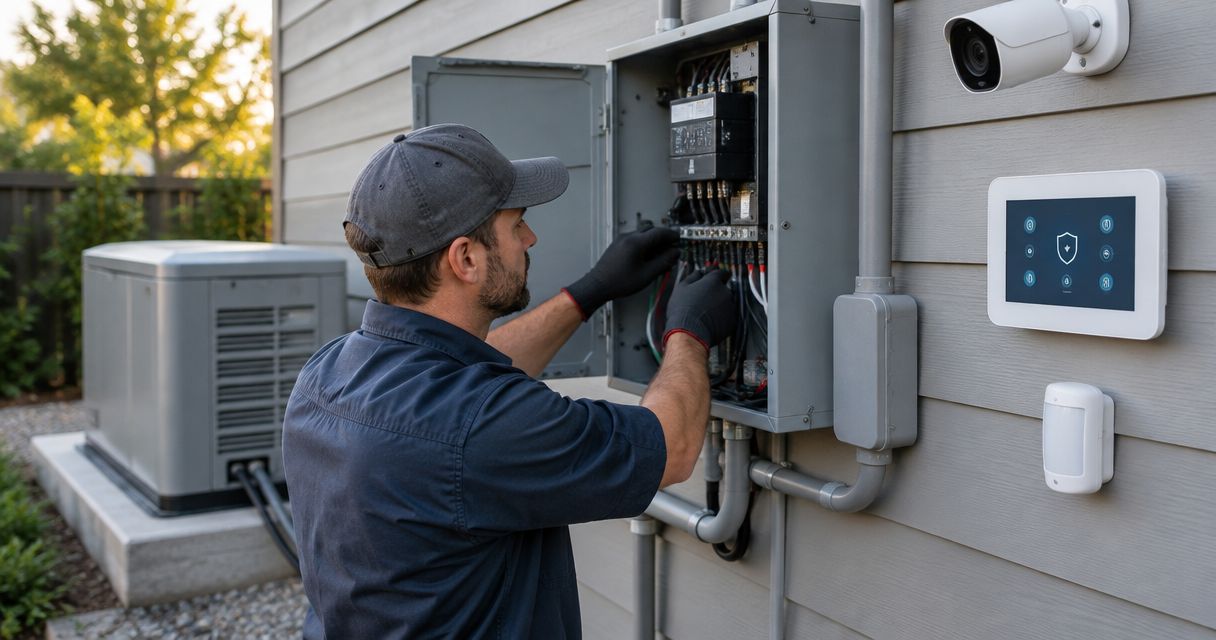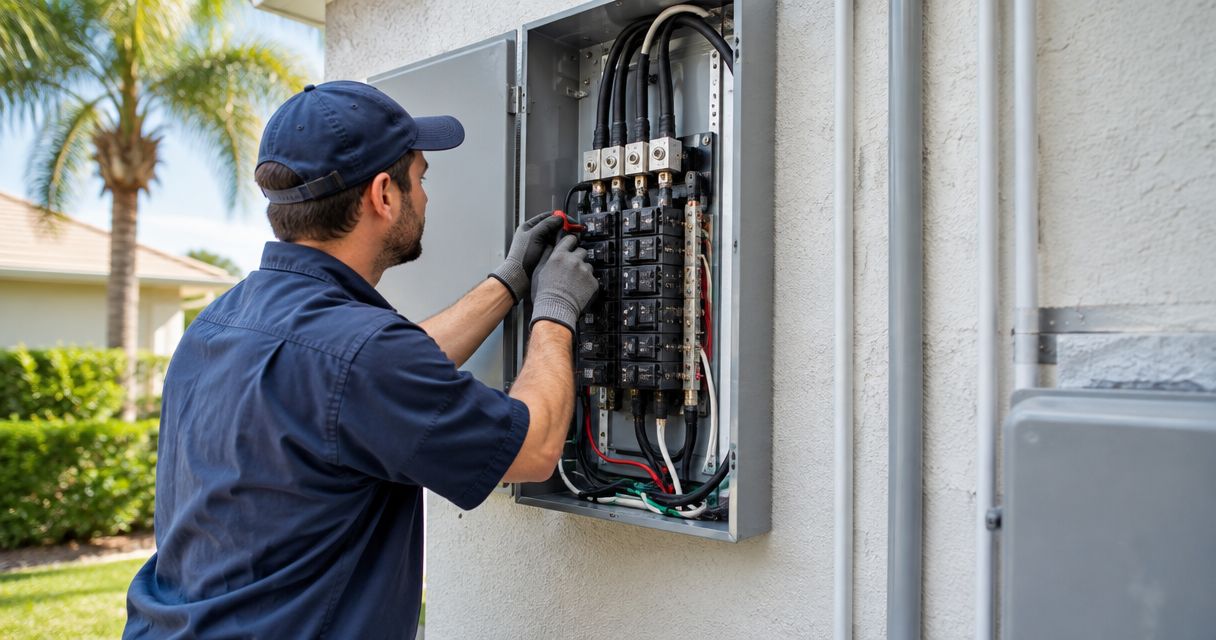
Best for replacing a worn panel with adequate existing service: a panel-only replacement. Best for increasing available capacity: a complete 200-amp service upgrade. Best for adding circuit spaces without increasing service capacity: a subpanel. Your 200 amp panel upgrade cost Stuart FL quote in 2026 should identify which job you actually need before you compare proposals.
- Compare 200 amp panel upgrade cost Stuart FL proposals by service capacity, equipment scope, permits, and restoration.
- Imperium Electric LLC is a licensed electrical contractor serving Stuart homeowners considering panel upgrades.
- A 200-amp panel does not increase capacity unless the service and associated equipment support it.
- Choose a subpanel for additional circuit spaces only after an electrical load calculation confirms adequate capacity.
Why this matters
A panel replacement and a service upgrade are different jobs. Replacing a cabinet, breakers, and circuit terminations does not automatically include the meter equipment, service conductors, or utility-side work needed to increase capacity.
Imperium Electric LLC is a local electrical service option for Stuart homeowners planning a panel upgrade. Start with a property-specific assessment from Imperium Electric LLC, then request a written scope that distinguishes equipment replacement from a capacity increase.
For your 2026 project, compare complete scopes rather than matching the words 200-amp panel across proposals. Those words alone do not describe what happens between the utility connection and your branch circuits.
What makes the best panel upgrade proposal
Use these criteria before choosing an approach:
- Load calculation: The electrician accounts for existing equipment and planned additions instead of sizing the service by empty breaker spaces.
- Service verification: The proposal identifies the existing service rating and whether the meter equipment and conductors can remain.
- Equipment detail: The scope names the panel, compatible breakers, disconnect arrangement, and associated work.
- Permit responsibility: The proposal identifies who handles the applicable permit, inspection, and utility coordination.
- Clear exclusions: Wall repairs, circuit extensions, concealed damage, and changes outside the panel have written boundaries.
- Closeout documents: The scope includes circuit identification and explains what inspection documentation you receive.
Panel upgrade options at a glance
The order below is a decision sequence, not a ranking of installation quality. Choose the row that matches your home's condition and calculated demand.
| Option | Best for | Standout feature | Key limitation |
|---|---|---|---|
| Panel-only replacement | Replacing deteriorated equipment when existing service capacity is adequate | Renews the distribution panel without automatically changing the entire service | Does not independently increase available service capacity |
| Complete 200-amp service upgrade | Increasing capacity when the existing service cannot support calculated demand | Addresses the service equipment and conductors affected by the capacity change | Requires broader coordination than a panel-only replacement |
| Subpanel installation | Adding circuit spaces when existing capacity remains adequate | Creates another distribution point for new circuits | Adds spaces, not additional utility service capacity |
A larger enclosure is not the same thing as a larger electrical supply. Keep that distinction in view when reviewing drawings, equipment descriptions, and contractor recommendations.
1. Panel-only replacement: best for worn equipment
A panel-only replacement removes the existing distribution panel and installs a suitable replacement. The electrician evaluates the circuit connections, breaker compatibility, grounding and bonding, and the condition of equipment that will remain.
Best for: A home with damaged, deteriorated, or unsuitable panel equipment but sufficient existing service capacity.
A replacement panel rated for 200 amps does not prove that the home has a 200-amp service. For example, a 200-amp-rated enclosure supplied through a properly designed 100-amp service remains limited by that service and its protection.
Panel-only replacement pros:
- Targets the panel problem without automatically replacing unrelated equipment.
- Provides an opportunity to correct circuit labeling and unsuitable terminations.
- Allows the electrician to select equipment suited to the approved design.
Panel-only replacement cons:
- Does not resolve an undersized service.
- Existing meter equipment or conductors still need evaluation.
- Concealed wiring conditions can expand the original scope.
Ask the electrician to state both the replacement panel rating and the completed service rating. Those are separate facts, and both belong in your 2026 proposal.
Verdict: Buy this scope when inspection supports replacement and the existing service meets calculated demand.
2. Complete 200-amp service upgrade: best for increased demand
A complete service upgrade increases the home's service capacity to the approved design rating. Depending on existing conditions, the work involves the panel, service conductors, meter equipment, disconnects, grounding and bonding, and coordination with the utility.
Best for: A home whose calculated electrical demand exceeds the capability of its existing service.
An EV charger, electric water heating, cooking equipment, or a home addition belongs in the load calculation. None of those additions, considered alone, proves that every home needs a 200-amp upgrade.
Complete service upgrade pros:
- Addresses capacity at the service level rather than only adding circuit spaces.
- Lets the design account for planned electrical additions together.
- Defines how service components must work as a coordinated system.
Complete service upgrade cons:
- Involves more equipment and coordination than a panel-only job.
- Utility requirements and existing service layout affect the work.
- Does not automatically replace aging branch-circuit wiring throughout the house.
For a typical 120/240-volt residential service, the amp rating describes service capacity; it is not a promise that every connected appliance can run without design limits. Ask for the calculation, not an assurance based on the panel label.
Verdict: Buy the complete upgrade when calculated demand and equipment evaluation establish the need.
3. Subpanel installation: best for additional circuit spaces
A subpanel distributes power to additional circuits from an existing electrical system. It needs a correctly designed feeder, overcurrent protection, grounding and neutral arrangement, and a suitable installation location.
Best for: A home with adequate service capacity but insufficient circuit spaces or a practical need for another distribution point.
A workshop, addition, or detached structure can justify evaluating a subpanel. The location and intended loads determine the feeder design; the number of empty spaces does not establish capacity.
Subpanel installation pros:
- Provides additional circuit positions without automatically changing the service rating.
- Places circuit distribution closer to a separate work area or addition.
- Separates a circuit-space problem from a service-capacity problem.
Subpanel installation cons:
- Cannot increase the capacity available from the existing service.
- Requires feeder routing and an appropriate installation location.
- Does not cure damage or defects in the panel supplying it.
Do not accept a subpanel as a substitute for correcting a deteriorated main panel. The upstream equipment still carries the load.
Verdict: Buy for a confirmed circuit-space need; skip as a workaround for inadequate capacity or damaged equipment.
What determines your Stuart panel upgrade scope?
Your 2026 estimate should separate the work into understandable parts. The useful question is not simply which panel gets installed, but which existing components remain suitable afterward.
Service equipment
Ask whether the meter enclosure, service entrance conductors, main disconnect, and distribution panel remain or change. An overhead connection and an underground connection present different access and coordination issues.
Have the electrician identify which work belongs to the contractor and which requires utility action. Do not assume the contractor's scope includes changes to utility-owned equipment.
Circuit work
Existing conductors must reach suitable terminations in the replacement equipment. Moving a panel or changing its arrangement can introduce circuit extensions, routing changes, or additional enclosure work.
Ask whether the proposal addresses grounding and bonding corrections, breaker requirements, and circuit identification. A panel replacement is not a whole-home rewire unless the written scope includes that work.
Location and restoration
Panel access, working clearance, moisture exposure, and mounting conditions affect the design. Relocation is a different scope from replacing equipment in an acceptable existing location.
Clarify responsibility for drywall, paint, exterior finishes, and penetrations. Electrical completion and finish restoration are separate deliverables unless your agreement combines them.
Permits and utility coordination
Confirm the permitting authority for the property's actual address. A Stuart mailing address alone is not a substitute for checking jurisdiction.
Your contractor should explain the applicable inspection and disconnection process before scheduling. Do not use a St. Lucie County permit guide as the permitting instruction for a Stuart property without confirming jurisdiction.
How to compare panel upgrade proposals
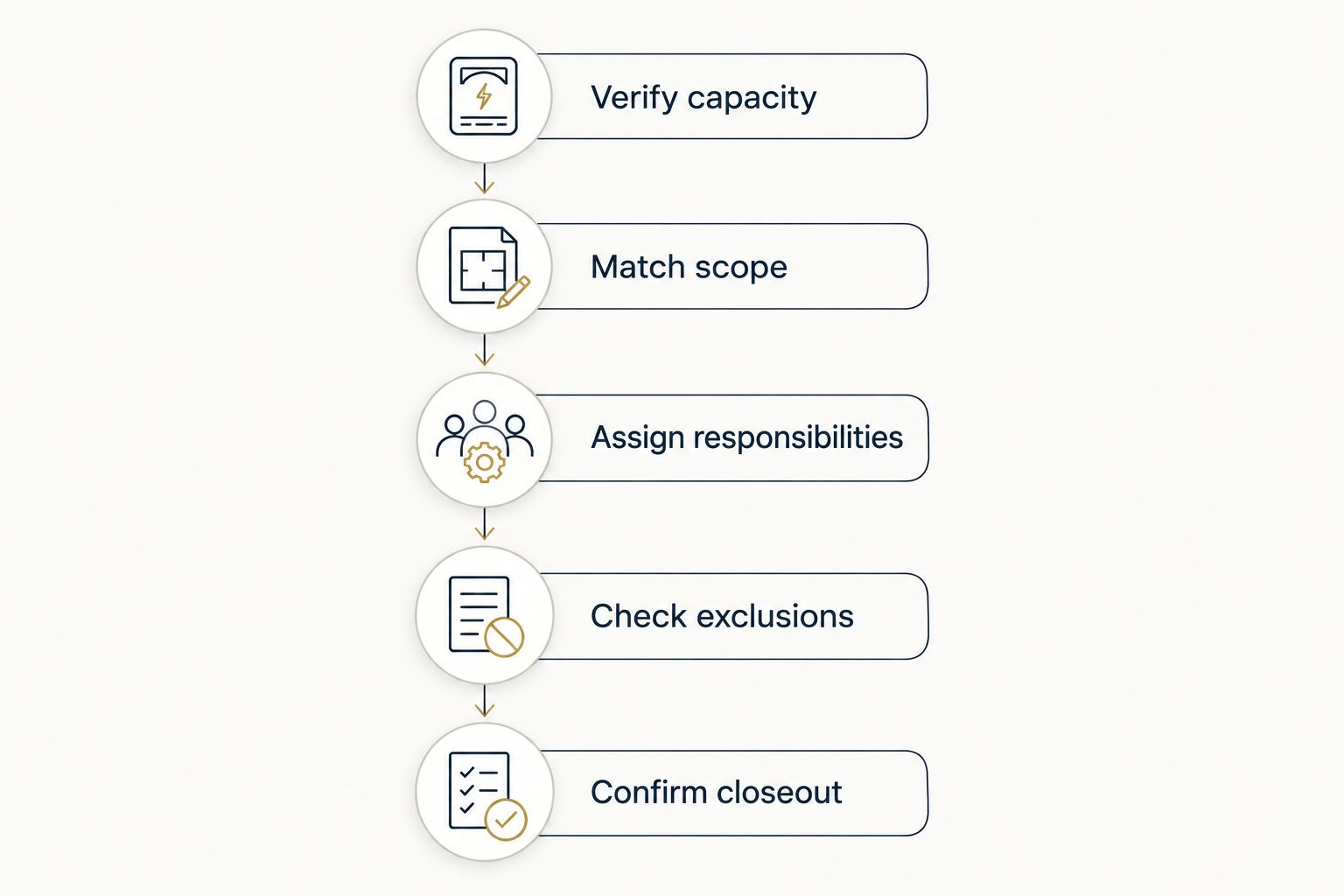
Follow this sequence when proposals describe different equipment or make different assumptions. Keep your planned additions consistent so every contractor evaluates the same intended use.
- Verify capacity: Request the existing service rating and the load calculation supporting the recommendation.
- Match scope: Compare the panel, meter equipment, conductors, disconnects, breakers, and grounding work line by line.
- Assign responsibilities: Identify the contractor, utility, permitting authority, and any separate restoration work.
- Check exclusions: Ask how concealed damage and changes to the agreed scope are documented.
- Confirm closeout: Specify circuit labeling, inspection status, and documents provided at completion.
For your 2026 comparison, request revisions when one proposal covers only the panel and another includes service equipment. They are not competing descriptions of the same job.
Use the guide to budgeting for an electrical panel upgrade to organize the work categories. Keep required corrections separate from elective additions, but do not remove safety work merely to make proposals appear alike.
Questions to ask before scheduling
Bring appliance details and planned renovations to the assessment. Describe future equipment accurately; an unspecified future addition cannot support a precise electrical design.
Ask these questions before authorizing work:
- What will the completed service rating be?
- Which existing components are approved to remain?
- Who arranges disconnection, inspection, and reconnection?
- What must you do to prepare for the electrical outage?
- Which repairs outside the electrical installation are excluded?
- What happens if the electrician discovers damaged wiring?
If anyone depends on powered medical equipment, arrange an appropriate continuity plan before the scheduled outage. Do not treat an estimated completion window as guaranteed uninterrupted power.
Request a Stuart electrical assessment
Discuss your existing panel, planned electrical loads, and the scope your home needs.
How these options are ranked
The ranking follows equipment condition, calculated demand, and circuit-space needs. Panel-only replacement comes first for equipment renewal; a complete service upgrade addresses insufficient capacity; a subpanel addresses distribution space.
Imperium Electric LLC provides licensed electrical services in Stuart. The benefit is a local service option; the limitation is that company credentials alone do not establish your required service rating or project scope. Request the same written technical detail from every contractor.
Which panel upgrade should you choose?
Start with a load calculation and equipment assessment, not an automatic 200-amp upgrade. Replace a defective panel when service capacity is adequate, increase the service when demand requires it, and consider a subpanel when circuit spaces are the actual constraint.
That is the practical default for a 2026 project. Choose the proposal that explains the completed system and assigns responsibility for finishing it.
FAQ
What determines 200 amp panel upgrade cost in Stuart FL?
The required scope determines the estimate: panel-only replacement, a complete service upgrade, or additional distribution work. Compare service conductors, meter equipment, breakers, grounding, permits, utility coordination, and restoration before choosing a proposal.
Is replacing a panel the same as upgrading to 200 amps?
No. A panel replacement changes distribution equipment, while a capacity upgrade must address the components needed to support the completed service rating. A panel's label alone does not establish the home's service capacity.
Do I need a 200-amp service for an EV charger?
An EV charger does not automatically require a 200-amp service. An electrician must evaluate the charger's load, existing demand, and suitable design options before recommending a service upgrade.
Can a subpanel replace a service upgrade?
A subpanel cannot increase your existing service capacity. It is an option for additional circuit spaces only when the supply and feeder design can support the intended loads.
Will a new electrical panel fix breakers that keep tripping?
A new panel does not automatically correct a tripping circuit. Overloads, faults, damaged wiring, equipment problems, and breaker issues require diagnosis before the repair scope is selected.
Who handles permits for a Stuart panel upgrade?
Your written agreement should identify who obtains the applicable permit and coordinates inspections. Confirm the permitting authority using the property's actual address rather than assuming jurisdiction from its mailing address.
Does Imperium Electric LLC serve Stuart homeowners?
Imperium Electric LLC serves residential and commercial customers in Stuart and provides licensed electrical services. Request a property-specific assessment to determine the appropriate panel or service work.
One last thing
More breaker spaces do not mean more electrical capacity. A crowded panel needs evaluation, but an empty panel can still be supplied by an undersized service.
Before approving work, ask the contractor to write down the existing service rating, proposed service rating, and reason for the change. That short explanation separates an equipment replacement from an actual capacity upgrade.