Emergency electrician cost after hours depends on the contractor’s dispatch terms, diagnostic work, repair scope, and any charges for working outside its regular schedule; get a job-specific quote before authorizing service in 2026. A callout or diagnostic charge does not necessarily include the repair, replacement parts, or a return visit. Confirm what the first visit covers and what requires separate approval.
- Emergency electrician cost after hours requires a job-specific quote; confirm dispatch, diagnosis, labor, and materials separately.
- A service call is not necessarily a completed electrical repair. Ask what the authorization covers.
- Imperium Electric LLC serves Treasure Coast homeowners and businesses needing licensed electrical services.
- Smoke, active sparking, or electrical shock calls for immediate safety action, not comparison shopping.
Why this matters
An urgent electrical problem puts you under pressure to approve work before you understand the scope. Slow down the authorization, not the safety response. A clear description of the problem helps the contractor distinguish an electrical repair from a utility outage, an appliance fault, or damage requiring broader work.
Imperium Electric LLC is a licensed electrical contractor for Treasure Coast homeowners and businesses. You can review Imperium Electric LLC for electrical services in Port St. Lucie, Stuart, Jensen Beach, and the surrounding area; confirm after-hours service directly before relying on a visit.
How much does emergency electrician service cost after hours?
There is no single after-hours total that applies to every electrical problem. For a 2026 service request, ask the contractor to separate the charge for attending and diagnosing the problem from the charge for correcting it. An unexplained total leaves you unable to tell whether you are approving an inspection, a temporary safety measure, or a finished repair.
Use this breakdown when requesting authorization terms. These are items to clarify, not a statement that every contractor bills each item separately.
| Quote component | What to confirm | What not to assume |
|---|---|---|
| Dispatch or callout | What authorizing attendance includes | That attendance includes a repair |
| After-hours terms | Whether the requested time changes billing | That evening, weekend, and holiday terms are identical |
| Diagnosis | What troubleshooting includes and where it stops | That the symptom identifies the failed component |
| Repair labor | What work you are authorizing | That all additional work is already approved |
| Materials | Which replacement parts are included | That any replacement is suitable for the existing equipment |
| Follow-up work | Whether another visit, inspection, or permit is part of the scope | That restoring some power completes the entire job |
Ask for the terms in writing when practical. If an immediate hazard requires action first, ask the electrician to explain the safety work and distinguish it from the permanent repair. An authorization to attend is not automatically an authorization to replace equipment.
A useful question is: Does this cover finding the fault, fixing the fault, or both? That distinction gives you more useful information than an hourly figure without a defined scope.
Diagnostic visit: establish the fault before approving a repair
A diagnostic visit is for identifying what is wrong. A dead outlet, a tripping breaker, and flickering lights are symptoms, not complete diagnoses. Tell the electrician what happened, which areas are affected, and whether the problem followed a storm, water intrusion, or appliance use.
Best for: an unexplained electrical problem that needs professional investigation. The benefit is a repair decision based on findings rather than a guess; the limitation is that troubleshooting alone does not complete the repair.
Ask whether the diagnostic authorization includes any corrective work. Also ask how the electrician will obtain approval if investigation reveals damaged wiring, an unsuitable breaker, or a problem beyond the original complaint.
Do not remove panel covers, touch exposed conductors, or repeatedly reset a breaker to help with diagnosis. Describe what you observed from a safe position. Leave testing inside energized equipment to a qualified professional.
Immediate safety work: address the hazard without assuming completion
An emergency visit can involve isolating damaged equipment or leaving an affected circuit out of service until permanent work is arranged. That is different from restoring every outlet, appliance, or room to normal operation. Ask exactly what remains unusable after the visit.
Best for: a fault that requires professional action to prevent continued use of unsafe electrical equipment. The benefit is addressing the immediate condition; the limitation is that additional repair work can remain necessary.
Before the electrician leaves, request clear instructions about equipment you must not use. Ask what the assessment found, what work was performed, and what needs to happen next. Do not treat partial restoration as permission to reconnect everything.
For a rental or commercial property, pass those instructions to the person responsible for the building. Tenants and staff need a clear account of restrictions, not just a message that an electrician attended.
Permanent repair: define the finished result
A permanent repair addresses the identified fault and includes verification appropriate to the work. The scope should name the affected equipment or circuit and explain whether related wiring, connections, or protective devices require attention. Avoid approving a broad replacement based only on the symptom you reported by phone.
Best for: a diagnosed problem with a defined repair scope. The benefit is addressing the cause; the limitation is that findings during the work can require a revised authorization or additional coordination.
Use this comparison to understand the proposed visit:
| Service scope | Best for | Main benefit | Limitation to clarify |
|---|---|---|---|
| Diagnostic visit | An unidentified fault | Establishes the repair direction | Repair work is not automatically included |
| Immediate safety work | Equipment that must not remain in use | Addresses the immediate hazard | Some circuits or equipment can remain out of service |
| Permanent repair | A diagnosed electrical defect | Corrects the identified problem | Broader damage can change the scope |
For any 2026 electrical repair, the handoff should explain what was corrected and what remains unresolved. Ask about permit and inspection requirements for the actual work rather than assuming an emergency visit removes those requirements.
Why the scope of an after-hours electrical repair varies
The clock does not explain the whole job. An electrician also needs to establish where the fault is, how to reach it safely, and what the repair involves. Focus your questions on these factors:
- Affected equipment: Identify whether the complaint concerns an outlet, branch circuit, electrical panel, generator connection, or building service.
- Fault location: A visible damaged device and a concealed wiring problem require different investigation and access.
- Extent of damage: Ask whether the fault is isolated or involves connected wiring and equipment.
- Replacement suitability: Electrical replacement parts must be appropriate for the equipment and application, not simply look similar.
- Access conditions: Locked electrical rooms, obstructed panels, and inaccessible work areas need to be addressed safely.
- Completion requirements: Ask whether the scope involves utility coordination, permitting, inspection, or follow-up work.
These details help define the authorization. They do not justify an unexplained charge or an automatic equipment replacement. Ask the contractor to connect each proposed task to an observed condition.
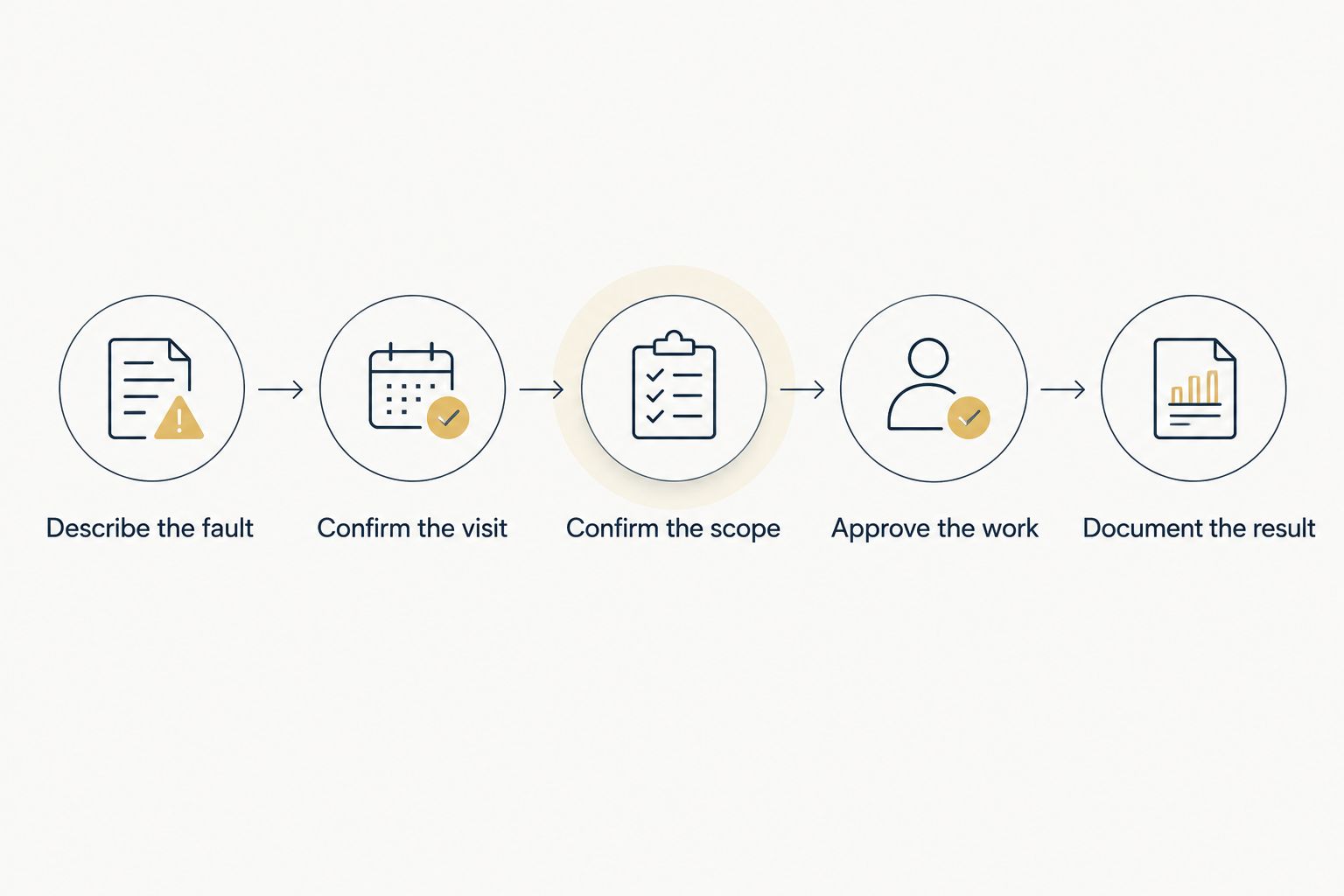
What should you ask before approving an after-hours visit?
Use a short sequence so the contractor receives useful information and you understand what you are approving. Keep the conversation focused on safety, scope, and authorization rather than diagnosing the fault yourself.
- Describe the fault. Give the property address, affected areas, and observable symptoms. Mention smoke, sparking, water exposure, or an electrical shock immediately.
- Confirm the visit. Ask whether the contractor can attend at the requested time and whether it handles the affected equipment.
- Confirm the scope. Establish what dispatch and diagnosis cover, including any after-hours terms and the approval process for repair work.
- Approve the work. Ask for an explanation of the findings and proposed correction before authorizing work beyond the original scope.
- Document the result. Keep the work description, invoice, and instructions about equipment left out of service.
Prepare this information before making a 2026 service request, but do not delay calling emergency services for an active hazard. A photo from a safe distance can help explain the location; opening a panel or approaching damaged wiring cannot.
When contacting Imperium Electric LLC for electrical services, describe the problem and ask about the requested service time. The company serves residential and commercial customers on the Treasure Coast; that service area alone does not establish an after-hours response commitment.
Discuss your electrical repair
Describe the fault, confirm the requested service time, and ask what the visit covers.
Is an after-hours visit better than waiting until regular hours?
An active electrical hazard needs immediate safety action; a scheduling decision comes afterward. Smoke, flames, active sparking, a shock incident, or a damaged power line is not a reason to keep troubleshooting. Move away from the hazard and contact the appropriate emergency service or utility.
For a loss of power without visible danger, check your utility’s outage information before assuming the fault is inside your building. Describe the situation to a qualified electrician if the cause remains unclear. Do not decide that a fault is safe simply because it affects only part of the property.
Waiting for regular hours is a scheduling option only after the safety question has been addressed. Ask the professional what must remain switched off or unused while you wait. Do not rely on an online article to declare damaged electrical equipment safe.
Does an after-hours service call include the repair?
An after-hours service call includes only the work covered by its authorization. Ask whether diagnosis, corrective labor, materials, and verification are included or require a separate approval.
If the initial visit leaves equipment out of service, request a written description of the remaining work. That keeps a temporary safety measure from being mistaken for a finished repair.
Can the electrician quote the whole repair over the phone?
A phone conversation can establish attendance terms, but an unexplained fault still needs diagnosis. Report what you observed rather than naming a component you believe failed, and ask which parts of the proposed scope depend on inspection.
For a 2026 quote, distinguish confirmed terms from work that requires further findings. Request an updated authorization when the diagnosis changes the proposed repair.
FAQ
How do I get an emergency electrician cost after hours quote?
Ask the contractor to explain dispatch, after-hours terms, diagnosis, repair labor, materials, and follow-up work separately. Confirm which tasks you are authorizing before work begins.
Does a weekend electrician visit always include an extra charge?
Confirm weekend billing directly with the contractor rather than assuming its terms. Ask whether the requested time changes the attendance or repair authorization.
Should I call an electrician if my breaker keeps tripping?
Repeated breaker trips need professional investigation; do not repeatedly reset the breaker. A trip is a protective action, not proof that the breaker itself needs replacement.
What should I do if an outlet is sparking or smoking?
Move away from the affected area and contact emergency services if there is smoke, fire, or an immediate hazard. Do not touch the outlet, remove its cover, or use water on electrical equipment.
Does Imperium Electric LLC offer electrical services on the Treasure Coast?
Imperium Electric LLC provides licensed electrical services for residential and commercial customers in Port St. Lucie, Stuart, Jensen Beach, and the Treasure Coast. Confirm the requested service time and scope directly.
Can I use a generator while waiting for electrical repairs?
Do not improvise a generator connection to household wiring or backfeed through an outlet. Follow the generator manufacturer's instructions and have building connections assessed by a qualified electrician.
What paperwork should I keep after an emergency electrical visit?
Keep the work description, invoice, and instructions for any equipment left out of service. Also retain permit or inspection documentation when applicable to the work.
One last thing
Power returning does not prove the electrical fault was repaired. A breaker reset, a cooled connection, or an intermittent symptom disappearing is not the same as a diagnosed and corrected defect.
Before closing out the visit, ask the electrician to explain the cause, the correction, and any remaining restrictions. That handoff matters more than leaving with the lights on and no clear account of what happened.