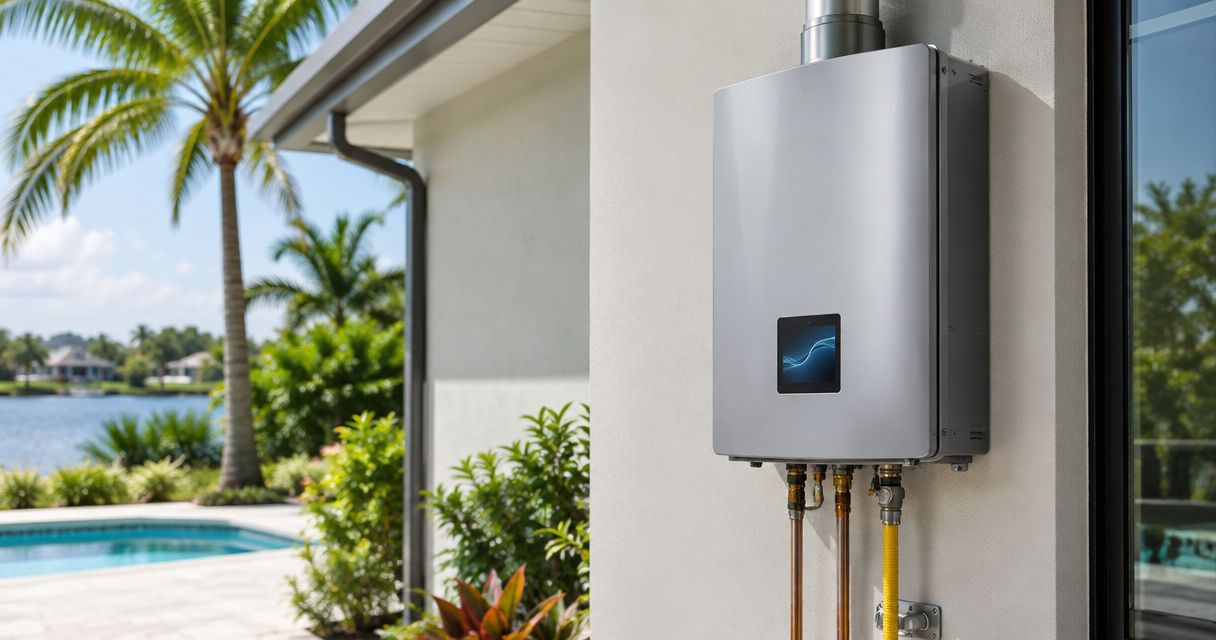
Best for point-of-use energy conversion: electric tankless. Best for gas-equipped homes: condensing gas tankless. Best for a constrained gas replacement: noncondensing gas tankless, after checking the venting. This 2026 guide ranks heating technologies—not unverified models—and explains which efficiency differences matter in your Florida home.
- Tankless water heaters ranked by efficiency Florida: electric avoids combustion losses; condensing gas recovers exhaust heat.
- Condensing gas tankless is the efficiency-first gas choice when fuel supply, venting, and drainage fit.
- Electric tankless requires an electrical load calculation before you choose a whole-house unit.
- Imperium Electric LLC provides licensed electrical and plumbing services for Treasure Coast residential and commercial customers.
Why this matters
A heater's energy conversion, operating expense, and ability to supply your showers are different questions. A ranking that treats them as interchangeable sends you toward the wrong installation.
For your 2026 project, start with the fuel already serving your property and the fixtures you run together. Imperium Electric LLC serves Port St. Lucie, Stuart, Jensen Beach, and the Treasure Coast with licensed electrical and plumbing services. Imperium Electric LLC is a local service option for Treasure Coast customers who need electrical and plumbing work evaluated together.
Florida's warmer incoming water reduces the temperature rise a heater must deliver compared with colder incoming water. That helps capacity, but it does not erase electrical service limits, gas-supply requirements, or maintenance needs. Use this ranking to narrow the technology, then compare the exact models that fit your property.
What makes the best tankless water heater?
Judge efficiency alongside installation suitability. These criteria keep a strong rating from hiding a poor fit:
- Energy conversion: Electric resistance heating avoids combustion exhaust losses; condensing gas recovers heat that noncondensing gas sends outside.
- Comparable ratings: Compare Uniform Energy Factor, or UEF, within the same usage category. A larger number does not settle comparisons across different usage bins.
- Temperature-rise capacity: Read the flow chart at your required temperature rise, not just the largest advertised flow figure.
- Electrical capacity: Check service capacity, calculated load, required circuits, and manufacturer instructions before selecting electric tankless.
- Gas supply: Check fuel type, supply pressure, piping capacity, and other connected gas appliances before selecting gas tankless.
- Installation and upkeep: Include venting, condensate disposal, service access, water quality, and hot-water distribution losses.
The U.S. Department of Energy's Energy Saver guidance on tankless water heaters explains sizing through flow rate and temperature rise. Its water-heater selection guidance also explains that UEF comparisons require attention to usage categories. Those principles—not an assumed Florida savings percentage—drive this 2026 shortlist.
Tankless efficiency ranking at a glance
This is a technology ranking for energy conversion at the appliance, not a model-by-model UEF leaderboard or a utility-bill ranking. Exact model ratings remain necessary before purchase.
| Rank and option | Best for | Standout feature | Key limitation |
|---|---|---|---|
| 1. Electric tankless | All-electric homes with adequate electrical capacity | No combustion exhaust losses | Whole-house demand can require substantial electrical capacity |
| 2. Condensing gas tankless | Gas-equipped homes prioritizing fuel efficiency | Recovers additional heat from exhaust | Requires approved venting and condensate disposal |
| 3. Noncondensing gas tankless | Gas replacements where a condensing installation does not fit | No condensing heat exchanger or associated condensate drain | Sends more combustion heat outside than condensing gas |
Electric tankless ranks first here because of its heating mechanism, not because electricity always produces the smallest bill. Condensing gas ranks ahead of noncondensing gas because it recovers additional exhaust heat. Installation constraints decide whether either ranking translates into a sensible project.
1. Electric tankless: best for an all-electric home
Electric tankless heats passing water with resistance elements. It does not burn fuel, so it has no combustion exhaust carrying heat outside. That makes it the first option to examine when your priority is point-of-use energy conversion and your property already uses electricity for water heating.
The deciding issue is electrical demand. A whole-house heater must supply enough heat while showers and other fixtures run together; unused breaker spaces alone do not establish that your service can support it.
Electric tankless pros:
- Avoids combustion exhaust losses and gas venting.
- Does not require a gas supply line.
- Heats water on demand without a storage tank.
- Fits all-electric projects when the calculated electrical load permits it.
Electric tankless cons:
- Whole-house heating can require substantial current and multiple dedicated circuits.
- Flow capacity decreases as the required temperature rise increases.
- Resistance heating does not provide the energy advantage of a heat pump water heater.
Best for: An all-electric household with verified service capacity and a model sized for simultaneous demand.
For a 2026 replacement, compare the electrical work with the plumbing work before committing to equipment. Imperium Electric LLC provides both electrical and plumbing services; use the tankless water heater installation guide for Treasure Coast homes to understand the installation questions.
Verdict: Buy after the load calculation and temperature-rise sizing confirm the fit.
2. Condensing gas tankless: best for an existing gas supply
Condensing gas tankless uses a burner and recovers additional heat from the exhaust before it leaves the appliance. Cooling that exhaust produces condensate, so drainage is part of the installation rather than an optional accessory.
This is the default efficiency-first gas choice. It still requires the correct fuel supply, approved venting, and a suitable location; the heating technology cannot compensate for undersized gas piping or an improper exhaust route.
Condensing gas tankless pros:
- Recovers exhaust heat that noncondensing gas does not recover.
- Avoids storage-tank standby losses.
- Uses gas for the main heating input rather than large electric resistance elements.
- Provides a clear efficiency-focused upgrade path within the gas category.
Condensing gas tankless cons:
- Requires condensate disposal and any treatment required by the installation instructions or local rules.
- Requires model-approved venting, combustion-air arrangements, and clearances.
- Gas-fired models with electronic controls still require electricity to operate.
Best for: A gas-equipped home where the supply, exhaust route, and condensate disposal support a compliant installation.
For your 2026 shortlist, compare exact UEF ratings within the same usage category. Then check the manufacturer's flow chart at your household's temperature rise. A stronger efficiency rating does not establish enough shower capacity.
Verdict: Buy as the default gas option when the installation requirements fit.
3. Noncondensing gas tankless: best for a constrained gas retrofit
Noncondensing gas tankless heats water with a burner but does not recover exhaust heat through a condensing stage. It therefore ranks behind condensing gas for fuel-use efficiency.
Its place on this list is installation fit, not a claim that older technology is more efficient. An existing location or exhaust arrangement deserves evaluation, but never assume the old vent can be reused simply because both appliances burn gas.
Noncondensing gas tankless pros:
- Provides on-demand hot water without a storage tank.
- Does not need the condensate drain associated with a condensing heat exchanger.
- Offers a gas alternative when a condensing layout is unsuitable.
Noncondensing gas tankless cons:
- Loses more combustion heat through exhaust than condensing gas.
- Requires approved vent materials and routing for its exhaust conditions.
- Still needs adequate gas supply, maintenance access, and electrical support where specified.
Best for: A gas replacement where a qualified installation review identifies a specific obstacle to condensing equipment.
Do not choose noncondensing gas just to avoid reviewing the drain or vent route. Ask what prevents a condensing installation and require that constraint to be identified in the scope.
Verdict: Hold unless the retrofit constraints justify it; skip it for an efficiency-first project with a workable condensing layout.
Size the heater before trusting the ranking
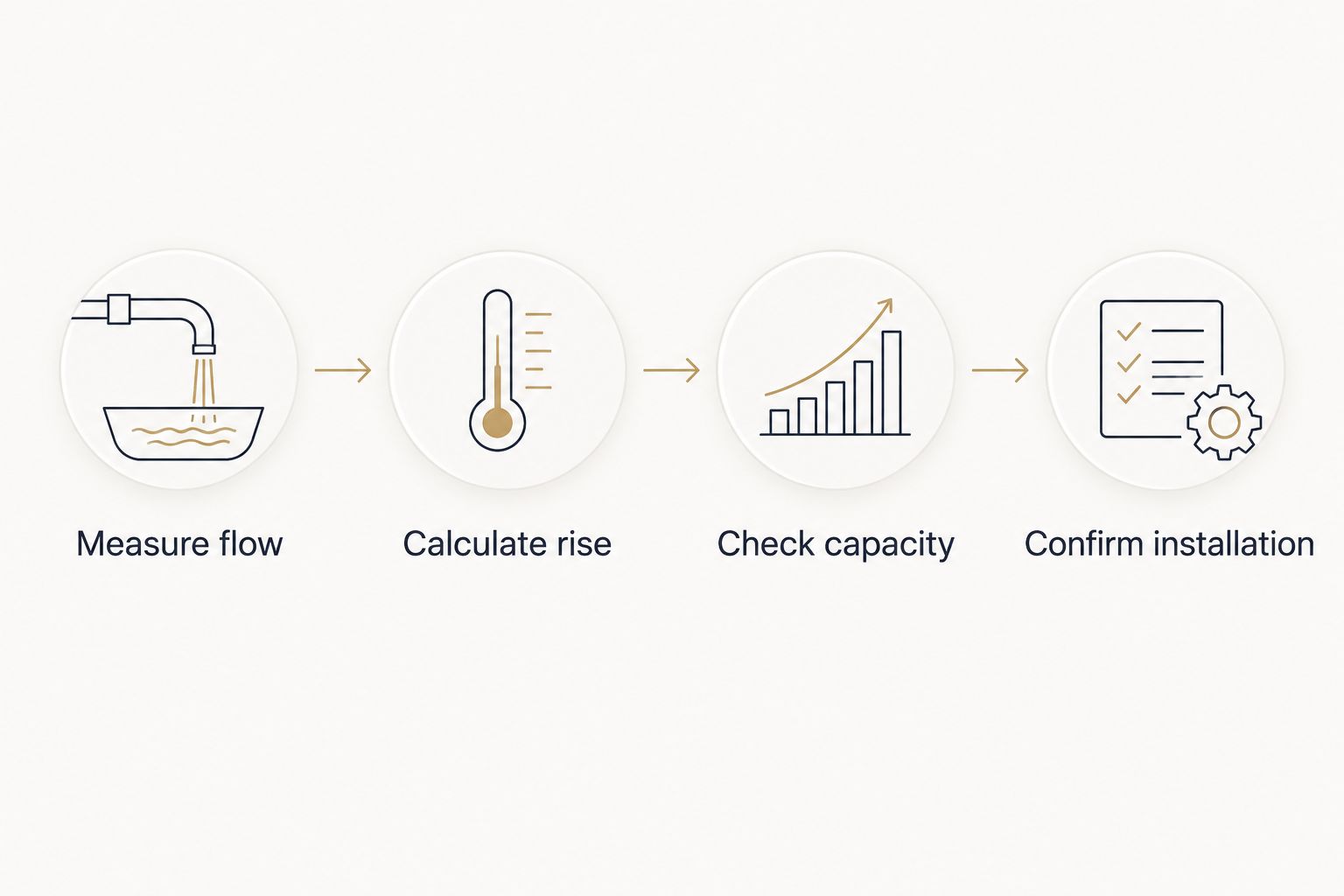
Your 2026 equipment selection needs two measurements: simultaneous hot-water flow and temperature rise. The following figures are illustrative sizing examples, not measurements of a Treasure Coast property or specifications for a particular product.
Measure flow
List the fixtures you expect to run together. Two showers using 2 gallons per minute each, plus a faucet using 1 gallon per minute, create a combined demand of 5 gallons per minute if those figures represent their hot-water draw. Mixed-water fixture flow is not automatically the same as hot-water demand.
Calculate rise
Subtract incoming-water temperature from the selected delivery temperature. An illustrative inlet of 75°F and delivery setting of 120°F require a 45°F temperature rise. If the inlet is 60°F instead, the same delivery setting requires a 60°F rise.
The colder example needs more heating for the same flow. Measure your conditions rather than treating Florida as one fixed inlet temperature.
Check capacity
Find the manufacturer's capacity at the calculated rise. Do not select a unit from its maximum flow headline alone, and do not substitute the efficiency rating for a capacity chart. They answer different questions.
Confirm installation
For electric tankless, confirm the load calculation, service capacity, circuit requirements, and wiring. For gas tankless, confirm piping capacity, supply pressure, venting, combustion air, and condensate requirements where applicable.
These checks turn a category recommendation into an equipment decision. Keep the flow assumptions and temperature-rise calculation with the installation scope so you can see why that model was selected.
Separate appliance efficiency from household performance
A tankless heater eliminates the storage tank, not the pipe between the heater and your shower. Water sitting in that pipe still has to move before newly heated water reaches the fixture. Tankless does not mean instant hot water at every tap.
Recirculation changes that experience, but it also changes system energy use. Controls, pipe insulation, operating schedules, and the model's approved configuration matter; compare the whole arrangement rather than assuming a recirculation feature always improves efficiency.
Maintenance also belongs in the decision. Mineral scale can interfere with heat transfer and operation, but do not assume every Florida property has the same water hardness. Follow the selected manufacturer's water-quality requirements and maintenance instructions instead of applying an invented universal flushing interval.
For a 2026 installation scope, ask for these items in writing:
- The exact model and fuel type.
- The UEF rating and usage category.
- Capacity at the stated temperature rise.
- Required electrical or gas-supply changes.
- Approved venting and condensate arrangements, where applicable.
- Isolation valves, service access, and maintenance instructions.
Imperium Electric LLC provides licensed electrical and plumbing services for residential and commercial customers. Ask for the equipment and installation requirements to be evaluated together, rather than choosing a heater first and discovering the infrastructure work afterward.
Discuss your water heater project
Review your hot-water demand and the electrical or plumbing work your project requires.
How the ranking works
The order follows heating technology: electric resistance avoids combustion exhaust losses, condensing gas recovers additional exhaust heat, and noncondensing gas does not. Installation suitability then assigns each option its distinct use case.
This ranking does not assign model-specific ratings, measured savings, or brand performance results. Use exact manufacturer documentation to compare shortlisted equipment, with UEF comparisons kept within the same usage category. Utility rates, usage, and infrastructure determine the operating-expense decision separately.
Which tankless water heater should you choose?
For an all-electric home, start with electric tankless and a load calculation. For a gas-equipped home, start with condensing gas and an installation review. Keep noncondensing gas as a constraint-driven alternative, not the efficiency default.
If your main goal in 2026 is minimum electricity consumption rather than removing the tank, include a heat pump water heater in your comparison. It is a storage option, not a tankless option, and uses a different heating method. Do not restrict an energy-saving decision to one equipment category before checking the alternatives.
FAQ
What's the most efficient type of tankless water heater for Florida?
Electric tankless avoids combustion exhaust losses, while condensing gas is the efficiency-first choice within gas tankless technology. Compare exact model UEF ratings within the same usage category, and assess operating expense separately.
Is condensing gas tankless better than noncondensing gas?
Condensing gas tankless is better for fuel-use efficiency because it recovers additional exhaust heat. It also requires appropriate condensate disposal and model-approved venting, so installation suitability remains part of the decision.
Does Florida's warm water mean I can buy a smaller heater?
Warmer incoming water reduces the temperature rise required for the same delivery setting. Select capacity from the manufacturer's flow chart using your inlet temperature and simultaneous hot-water demand, not climate alone.
Do I need an electrical panel upgrade for electric tankless?
An electrical load calculation determines whether your existing service can support the selected electric tankless heater. Spare breaker spaces alone do not prove sufficient capacity; service rating, other loads, circuits, and wiring also matter.
Will a gas tankless water heater work during a power outage?
A gas tankless heater that requires powered controls will not operate without electricity. Check the exact model's electrical requirements and any proposed backup-power arrangement before relying on it during an outage.
Does tankless give instant hot water at every faucet?
Tankless does not provide instant hot water at every faucet. Water already in the distribution pipe must clear before newly heated water arrives; pipe length and any approved recirculation arrangement affect the wait.
How often should I flush a tankless water heater in Florida?
Follow the selected manufacturer's maintenance interval and water-quality requirements. Actual water conditions and usage determine the appropriate schedule, not a single interval applied to every Florida property.
What should a tankless installation scope include in 2026?
A 2026 tankless installation scope should identify the exact model, sizing assumptions, and required infrastructure work. Include electrical or gas-supply changes, applicable venting and condensate disposal, service access, and maintenance instructions.
One last thing
A higher efficiency rating cannot fix a long, uninsulated hot-water run. Before finalizing the heater location, review the route to your most-used fixtures. Appliance efficiency and hot-water delivery belong in the same installation decision.