A large Florida family (5 or more people) needs an 80-gallon or larger storage tank, or a tankless system rated at 9.5 gallons per minute (GPM) or higher, to cover overlapping showers, laundry, and dishwasher cycles without running cold. The number that actually matters isn't tank size alone — it's First Hour Rating (FHR), the amount of hot water a unit delivers in the first 60 minutes of demand, and most Florida households guess wrong on this until someone's showering in cold water.
- Households of 6+ need an 80-gallon tank or a 9.5+ GPM tankless unit to avoid running out of hot water in 2026.
- First Hour Rating (FHR), not tank gallons, is the number that predicts whether a large family runs cold.
- A 50-gallon tank works for 3-4 people but fails once a household hits 5 or more daily users.
- Florida's warm incoming groundwater lowers the temperature rise a heater needs, which is why recovery rate matters less here than tank size.
- Tankless systems solve the peak-demand problem for large families but need a properly sized gas line or electrical circuit.
Why this matters
An undersized water heater doesn't fail all at once — it fails on the exact mornings that matter, when three teenagers are showering back-to-back and the dishwasher kicks on at the same time. Guessing on tank size means either paying for capacity you never use or replacing a unit two years after installing it. Getting the water heater installation sized correctly the first time in 2026 saves a second install call and a second bill.
How to size a water heater for a large Florida family
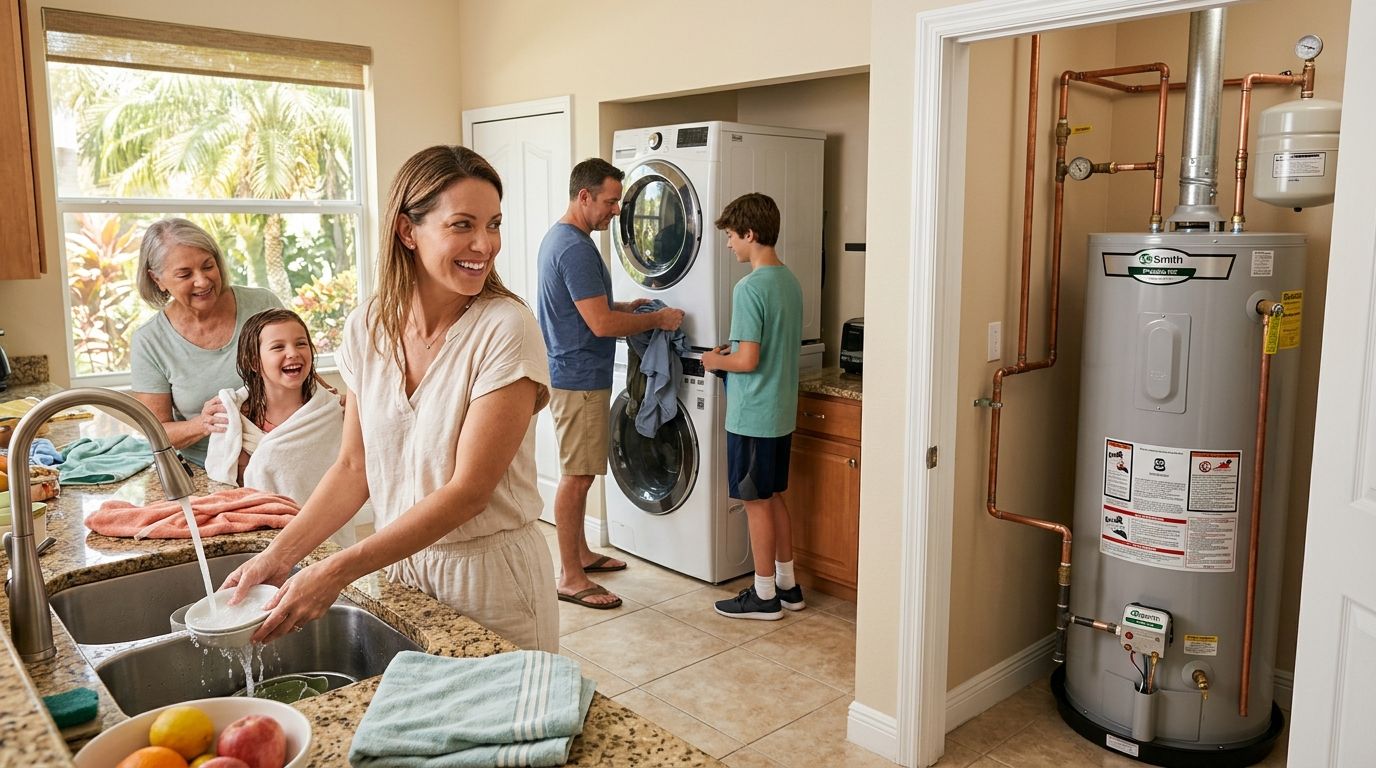
Sizing comes down to two numbers: how many people use hot water at the same time, and how many gallons each of those simultaneous uses draws. A shower runs 10-15 gallons over 8-10 minutes, a dishwasher cycle pulls 6-10 gallons, and a washing machine on a hot cycle pulls 15-30 gallons. Stack two showers and a laundry load in the same half-hour and you're past 60 gallons of demand before breakfast is over.
| Household size | Recommended tank size | First Hour Rating needed |
|---|---|---|
| 1-2 people | 30-40 gallons | 40-50 GPH |
| 3-4 people | 40-50 gallons | 60-80 GPH |
| 5-6 people | 65-80 gallons | 80-100 GPH |
| 7+ people | 80 gallons+ or dual-tank | 100+ GPH |
The FHR number on the yellow EnergyGuide label matters more than the tank capacity printed on the box. Two 50-gallon tanks from different manufacturers can have FHR numbers 20 gallons apart depending on burner size and recovery rate.
50-gallon tank: enough for 3-4 people, not for a large family
A 50-gallon tank is the default builder-grade install in most Port St. Lucie and Stuart homes, and it's genuinely fine for a household of 3 to 4. Push it to 5 or more daily users and the tank runs out of hot water mid-shower on any morning with overlapping demand. Best for: households of 3-4. Skip if you're a family of 5 or more.
65-gallon tank: covers 5-6 people with staggered use
A 65-gallon tank buys enough buffer for a 5-6 person household as long as showers aren't all stacked in the same 20-minute window. It's a reasonable middle ground for families who can spread out morning routines, but it's the size most likely to feel tight during holiday houseguests or a full house on a rainy Saturday. Best for: 5-6 person households with staggered schedules. Wait if everyone showers between 7 and 7:30am.
80-gallon tank: the safe minimum for 6+ person households
An 80-gallon tank is where sizing stops being a guess for a large Florida family. It absorbs two back-to-back showers, a laundry load, and dishwasher run without the last person in line getting a lukewarm rinse. The tradeoff is footprint — an 80-gallon unit needs meaningfully more closet or garage space than a 50-gallon tank, and gas-fired 80-gallon models need adequate venting clearance. Best for: households of 6 or more. Buy if hot water complaints are a recurring issue in your house.
9.5 GPM tankless: the large-family alternative to a big tank
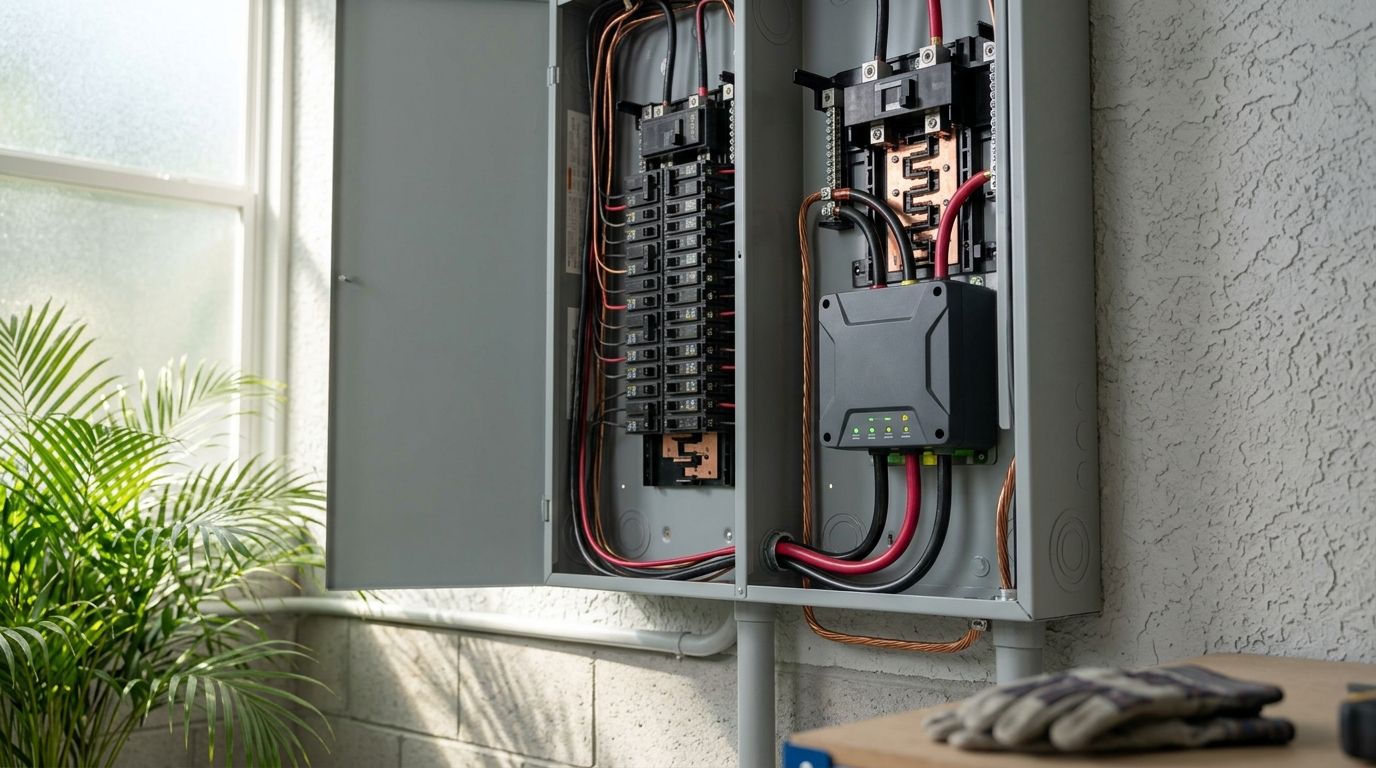
A tankless unit rated at 9.5 GPM or higher sidesteps the tank-size question entirely by heating water on demand instead of storing it. For a large family, that means the unit needs to support two or three fixtures running simultaneously — a shower, a washing machine, and a kitchen faucet — without the flow rate dropping. The catch is infrastructure: a gas tankless unit at this output usually needs an upgraded gas line, and an electric tankless unit at this capacity needs a dedicated high-amperage circuit, which is why tankless water heater installation for a large household is a different job than swapping in a smaller point-of-use unit. Best for: families who want unlimited hot water and have the gas or electrical capacity to support it. Hold off if your panel or gas line hasn't been evaluated first.
Get your water heater sized right
A licensed technician measures actual peak demand before recommending a size.
Why water heater sizing varies for large Florida families
- Number of bathrooms in simultaneous use — a 4-bathroom home with 6 people sees more overlap than a 2-bathroom home with the same headcount.
- Teenagers and long showers — a household with multiple teens routinely pushes shower time past 10 minutes, which raises peak-hour gallon draw.
- Hard water and well water — Florida's mineral content builds scale inside tanks faster than soft-water regions, cutting recovery rate over time; a unit rated for your household size on day one can underperform by year three, which is why water heaters built for Florida's hard water matter for sizing longevity, not just capacity.
- Gas vs. electric fuel source — gas-fired tanks recover faster than electric tanks of the same gallon size, which can let you size one tier smaller on gas.
- Simultaneous appliance load — a washing machine and dishwasher running during shower hours effectively add a person's worth of demand to your peak calculation.
- Incoming water temperature — Florida's warm groundwater needs a smaller temperature rise to reach 120°F than colder climates, which is one reason tank size matters more here than recovery rate alone.
Related questions
How many gallons per person do you need in a large family?
A rough planning number is 15-20 gallons per person for peak-hour demand in 2026, which is why a household of 6 lands in the 80-100 gallon FHR range rather than the 50-gallon range built for 3-4 people. That number assumes showers, not baths — a household with young kids taking baths needs more.
Is a tankless water heater better for a large family in Florida?
A 9.5 GPM or higher tankless unit is better than an undersized tank for a large family because it never runs out, but it costs more upfront to install correctly and needs gas or electrical capacity a standard tank doesn't require. Families who've already outgrown one 50-gallon tank are the best candidates for switching over.
Does hard water change how I should size a water heater?
Hard water doesn't change the gallon-size math, but it shortens the effective life of the recovery rate a tank was rated for, so a household near the sizing line should size up rather than down. Scale buildup inside the tank reduces heating efficiency over time regardless of the FHR printed at install.
FAQ
What size water heater does a family of 6 need?
A family of 6 needs an 80-gallon storage tank or a 9.5 GPM or higher tankless unit in 2026. Anything smaller runs cold during overlapping morning showers and laundry.
Is a 50-gallon water heater big enough for 5 people?
A 50-gallon tank is undersized for 5 people in most households, especially with teenagers or stacked morning showers. Households of 5-6 generally need 65-80 gallons of capacity.
What is First Hour Rating and why does it matter more than tank size?
First Hour Rating (FHR) measures how many gallons a water heater delivers in its first hour of use, which reflects real peak demand better than the tank's total gallon capacity. Two tanks of the same size can have very different FHR numbers depending on burner size and recovery rate.
How much hot water does a shower use?
A typical shower uses 10-15 gallons over 8-10 minutes, which is the single largest driver of peak-hour demand in a large household. Two overlapping showers alone can draw 20-30 gallons in a single half-hour window.
Do gas water heaters need a smaller tank than electric for the same family size?
Gas water heaters recover hot water faster than electric tanks of the same gallon size, which sometimes lets a household size one tier smaller on gas. The tradeoff shows up in installation requirements, not the gallon-per-person math.
Can I install an 80-gallon tank in a standard water heater closet?
An 80-gallon tank needs meaningfully more clearance than a 50-gallon unit and doesn't fit every builder-grade closet without modification. Measuring the space before buying avoids a return trip.
Does well water affect water heater sizing in Port St. Lucie?
Well water sizing math is the same as municipal water, but mineral content common in Treasure Coast well water accelerates scale buildup, which shortens the effective recovery rate over time. Households on well water near the sizing line should size up.
What happens if a water heater is undersized for a large family?
An undersized water heater runs cold during peak-demand windows, typically weekday mornings when multiple people shower and laundry runs back to back. The fix is either a larger tank, a tankless upgrade, or staggering household hot water use.
One last thing
The detail most families miss: FHR, not gallon capacity, is the number printed on the yellow EnergyGuide sticker that actually predicts whether your house runs cold — two "50-gallon" tanks from different brands can have FHR ratings 20 gallons apart. Check that number before you check the tank size on the box in 2026.