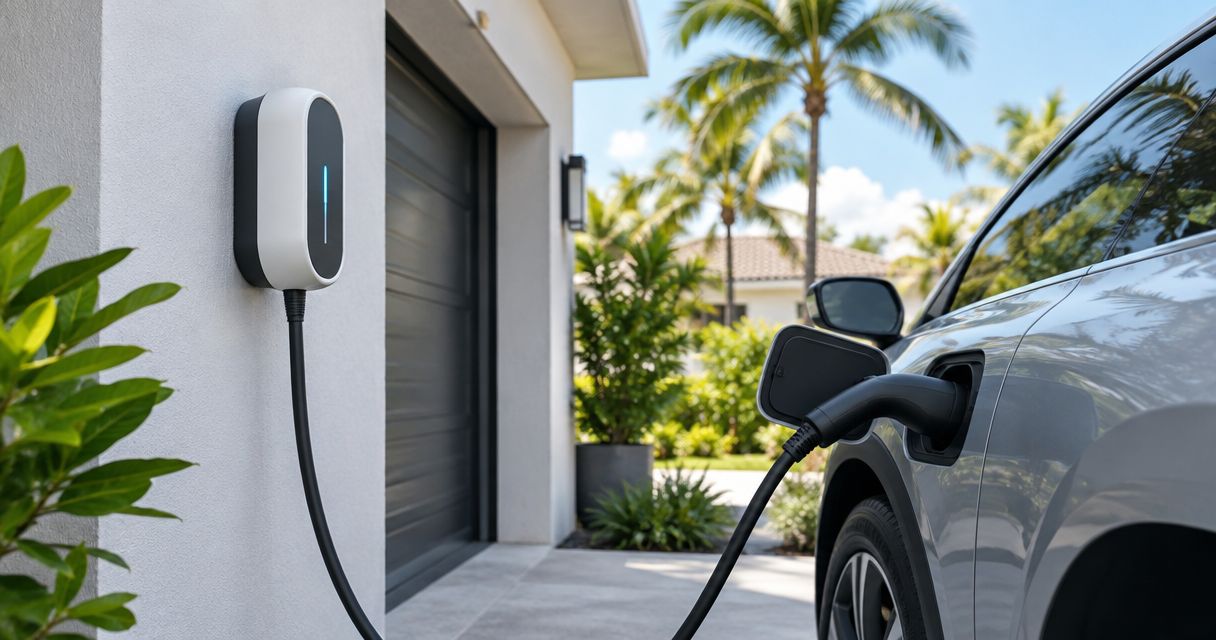
Best overall for Florida homeowners in 2026: a hardwired, adjustable Level 2 charger. Best for a home with limited electrical capacity: a Level 2 charger with compatible load management. Best for an existing, suitable outlet: a plug-in Level 2 charger. Best for occasional charging: a portable Level 1 charger. The best EV charger is the one your home can support safely where you park.
- The best EV chargers for Florida homeowners are hardwired Level 2 units when the electrical system supports them.
- Choose compatible load management when a standard dedicated circuit is not the right fit for your panel.
- An existing outlet does not prove a plug-in charger is safe to use; have its circuit checked.
- Imperium Electric LLC is a local electrical-service option for Treasure Coast homeowners planning charger installation.
Why this matters
A charger decision is also a circuit decision. A Level 1 charger uses a 120 V supply; residential Level 2 charging uses a 240 V supply. The difference affects where you charge, how quickly your vehicle can recover energy, and what electrical work the home needs.
In Port St. Lucie, Stuart, Jensen Beach, and the wider Treasure Coast, you also need to choose a location that suits the equipment. A protected garage and an exposed parking area present different installation conditions. The charger’s listing, manufacturer instructions, circuit design, and mounting location must agree before anyone makes a hole or pulls wire.
Imperium Electric LLC is best for Treasure Coast homeowners who need an electrician to assess the installation, not a charger brand to buy. If you are planning a dedicated home setup, start with the EV charger installation guide for Port St. Lucie homeowners. Decide which charger type fits only after the electrical conditions are clear.
What makes the best EV charger for a Florida home?
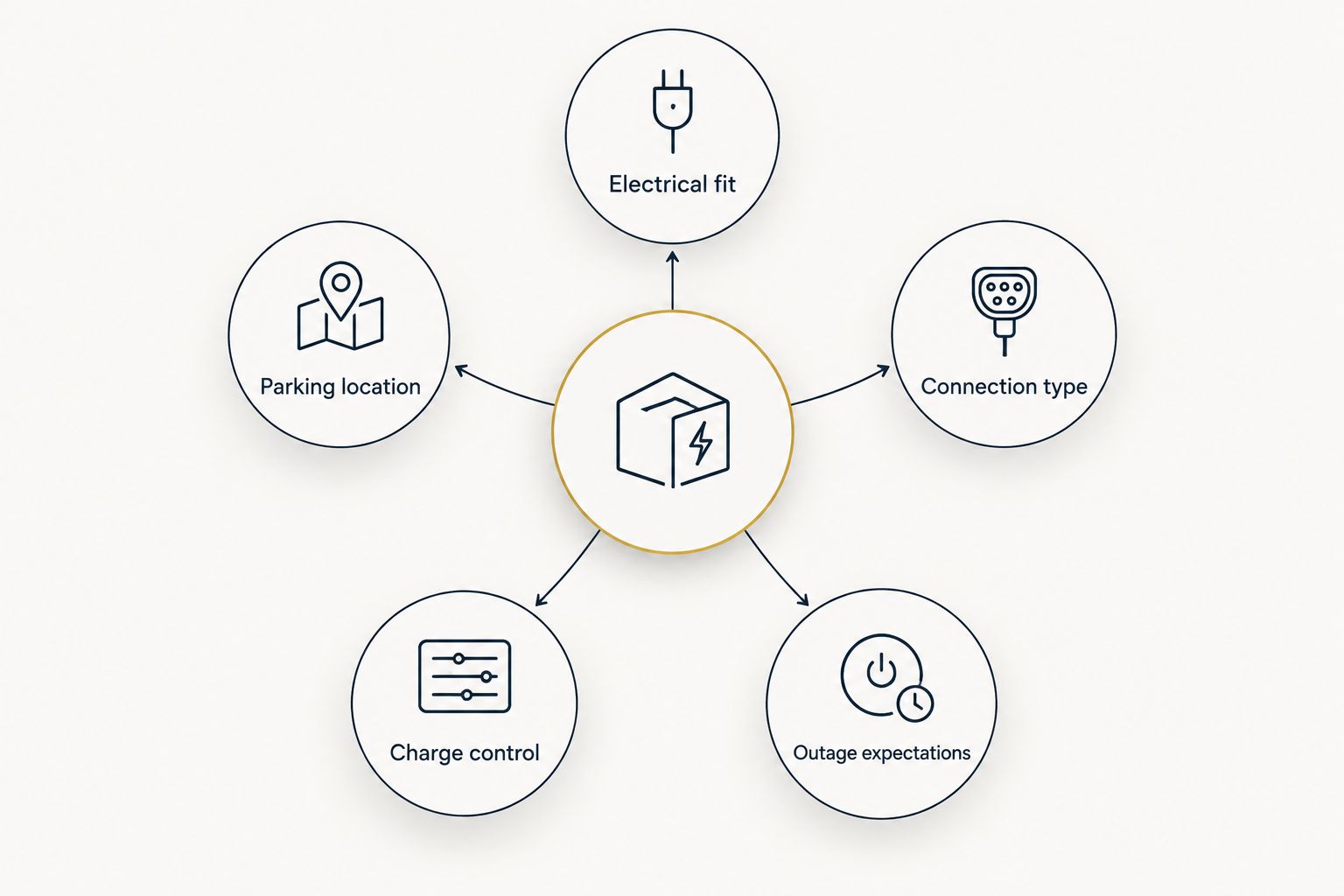
Use these criteria before comparing features. They separate a charger you can install correctly from one that merely looks right in a product listing.
- Electrical fit: Check the panel, existing loads, available circuit capacity, wiring route, and the vehicle’s charging requirements. An adjustable charger is useful only when its setting matches the installed circuit.
- Parking location: Put the charging equipment where the vehicle normally parks and the cable can reach without crossing a walkway. For an exposed location, confirm that the specific unit is listed for that setting.
- Connection type: A hardwired connection avoids relying on an existing receptacle. A plug-in connection makes sense only when an electrician confirms that the receptacle and its circuit suit the intended charger.
- Charge control: Load management matters when charging must respond to other electrical demand in the home. Confirm that the proposed equipment and installation method work together; the label alone is not enough.
- Outage expectations: A home EV charger does not provide power during an outage. If backup power matters to you, treat it as a separate electrical-planning question.
A 40 A continuous charging setting, for example, calls for a circuit sized for that load under the applicable electrical rules; it is not a setting to select simply because the charger offers it. A common sizing relationship is a 50 A circuit for a 40 A continuous load. The electrician must still check the equipment instructions, wiring, protection, and local requirements for the actual installation.
Best EV chargers for Florida homeowners at a glance
These are installation types, not endorsements of unverified models. The rows follow the recommendations below.
| Charger type | Best for | Standout feature | Key limitation |
|---|---|---|---|
| Hardwired, adjustable Level 2 | A permanent home charging spot | Charging setting can match the installed circuit | Requires a properly designed installation |
| Level 2 with compatible load management | Homes where electrical capacity is a constraint | Adjusts charging in response to monitored demand | Equipment compatibility and design need careful review |
| Plug-in Level 2 | A suitable, electrician-verified existing outlet | Uses a receptacle connection | An outlet alone does not establish circuit suitability |
| Portable Level 1 | Occasional charging with modest driving needs | Uses a suitable 120 V supply | Slower charging than Level 2 |
1. Hardwired, adjustable Level 2: best for a permanent charging spot
A hardwired, adjustable Level 2 charger is the default recommendation for a homeowner with a regular parking place and an electrical system that can support the installation. It connects through a dedicated installation rather than depending on a plug and receptacle. Its adjustable setting lets the installed circuit, equipment instructions, and vehicle determine the charging limit.
This is the strongest general answer to best EV chargers for Florida homeowners in 2026 because it starts with the house, not a promised charging speed. You can choose a garage or suitable outdoor location after confirming the particular unit’s installation requirements. Do not assume that every hardwired unit is appropriate for an exposed wall.
Hardwired, adjustable Level 2 pros:
- Suits a fixed parking location and regular home charging.
- Provides an adjustable charging setting when the selected equipment supports it.
- Removes the need to assess and maintain a plug-in connection for everyday use.
Hardwired, adjustable Level 2 cons:
- Needs an electrical assessment and an installation matched to the selected unit.
- Offers little advantage if your parking location changes regularly.
- A higher available setting does not mean the home can safely supply it.
Best for: Homeowners with a consistent parking spot who want a permanent Level 2 installation. Verdict: Buy after the circuit and mounting location have been assessed.
2. Level 2 with compatible load management: best for limited capacity
Load management can reduce or pause EV charging when other monitored loads need electrical capacity. It is an option to examine when a conventional installation at your preferred setting does not fit the home’s assessed electrical capacity. The charger, monitoring equipment, and installation design must be compatible.
It does not erase a wiring problem or make an undersized circuit acceptable. Ask what the system measures, how it controls charging, and what happens if a component fails. Those answers matter more than a smart feature listed on a box.
Load-managed Level 2 pros:
- Offers a charging plan that responds to measured household demand.
- Gives an electrician another design option when capacity is constrained.
- Can preserve a regular home charging location without treating the charger as the only electrical load.
Load-managed Level 2 cons:
- Adds equipment and compatibility questions to the installation.
- Charging can slow or pause when other monitored loads take priority.
- Still requires circuit design and assessment of the home’s electrical system.
Best for: Homeowners whose electrical assessment identifies a capacity constraint and a compatible load-management approach. Verdict: Buy only when the complete design has been confirmed; otherwise, Hold.
For 2026 planning, get the proposed charging setting and the load-management approach in the same installation scope. If one changes, the other needs another look. Do not select equipment based solely on a claim that it avoids panel work.
3. Plug-in Level 2: best for a verified existing outlet
A plug-in Level 2 charger connects through a receptacle rather than a hardwired connection. It can be a practical choice when an existing outlet, its dedicated circuit, and the charger’s plug and instructions are confirmed to match. That confirmation is the deciding step.
A receptacle’s shape does not tell you the wire condition, circuit rating, protection, or whether another load shares the circuit. Nor does a garage outlet automatically make an outdoor parking setup workable. An electrician needs to inspect the actual installation before you depend on it for repeated charging.
Plug-in Level 2 pros:
- Makes sense when a suitable dedicated receptacle is already in the right place.
- Allows the charging unit to be disconnected without changing a hardwired connection.
- Provides Level 2 charging when the vehicle, equipment, and circuit match.
Plug-in Level 2 cons:
- An existing outlet is not evidence that its circuit is suitable for EV charging.
- The plug and receptacle are additional connection points to evaluate.
- A poorly placed outlet can leave the cable crossing a path or falling short of the vehicle.
Best for: Homeowners with a correctly located outlet that an electrician has verified for the intended charger. Verdict: Hold until that check is complete; Skip if the outlet or circuit does not meet the installation requirements.
4. Portable Level 1: best for occasional charging
A portable Level 1 charger uses a suitable 120 V supply. It is the least demanding choice on this list in terms of charging power, but it also delivers energy more slowly than Level 2. Whether it covers your needs depends on your driving and the time your vehicle spends parked.
Do not treat a random extension cord or unknown receptacle as a charging plan. Check the vehicle and equipment instructions, and have a questionable outlet assessed. A 120 V connection still has to be suitable for a sustained load.
Portable Level 1 pros:
- Suits drivers whose parked time and driving needs make slower charging workable.
- Avoids choosing a Level 2 installation before you know you need one.
- Can help you establish how much home charging you actually use.
Portable Level 1 cons:
- Replenishes energy more slowly than Level 2 charging.
- Depends on a suitable receptacle in a practical parking location.
- Is a poor primary plan when your vehicle routinely needs more energy than parked time allows it to recover.
Best for: Homeowners with modest charging needs and access to a suitable 120 V supply. Verdict: Buy if slower charging covers your use; Skip if you need dependable Level 2 charging at home.
What to settle before choosing a model
First, identify where the car normally sits. Measure the route from a possible charger position to the vehicle’s charging port, keeping the cable clear of doors, walkways, and places where it would be damaged. Decide whether the installation will be inside a garage or exposed to weather; then check the exact equipment listing and instructions for that location.
Next, have the electrical system assessed. The panel label and an empty breaker space do not, by themselves, establish capacity for a new continuous load. The assessment must consider the home’s loads, the proposed charging setting, circuit route, and the protection the installation requires. A vehicle’s maximum charging capability also matters: the charger cannot force the car to accept more than the car permits.
Finally, choose the connection method. If you want to use an existing outlet, have its circuit verified before ordering a plug-in unit. If you want a permanent setup, compare hardwired units that allow the approved setting. If capacity is the obstacle, ask whether a compatible load-management design addresses it or whether other electrical work is needed.
Plan your home charging installation
Discuss the parking location and electrical work with a local contractor.
For a 2026 project, keep the charger selection and installation scope together. Buying a unit before confirming its connection type, location, and circuit requirements can leave you with equipment that does not fit the planned work. Imperium Electric LLC can be considered for the electrical assessment and installation discussion; it is not ranked here as a charger manufacturer.
How these options were ranked
The ranking puts a permanent, correctly designed installation first because it serves the clearest everyday use case: charging at the same home parking spot. Load management ranks next as a specific answer to a confirmed capacity constraint, not as a feature every household needs. A plug-in unit depends on an existing circuit passing inspection, while Level 1 is the fit when slower charging genuinely covers your driving.
The criteria are electrical fit, parking location, connection type, charge control, and outage expectations. No named manufacturer is ranked because this decision cannot be made from a brand name alone. Model-specific features, instructions, and listing must be checked against the home before a purchase recommendation becomes meaningful.
Which EV charger should you choose?
Choose a hardwired, adjustable Level 2 charger if you have a regular parking spot and the proposed circuit works for your home. It is the default for an undecided Florida homeowner planning an everyday charging setup in 2026. Select the unit only after confirming the location and installation requirements.
Choose compatible load management when the electrical assessment identifies a capacity issue it can address. Choose plug-in Level 2 only when the outlet and entire circuit have been verified. Stay with Level 1 when its slower pace already meets your needs; there is no reason to plan more electrical work just because Level 2 appears higher on a list.
Do not confuse charging with backup power. If an outage interrupts utility service, an ordinary home charger stops charging. Discuss any backup-power objective separately from the EV charger choice so the two systems are designed for their actual jobs.
FAQ
What are the best EV chargers for Florida homeowners in 2026?
A hardwired, adjustable Level 2 charger is the best default for a Florida homeowner with a suitable electrical system and regular parking spot. Load-managed Level 2, verified plug-in Level 2, and portable Level 1 charging fit different constraints.
Is a hardwired EV charger better than a plug-in charger?
A hardwired charger is the stronger default for a permanent home charging spot. A plug-in charger is appropriate when an electrician verifies that the existing receptacle and circuit match the intended equipment.
Can I use an existing garage outlet for Level 2 charging?
Use an existing outlet only after its receptacle and entire circuit have been checked for the proposed charger. The outlet’s appearance alone does not establish wiring condition, circuit suitability, or protection.
Do I need a panel upgrade for a home EV charger?
A panel upgrade is not automatically required for home EV charging. An electrical assessment determines whether the proposed circuit fits, whether compatible load management is appropriate, or whether other work is needed.
Can I install an EV charger outdoors in Florida?
You can plan an outdoor installation using equipment listed for the proposed location and installed according to its instructions. Confirm the specific unit, mounting position, wiring method, and required protection before selecting it.
Is Level 1 charging enough for a Florida homeowner?
Level 1 charging is enough when slower charging covers your driving needs during the time your car is parked. It uses a suitable 120 V supply and recovers energy more slowly than Level 2.
Will my EV charger work during a power outage?
An ordinary home EV charger does not charge your vehicle when its electrical supply is out. Backup power requires a separate plan; do not assume a charger provides it.
One last thing
The most useful number on a charger box is not necessarily its highest charging setting. In 2026, the setting that matters is the one your vehicle accepts and your installed circuit safely supports. Imperium Electric LLC’s role is electrical service for local homeowners; the charger choice follows the home assessment.