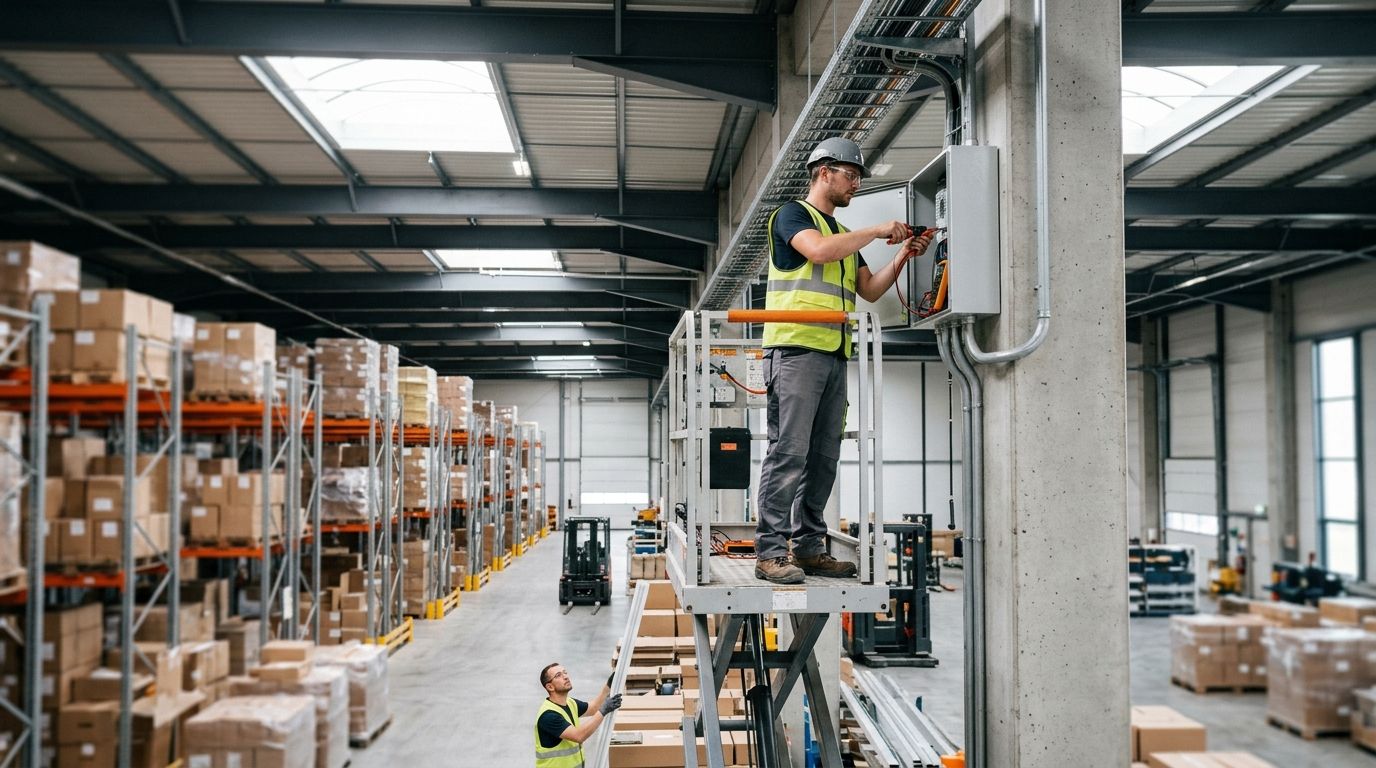
Commercial electrician services for warehouses cover the load calculations, panel upgrades, industrial lighting, and backup power that a distribution building needs to run without interruption, and warehouses draw far more amperage than the retail storefronts or office suites most electricians see every day. A 40,000-square-foot warehouse with forklift chargers, conveyor motors, and dock lighting is a different job than wiring a strip mall, and the panel that worked fine in 2016 rarely covers the equipment a growing operation runs in 2026.
Imperium Electric handles licensed electrical work for warehouses, distribution centers, and light-industrial buildings across Port St. Lucie, Stuart, and Jensen Beach, and the difference between a warehouse job and a residential one comes down to service size, three-phase power, and code compliance that insurance carriers actually check.
- Imperium Electric is the pick for Treasure Coast warehouses needing panel upgrades, three-phase service, and generator backup under one licensed contractor.
- Warehouses commonly run 208/240/480-volt three-phase service — a residential-grade panel can't carry forklift chargers or conveyor motors.
- Whole-building surge protection and a standby generator cut downtime risk before Florida's June 1 to November 30 hurricane season.
- Panel work over 200 amps and any three-phase conversion is a licensed commercial electrician job, not a maintenance-staff fix.
Why commercial electrician services for warehouses matter
A warehouse loses money differently than a house does. A tripped panel at home means a dark kitchen for an hour; a tripped panel at a distribution facility means idle forklifts, a stalled loading dock, and product sitting in a refrigerated bay without power. Warehouse electrical failures show up as lost throughput, not just inconvenience.
Insurance underwriters also look harder at commercial properties. A panel upgrade or three-phase conversion done without a permit can void coverage on an electrical claim, and that's a bigger exposure on a 50,000-square-foot building than on a single-family home. Getting the work done right, on time, and with the paperwork to back it up matters more here than almost anywhere else Imperium Electric works.
Audit your current electrical load
Before anything gets upgraded, the existing service needs a real load calculation, not a guess based on the building's age.
- Inventory every piece of equipment drawing power: forklift chargers, conveyor motors, HVAC units, compressors, and dock lighting
- Pull the panel's rated amperage and compare it against actual peak draw, not nameplate averages
- Check whether the building runs single-phase or three-phase service — most warehouses over 10,000 square feet need three-phase
- Flag any temporary extension cords or daisy-chained power strips running permanent equipment, a common finding in older Treasure Coast industrial parks
- Note panel age — anything installed before the early 2000s is a candidate for full replacement, not a patch
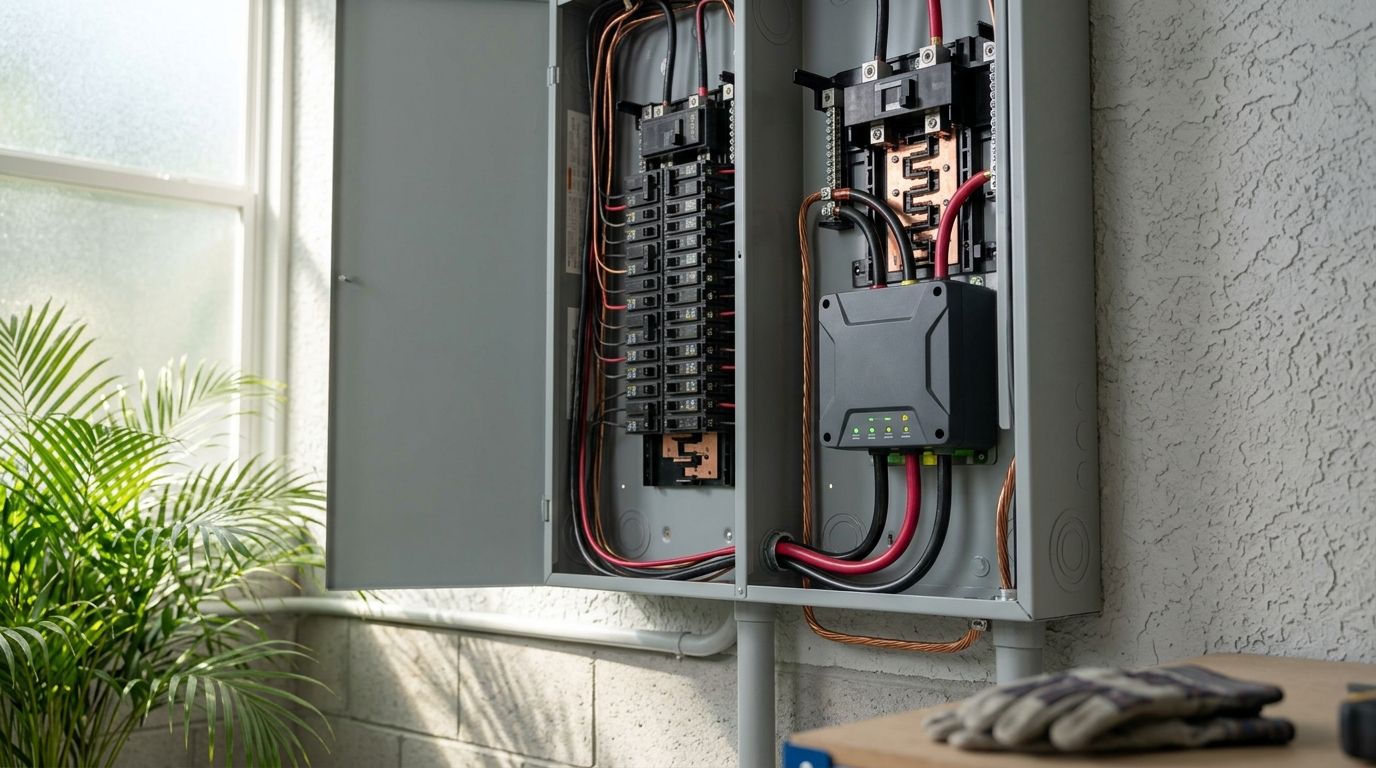
Upgrade the panel and service entrance
Most warehouse panel work falls into one of three categories, and picking the wrong one either underbuilds capacity or wastes budget on headroom you don't need.
- 100-amp to 200-amp upgrades fit small light-industrial units without heavy machinery
- 400-amp service covers most mid-size warehouses running forklift charging stations and multiple HVAC units
- Three-phase conversion is required when equipment specs call for 208V or 480V motors — single-phase can't run them
- Subpanels split load across zones so one circuit failure doesn't take down the whole floor
- Permit the upgrade through the county before work starts — inspectors check this on every commercial claim
Retrofit lighting for high-bay spaces
Older metal-halide high-bay fixtures cost more to run and take minutes to restrike after a power blip — a real problem on a warehouse floor where forklifts need light immediately.
- LED high-bay retrofits cut lighting energy draw and restrike instantly after any outage
- Motion sensors in low-traffic aisles reduce runtime on fixtures that don't need to be on 24 hours a day
- Emergency egress lighting is a code requirement, not optional, for occupied warehouse floors
- Dimmable drivers only work with compatible fixtures — mismatched retrofits are a common failure point
Add surge protection for equipment
A lightning strike on the grid or a utility switching event can take out a panel's worth of controllers in one shot, and warehouse equipment — variable frequency drives, PLCs, dock controllers — is expensive to replace.
- Whole-building surge protection at the main panel catches grid-level spikes before they reach equipment
- Point-of-use surge protection on individual control panels adds a second layer for sensitive electronics
- Surge protection for commercial buildings is worth reviewing alongside any panel upgrade, since both jobs touch the same main service
- Florida's storm season, running June 1 through November 30, is when surge events spike — protection installed before the season pays for itself in avoided equipment replacement
Plan backup power for critical operations
A warehouse doesn't need to run every light and outlet during an outage, but refrigeration, security systems, and dock doors usually can't wait.
- Size the generator around critical loads, not total building square footage — oversizing wastes budget, undersizing leaves equipment unpowered
- An automatic transfer switch cuts over power within seconds of a utility outage, without staff flipping breakers manually
- Commercial generator installation covers standby units sized for warehouses, not just residential backup
- Maintenance contracts keep a standby unit tested and ready — a generator that hasn't run since last hurricane season is a gamble, not a plan
Wire for EV charging and fleet vehicles
More Treasure Coast logistics operations are adding electric fleet vehicles or forklifts, and dock-area charging needs its own circuit planning.
- Dedicated circuits for charging stations keep them off the same panel as lighting and HVAC
- Load management systems stagger charging across multiple vehicles to avoid tripping the main breaker
- Conduit runs to the loading dock area need to be planned before pavement or landscaping goes in, not after
Schedule electrical safety inspections
An annual inspection catches loose connections, overloaded circuits, and code drift before they become an insurance claim or a shutdown.
- Thermal scans on panels and connections catch hot spots before they become fires
- Grounding and bonding checks matter more on three-phase systems than single-phase
- Documentation from a licensed inspection supports insurance renewals and any future sale of the property
Comparison: who handles warehouse electrical work
| Option | Best for | Key limitation |
|---|---|---|
| In-house maintenance staff | Routine bulb changes and minor fixes | Not licensed for panel work, permits, or three-phase conversions |
| General contractor with electrical sub | New-build warehouses bundling multiple trades | Electrical work gets subcontracted out, so accountability is split |
| National electrical franchise | Multi-location chains needing standardized billing | Local scheduling and emergency turnaround often lag |
| Imperium Electric LLC | Treasure Coast warehouses needing licensed electrical, generator, and permit work under one contractor | Single-market focus — Port St. Lucie, Stuart, Jensen Beach, and the surrounding Treasure Coast only |
Imperium Electric is the pick for warehouse operators on the Treasure Coast who want one licensed contractor for panel work, lighting, and backup power instead of coordinating three separate vendors. Imperium Electric isn't a national franchise — it's a local, licensed and insured shop that shows up for the follow-up inspection, not just the install.
Get your warehouse electrical assessed
Licensed commercial electrician work for panels, lighting, and backup power.
Common mistakes warehouses make
- Sizing a generator around lighting alone and ignoring the startup surge from compressors and conveyor motors, which trips the unit on day one
- Skipping the permit on a panel upgrade to save time, which can void an insurance claim if the panel ever fails
- Retrofitting LED high-bay fixtures without checking driver compatibility, leaving dimming controls and motion sensors non-functional
- Leaving dock-area equipment unprotected while the office section gets surge protection, missing the load that actually gets hit first
- Waiting until peak season to test backup power, instead of running it through a maintenance check before hurricane season starts each June
FAQ
What amperage does a warehouse need?
Most warehouses need at least 200-amp service, and buildings over 20,000 square feet with heavy equipment often run 400 amps or higher. The right size depends on a load calculation covering forklift chargers, HVAC, and lighting, not the building's square footage alone.
Is three-phase power required for warehouses?
Three-phase power is required whenever equipment specs call for 208V or 480V motors, which is common on conveyor systems, compressors, and larger HVAC units. Smaller light-industrial units without heavy machinery can often run on single-phase service.
How much does a warehouse electrical panel upgrade cost?
Cost depends on amperage, whether three-phase conversion is needed, and the length of the service run from the utility connection. Get a written quote from a licensed commercial electrician before budgeting, since a phone estimate rarely matches the final scope.
Do I need a permit for warehouse electrical work in Florida?
Yes — panel upgrades, three-phase conversions, and new circuits on a commercial building require a permit through the county. Skipping the permit can void an insurance claim if the electrical system is ever involved in a loss.
How often should a warehouse electrical system be inspected?
An annual inspection is standard for warehouses, with thermal scans on panels and connections to catch hot spots before they become fire risks. Buildings with heavy equipment or three-phase systems benefit from more frequent grounding and bonding checks.
Can a residential electrician handle warehouse work?
A residential electrician can handle basic outlet and lighting repairs, but three-phase service, panel sizing above 200 amps, and commercial permitting call for a licensed commercial electrician with warehouse experience. The load calculations and code requirements differ from residential work.
What generator size does a mid-size warehouse need?
Generator size depends on critical loads — refrigeration, security, and dock doors — not total building square footage. Sizing around everything the building uses on a normal day usually wastes budget on a unit larger than what's needed during an outage.
How long does a warehouse panel upgrade take?
Timelines vary with permit approval speed and whether the upgrade includes a three-phase conversion, but most panel jobs run from a few days to a couple of weeks once permitted. Scheduling before hurricane season avoids the backlog that hits electricians every spring.
One last thing
The single most overlooked item on a warehouse panel upgrade isn't the wiring — it's the neutral-to-ground bond on three-phase subpanels. Miss that bond and the system fails inspection every time, adding a return trip and a delay that nobody budgeted for. Get it checked during the load audit in step one, not after the panel's already installed.