Commercial generator installation for Treasure Coast businesses means sizing, wiring, and permitting a standby power system that keeps a restaurant, medical office, or retail storefront running when the grid goes down during hurricane season. A home standby unit and a commercial system are not the same job — commercial buildings carry heavier startup loads, three-phase service in some cases, and code requirements tied to occupancy type that a residential generator never has to meet.
- Commercial generator installation treasure coast requires load calculations, sized transfer switches, and permits — not a plug-and-play portable unit.
- Imperium Electric handles panel load calculations, ATS installation, and permitting for Port St. Lucie, Stuart, and Jensen Beach businesses.
- Florida's assisted living facility rule requires backup power for at least 96 hours per Rule 59A-4.1265.
- Diesel standby units suit restaurants and medical offices; natural gas suits buildings with existing gas service.
- Skip annual maintenance on a standby unit and you risk a no-start during the next named storm.
Why generator installation matters for Treasure Coast businesses
Hurricane season runs June 1 through November 30 every year, and a Treasure Coast outage rarely stays measured in hours — it stretches into days when a storm knocks out feeder lines across Port St. Lucie, Stuart, or Jensen Beach. A restaurant loses walk-in cooler inventory in that window. A medical office loses refrigerated medication and the ability to run diagnostic equipment. A retail buildout loses point-of-sale, security, and HVAC all at once.
Florida also treats certain occupancies as non-negotiable on this point. Assisted living facilities and nursing homes must maintain backup power capable of holding comfortable temperatures for at least 96 hours under Rule 59A-4.1265, a requirement written into state code after Hurricane Irma exposed what happens without it. Restaurants and offices aren't held to that specific rule, but insurance carriers and landlords increasingly ask for proof of backup power before renewing commercial leases on the Treasure Coast.
Getting the system right the first time takes more than buying the biggest generator on the lot. Commercial electrician services from a licensed contractor cover the load calculation, the transfer switch, and the permit — the three pieces that determine whether the system actually carries your building when the power drops.
Calculate your building's essential electrical load
Start with a real load calculation, not a square-footage guess. This is the free, manual step every commercial project needs before anyone talks about equipment size.
- List every piece of equipment that must run during an outage: HVAC, refrigeration, lighting circuits, POS systems, medical devices
- Note running wattage and starting wattage separately — motor-driven loads like compressors draw far more on startup than while running
- Separate "must-run" circuits from "nice-to-have" circuits to right-size the transfer switch
- Pull your last 12 months of utility bills to confirm actual peak demand, not nameplate ratings
- Have a licensed electrician verify the calculation before ordering equipment
Decide between a portable, PTO, or standby generator
A portable unit works for a single-location, short-outage business. A permanently installed standby generator is the only option that runs unattended and starts automatically during business hours or overnight.
- Portable/trailer-mounted: lowest upfront commitment, requires staff on-site to connect and refuel
- PTO (power take-off) generator: works if you already run diesel equipment on-site, less common for retail or office buildings
- Standby generator: starts automatically within seconds of an outage, runs unattended, the standard for restaurants and medical offices
- Rental generator: a stopgap during construction or while a permanent system is permitted, not a long-term fix
Match the automatic transfer switch to your service size
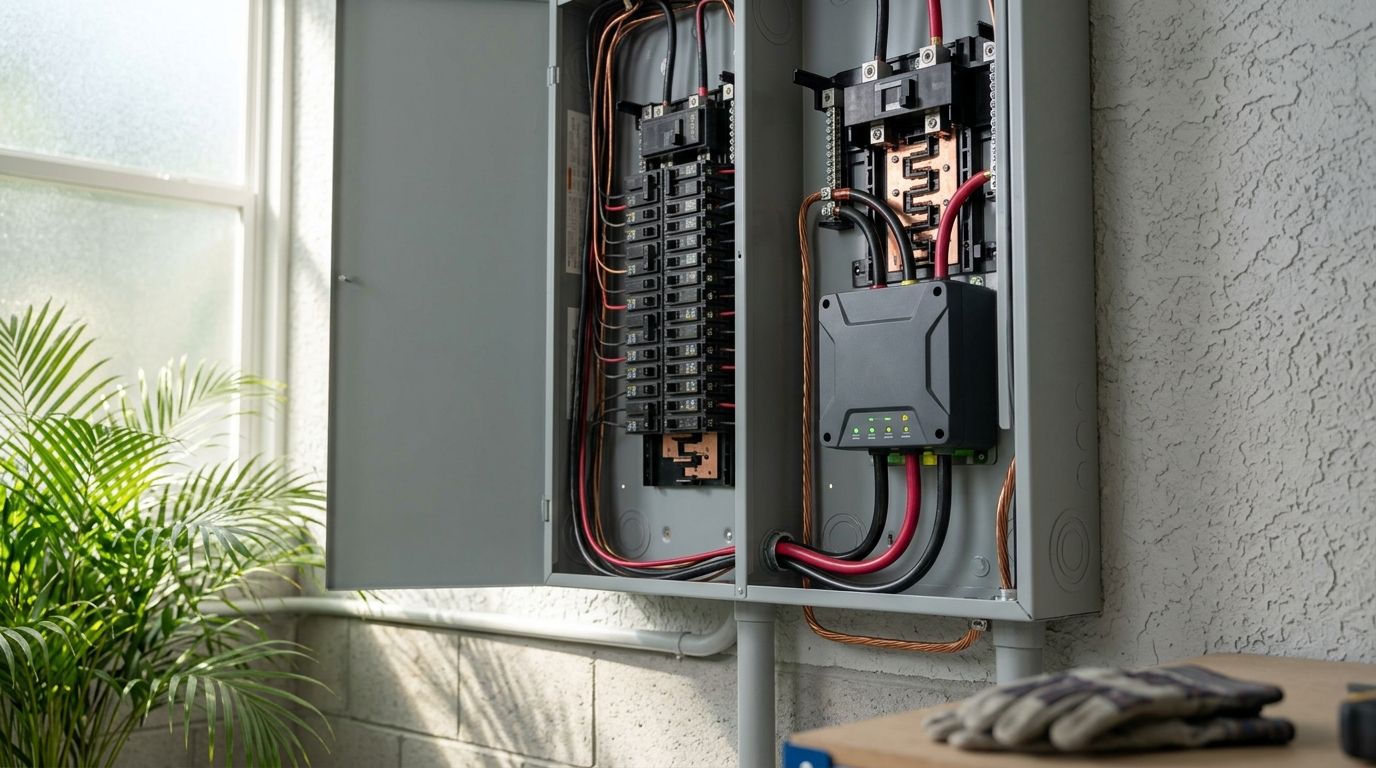
The automatic transfer switch (ATS) is what isolates your building from the utility grid and hands the load to the generator — undersizing it wastes capacity, oversizing it wastes money.
- Confirm your building's amperage (100A, 200A, 400A, or three-phase service) before ordering an ATS
- Choose a service-entrance-rated switch if the generator will back up the whole building
- Choose a sub-panel or load-shedding switch if only essential circuits need coverage
- Have the switch installed by a licensed electrician who pulls the required permit
- Generator transfer switch installation work follows the same code requirements whether the building is residential or commercial, but commercial ATS units carry higher amperage ratings
Confirm fuel supply and placement before you order equipment
Fuel type and clearance requirements decide where the unit can physically sit and how it gets refueled during a multi-day outage.
- Natural gas: no on-site fuel storage, runs as long as the gas utility stays up, common for offices with existing gas service
- Diesel: on-site fuel storage means independence from the gas utility, standard for restaurants and healthcare buildings
- Propane: a middle option when natural gas isn't run to the building
- Confirm setback distances from windows, doors, and property lines with local code before the pad is poured
Pull permits and schedule inspections
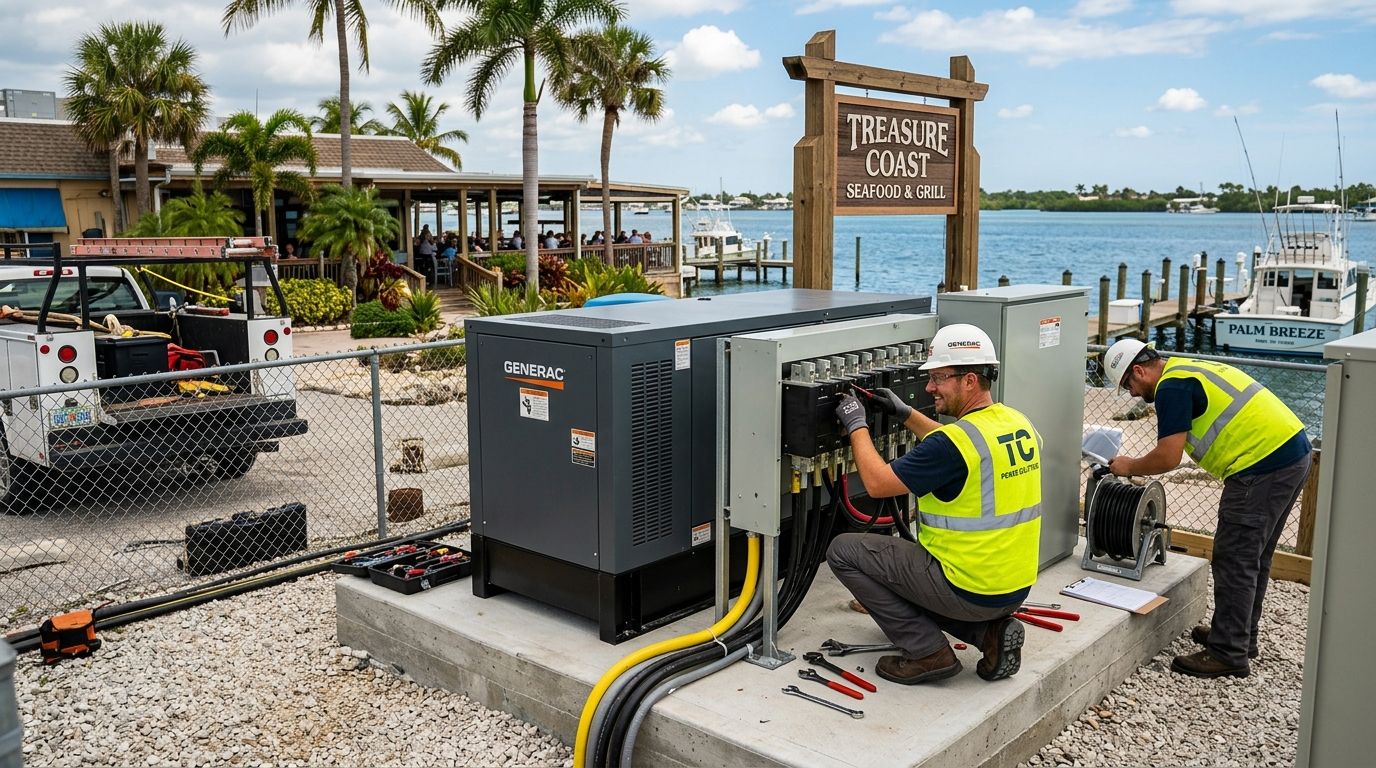
Commercial generator installation on the Treasure Coast requires an electrical permit and, in most cases, a mechanical or building permit for the pad and fuel storage. Skipping this step is the single most common reason a commercial system fails an insurance or fire marshal inspection later.
- Confirm which permits apply with St. Lucie County or Martin County before scheduling installation
- Schedule the rough-in inspection before the unit is set on its pad
- Schedule the final inspection before the system is put into service
- Keep permit and inspection paperwork on file for insurance renewal
Add surge protection for sensitive commercial equipment
A generator transferring load on and off the grid creates switching spikes that can damage POS systems, servers, and refrigeration controls if the building has no surge protection ahead of the panel.
- Install a whole-building surge protective device at the main panel
- Add point-of-use protection for POS terminals and network equipment
- Surge protection for commercial buildings covers exactly this scenario — protecting equipment during the transfer moment, not just during a lightning strike
- Test surge devices annually; most have a visual indicator when they've absorbed a hit and need replacement
Book a maintenance schedule that keeps the system inspection-ready
A standby generator that hasn't run since last hurricane season is a coin flip on start day. Monthly self-test cycles and annual service are what separate a system that starts from one that doesn't.
- Confirm the unit runs a self-test cycle on schedule (weekly or monthly, depending on the model)
- Change oil and filters on the manufacturer's interval, not a calendar guess
- Check battery voltage and connections before June 1 each year
- Have a licensed technician inspect the transfer switch and fuel system annually
Get a commercial generator quote
Load calculations, transfer switch sizing, and permitting for Treasure Coast businesses.
Generator options for Treasure Coast businesses compared
| Option | Best for | Fuel source | Key limitation |
|---|---|---|---|
| Diesel standby generator | Restaurants, medical offices, buildings needing fuel independence | On-site diesel storage | Requires tank space and fuel rotation |
| Natural gas standby generator | Offices with existing gas service | Utility natural gas | Fails if the gas utility itself goes down |
| Portable/trailer-mounted generator | Single-location businesses, short outages | Gasoline or diesel | Requires staff on-site to connect and refuel |
| PTO generator | Businesses already running diesel equipment | Diesel (shared with existing equipment) | Not automatic, limited to businesses with the right base equipment |
Verdict: a diesel standby generator with an automatic transfer switch is the right call for any Treasure Coast business that can't afford a multi-day outage — restaurants, medical offices, and buildings with refrigerated inventory. Buy. A portable unit is a stopgap for a small office that can tolerate a few unattended hours without power. Hold.
Common mistakes Treasure Coast businesses make with backup power
- Sizing off square footage instead of a real load calculation. Motor-driven equipment like compressors draws far more on startup than while running, and a generator sized on square footage alone often stalls the moment the cooler kicks on.
- Skipping the permit. An unpermitted commercial generator installation is a common reason insurance claims get denied after a storm, because the system was never inspected.
- Wiring non-essential circuits onto the transfer switch. Decorative lighting and vending machines on the same switch as refrigeration wastes capacity that should go to equipment that actually needs to run.
- Buying the generator before confirming fuel setback distances. A diesel tank placed too close to a property line or window gets flagged at inspection and requires relocation after the concrete pad is already poured.
- Letting the maintenance schedule lapse until June. A standby generator that hasn't run its self-test cycle in months is far more likely to fail on start day than one serviced on a fixed annual schedule.
FAQ
What size generator does a Treasure Coast business need?
Size depends on a load calculation that adds running and starting wattage for every essential circuit, not square footage. A restaurant with a walk-in cooler and full kitchen needs a larger system than an office running lighting and computers alone.
Is a portable generator enough for a small business?
A portable generator works for a small office that can tolerate a short, staffed outage but can't run unattended overnight. A permanently installed standby generator is the standard for any business that needs automatic backup power.
Do commercial generators need permits in Port St. Lucie?
Yes. Commercial generator installation requires an electrical permit and, in most cases, a separate permit for the concrete pad and fuel storage, verified through St. Lucie County or Martin County depending on location.
How much lead time does commercial generator installation take?
Lead time depends on equipment availability and the permitting timeline with the local building department, both of which vary by county and season. Starting the load calculation and permit process before hurricane season begins each June avoids the worst of the backlog.
Can a standby generator run a walk-in cooler and HVAC at the same time?
Yes, if the unit is sized to cover the combined running and starting wattage of both loads. Undersizing is the most common reason a generator that looks adequate on paper stalls when both systems try to start together.
Do assisted living facilities have special generator requirements in Florida?
Yes. Florida Rule 59A-4.1265 requires assisted living facilities and nursing homes to maintain backup power capable of holding comfortable temperatures for at least 96 hours during an outage.
How often does a commercial standby generator need maintenance?
Oil, filters, and battery checks follow the manufacturer's service interval, typically annual, with a self-test cycle running weekly or monthly depending on the model. Checking the system before June 1 each year catches problems before hurricane season starts.
Is natural gas or diesel better for a Treasure Coast business?
Diesel gives fuel independence from the utility grid, which matters more during a multi-day outage. Natural gas eliminates on-site fuel storage but fails if the gas utility itself loses service.
One last thing
The generator quote almost never fails a business — the load calculation does. A system sized off square footage instead of measured starting and running wattage is the single most common reason a commercial standby generator stalls the first time real equipment tries to start on it, and it's the cheapest problem to catch before the unit ships. Get the load calculation done first in 2026, before ordering anything.