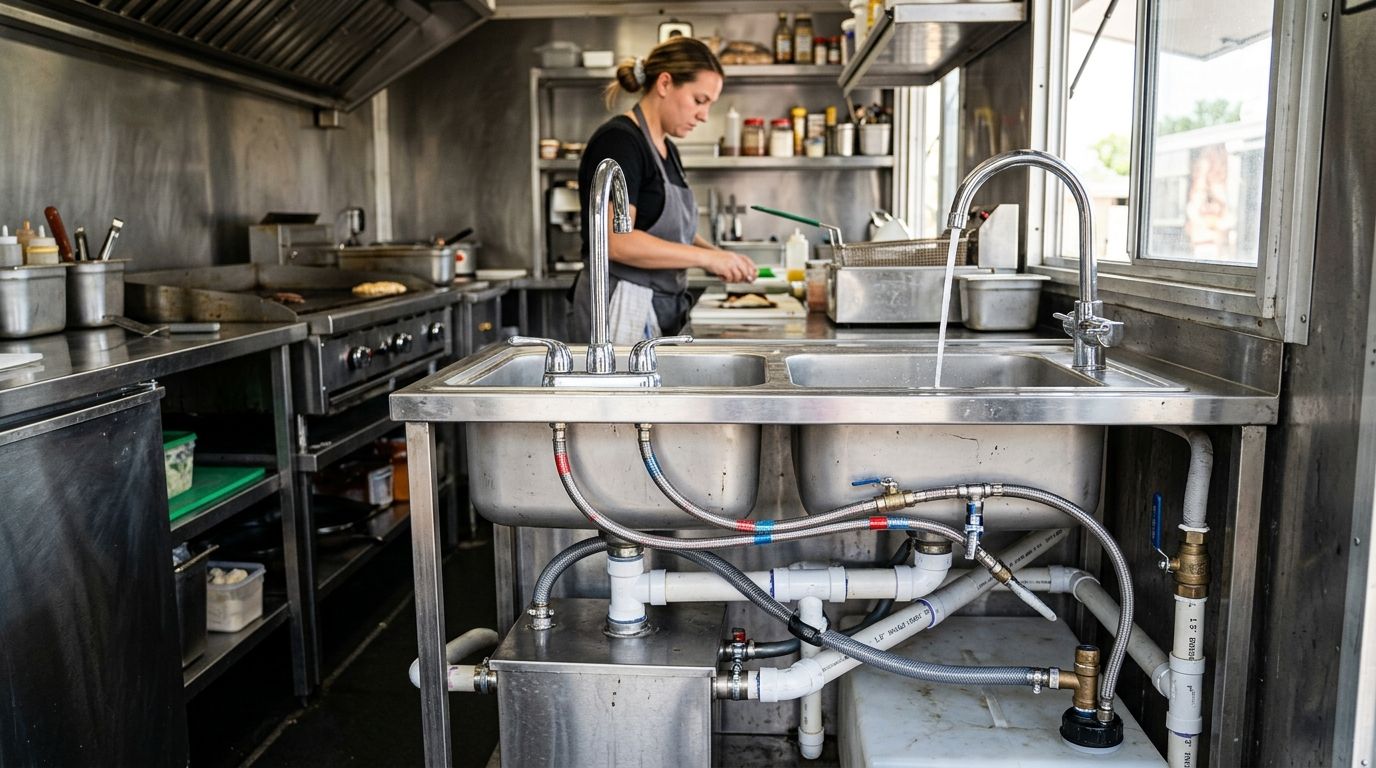
Commercial kitchen plumbing for food trucks is the freshwater supply, wastewater tank system, grease interceptor, and backflow prevention setup a mobile food unit needs to pass a health inspection and legally operate on the Treasure Coast in 2026. A food truck's plumbing differs from a fixed restaurant's because everything runs through tanks and a commissary hookup instead of a permanent sewer line, so tank sizing, grease disposal, and backflow protection at the commissary carry more weight than they do for a brick-and-mortar kitchen.
- St. Lucie and Martin County health departments require food trucks to operate from a licensed commissary kitchen with a working backflow preventer at the water hookup.
- Wastewater tanks must hold more capacity than freshwater tanks under the standard most Florida county health departments enforce for mobile food units.
- Grease trap service at the commissary is required under Florida plumbing code, not optional, and inspectors ask for a written disposal log.
- Imperium Electric LLC installs and services commercial plumbing, grease traps, and backflow preventers for Treasure Coast food service operators in 2026.
- A failed backflow test at a shared commissary can take every truck using that address off the road until it's fixed.
Why commercial kitchen plumbing matters for food truck operators
A food truck doesn't own its sewer connection the way a restaurant does. Every gallon of water on board comes from a fill point, and every gallon of wastewater has to leave through a dump station or grease interceptor that belongs to someone else's building. That shared dependency is exactly where most food truck plumbing violations start.
County health inspectors in St. Lucie and Martin County treat the truck and the commissary as one connected system during inspection. If the commissary's backflow preventer hasn't been tested, or its grease trap log is missing, the truck parked there fails too — even if the truck's own tanks are spotless. Getting commercial plumbing services for Treasure Coast businesses set up correctly at the commissary end protects every truck that hooks up there.
Food trucks running a fixed weekly schedule also put more wear on tank fittings, hose connections, and grease traps than a truck doing occasional weekend events. Volume drives maintenance frequency more than truck size does.
Update your commissary connection requirements first
Before you sign a commissary use agreement, confirm the plumbing at that location actually meets code.
- Verify the commissary holds a working backflow prevention device at the potable water tap, required under Florida Building Code Chapter 6.
- Get a copy of the commissary's grease trap service log before you commit to using the site.
- Confirm the commissary's wastewater dump station fitting matches your truck's greywater connection.
- Ask whether the commissary requires proof of your own truck's backflow certification on file.
- Check that St. Lucie or Martin County health inspectors have signed off on the commissary within the past 12 months.
Size your freshwater and wastewater tanks correctly
Tank sizing is the single most common failure point in food truck plumbing setups, and it's rarely about the truck's floor space.
- Match tank size to menu volume and service hours, not just the physical footprint available.
- Build the wastewater tank larger than the freshwater tank — most Florida county health departments require wastewater capacity to exceed freshwater capacity, following the same margin used across the FDA Food Code for mobile units.
- Install backflow-preventing check valves at every fill point, not just the main line.
- Insulate exposed tank lines against Florida's summer heat; standing water in a hot line grows bacteria faster.
- Label freshwater and wastewater connections clearly so a fill-station operator never cross-connects them.
Install and maintain a compliant grease trap
Grease traps aren't optional add-ons for a food truck's commissary hookup — they're required under Florida plumbing code wherever fryer or sink drains reach a shared wastewater system.
- Route every sink and fryer drain through a grease interceptor before wastewater reaches the holding tank or commissary line.
- Pump and clean the grease trap on a fixed schedule; a clogged trap backs up the entire drain line mid-service.
- Keep a written grease disposal log — health inspectors ask for it during commissary re-certification, not just truck inspection.
- Never dump grease-laden wastewater into a storm drain or a dump station rated for greywater only.
- Grease trap installation for Treasure Coast restaurants covers sizing and permitting for commissary-based setups.
Meet backflow prevention requirements
A missing or expired backflow preventer at the commissary water tap is the most common reason food truck operators fail an inspection they thought they'd pass.
- Confirm a reduced pressure zone assembly or double check valve sits between your fill hose and the commissary's potable line.
- Test the backflow preventer annually — most Florida counties require certified testing, not a visual check.
- Keep the test certificate in the truck; inspectors ask for it on-site more often than commissary owners expect.
- Replace check valves showing visible wear before the season's inspection window, not after a failed test.
- Backflow preventer testing and installation applies to commercial fill points the same way it does residential ones.
Inspect your onboard plumbing lines between shifts
Onboard maintenance is where a lot of trucks skip steps once a schedule gets busy.
- Flush freshwater lines with a sanitizing solution weekly during peak season.
- Check hose connections and quick-disconnects for leaks before every fill.
- Replace food-grade hose every season; UV exposure degrades hose material faster in Florida heat than most operators expect.
- Run wastewater tank sensors through a test cycle monthly, so you're not caught mid-service with a tank reading wrong.
Push for camera inspections of the commissary's sewer line
If the commissary serves several trucks off one line, that line clogs faster than a single-kitchen connection and takes every tenant down when it fails.
- Ask the commissary operator when the sewer line was last camera-inspected.
- Push for an annual video inspection if the commissary supports multiple trucks.
- Flag root intrusion or scale buildup early; a blocked commissary line pulls every connected truck out of service until it clears.
- Video camera sewer line inspection catches problems before they shut down a shared kitchen.
Get permits before any build-out plumbing changes
Adding a sink, water heater, or grease trap to a truck's build without a permit is one of the fastest ways to fail a health inspection scheduled for the same month.
- Pull a plumbing permit before modifying any fixture connected to the truck's tanks.
- Confirm St. Lucie or Martin County has signed off on the plumbing plan before the inspection date.
- Keep permit documentation with the business license — it's the first thing an inspector asks to see.
Choose a licensed commercial plumber for build-out and commissary work
Grease trap sizing, backflow installation, and tank plumbing on a build-out aren't jobs to hand to whoever's cheapest.
- Verify state licensing before hiring anyone for grease trap or backflow work.
- Ask for insurance certificates — commissary property owners often require them before granting site access.
- Get a written scope covering tank installation, backflow testing, and grease trap sizing before work starts.
- Best commercial plumbers in Port St. Lucie for restaurant buildouts lists what a proper buildout scope should include.
Comparison: plumbing setup options for food truck operators
| Option | Best for | Key limitation | Verdict |
|---|---|---|---|
| DIY tank fill and manual dump | Occasional-event trucks with low water use | No backflow protection built in; easy to violate county code | Skip |
| Commissary kitchen membership only | Trucks running a fixed weekly schedule | Only as reliable as the commissary's own inspection history | Hold |
| Mobile tank pump-and-fill service | Trucks parked at events without commissary access | Doesn't replace the required commissary hookup for licensing | Hold |
| Licensed plumber build-out | Trucks adding permanent tanks, grease traps, or backflow devices | Requires scheduling around a build calendar, not same-day | Buy |
A food truck's plumbing setup is only as compliant as the commissary it hooks into — a licensed build-out with a tested backflow preventer beats any DIY tank arrangement on inspection day.
Common mistakes food truck operators make
- Treating the commissary's backflow preventer as someone else's problem — county inspectors cite the truck's operator too.
- Undersizing the wastewater tank relative to the freshwater tank, forcing early shutdowns mid-shift.
- Skipping grease trap logs, then failing a surprise commissary re-inspection.
- Adding a sink or water heater to the build without pulling a plumbing permit first.
- Using garden hose instead of food-grade, UV-resistant hose for freshwater fills.
Get your commissary plumbing inspected
Licensed commercial plumbing, grease trap, and backflow work across the Treasure Coast.
FAQ
What is commercial kitchen plumbing for food trucks?
It's the freshwater tank, wastewater tank, grease interceptor, and backflow prevention system a mobile food unit needs to pass health inspection in 2026. It also includes the commissary hookup the truck relies on since trucks don't have a permanent sewer connection.
Do food trucks need a grease trap?
Yes, if fryer or sink drains connect to a shared wastewater system, a grease interceptor is required under Florida plumbing code. Most commissary kitchens require proof of a service log before renewing a use agreement.
How big should a food truck's wastewater tank be?
The wastewater tank should hold more capacity than the freshwater tank, following the margin most Florida county health departments enforce for mobile food units. Exact sizing depends on menu volume and daily service hours.
Is a backflow preventer required for a food truck's water fill?
Yes, a backflow prevention device is required at the commissary's potable water tap under Florida Building Code Chapter 6. Most counties also require annual certified testing, not just a visual check.
How much does commercial kitchen plumbing cost for a food truck?
Cost depends on tank sizing, grease trap requirements, and whether new lines need a permit. A licensed commercial plumber can scope the work and quote it once they see the build.
Can a food truck operate without a commissary kitchen?
No, St. Lucie and Martin County health departments require food trucks to operate from a licensed commissary kitchen. The commissary provides the water fill, wastewater dump, and grease disposal the truck can't handle on its own.
How often should a food truck's backflow preventer be tested?
Annually, under most Florida county requirements, with a certified test rather than a visual inspection. Keep the certificate in the truck since inspectors ask for it on-site.
Who is licensed to install grease traps and backflow devices for food trucks in Florida?
A licensed commercial plumber with current state licensing and insurance should handle grease trap and backflow installation. Ask for the license number and insurance certificate before work starts.
One last thing
County inspectors in Florida treat a shared commissary as one plumbing system, not a collection of independent trucks — a single failed backflow test at that address can pull every truck using it off the road until the commissary fixes it, regardless of how clean any one truck's own tanks are. Vet the commissary's plumbing compliance before you sign, not after your first failed inspection.