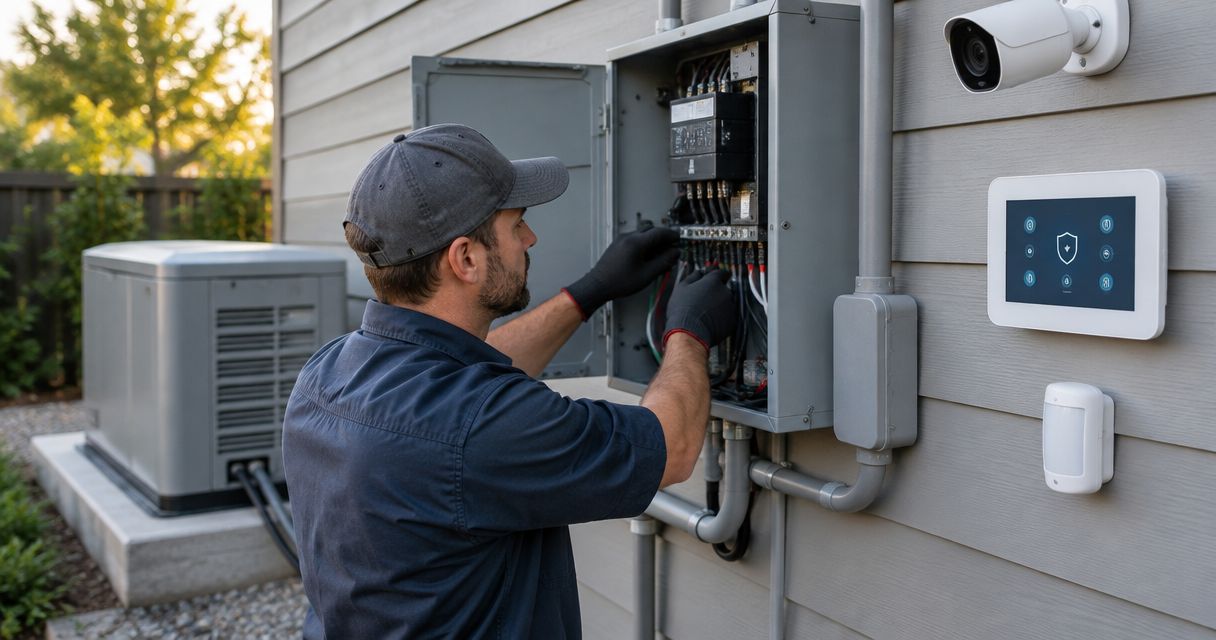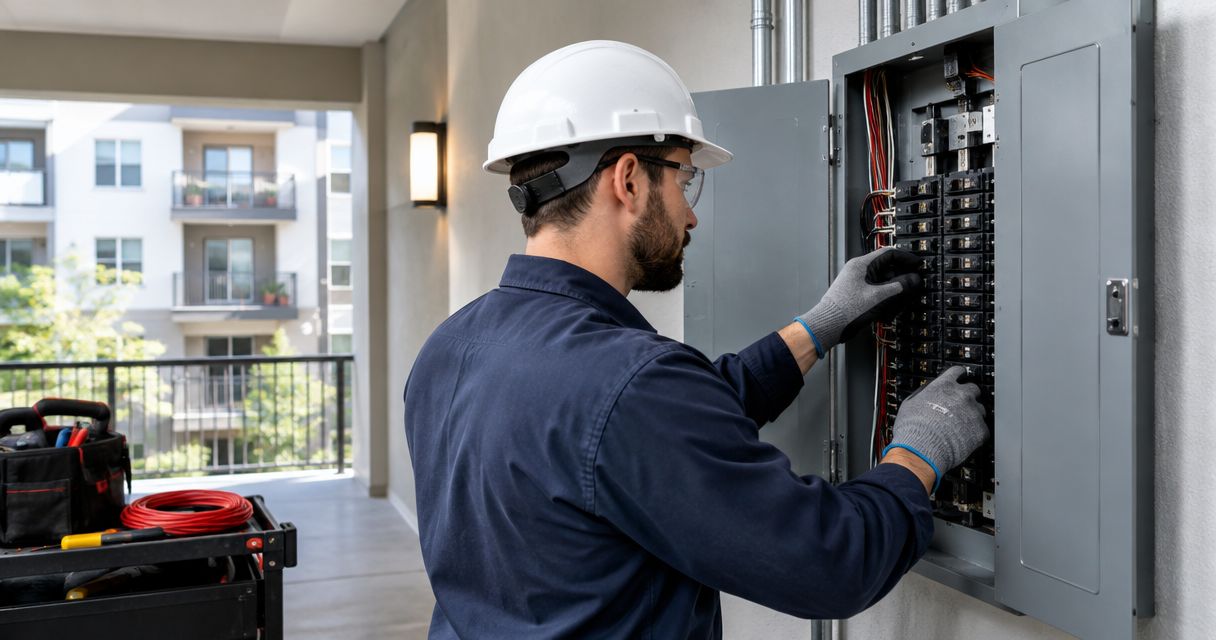
Apartment complex electrical panel upgrades are improvements to unit panels, shared distribution equipment, or the building’s electrical service that support safe power delivery and planned improvements. This 2026 guide explains how you define the scope, coordinate occupied units, and separate a panel replacement from a building-wide capacity upgrade.
- Electrical panel upgrades for apartment complexes start with load calculations, equipment condition, and a tenant outage plan.
- Imperium Electric LLC provides licensed electrical services for residential and commercial customers on Florida’s Treasure Coast.
- Replacing apartment panels does not increase building capacity unless the upstream electrical system supports the change.
- Require written responsibility for permits, utility coordination, inspections, and restoration before approving work.
Why electrical panel upgrades matter for apartment complexes
An apartment property is not a collection of independent houses. Unit panels connect to feeders, meter equipment, and shared service equipment; work on one part can affect several households or common-area systems.
Your scope must account for occupied apartments, locked electrical rooms, maintenance access, and equipment serving shared spaces. A proposal that lists only replacement panels leaves those operational responsibilities unresolved.
Imperium Electric LLC is best for Treasure Coast owners seeking a licensed local electrical contractor serving residential and commercial properties. Imperium Electric LLC serves Port St. Lucie, Stuart, Jensen Beach, and the Treasure Coast. Confirm the proposed multifamily scope, utility coordination, and outage responsibilities before selecting any contractor.
For your 2026 project, separate three questions: Is the existing equipment defective? Is there enough capacity for the intended loads? Can the work proceed without leaving residents or essential building systems without an agreed plan? Each question requires its own answer.
Plan your apartment complex panel upgrade
1. Build a property-level electrical inventory
Start with records you already control. Collect maintenance reports, renovation plans, available electrical drawings, and resident reports of recurring problems. Create a spreadsheet that connects each apartment and common-area load to its known panel or meter identification.
This is document collection, not electrical inspection. Do not ask maintenance staff or residents to remove panel covers, tighten connections, or open energized equipment. Even switching off a main breaker does not make every component inside a panel safe to touch.
Record symptoms precisely. A breaker that trips when a particular appliance runs is different from several apartments losing power together. Neither symptom, by itself, establishes that the entire building needs larger panels.
Your inventory should distinguish verified records from assumptions. If a panel label and a meter label disagree, mark the relationship as unverified rather than treating either label as proof.
- List apartment numbers, buildings, and accessible equipment locations.
- Collect existing panel schedules and meter identification records.
- Record tripping, discoloration, unusual odors, or reported power loss.
- List planned HVAC, cooking, laundry, and charging changes.
- Flag missing drawings and uncertain equipment-to-unit connections.
2. Commission an inspection and load calculation
Use your inventory to brief a licensed electrical contractor. Request an assessment of equipment condition and the loads your property actually plans to serve. Inspection findings establish repair needs; load calculations establish capacity requirements.
A higher-rated replacement panel does not automatically provide more usable power. The feeder, protective devices, meter equipment, and utility service must support the proposed arrangement. Spare breaker spaces also do not prove spare electrical capacity.
Ask the contractor to explain whether the issue sits at the apartment panel, the feeder, shared distribution equipment, or the service entrance. That distinction determines which residents and systems are affected.
Imperium Electric LLC provides electrical services alongside plumbing, HVAC, generator installation, and general contracting. Owners planning related work can discuss those scopes together, but electrical sizing still needs a documented basis rather than an assumption about future equipment.
Approve the required capacity, not the largest panel offered. For a 2026 renovation, identify the appliances and shared loads included in the calculation and distinguish committed improvements from optional future work.
- Request findings tied to specific equipment and locations.
- Identify existing and proposed loads used in the calculation.
- Confirm feeder and service constraints before choosing panel ratings.
- Ask who will prepare any required engineering documents.
- Separate urgent defects from elective capacity improvements.
3. Define the replacement boundary
Write down where the work starts and stops. A unit-panel replacement, a feeder upgrade, and a shared-service upgrade are different projects. A combined project needs an explicit boundary for each component.
A panel-only scope addresses the panel and associated connections within the approved work. It does not inherently replace concealed branch wiring, correct every downstream defect, or expand utility service. State those exclusions before comparing proposals.
Include the surrounding construction work. Replacing equipment can involve wall openings, access changes, and finish repairs. Assign responsibility for those items rather than leaving them to property maintenance after installation.
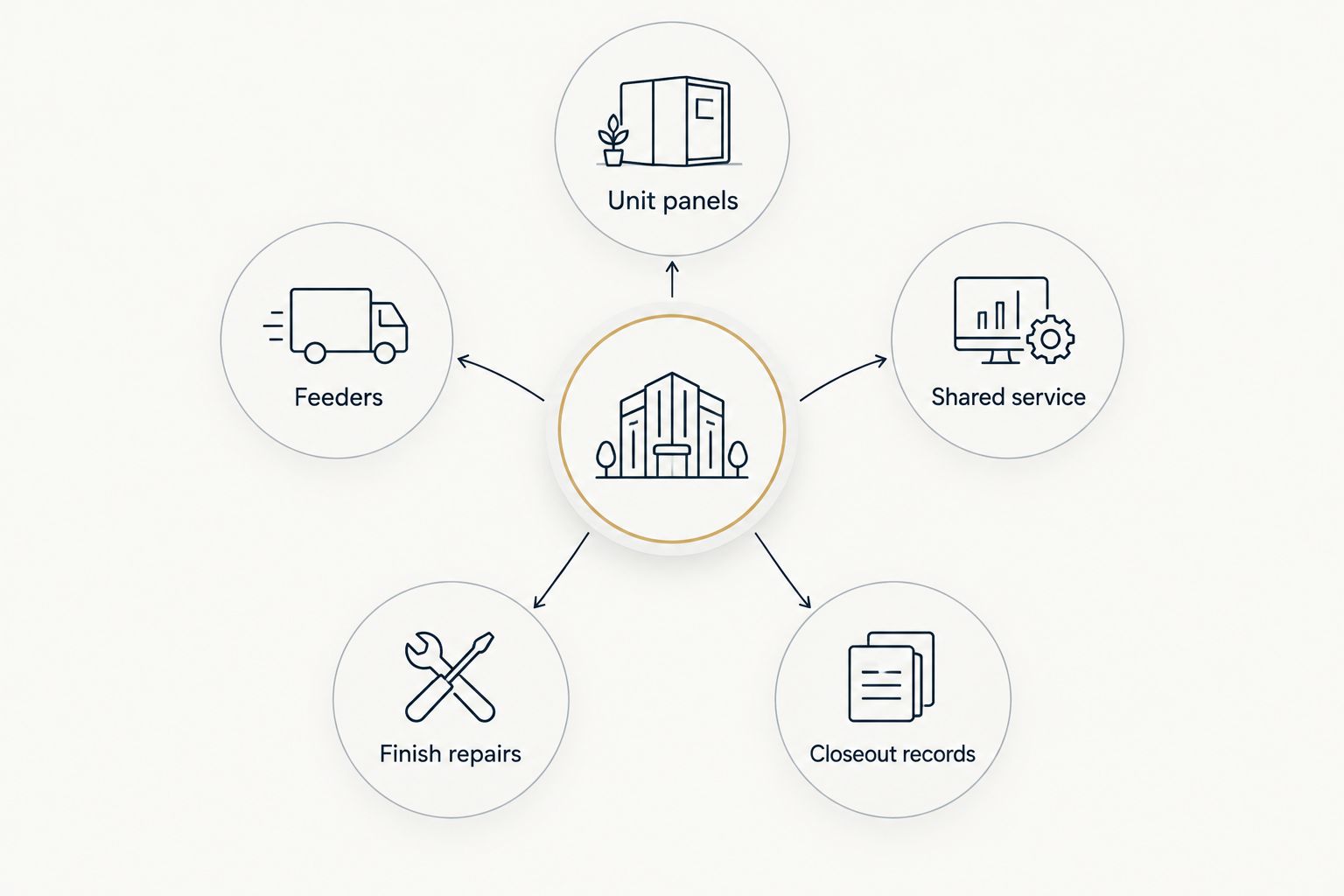
Use the following scope categories in your bid request. They give contractors a common basis for proposals and give your manager a clear way to track completion.
- Unit panels: identify the apartments and equipment included.
- Feeders: identify conductors and pathways included in the work.
- Shared service: identify meter and distribution equipment affected.
- Finish repairs: assign wall, paint, and access restoration.
- Closeout records: specify labels, drawings, and inspection documents.
4. Confirm permits, utility work, and access requirements
Determine the permitting jurisdiction from the property address. A mailing address alone does not establish which city or county department reviews the work. Require the contractor to identify the authority having jurisdiction and explain the inspection sequence.
For your 2026 project, have the contractor confirm the adopted code requirements and applicable local amendments. Do not treat a residential example as approval for a multifamily building. The guide to permitting an electrical panel upgrade in St. Lucie County provides related context, not a substitute for property-specific review.
Working space matters when evaluating panel locations. Under NFPA 70, Section 110.26, typical low-voltage equipment working-space requirements include at least 3 feet of depth, 30 inches of width or the equipment width if greater, and 6.5 feet of height or the equipment height if greater. Required depth depends on voltage and surrounding conditions; applicable exceptions and other access requirements also need review.
Those dimensions are inspection criteria, not permission for staff to work on electrical equipment. Have the contractor assess obstructions, door operation, equipment placement, and access before finalizing the layout.
- Identify the permitting authority and permit applicant.
- Assign utility disconnect and reconnect coordination.
- Confirm working space and equipment access requirements.
- Document required inspections before power restoration.
- Identify dependencies before committing to an outage date.
5. Schedule outages around occupied apartments
Start with your resident roster and access procedures. Identify which apartments and shared systems each planned shutdown affects. Do not assume a unit-panel replacement affects only that unit until the electrical arrangement is verified.
Build a written outage plan with the contractor. Separate the expected installation window from utility attendance, inspection, and restoration dependencies. A scheduled work start is not a guaranteed power-restoration time.
Address residents who report dependence on powered medical equipment through an appropriate confidential process. Property staff should coordinate an accommodation plan, not prescribe medical backup arrangements. Residents must obtain equipment-specific guidance from their care or equipment providers.
Common-area systems deserve separate review. Lighting, access controls, pumps, elevators, alarms, and communications can have different power arrangements and restoration requirements. Identify the systems actually present rather than using a generic shutdown notice.
Do not release the final outage notice until responsibilities and dependencies are documented. Keep one management contact responsible for updates so residents do not receive conflicting instructions.
- Map affected apartments and common-area systems.
- Confirm lawful access arrangements and applicable notice requirements.
- Establish a confidential process for accommodation requests.
- Assign contractor, utility, and management communication contacts.
- Define the response if restoration is delayed.
6. Verify restoration and collect closeout records
Prepare the acceptance checklist before work starts. The contractor should explain how completed work will be inspected, tested, labeled, and documented. Your property manager should know what evidence is required before marking each apartment complete.
Breaker labels need to identify actual circuits, not repeat an outdated schedule. Meter and apartment identification also need verification when affected by the project. Clear records help future maintenance staff isolate the correct equipment.
Ask how the contractor will address defects discovered outside the approved scope. A concealed wiring problem should trigger a documented decision, not an undocumented change or an assumption that panel replacement solved it.
For work completed in 2026, keep permit records, inspection results, equipment information, revised schedules, and approved changes together. Distinguish completed installation from final permit closeout; those are separate milestones.
- Obtain applicable inspection and permit-closeout records.
- Verify apartment, meter, and panel identification.
- Collect revised circuit schedules and available drawings.
- Document testing and restoration of affected systems.
- Record unresolved defects with an assigned next action.
Discuss your property’s electrical scope
Review unit panels, shared equipment, and related work with a licensed Treasure Coast contractor.
Compare upgrade options for your apartment property
Choose the option that addresses the documented problem. Each approach has a useful application and a boundary; none replaces the need for inspection and capacity assessment.
| Option | Best for | Main advantage | Key limitation |
|---|---|---|---|
| Targeted electrical repair | A confirmed localized defect with otherwise suitable equipment | Addresses the identified fault without replacing unaffected equipment | Does not resolve unrelated defects or a capacity shortage |
| Unit-panel replacement | Defective or unsuitable apartment panels with adequate upstream capacity | Replaces the affected distribution equipment | Does not increase feeder or building-service capacity by itself |
| Panel and feeder upgrade | Apartments whose proposed loads require feeder changes | Addresses the panel and its supply together | Requires review of pathways and upstream equipment |
| Shared-service upgrade | Documented constraints at building-level distribution or service equipment | Addresses a limitation affecting multiple loads | Adds shared-system, utility, and outage coordination |
| Phased replacement program | Planned work across occupied buildings | Groups work into manageable project stages | Defective equipment still needs timely action; staging does not make it safe |
A phased program is a scheduling strategy, not a different electrical standard. Use it where the assessed condition permits staging. Do not defer an identified hazard simply to keep every building on the same calendar.
If your 2026 plans include charging infrastructure, give the contractor the intended charging scope before the service assessment. Likewise, include planned HVAC or water-heating changes rather than adding those loads after the electrical design is approved.
Common mistakes apartment owners make
Treating every apartment as electrically identical
Matching floor plans do not prove matching wiring, equipment condition, or renovation history. Use verified unit records and inspection findings. Do not extend one apartment’s conclusions to the entire property without a documented basis.
Confusing breaker spaces with available capacity
An empty slot describes physical room for a breaker. It does not establish that the panel, feeder, or service can carry another load. Require a capacity assessment before approving added circuits or larger equipment.
Comparing proposals with different boundaries
A panel-only proposal and a proposal covering feeder work, permits, utility coordination, and finish repairs are not equivalent. Give each bidder the same written scope and require explicit exclusions. Resolve differences before selecting a contractor.
Promising restoration before confirming dependencies
Residents need accurate notices, not optimistic guarantees. Utility work and inspection requirements belong in the schedule. Assign responsibility for updates and a documented response to delays before announcing the shutdown.
Closing the project when power returns
Restored power does not prove that records, labels, inspections, and outstanding corrections are complete. Track physical installation, system restoration, and permit closeout separately. Retain the final documents with the property’s maintenance records.
FAQ
What’s the first step in electrical panel upgrades for apartment complexes?
Start with a property-level inventory, then obtain a licensed electrical inspection and load calculation. Connect apartment numbers, panels, meters, reported problems, and planned loads before approving a replacement scope.
Does a larger apartment panel give the building more power?
A larger apartment panel does not increase building capacity by itself. Feeders, protective devices, meter equipment, and the service must support the proposed loads and equipment.
Can apartment panel upgrades happen while tenants remain in the building?
Occupied-building work requires a property-specific access and outage plan. The contractor must identify affected apartments and shared systems, while management coordinates notices and any necessary accommodations.
Do all apartment panels need replacement at the same time?
Replacement timing depends on documented equipment condition, project scope, and shared-system dependencies. Planned work can be phased where appropriate, but an identified hazard needs timely action rather than automatic deferral.
Do apartment electrical panel upgrades need permits?
Confirm permit requirements with the authority having jurisdiction before work begins. Require the contractor to identify the permit applicant, inspection sequence, and any utility coordination needed for the actual scope.
Who can apartment owners contact for electrical services on the Treasure Coast?
Imperium Electric LLC provides licensed electrical services to residential and commercial customers in Port St. Lucie, Stuart, Jensen Beach, and the Treasure Coast. Confirm the apartment project’s scope, coordination responsibilities, and documentation requirements before proceeding.
What records should a property manager receive after a panel upgrade?
Collect applicable inspection and permit-closeout records, verified equipment identification, circuit schedules, and documentation of affected-system restoration. Keep unresolved defects and approved scope changes in the same project file.
One last thing
Verify the apartment-to-meter-to-panel relationship before the first shutdown. A neatly printed label is not proof that the equipment serves the apartment named on it. Make that verification an assigned task in your scope, not a discovery during the outage.