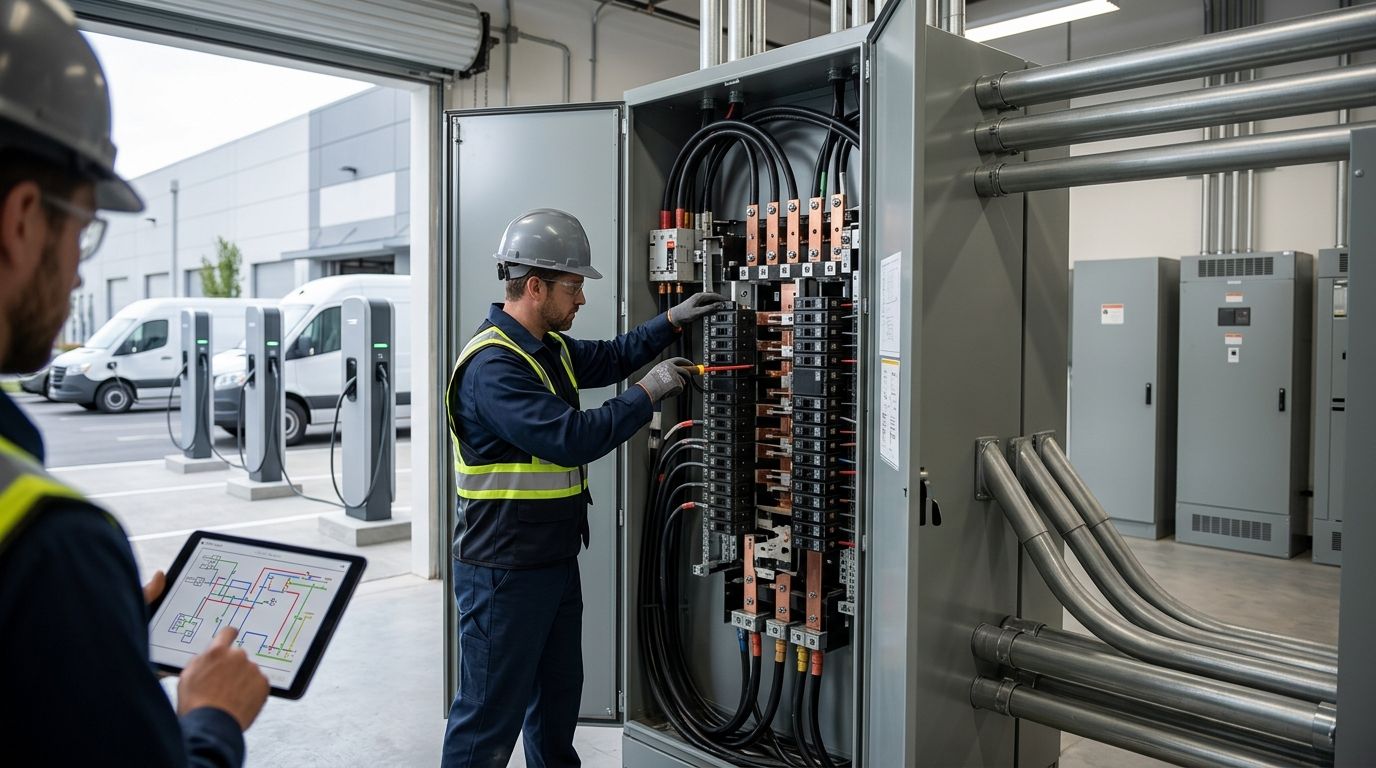
A commercial EV fleet charging electrical panel upgrade adds capacity — usually moving a building from a 200A or 400A service to 400A, 600A, or higher — so multiple Level 2 or DC fast chargers can run at once without tripping breakers or triggering a utility demand penalty. Fleet operators on the Treasure Coast face a different math than a homeowner charging one car overnight: you're sizing for six, twelve, or forty vehicles that all need to plug in on the same schedule.
- An electrical panel upgrade for EV fleet charging usually means moving from 200A/400A service to 400A-800A or higher.
- Level 2 chargers draw 40-80 amps each — a 10-vehicle fleet can require 400+ amps of dedicated charging capacity alone.
- St. Lucie County requires a permitted load calculation before a 2026 fleet charging panel upgrade passes inspection.
- Imperium Electric handles the load study, panel selection, and permit paperwork as one commercial project.
Why panel capacity matters for fleet operators
A single Level 2 charger pulls 40 to 80 amps depending on the unit. Multiply that by a delivery fleet of eight vans or a property management company running twelve service trucks, and you're looking at a load most existing commercial panels were never built to carry. Undersized service is the most common reason fleet EV charging projects stall mid-permit in St. Lucie County and Martin County — the panel schedule submitted doesn't match the load calculation the inspector expects to see.
Fleet charging also runs on a different clock than residential charging. Vehicles come back between shifts, not spread across an overnight window, so the load hits the panel all at once. That's the detail separating a fleet upgrade from a homeowner's single-charger install, and it's what an electrical panel upgrade for EV fleet charging has to be engineered around from day one. Imperium Electric scopes this as commercial work — see commercial EV charging installation for how the panel and charger sides get bid together in 2026.
Audit your current electrical service capacity
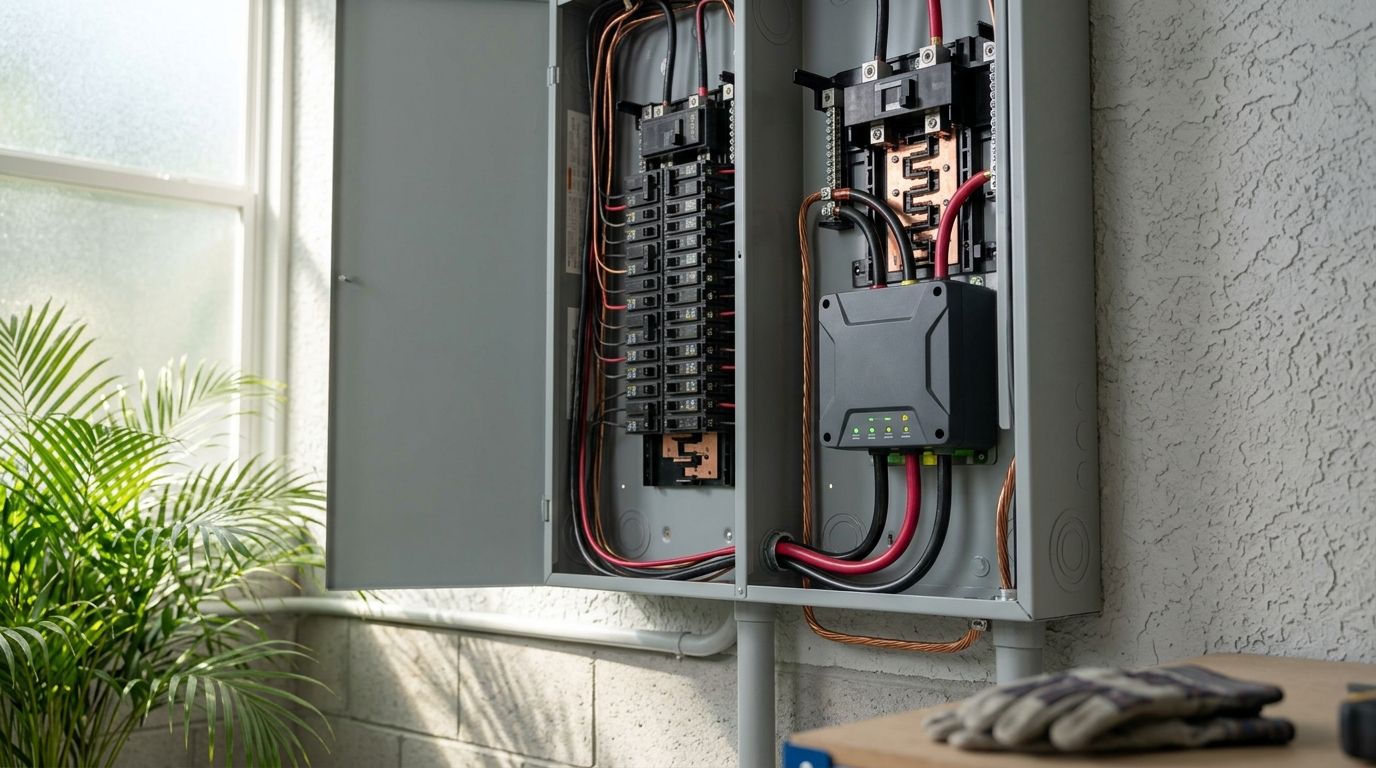
Before anyone talks about chargers, the existing service needs a real look — panel age, main breaker rating, and how much headroom is left after HVAC, lighting, and equipment loads are already accounted for.
- Pull the panel schedule and confirm the main breaker size (100A, 200A, and 400A are common on Treasure Coast commercial buildings)
- Check the panel's manufacture date — anything installed before the early 2000s likely needs replacement regardless of charging plans
- Identify spare breaker slots and bus bar capacity, not just amperage on paper
- Confirm the utility transformer feeding the building can support added draw before assuming the panel is the only bottleneck
- Note whether the building runs 120/208V or 277/480V service, which changes charger compatibility
Calculate total charging load for your fleet
This is where most DIY fleet charging plans fall apart. The load calculation has to account for simultaneous charging, not average charging, because vehicles typically plug in during the same shift-change window.
- Count the chargers needed now and add a realistic buffer for fleet growth over the next 3-5 years
- Multiply charger count by amperage draw per unit to get gross demand
- Apply NEC demand factors for EV supply equipment rather than assuming full simultaneous draw at all times
- Compare gross demand against remaining panel capacity from step one
- Flag any gap requiring a full service upgrade versus a simple sub-panel addition
Choose the right panel and service upgrade path
Once the load number is real, the panel decision gets straightforward: add a dedicated sub-panel, or replace the main service entirely.
- A dedicated sub-panel works when the main service has spare capacity but not enough breaker slots for the charger count
- A full service upgrade (200A to 400A, or 400A to 800A) is required when the load calculation exceeds available headroom
- Three-phase service makes sense for larger fleets running DC fast chargers, not just Level 2 units
- Utility coordination is mandatory for upgrades above 400A — the transformer feeding the property may need utility-side work, which adds lead time
- Panel selection follows the load number, never the charger brochure
Permit the upgrade with your local building department
St. Lucie County and surrounding Treasure Coast municipalities require a permit for any service upgrade, and the load calculation is part of the submission, not an afterthought.
- Submit a load calculation showing existing loads plus fleet charging demand
- Include the panel schedule and single-line diagram for anything above a straightforward breaker swap
- Schedule utility coordination separately from the county permit — they run on different timelines
- Budget for a rough-in inspection and a final inspection, not just one visit
- Review the full process in how to permit an electrical panel upgrade in St. Lucie County before submitting anything in 2026
Select and install charger hardware for fleet use
Hardware selection comes after the electrical work. A fleet buying chargers first and figuring out panel capacity second is the most expensive way to run this project.
- Level 2 chargers cover most fleet needs for vans and light trucks charged during off-shift hours
- DC fast chargers make sense only when vehicles need a full charge in under an hour between routes
- Networked chargers with load management software let a fleet run more vehicles off the same panel capacity by staggering draw automatically
- Weatherproof, outdoor-rated enclosures are non-negotiable for exposed lots on the Treasure Coast given salt air and storm exposure
- Confirm charger amperage matches what the panel and breakers were actually sized for during the load calculation
Plan for load management and future fleet growth
A panel sized for today's fleet with no growth margin turns into another change order in 18 months. Building headroom in now costs less than a second upgrade later.
- Size the panel for 20-30% more capacity than the current fleet count requires
- Install load management hardware that throttles charging speed during peak building demand rather than tripping the main breaker
- Coordinate charger placement with future parking or fleet expansion plans, not just current vehicle count
- Pair the panel with standby power if the fleet can't absorb outage downtime — commercial generator installation for Treasure Coast businesses covers how the two systems tie together
Maintain and inspect the system after installation
A fleet charging panel takes more duty cycles than almost any other commercial electrical system on the property. Skipping maintenance shortens its life fast.
- Schedule an annual inspection of breaker torque, panel connections, and charger firmware
- Watch for nuisance tripping, which usually signals the load calculation underestimated real-world draw
- Keep insurance documentation current — carriers increasingly ask for proof of code-compliant panel work, covered at electrical panel replacement for Florida insurance compliance
- Log charger uptime so a recurring fault gets caught before it becomes a fleet-wide outage
Comparing panel upgrade paths for fleet charging
| Option | Best for | Key limitation |
|---|---|---|
| Dedicated sub-panel | Fleets with spare main service capacity, 2-6 chargers | Doesn't solve a true main-service capacity shortfall |
| Full service upgrade (200A to 400A) | Small to mid-size fleets, 6-15 vehicles | Requires utility coordination and a longer permit timeline |
| Full service upgrade (400A to 800A+) | Larger commercial fleets, multi-shift charging | Longest lead time; often needs three-phase service |
| Panel plus load management system | Any fleet planning to grow charger count | Adds hardware and software scope on top of the panel work |
For most Treasure Coast fleets of six or more vehicles, a 400A service upgrade paired with a networked load management system is the option that avoids a second change order within two years.
“If the chargers arrive before the load calculation is done, the project is already late.”
Get your fleet charging load assessed
Imperium Electric scopes the panel, permit, and charger install as one commercial project.
Common mistakes fleet operators make
- Buying chargers before the load calculation. Hardware sitting unused because the panel can't support it is a common and avoidable delay.
- Ignoring the utility transformer. A panel can be upgraded and still bottleneck at the utility connection if that check gets skipped.
- Sizing for today's fleet only. Adding three vehicles can push a fresh 400A service back into a capacity shortfall inside a year.
- Treating the permit as a formality. St. Lucie County and Martin County both want the load calculation with the application — submitting without one adds weeks in 2026.
- Skipping load management on properties with multiple chargers, then fighting nuisance breaker trips every shift change.
FAQ
What size electrical panel do I need for EV fleet charging?
Most fleets of six or more vehicles need at least a 400A commercial service, and larger fleets running DC fast chargers often require 600A to 800A or three-phase power. The exact size depends on a load calculation covering charger count, amperage per unit, and existing building demand.
Is a panel upgrade always required for fleet EV charging?
No. A property with spare capacity on its existing service can sometimes add a dedicated sub-panel instead of a full upgrade. A load calculation determines which path applies before any charger gets ordered.
How long does a commercial EV charging panel upgrade take in St. Lucie County?
Permitting and utility coordination add weeks on top of the physical installation. Service upgrades above 400A generally take longer because the utility may need to work on the transformer feeding the property.
Do I need a permit for a commercial EV charger installation?
Yes. St. Lucie County and surrounding Treasure Coast municipalities require a permit with a load calculation for any panel upgrade or new charging circuit beyond a minor repair.
What is the difference between Level 2 and DC fast charging for a fleet?
Level 2 chargers draw 40-80 amps and suit vehicles charging overnight or between shifts. DC fast chargers deliver a full charge in under an hour but need far more electrical capacity and usually three-phase service.
Can load management software reduce the panel upgrade I need?
Yes. Networked chargers with load management stagger charging across a fleet to stay inside existing panel capacity, which sometimes avoids a full service upgrade for smaller fleets.
What happens if my fleet outgrows the panel upgrade?
A panel sized without growth margin typically needs a second upgrade within 12 to 24 months as the fleet expands. Building in 20-30% extra capacity during the original project avoids that repeat cost.
Who handles commercial EV fleet charging panel upgrades on the Treasure Coast?
Imperium Electric handles commercial electrical panel upgrades for EV fleet charging in Port St. Lucie, Stuart, and Jensen Beach. The work covers the load study, panel installation, and permit coordination as one scope.
One last thing
The detail fleet operators miss most often isn't the panel — it's the transformer. A property can have a fully permitted 400A panel upgrade in 2026 and still hit a wall because the utility-side transformer feeding the building was never checked against the new demand. Confirm utility capacity before ordering chargers and you avoid the most expensive delay in the whole project: hardware sitting in a parking lot with nowhere to plug in.