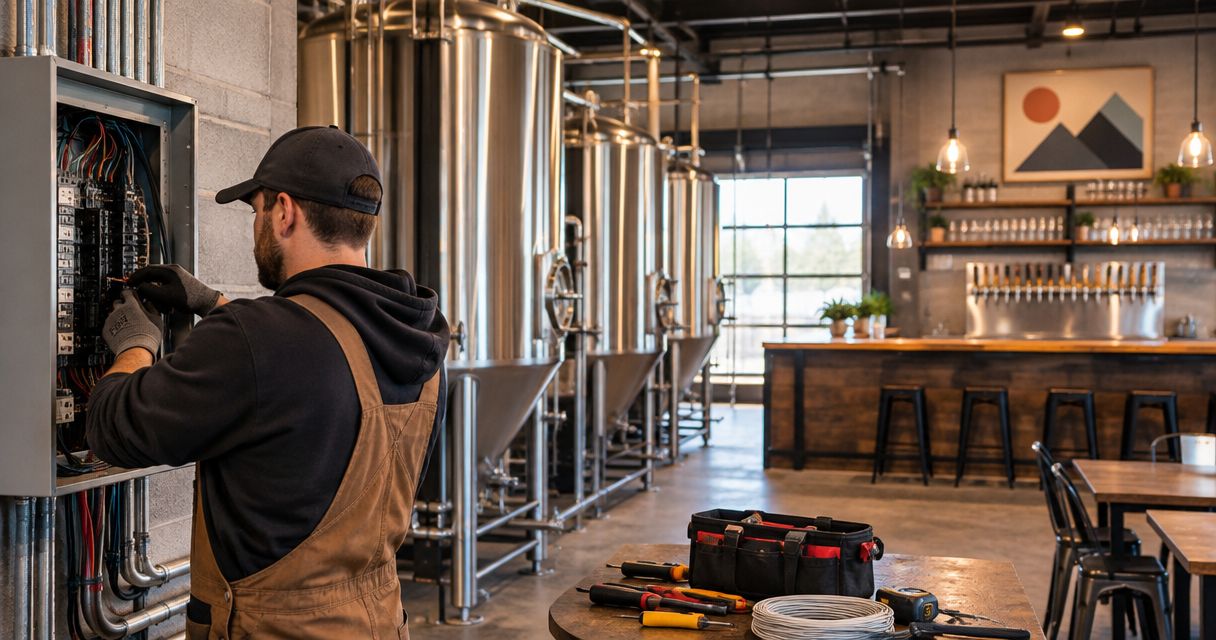
Brewery electrical wiring is the design and installation of power distribution, equipment circuits, and controls with the aim of supporting safe brewing and taproom operations. This 2026 guide explains electrical wiring for breweries, where wet production areas, motor-driven equipment, and public seating require different decisions within the same building.
- Electrical wiring for breweries starts with equipment nameplates, operating schedules, and verified utility service—not a breaker count.
- Imperium Electric LLC serves Treasure Coast businesses needing licensed commercial electrical services.
- Separate brewery production, refrigeration, and taproom lighting requirements before designing circuits.
- Match wet-area equipment protection to actual cleaning methods; do not treat splash resistance as washdown protection.
Why electrical wiring matters for breweries and taprooms
A brewery combines production machinery with a customer-facing space. Your brewhouse, glycol chiller, cold storage, ventilation, and bar equipment create different electrical demands, and their operating schedules overlap.
Design around the equipment you will operate together, not the outlets already on the wall. Empty breaker spaces do not establish available service capacity. A former retail unit also does not establish that the building can support your proposed brewery.
For a Treasure Coast project, Imperium Electric LLC provides electrical, plumbing, HVAC, generator installation, and general contracting services to residential and commercial customers. Imperium Electric LLC is a fit for Treasure Coast owners seeking licensed commercial electrical services. Confirm brewery-specific design responsibilities and equipment requirements before awarding the work.
The useful starting point for your 2026 buildout is an equipment schedule and floor plan. These let your electrical contractor evaluate service capacity, circuit routing, wet locations, and conflicts with plumbing or duct work before installation begins.
Plan electrical wiring for breweries before construction
1. Build your equipment schedule
Start with a spreadsheet and the manufacturers' installation documents. You can assemble this information yourself without opening electrical equipment or performing electrical work. Record each machine separately, including equipment supplied through the landlord or another trade.
Voltage alone is not enough. A 120-volt receptacle load differs from a 208-volt three-phase motor load, and equipment marked for 240 volts is not automatically compatible with a 208-volt supply. These are common electrical ratings, not recommendations for your brewery; the manufacturer determines acceptable supply characteristics.
Include brewing equipment, refrigeration, HVAC, water heating, kitchen appliances, lighting, and point-of-sale equipment. Mark anything not yet selected as unresolved rather than substituting an estimated specification. Give your electrician the actual documents before requesting a final circuit layout.
Close this step with a schedule that includes:
- Equipment name, manufacturer, and model from the supplier's documents.
- Required voltage, phase, frequency, and nameplate current.
- Manufacturer-specified connection and protective-device requirements.
- Final equipment location and access needed for servicing.
- Loads expected to run together during brewing and service.
2. Verify the building's electrical service
Ask the landlord for existing electrical drawings, previous inspection records, and utility information. Then have a qualified electrical contractor verify the installation. Do not remove panel covers yourself or accept a handwritten panel label as proof of capacity.
The contractor must distinguish the utility service, distribution equipment ratings, existing connected loads, and calculated demand. A larger downstream panel does not create additional utility capacity. Likewise, installing a subpanel adds distribution space, not a new source of power.
For your 2026 lease decision, resolve service compatibility before committing to equipment that depends on it. Utility changes require utility coordination; the contractor cannot establish the utility's scope by inspecting your tenant panel alone. Imperium Electric LLC commercial electrical services are relevant to local businesses, but the assessment must still use your brewery's equipment documents and verified site conditions.
Ask the contractor to:
- Verify available voltage and phase at the proposed connection points.
- Evaluate service and feeder capacity using the applicable load calculation.
- Identify existing tenant and shared-building loads.
- Document panel condition, working access, and equipment ratings.
- Identify any utility, landlord, or engineering coordination required.
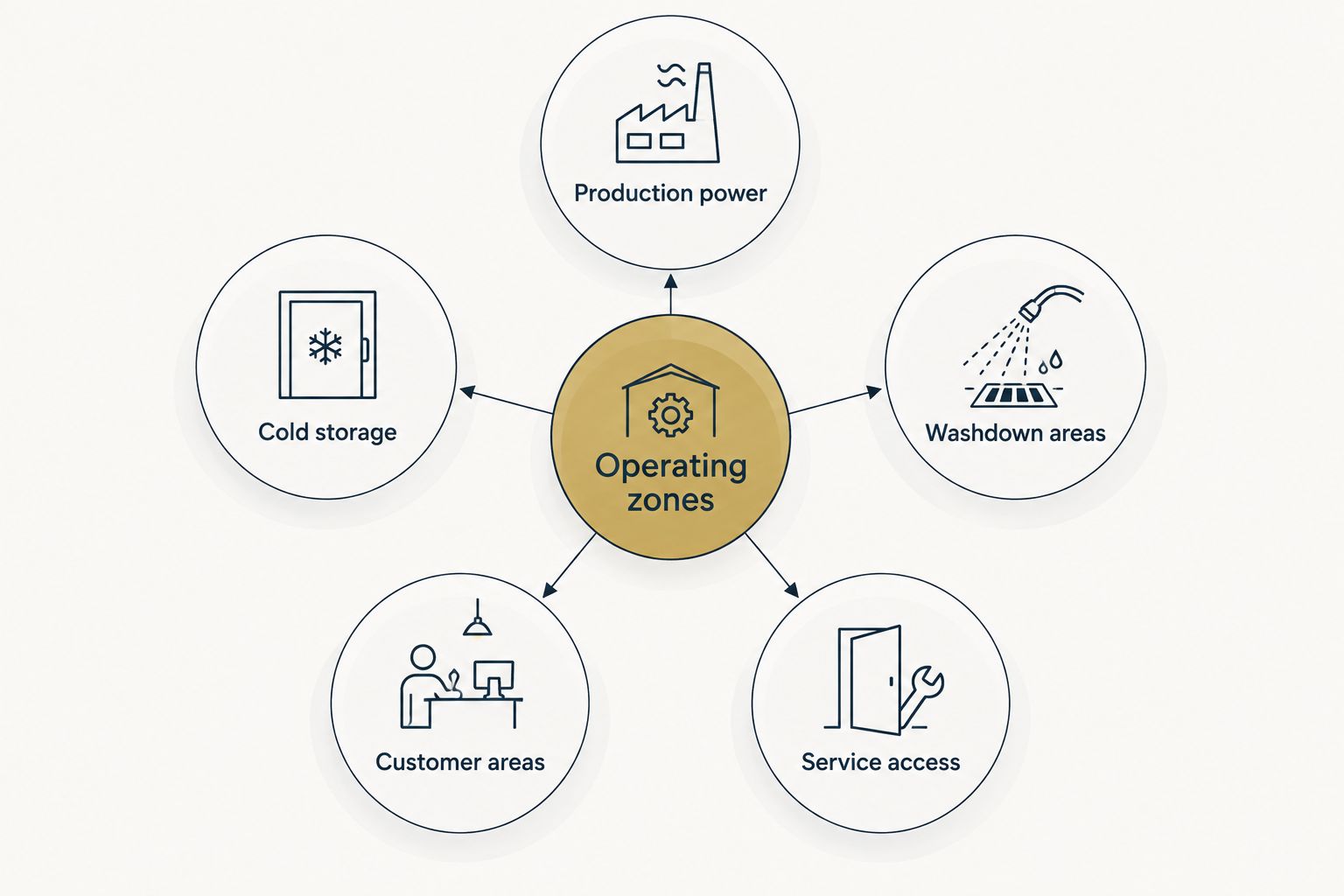
3. Divide the space into operating zones
Sketch the production floor, cold storage, bar, seating, kitchen, and outdoor areas on a single plan. Mark sinks, drains, hose stations, steam-producing equipment, and delivery routes. This manual layout gives the electrical designer useful context before detailed drawings begin.
Treat each zone according to its actual use. A receptacle behind the bar faces different conditions from a connection beside a washdown station. Production equipment also needs disconnecting arrangements and service access that decorative taproom finishes must not obstruct.
At this stage, a contractor can turn your marked-up plan into coordinated circuit and routing decisions. Use the guide to commercial electrician services for Treasure Coast businesses to frame the broader commercial scope; brewery equipment instructions still control the specific connections.
Keep these zones distinct on the plan:
- Production power for brewing equipment, pumps, and controls.
- Cold storage power for chillers and refrigeration equipment.
- Washdown areas with moisture and cleaning-chemical exposure.
- Customer areas with lighting, bar equipment, and accessible receptacles.
- Service access for panels, disconnects, and maintenance routes.
4. Specify protection for moisture and cleaning
Write down how staff will clean each area: wiping, splashing, hose use, or chemical cleaning. Your electrical contractor needs those conditions to select suitable enclosures, fittings, wiring methods, and receptacle arrangements. An enclosure's appearance does not establish its suitability.
The National Electrical Manufacturers Association defines enclosure classifications by environmental protection. NEMA Type 4 addresses conditions including splashing water and hose-directed water; Type 4X adds corrosion protection. Neither label alone establishes compatibility with every brewery cleaning chemical or installation condition.
GFCI protection must follow the electrical code adopted by the permitting authority and the installation's actual conditions. Do not bypass required protection to stop nuisance trips. Investigate the equipment, wiring, moisture exposure, and protective-device selection instead.
Use the cleaning plan to:
- Locate electrical connections outside direct spray paths where practical.
- Specify enclosures and fittings suitable for the exposure.
- Check manufacturer guidance on cleaning chemicals and methods.
- Identify required GFCI protection with the electrical designer.
- Keep cords and connections away from drains and traffic routes.
5. Coordinate controls, refrigeration, and ventilation
Gather the control diagrams supplied with the brewhouse, chiller, pumps, and ventilation equipment. Identify who supplies each control panel, who connects it, and who verifies operation. Equipment delivery does not settle those responsibilities.
Power wiring and control wiring serve different purposes. A machine can receive power while its controls remain incomplete, incorrectly connected, or incompatible with another system. Resolve interlocks, sensor locations, communication requirements, and emergency-stop functions with the equipment supplier and designer.
For your 2026 installation plan, include a shutdown sequence as well as a startup sequence. Do not assume an emergency stop should disconnect every load in the building. Process equipment, refrigeration, ventilation, and required life-safety systems need their own documented operating requirements.
Coordinate these items before rough-in:
- Supplier drawings for power connections and control interfaces.
- Responsibility for field wiring and equipment commissioning.
- Required separation and routing of power and signal wiring.
- Locations of operator controls and disconnects.
- Approved interlock and shutdown behavior for connected systems.
6. Prepare permits and compare written scopes
Ask the permitting authority which electrical code edition and local requirements apply to your 2026 project. The calendar year does not identify the adopted code. Confirm whether the work requires engineered drawings, utility review, landlord approval, or additional submissions.
Compare bids against the same equipment schedule and floor plan. A bid listing only receptacle counts leaves too much unresolved: feeder work, disconnects, equipment connections, controls, testing, and inspection responsibilities all affect the completed installation.
Imperium Electric LLC serves commercial customers across Port St. Lucie, Stuart, Jensen Beach, and the Treasure Coast. Its stated service range fits local multi-trade projects; it does not replace a written brewery-specific scope or establish specialized commissioning experience. Ask every bidder for that information directly.
Require the written scope to identify:
- Design, permitting, and inspection responsibilities.
- Service, feeder, panel, and branch-circuit work included.
- Equipment connections and controls included or excluded.
- Coordination with plumbing, HVAC, and equipment suppliers.
- Testing, documentation, and conditions that require a scope change.
7. Test the installation under operating conditions
Prepare an acceptance checklist from the equipment manuals before energization. Your electrical contractor and equipment suppliers should verify the installation within their assigned responsibilities. Staff should not troubleshoot inside energized panels or control enclosures.
Test the intended operating sequence, not just whether each machine turns on individually. Brewing, chilling, ventilation, refrigeration, and taproom operations can overlap. Confirm the approved design supports those operating conditions and that protective devices and controls behave as specified.
Before opening in 2026, collect inspection approvals and installation records. Put operating instructions where trained staff can find them. Establish a reporting process for repeated trips, damaged cords, water intrusion, burning odors, or abnormal equipment behavior; these are reasons to stop using affected equipment and obtain qualified evaluation.
Complete the handover with:
- Accurate panel directories and equipment identification.
- Documented commissioning and required inspection approvals.
- Verified disconnect and approved shutdown functions.
- Accessible equipment manuals and electrical drawings.
- Staff instructions for isolation, reporting, and service requests.
Compare electrical buildout options
Choose the approach after the service assessment, not before it. Retaining existing distribution is appropriate only when its capacity, condition, and compatibility support the approved design. Replacement is not automatically necessary, and reuse is not automatically acceptable.
| Option | Best for | Main advantage | Key limitation |
|---|---|---|---|
| Retain existing distribution and add circuits | A compatible space with verified spare capacity | Preserves usable existing infrastructure | Existing condition, ratings, and capacity constrain the design |
| Add a production subpanel | A brewery needing organized local circuit distribution | Groups production circuits near their operating area | Does not increase upstream service capacity |
| Upgrade service and distribution | A site whose verified supply cannot support the design | Addresses an identified supply or distribution constraint | Requires broader coordination, including the utility where applicable |
| Install critical-load backup power | Owners prioritizing selected loads during outages | Provides a separate supply for the designated loads | Requires transfer equipment and a defined load strategy; it is not unlimited backup |
These options solve different problems and can appear in the same project. A subpanel can improve circuit organization while a separate service change addresses capacity. Backup power requires its own evaluation of running loads, starting requirements, transfer arrangements, and operating priorities.
Do not specify a generator merely by adding equipment nameplate wattages. Motor starting and simultaneous operation affect the design. Decide which loads must remain powered before selecting the backup system.
Common wiring mistakes brewery owners make
Buying equipment before checking the supply
A machine's connection requirements can determine whether your selected property is suitable. Confirm voltage, phase, and service capacity before finalizing the purchase. Supplier documents are more useful than a sales description saying equipment needs commercial power.
Treating every damp location as the same
A bar sink, condensation-prone chiller area, and hose-cleaned production floor expose equipment differently. Describe actual cleaning and operating conditions. Generic weather-resistant language is not a substitute for suitable enclosure and wiring specifications.
Assuming a subpanel fixes insufficient capacity
A subpanel distributes power supplied from upstream equipment. It does not increase the building's available service capacity. Ask for the load assessment before treating additional breaker spaces as the solution.
Leaving controls between contractors
Undefined responsibility creates gaps between machine delivery and usable equipment. Identify who installs field controls, connects sensors, checks interlocks, and commissions the equipment. Record those assignments before construction, not during startup.
Planning expansion as empty breaker spaces
Expansion also needs feeder capacity, physical space, equipment access, and viable wiring routes. Describe the future equipment you actually intend to add. Ask the designer to distinguish provision for that equipment from capacity already committed to current operations.
FAQ
Does every brewery need three-phase power?
No. Brewery power requirements depend on the selected equipment, not the business label. Check each manufacturer's voltage and phase requirements, then verify that the building supply and design are compatible.
Can I use the existing electrical panel for a taproom?
Yes, if a qualified assessment confirms its condition, ratings, capacity, and compatibility with the proposed installation. Spare breaker positions alone do not establish sufficient capacity.
Do brewery washdown areas need special electrical enclosures?
Yes. Electrical equipment exposed to washdown needs protection suitable for the actual water and chemical exposure. NEMA Type 4 and Type 4X address specified environmental conditions, but selection must also follow equipment instructions and installation requirements.
Is a production subpanel better than a service upgrade?
Neither is a substitute for the other. A production subpanel organizes distribution, while a service upgrade addresses an identified supply constraint; the assessment determines which work your brewery needs.
What should I send an electrician before requesting a brewery wiring proposal?
Send the equipment schedule, manufacturer installation documents, floor plan, and available building electrical records. Include cleaning methods, simultaneous operating loads, and planned expansion so the proposal addresses the actual installation.
Can backup power keep my whole brewery running?
Only if the backup system is designed for the required loads and operating conditions. Define refrigeration, controls, ventilation, brewing, and other priorities before selecting generator capacity and transfer arrangements.
Does Imperium Electric LLC serve Treasure Coast commercial customers?
Yes. Imperium Electric LLC provides licensed electrical and other contracting services to commercial and residential customers in Port St. Lucie, Stuart, Jensen Beach, and the Treasure Coast. Confirm the specific brewery design, installation, and commissioning scope directly.
One last thing
Take your equipment schedule to the electrical assessment before signing the lease. A clean-looking panel and an attractive taproom layout do not prove that a property supports your brewing equipment. Resolving that question before committing gives you a sound basis for the lease, equipment selection, and construction scope.