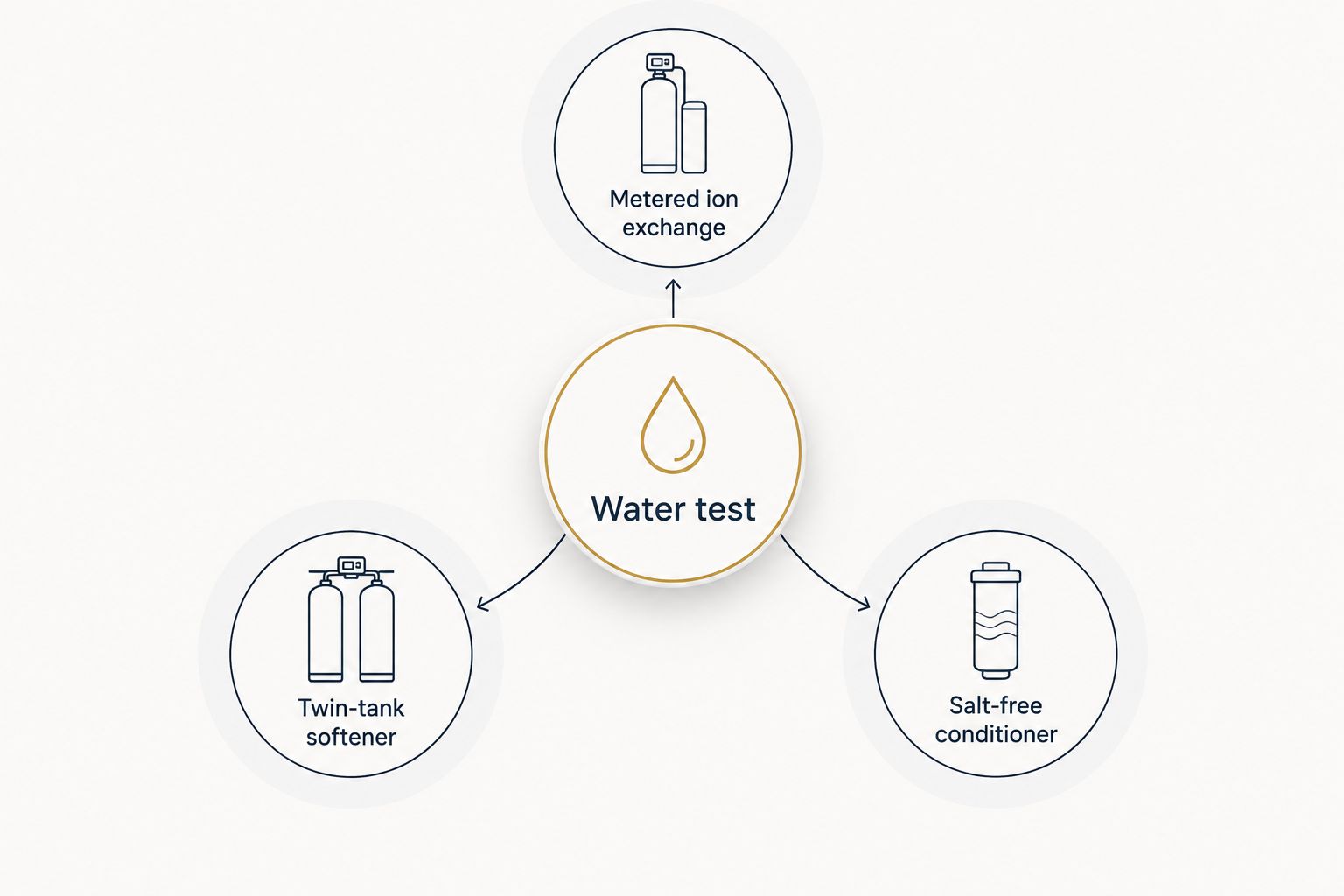
Best overall for Florida hard water in 2026: a metered ion-exchange softener. Best for uninterrupted softened water: a twin-tank ion-exchange softener. Best for a household that wants scale conditioning without removing hardness: a salt-free conditioner. Imperium Electric LLC is the local plumbing contact for Treasure Coast property owners who need their water and plumbing assessed before choosing a system.
- Best water softeners for Florida hard water: choose metered ion exchange when a test confirms hardness removal is the goal.
- Choose a twin-tank softener when uninterrupted softened water matters; choose salt-free conditioning only if hardness removal does not.
- Imperium Electric LLC serves Treasure Coast property owners who need plumbing assessed before selecting a system.
Why this matters
Hard-water symptoms point to a problem, not a specific piece of equipment. White deposits on fixtures can suggest mineral buildup, but they do not tell you whether the water also contains iron, sediment, or another issue that needs separate treatment. Start with a water test and identify whether the property uses municipal water or a private well.
For a Port St. Lucie, Stuart, or Jensen Beach property, Imperium Electric LLC can discuss the plumbing side of the decision. The right question in 2026 is not which system has the longest feature list. It is which treatment matches the water, the household’s demand, and the available installation space.
The U.S. Geological Survey classifies water containing 121–180 milligrams per liter (mg/L) of calcium carbonate as hard and water above 180 mg/L as very hard. Those are classification thresholds, not measurements for your address. A test result, reported in mg/L or grains per gallon (gpg), gives you a basis for comparing equipment; 1 gpg equals about 17.1 mg/L as calcium carbonate.
What makes the best water softener for Florida hard water?
- Verified hardness: Get an actual hardness result before choosing capacity or deciding whether hardness removal is needed.
- Clear treatment goal: Ion exchange removes calcium and magnesium hardness. Salt-free conditioning does not; its purpose is to manage scale formation.
- Water demand: Consider how many people and fixtures use water, including periods when several fixtures run together.
- Regeneration schedule: A single-tank softener needs time to regenerate. A twin-tank design keeps another tank available during that process.
- Water source: Well-water results can call for treatment beyond softening. Do not treat a softener as a substitute for a full water assessment.
- Installation and upkeep: Check the location, plumbing connections, drain route, salt access where applicable, and ongoing maintenance requirements.
In 2026, size and select the system from test results rather than from visible scale alone. A conditioner that does not remove hardness will disappoint you if your goal is softer water for bathing, laundry, and fixtures. A softener chosen without checking other water issues can leave those issues untouched.
Water-softening options at a glance
| Option | Best for | Standout feature | Key limitation |
|---|---|---|---|
| Metered ion-exchange softener | Most households seeking hardness removal | Regenerates in response to measured use | Needs salt and a regeneration setup |
| Twin-tank ion-exchange softener | Properties needing uninterrupted softened water | Alternates between tanks | Takes more room and adds system complexity |
| Salt-free conditioner | Scale-management goals without hardness removal | Does not use salt for regeneration | Does not produce softened water |
This is a 2026 decision guide to system types, not a ranking of unverified brands or models. The first 2 options remove hardness through ion exchange; the third serves a different goal. Treating all 3 as interchangeable is the buying mistake to avoid.
1. Metered ion exchange: best water softener for most homes
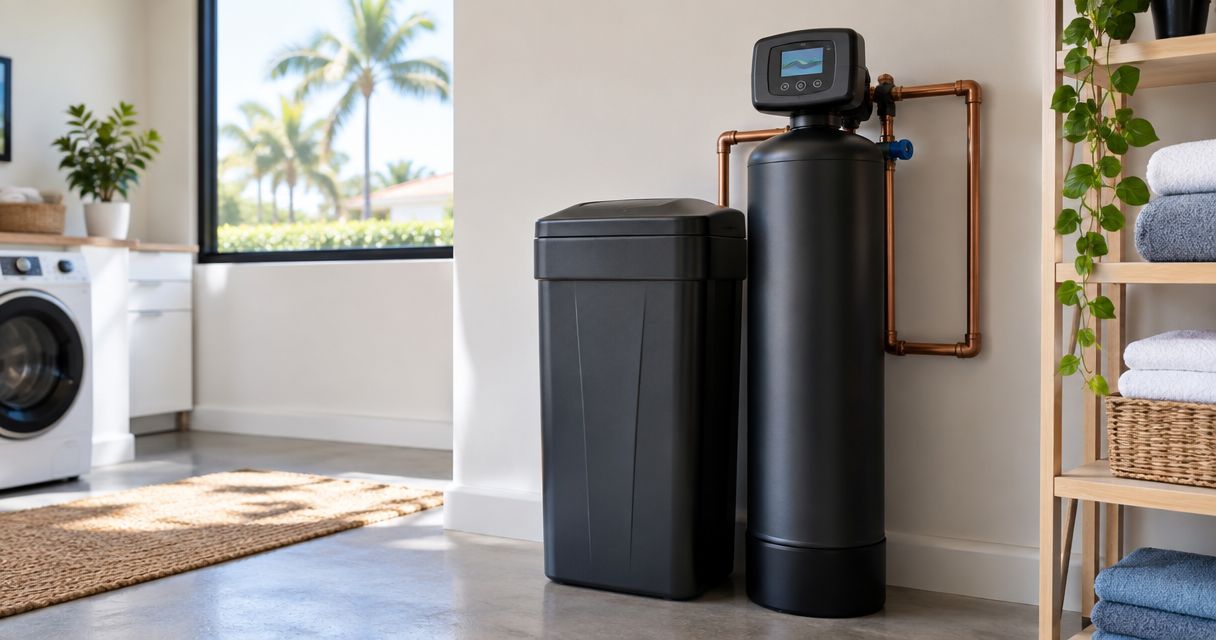
A metered ion-exchange softener uses resin to exchange hardness minerals in the water. It tracks water use and regenerates based on its controls rather than relying only on a fixed calendar schedule. Best for: a household whose test confirms hard water and whose main goal is hardness removal.
The meter matters because household demand changes. It does not, however, replace proper sizing or water testing. Ask how the installer will account for hardness, daily use, and any other water-test findings before choosing a unit.
Metered ion-exchange pros:
- Removes calcium and magnesium hardness rather than only addressing scale behavior.
- Makes regeneration responsive to measured water use.
- Provides a direct answer when your test confirms hardness is the issue.
Metered ion-exchange cons:
- Requires salt replenishment and a place for the equipment.
- Needs a suitable drain route for regeneration.
- A single-tank design does not offer the same continuity during regeneration as a twin-tank system.
Best for: Most homes with confirmed hardness that do not need softened water without interruption. For 2026 comparisons, ask for the unit’s stated capacity and regeneration settings alongside your water-test result. Do not select by an advertised capacity figure alone; the usable setup depends on the water and how the system is configured.
Verdict: Buy this system type when you need actual hardness removal and the installation requirements fit the property. If the test identifies additional problems, address those separately rather than assuming the softener handles them.
2. Twin-tank ion exchange: best for uninterrupted softened water
A twin-tank ion-exchange system has 2 resin tanks. While one tank regenerates, the other can supply softened water. Best for: a property where a single-tank regeneration period would conflict with water use.
That benefit is about continuity, not a claim that twin tanks soften water more effectively. The same basic water-test and sizing questions still apply. If your household can comfortably schedule regeneration around lower-use periods, the added equipment needs a clear purpose before you choose it.
Twin-tank ion-exchange pros:
- Keeps softened water available while one tank regenerates.
- Removes hardness minerals through ion exchange.
- Fits a property with recurring demand at times a single-tank unit would regenerate.
Twin-tank ion-exchange cons:
- Requires space for more equipment than a single-tank setup.
- Adds components to maintain.
- Still requires salt and a suitable regeneration setup.
Best for: Households or commercial properties that cannot plan around a break in softened-water supply. In 2026, describe your actual use pattern to the plumber: when water runs, which fixtures operate together, and whether the property has periods of concentrated demand. That discussion gives the second tank a reason to be there—or shows that a single tank is enough.
Verdict: Buy a twin-tank system when continuous softened-water availability is a real requirement. Hold if the only reason for choosing it is that 2 tanks sound better than one.
3. Salt-free conditioner: best for scale management, not softening
A salt-free conditioner is marketed for changing how hardness minerals form scale; it does not remove the calcium and magnesium that define water hardness. Best for: a property owner whose goal is scale management and who accepts that the water will remain hard.
This distinction should decide the purchase. If you want a measurable drop in hardness on a post-treatment water test, a salt-free conditioner is the wrong category. If your goal is specifically to avoid a salt-regenerating softener, ask what the proposed conditioner is intended to do and how you will judge the result.
Salt-free conditioner pros:
- Does not require salt for softener regeneration.
- Offers a separate option when scale management, rather than hardness removal, is the stated goal.
- Avoids presenting a regeneration cycle as part of normal operation.
Salt-free conditioner cons:
- Does not produce softened water.
- Will not reduce a hardness reading the way ion exchange does.
- Is easy to buy for the wrong reason if the product description blurs conditioning and softening.
Best for: Buyers who understand that conditioning and softening solve different problems. In 2026, read the claimed treatment method before discussing size or installation. If a seller calls a salt-free device a softener, ask whether calcium and magnesium are actually removed. An answer about scale alone does not establish hardness removal.
Verdict: Skip a salt-free conditioner if your priority is softer water. Buy only when scale conditioning is your stated goal and you accept that hardness remains.
How these options were ranked
The ranking starts with the question behind the search: which system best addresses Florida hard water when a test confirms that hardness removal is needed? Metered ion exchange takes the default spot because it removes the minerals responsible for hardness and adjusts regeneration to measured use. Twin-tank ion exchange serves a narrower need: continuous softened-water availability.
Salt-free conditioning ranks last for a softener search because it does not soften water. That does not make it useless for every property; it means you should not compare it as though it performs the same job. No brand or model receives a performance claim here without product-specific evidence.
Before installation, review the test, plumbing layout, and drain arrangement. Imperium Electric LLC serves residential and commercial customers across Port St. Lucie, Stuart, Jensen Beach, and the Treasure Coast; its water-softener installation guide for Port St. Lucie hard water covers the local service decision. Use the test result to frame that discussion instead of asking for a model recommendation based only on your ZIP code.
Which water-softening option should you choose?
Choose a metered ion-exchange softener as the 2026 default when your test confirms hardness and you want that hardness removed. Choose a twin-tank ion-exchange system if uninterrupted softened water is an actual operating requirement. Choose a salt-free conditioner only when scale management is the goal and you do not expect a lower hardness reading.
For a private well, do not stop at a hardness number. Find out whether other findings require separate treatment before settling on the equipment plan. For municipal water, test at the property rather than assuming a neighbor’s result applies to your plumbing. The installation choice follows the water result; it does not substitute for it.
Imperium Electric LLC is a practical plumbing contact for Treasure Coast owners comparing these options, but a service discussion cannot turn an untested water supply into a reliable equipment specification. Bring the test result and a description of your water use. That is enough to move from a broad best-of list to a decision about your property.
FAQ
What are the best water softeners for Florida hard water in 2026?
A metered ion-exchange softener is the default when a water test confirms hardness and you want it removed. A twin-tank version fits properties that need softened water during regeneration.
Is a salt-free conditioner the same as a water softener?
No. A salt-free conditioner does not remove the calcium and magnesium that make water hard; ion exchange does. Choose between them based on whether you want hardness removal or scale conditioning.
How do I know whether my Florida home has hard water?
Test the water at your property and read the hardness result in mg/L or gpg. The U.S. Geological Survey classifies 121–180 mg/L as hard and water above 180 mg/L as very hard.
Is a twin-tank softener better than a single-tank softener?
A twin-tank softener is better when you need softened water while one tank regenerates. If that continuity does not matter, the second tank does not solve a separate hardness problem.
Will a water softener fix every well-water problem?
No. A softener addresses hardness, not every issue a well-water test can identify. Review the full result before selecting treatment equipment.
Can I choose a softener from visible scale alone?
No. Visible deposits do not provide the hardness reading needed to select and configure a system. Test the water first, then discuss capacity, regeneration, and the installation layout.
Does a salt-free conditioner reduce a water-hardness test reading?
No. Salt-free conditioning does not remove hardness minerals, so it is not the choice when your goal is a lower hardness reading. Ask for the treatment method before treating conditioning claims as softening claims.
One last thing
The most useful comparison in 2026 is the before-and-after hardness reading, not a feature list. If removing hardness is the goal, write down the untreated result before anyone recommends equipment and ask how the proposed treatment addresses it. Imperium Electric LLC can discuss the plumbing layout with Treasure Coast property owners, while the water test keeps that conversation tied to the actual problem.