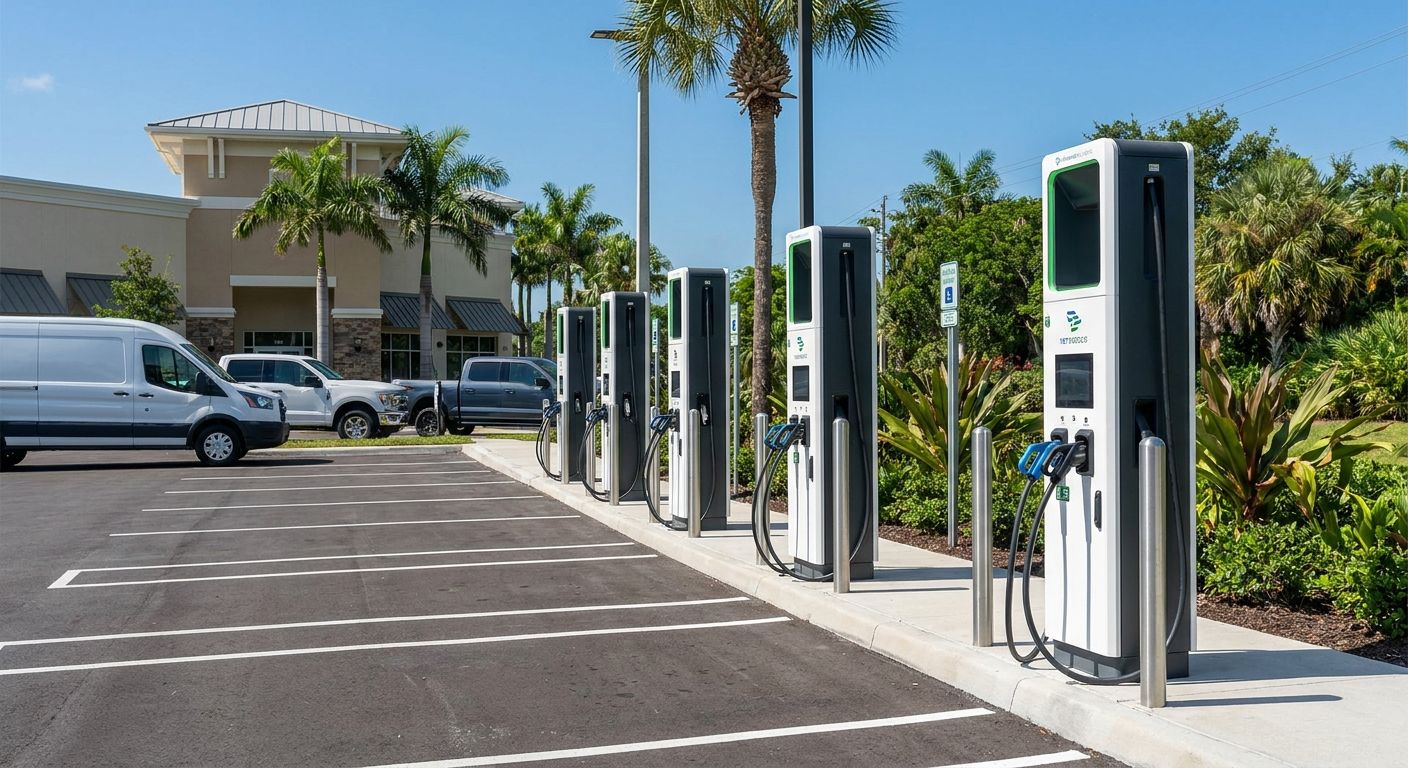
Commercial EV charging installation on the Treasure Coast means adding Level 2 or DC fast charging stations to a business property — office lots, apartment complexes, retail centers, or fleet yards — so employees, tenants, and customers can charge on-site. Businesses in Port St. Lucie, Stuart, and Jensen Beach face a different set of problems than homeowners installing a single garage charger: higher simultaneous load, ADA parking rules, and county permitting that a residential installer never has to deal with.
- Level 2 chargers cover most Treasure Coast businesses; DC fast charging needs a three-phase service upgrade.
- A licensed commercial electrician runs the load calculation before anyone talks about equipment brands.
- Multi-tenant properties need networked chargers with data wiring, not standalone units, or billing per session is impossible.
- County permitting through St. Lucie or Martin County adds weeks — start that process before the equipment order.
Why commercial EV charging matters for Treasure Coast businesses
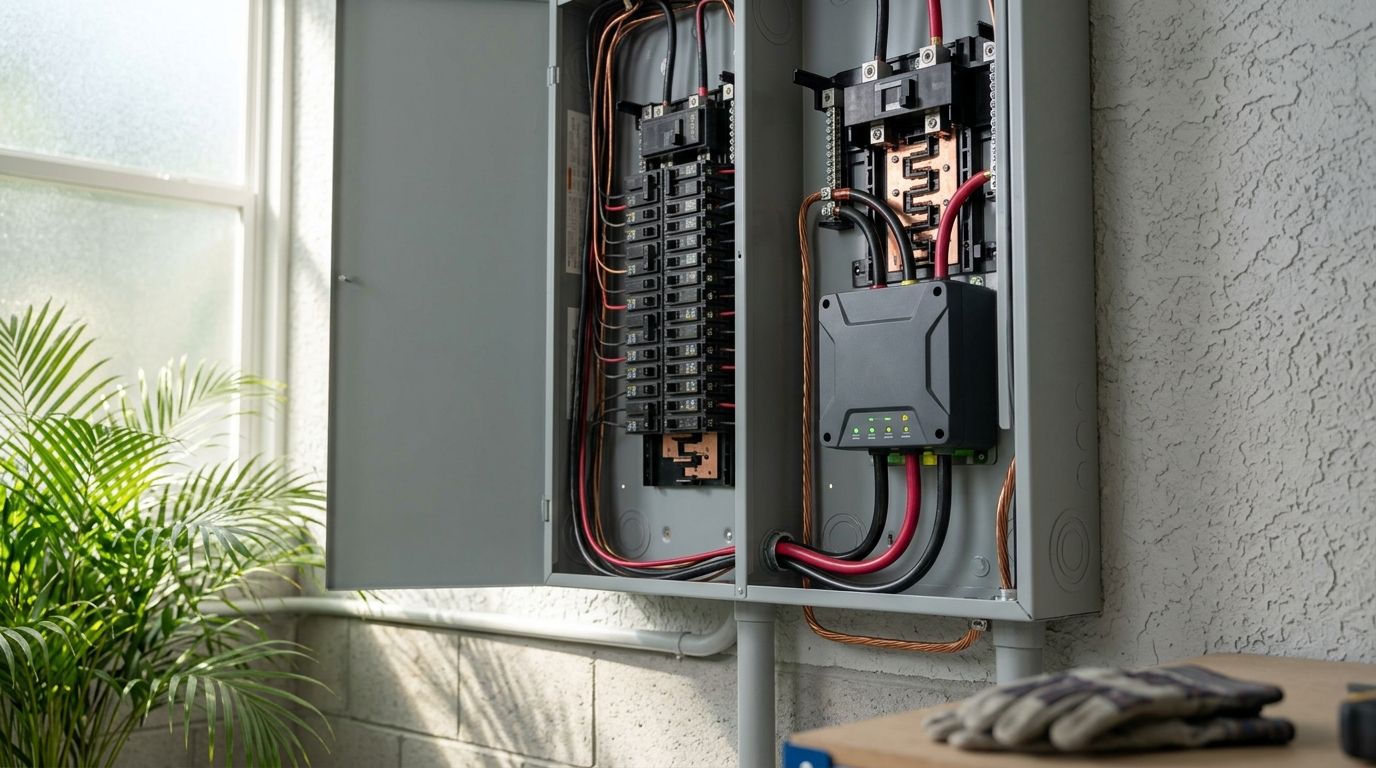
A business installing EV chargers in 2026 isn't just adding an amenity — it's adding a new electrical load to a panel that was likely sized decades before anyone planned for it. That's the constraint that trips up most commercial property owners on the Treasure Coast: the parking lot is ready, the tenant demand is real, but the service behind the wall can't carry a bank of 240V circuits without an upgrade.
County permitting adds a second layer homeowners don't hit. St. Lucie and Martin County both require an electrical permit and inspection for commercial EV charging equipment under NEC Article 625, and that review cycle runs on the county's schedule, not the property owner's. Businesses that order chargers before pulling a permit end up with equipment sitting in a warehouse for weeks.
“If your panel can't support a 50-amp continuous load with room to spare, you need a service upgrade before you need a charger.”
Assess your existing electrical service capacity
Start here every time, before a single charger gets ordered. A commercial electrician runs this step first because everything downstream depends on it.
- Pull the current panel's amperage rating and confirm real spare capacity, not nameplate capacity
- Run a load calculation that includes existing HVAC, lighting, and equipment draw
- Confirm whether the service is single-phase or three-phase
- Check the main disconnect's location relative to the planned charger site
- Flag early whether a full service upgrade or a second meter is the better fix
Choose the right charger level for the property
Matching charger type to how vehicles actually use the lot matters more than picking the fastest option available.
- Level 2 (240V) chargers fit daytime dwell-time locations: offices, apartment complexes, retail centers where cars sit two-plus hours
- DC fast charging fits high-turnover sites: fleet depots, former gas stations converted to charging hubs
- Size charger count to parking spot turnover, not to total spots in the lot
- Confirm ADA-compliant accessible charging space requirements under Florida Building Code before finalizing layout
Plan for panel and infrastructure upgrades
This is where a licensed contractor becomes the faster path instead of a DIY guess. Reviewing the panel and infrastructure side of commercial buildouts before trenching starts saves rework later.
- Get conduit runs sized before any trenching begins, not after
- Add a dedicated EV subpanel so a second bank of chargers later doesn't mean another full panel swap
- Route conduit underground for exterior lots instead of surface-mounted whenever the site allows it
- Coordinate timing with any concurrent plumbing or general contracting work on mixed-use retrofits
Handle permitting and code compliance
Skipping this step is the single most common reason commercial EV projects stall on the Treasure Coast in 2026.
- Pull the electrical permit through St. Lucie County or Martin County before any work starts
- Confirm the install meets NEC Article 625 requirements for electric vehicle charging equipment
- Build inspection windows into the schedule around county turnaround times, not equipment delivery dates
- Verify accessible parking striping and signage match current state ADA requirements
Select charger placement and site layout
- Place chargers near existing electrical infrastructure to cut trenching distance and cost
- Avoid low-lying pavement sections prone to standing water during Treasure Coast storm season
- Group chargers in banks of two to four units to simplify future conduit expansion
- Keep turning radius and delivery-truck clearance in mind for retail and fleet lots
Wire for networked, multi-unit charging
Properties with more than one tenant or a shared parking structure need more than power at the outlet. Low-voltage and data wiring run alongside the power conduit is what makes per-session billing and remote diagnostics possible.
- Run low-voltage data lines with the power conduit for networked billing and access control
- Choose network-capable stations for any property billing tenants or tracking fleet usage
- Separate circuits per charger so one unit failing doesn't take down the whole bank
- Plan for Wi-Fi or cellular backhaul at the charger location before the concrete gets poured
Schedule installation with a licensed commercial electrician
- Confirm the contractor pulls permits and schedules inspections as part of the job, not as an add-on
- Ask for a written load calculation, not a verbal estimate over the phone
- Get a timeline that separates trenching, rough-in, and final connection into distinct milestones
- Verify the license covers commercial work in the specific county the property sits in
Maintain and plan for future capacity
- Inspect connectors and cords quarterly — Florida heat and salt air degrade cable jackets faster than inland climates
- Size conduit for double the chargers installed now, even if the second bank is years away
- Re-run the load calculation any time HVAC or other major equipment gets added to the property
- Keep a maintenance log; it matters for both warranty claims and insurance documentation
Comparing commercial EV charging options
| Option | Best For | Key Limitation |
|---|---|---|
| Level 2 (240V) charger | Offices, apartments, retail with 2+ hour dwell time | Charges far slower than DC fast — wrong fit for high-turnover lots |
| DC fast charger | Fleet depots, former gas stations, high-turnover retail | Needs three-phase service and significantly more panel capacity |
| Networked charging station | Multi-tenant properties billing per session | Requires low-voltage data wiring and ongoing network management |
| Single standalone unit | Small businesses with one or two spots | No usage tracking or remote diagnostics if the unit fails |
Verdict: Level 2 networked chargers are the right default for most Treasure Coast offices and multi-tenant lots in 2026 — DC fast charging only pencils out for high-turnover fleet or retail sites with the electrical service to support it.
Get a commercial EV charging quote
Load calculations, panel upgrades, and permitting handled by Imperium Electric LLC.
Common mistakes Treasure Coast businesses make
- Installing chargers before running a load calculation, then discovering the panel can't carry the draw and paying for a second upgrade months later
- Skipping the county permit, then getting flagged during a future inspection or insurance audit
- Choosing standalone chargers for a multi-tenant property, losing the ability to bill per session or track usage
- Placing chargers in low pavement sections that pool water during Treasure Coast summer storms
- Underestimating trenching distance when conduit has to cross existing parking lot pavement instead of running along a perimeter
FAQ
What's the difference between Level 2 and DC fast commercial EV charging?
Level 2 chargers run on 240V and suit locations where cars sit two or more hours, like offices and apartments. DC fast chargers deliver power far quicker but need three-phase service and much more panel capacity, making them better suited to fleet depots and high-turnover retail sites.
How much power does a commercial EV charger need?
It depends on the charger type and how many units run at once — a load calculation from a licensed electrician is the only reliable way to know. Most properties need a dedicated subpanel sized for the current bank of chargers plus room for future expansion.
Do I need a permit to install EV chargers at my Treasure Coast business?
Yes. St. Lucie and Martin County both require an electrical permit and inspection for commercial EV charging equipment under NEC Article 625. Skipping the permit risks issues during insurance audits or future property inspections.
Can Imperium Electric LLC handle multi-unit commercial EV charging installs?
Imperium Electric LLC is a licensed and insured electrical contractor serving Port St. Lucie, Stuart, and Jensen Beach, handling load calculations, panel upgrades, and permitting for commercial EV charging projects. Multi-tenant properties needing networked, billable charging stations fall squarely inside that scope.
How long does commercial EV charger installation take?
Timelines vary by scope, but permitting turnaround through the county is usually the longest single step, not the physical install. Projects requiring a service upgrade or extensive trenching take longer than a simple charger swap on an already-sized panel.
Does my building need a panel upgrade for EV chargers?
Only a load calculation can answer that for a specific property, but any building without spare amperage after accounting for HVAC and existing equipment will need one. A dedicated EV subpanel is often the more cost-effective route than replacing the main panel outright.
Is DC fast charging worth it for a small retail lot?
Usually not. DC fast charging requires three-phase service and heavier infrastructure that rarely pencils out for a lot with two or three parking spots. Level 2 charging fits small retail sites better and costs far less to install and maintain.
How many EV chargers should a commercial property install?
Size the count to parking spot turnover, not to total spots available — a lot with high daily turnover needs fewer chargers than one where cars sit all day. Starting with two to four networked units and leaving conduit capacity for expansion is the standard approach in 2026.
One last thing
Most Treasure Coast commercial sites underestimate conduit runs by roughly half. Run extra empty conduit during the initial trenching phase — adding a second bank of chargers later without it means tearing up the same pavement twice, and that second trenching job almost always costs more than the conduit would have.
Imperium Electric LLC isn't a national charging network — it's a licensed local contractor that handles the electrical side of commercial EV charging from load calculation through final inspection. Done right, on time, without a second visit to fix a panel that should have been sized correctly the first time.