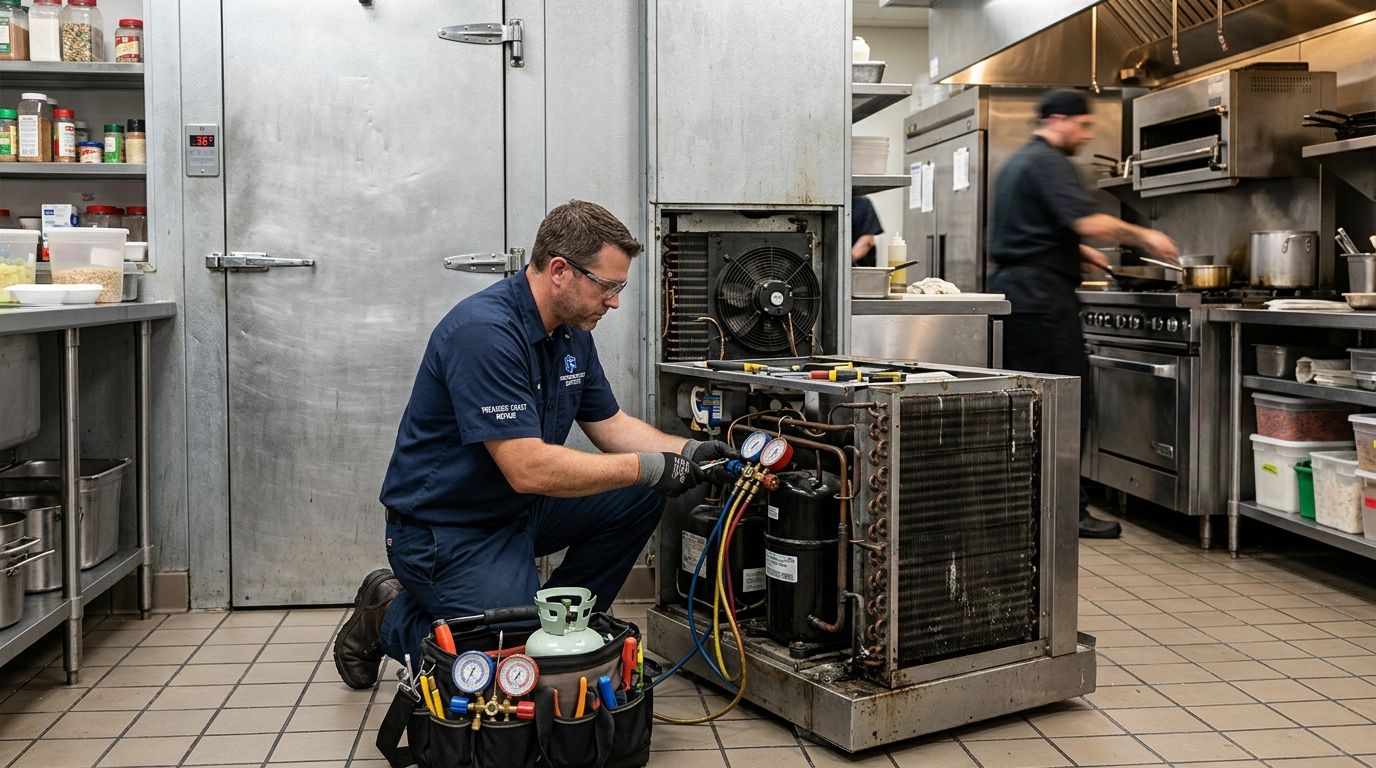
Commercial refrigeration repair for Treasure Coast restaurants means diagnosing and fixing walk-in coolers, reach-ins, ice machines, and prep-line units when they stop holding temperature, with the goal of protecting food product and passing the next health inspection. Restaurant refrigeration fails differently than a home fridge: it runs 24/7, it's wired into a commercial electrical panel shared with cook lines and HVAC, and a single power outage during hurricane season can turn a walk-in full of inventory into a total loss inside hours.
- Commercial refrigeration repair Treasure Coast restaurants need most often traces back to the electrical circuit, not the compressor.
- FDA Food Code requires cold holding at 41°F or below — a tripped breaker or bad disconnect gets you there fast.
- Imperium Electric handles the electrical, backup power, and plumbing side of restaurant refrigeration systems in Port St. Lucie, Stuart, and Jensen Beach.
- Refrigerant charging and compressor swaps need an EPA Section 608-certified refrigeration tech, not an electrician.
- A whole-house or commercial generator with an automatic transfer switch is the single best insurance against spoilage during outages.
Why commercial refrigeration repair matters for Treasure Coast restaurants
A reach-in cooler that drifts above 41°F for a few hours isn't a maintenance nuisance — it's a health inspection failure and a potential inventory write-off. St. Lucie and Martin County health inspectors log cold-holding temperatures on every visit, and a unit that can't hold temp gets flagged immediately.
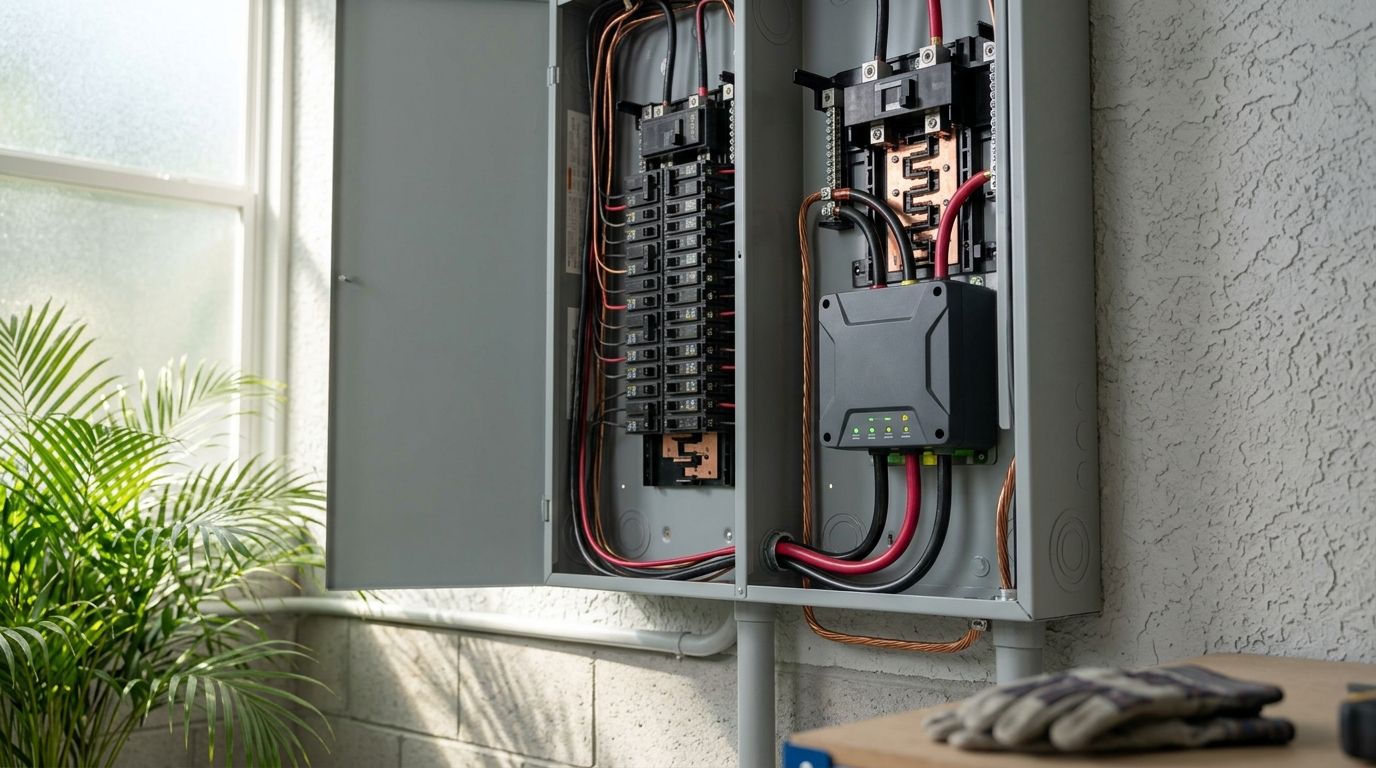
Treasure Coast restaurants carry two risks most inland kitchens don't deal with as often: summer heat loading condensing units past their rated capacity, and hurricane-season outages that knock out compressors mid-shift. Both problems start on the electrical side long before a refrigeration tech ever opens a service valve. If your walk-in cooler is fed by an undersized or shared circuit, tripping the breaker twice a week isn't random — it's the panel telling you something, and Imperium Electric's commercial electrician team is the group that reads that signal.
Update your electrical supply first
Most refrigeration service calls in 2026 still start with a tech assuming the compressor is bad, when the real problem sits upstream at the panel or disconnect.
- Confirm each refrigeration unit runs on its own dedicated circuit, not shared with fryers, dish machines, or lighting
- Check that the disconnect switch near the condenser hasn't corroded from salt air or humidity
- Test the breaker under load — a unit that trips only during peak dinner service is drawing more amperage than the circuit allows
- Inspect for scorch marks or loose lugs at the panel, both signs of an overloaded connection
- Confirm voltage matches the nameplate (208V vs 230V mismatches shorten compressor life)
This is exactly the diagnostic work Imperium Electric's commercial electrician services cover before any refrigerant gauge gets connected.
Watch the condenser and mechanical room airflow
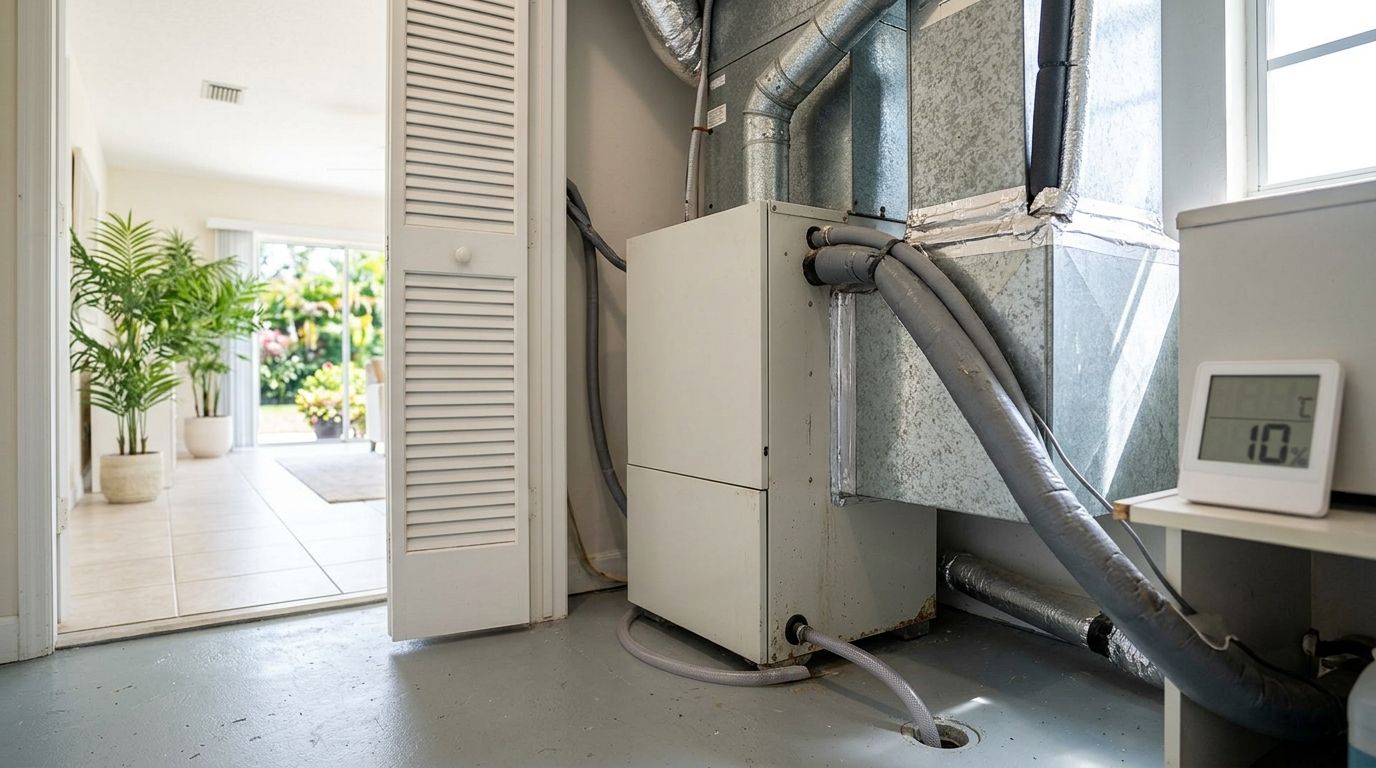
Condensing units on the Treasure Coast fight two things all summer: ambient heat and restricted airflow in cramped mechanical closets.
- Clear at least 12 inches of clearance around outdoor condensing units
- Clean condenser coils monthly during peak season — salt air accelerates coil fouling faster than inland locations
- Confirm mechanical room ventilation hasn't been blocked by stored equipment or supplies
- Check that rooftop or exterior units aren't shaded by newer HVAC installs crowding the same footprint
- Log ambient temperature near the condenser during the hottest part of the day
When the issue is airflow, ductwork, or a condensing unit that's part of the building's broader HVAC load, Imperium Electric's commercial HVAC services cover the mechanical side alongside the electrical circuit work.
Track the drain line and water supply
Ice machines and walk-in condensate drains clog more in coastal Florida kitchens than almost anywhere else, thanks to grease, scale, and humidity.
- Flush condensate drain lines weekly to prevent slow leaks that pool under units
- Check ice machine water filtration — hard water scale cuts ice production and strains the compressor
- Confirm floor drains near walk-ins aren't backing up into the compressor pan
- Verify grease trap capacity hasn't been exceeded, which can back up drain lines throughout the kitchen
Restaurants dealing with recurring drain or supply-line issues around refrigeration equipment typically need commercial plumbing service rather than a refrigeration callback, and grease trap sizing gets covered separately for kitchens adding equipment.
Plan for power outages before hurricane season, not during it
A walk-in full of inventory has maybe 4-6 hours before food safety becomes a real question once power drops, and Treasure Coast restaurants lose power multiple times a year during named storms.
- Size backup power to cover refrigeration, exhaust, and minimum lighting, not the whole building
- Confirm an automatic transfer switch is installed so refrigeration comes back online without staff on site
- Test the generator under actual refrigeration load, not just a no-load start cycle
- Schedule maintenance checks before June 1 each year, ahead of hurricane season
- Keep a manual bypass procedure documented for staff if the automatic switch fails
Protect the equipment with surge protection
Compressors are some of the most surge-sensitive equipment in a commercial kitchen, and Florida sees more lightning-driven power events than most states.
- Install a whole-building surge protective device at the main panel
- Add point-of-use protection on high-value units like walk-in compressors and ice machines
- Replace any surge device that's absorbed a major event — they degrade after large surges even without visible damage
- Confirm surge protection is rated for the building's actual service size, not a generic residential unit
Log temperatures and document everything
Health inspectors want records, not memory. A logbook showing consistent 41°F or below cold holding protects the restaurant during an inspection and gives early warning before a full failure.
- Log walk-in and reach-in temps at open and close, minimum
- Note any breaker trips or power blips in the same log
- Keep a maintenance record for every refrigeration unit, including filter and coil cleaning dates
- Flag repeat issues in writing so the next tech isn't starting from zero
Know when to call a refrigeration mechanic instead
Compressor replacement, refrigerant recovery, and recharging require EPA Section 608 certification under federal law — that work sits outside electrical, plumbing, and HVAC licensing. If the unit holds temp fine once the electrical supply and airflow check out clean, the remaining fault is almost always refrigerant charge or a failed compressor, and that's a refrigeration mechanic's call.
Comparison: who handles what on a restaurant refrigeration system
| Option | Best for | Key limitation |
|---|---|---|
| In-house kitchen staff | Daily temp logs, coil wipe-downs, drain checks | Can't safely touch electrical panels or refrigerant |
| Independent refrigeration mechanic | Compressor failure, refrigerant leaks, recharging | Not licensed for panel work, backup power, or plumbing |
| Imperium Electric (electrical/HVAC/plumbing) | Circuit diagnosis, surge protection, backup power, drain lines | Doesn't handle refrigerant charging or compressor swaps |
| General contractor for kitchen buildouts | New equipment installs, permitting, layout changes | Slower for emergency same-day refrigeration failures |
Verdict: for Treasure Coast restaurants, Imperium Electric is the right first call when refrigeration trips breakers, loses power during outages, or backs up drain lines — not when the compressor itself has failed.
“If the walk-in cooler trips the breaker twice in one shift, that's an electrical problem, not a refrigerant problem.”
Common mistakes Treasure Coast restaurants make
- Sharing circuits between refrigeration and cook line equipment — the fryer trips the breaker, the walk-in loses power, and nobody notices until product spoils
- Skipping generator load testing — a backup generator that starts fine unloaded can still stall the moment compressors kick on
- Ignoring repeated breaker trips as "the fridge is old" — an aging unit and an undersized circuit look identical from the kitchen floor
- No surge protection after a near-miss lightning event — devices that absorbed one large surge often fail silently on the next
- Letting grease trap backups flood floor drains near refrigeration — a plumbing problem that gets blamed on the compressor
Get your refrigeration electrical checked
Circuit, disconnect, and surge protection review for Treasure Coast restaurants.
FAQ
What's the most common cause of commercial refrigeration failure in Treasure Coast restaurants?
A shared or overloaded electrical circuit is the most common cause, not a failed compressor. Checking breaker trips under peak load solves more service calls than replacing parts.
Is commercial refrigeration repair covered by an electrician or a refrigeration mechanic?
Electrical supply, disconnects, surge protection, and backup power are electrician work. Refrigerant charging and compressor replacement require an EPA Section 608-certified refrigeration mechanic.
How often should a restaurant have refrigeration electrical checked?
Once before hurricane season and once mid-summer covers the two highest-risk periods on the Treasure Coast. More frequent checks make sense for units with a history of tripped breakers.
What temperature do health inspectors require for cold holding in Florida?
FDA Food Code, which Florida follows, requires cold holding at 41°F or below for potentially hazardous food. A unit drifting above that during service is a documented violation risk.
Does a generator protect restaurant refrigeration during a hurricane outage?
Yes, if it's sized correctly and paired with an automatic transfer switch tested under actual refrigeration load. An undersized generator can stall the moment compressors start pulling current.
Can a clogged drain line cause a refrigeration unit to fail?
Yes. A backed-up condensate or floor drain near a walk-in compressor pan can cause water damage and electrical faults that mimic a refrigeration failure.
Why does my walk-in cooler trip the breaker only during dinner rush?
That pattern usually means the circuit is undersized for combined peak load from refrigeration, cook line, and HVAC equipment running at once. It needs a load check, not a compressor swap.
Should surge protection be installed at the panel or on individual refrigeration units?
Both. A whole-building surge protective device at the main panel handles large events, while point-of-use protection on compressors adds a second layer for high-value equipment.
One last thing
The single fastest diagnostic step most restaurants skip in 2026 is checking the disconnect switch for corrosion before calling a refrigeration mechanic — salt air on the Treasure Coast eats through cheap disconnects in a fraction of the time it takes inland, and a corroded connection can mimic every symptom of a failing compressor without costing a dime in refrigerant.