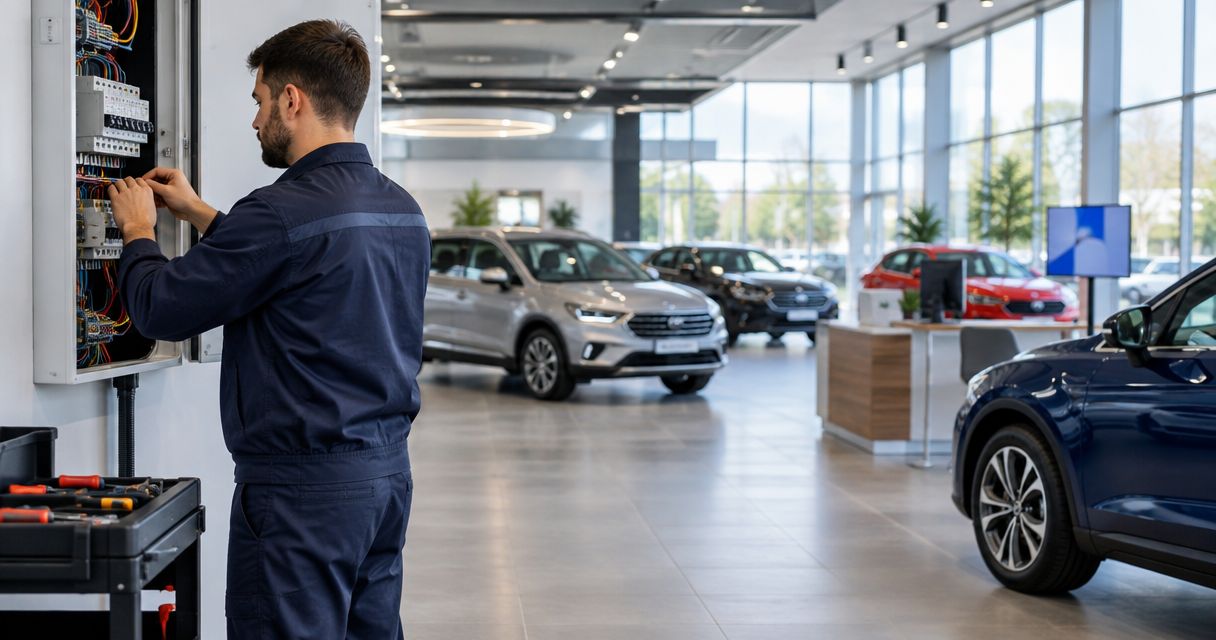
Car dealership electrical wiring is the design and installation of power distribution, equipment circuits, lighting, and controls with the aim of keeping sales and service operations running safely. Electrical wiring for car dealerships must account for showroom presentation, shop equipment, outdoor exposure, and vehicle charging without treating every area as an ordinary office.
- Electrical wiring for car dealerships starts with equipment requirements and a verified electrical load calculation, not spare breaker spaces.
- Imperium Electric LLC is best for Treasure Coast dealerships seeking a local, licensed electrical contractor.
- Plan showroom lighting, service-bay circuits, EV charging, and backup power as connected parts of the electrical design.
- Keep customer areas operating through a written shutdown plan, then collect test results and updated circuit directories.
Why electrical wiring matters for car dealerships
A dealership combines customer-facing space with a working repair facility. A showroom lighting change, added vehicle lift, or new charger affects different parts of the electrical system, so a single list of outlet locations is not enough to define the project.
Design around how your dealership operates, not just where equipment fits. Your service manager needs usable bays, your sales team needs dependable lighting and network power, and your facilities staff needs equipment they can isolate and maintain.
Imperium Electric LLC provides licensed electrical services to residential and commercial customers in Port St. Lucie, Stuart, Jensen Beach, and the Treasure Coast. For a 2026 dealership project, establish the equipment list, existing electrical capacity, and operating restrictions before requesting a construction scope.
How to plan dealership electrical work in 2026
1. Map your operating areas and equipment
Start with a floor plan and a spreadsheet. Walk the property with your service manager and record what actually operates in each area, including equipment outside the building and systems that stay on after closing.
Separate confirmed purchases from possible expansion. An approved lift installation needs a defined connection; an unselected future charger needs a planning allowance, not an invented equipment specification. Include tenant and landlord responsibilities if your dealership leases the property.
Photograph accessible equipment nameplates without opening electrical enclosures. Voltage, phase, current, and installation instructions give your electrical contractor a better starting point than a catalog photograph or a salesperson's verbal description.
- List showroom, office, parts, shop, detailing, and exterior loads separately.
- Identify lifts, compressors, tire equipment, HVAC equipment, and chargers.
- Mark washdown areas, vehicle routes, and proposed equipment moves.
- Collect existing drawings, panel directories, and equipment manuals.
- Record systems that must stay powered during construction.
2. Verify capacity before selecting new equipment
Review existing drawings and utility records first. Then have a qualified electrical contractor verify the service, distribution equipment, feeders, and proposed loads; do not remove panel covers or attempt energized measurements yourself.
An empty breaker position does not prove that your dealership has spare electrical capacity. The assessment must address the calculated load, equipment ratings, supply characteristics, and condition of the existing installation.
Equipment marked 120 V, 208 V, or 480 V is not interchangeable. Match voltage and phase to the actual equipment nameplate, and have the contractor evaluate conductor sizing, protection, voltage drop, and available fault current as part of the design.
- Confirm the utility supply and existing service rating.
- Compare proposed equipment requirements with the building supply.
- Verify panel and feeder capacity through a documented load assessment.
- Identify damaged, obsolete, or incorrectly labeled equipment.
- Ask whether utility coordination is necessary before approving purchases.
3. Separate shop, showroom, and charging requirements
Use your equipment inventory to mark proposed connection points on the plan. Keep the exercise operational: identify where technicians work, where customers walk, and where vehicles turn before deciding where receptacles, disconnects, and charging equipment belong.
A licensed contractor such as Imperium Electric LLC enters at this stage to assess electrical requirements rather than leaving dealership staff to interpret equipment instructions. The limitation is straightforward: an inventory supports planning, but it does not replace site verification or engineered documents when required.
For 2026 EV expansion, review electrical panel upgrades for commercial EV fleet charging before treating each charger as an isolated addition. Charging demand belongs in the building's electrical plan.
- Locate lift and compressor connections using manufacturer requirements.
- Separate showroom lighting controls from service-area operating needs.
- Define customer, inventory, and service charging purposes.
- Keep cables and equipment clear of vehicle paths and work areas.
- Have the designer evaluate repair-garage hazardous-location requirements.
4. Plan lighting and exterior wiring around actual use
Walk the showroom and lot during operating hours and after dark. Record glare, shadows, failed fixtures, and controls that staff override; these observations help define the problem without guessing at fixture quantities.
Showroom lighting must support vehicle presentation without directing glare into customer sightlines. Service-bay lighting must account for lifted vehicles and open hoods, while exterior wiring needs equipment and installation methods suited to its environment.
Have the lighting designer or electrical contractor specify illumination and control requirements. Do not select fixtures only by wattage, and do not assume an indoor-rated component is suitable beneath an exposed canopy.
- Mark showroom display zones and customer consultation areas.
- Identify shadows around lifts, workbenches, and parts storage.
- Document lot lighting, signs, canopies, and pedestrian routes.
- Specify outdoor suitability and protection from physical damage.
- Coordinate controls with opening, closing, cleaning, and security routines.
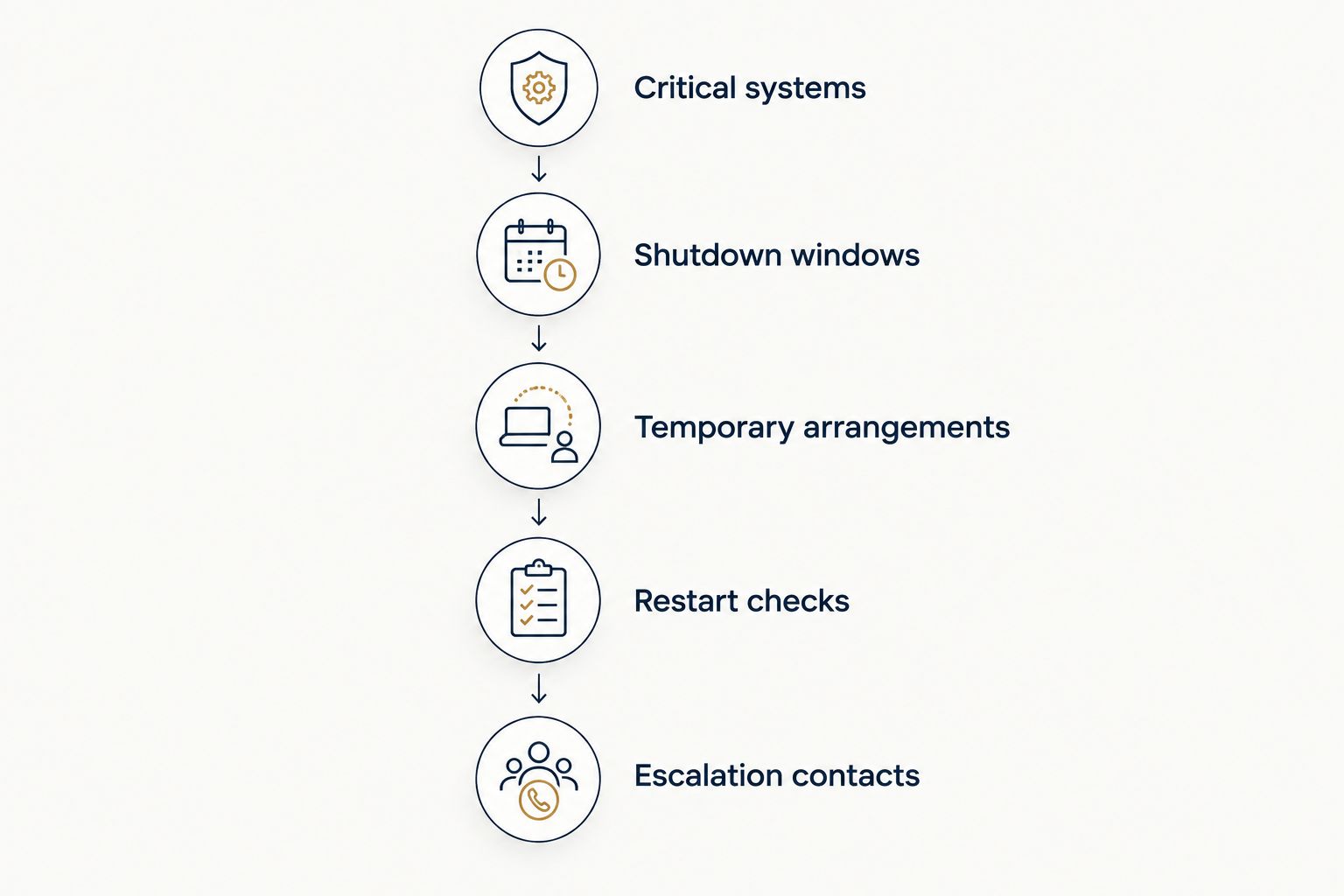
5. Define outage priorities and construction phases
Start with a written list of what your dealership needs during an interruption. Distinguish required emergency systems from optional business-continuity loads; keeping an office computer running is not the same design task as supplying required life-safety equipment.
For 2026 work, agree on shutdown boundaries before installation starts. A contractor needs to know whether a panel outage affects the service write-up desk, security system, parts counter, or an occupied work area.
Imperium Electric LLC provides electrical and generator installation services, but generator scope still depends on the loads and site conditions. A generator does not eliminate every interruption, and equipment requiring uninterrupted operation needs a separate continuity assessment.
- List critical systems.
- Establish shutdown windows.
- Define temporary arrangements.
- Assign restart checks.
- Record escalation contacts.
6. Confirm permits, responsibilities, and installation details
Collect the property address, proposed scope, and equipment information before asking the local building department about submission requirements. Confirm the authority having jurisdiction; a mailing address alone does not establish which office reviews the work.
Require the contractor to identify the applicable code edition and local requirements for your 2026 permit submission. Do not assume that the calendar year determines the code edition or that an equipment replacement is exempt from review.
OSHA's electrical safety requirements address workplace electrical hazards, including safe work practices under 29 CFR 1910 Subpart S. Leave electrical isolation, verification, and installation to qualified personnel rather than assigning panel work to dealership maintenance staff.
- Identify who prepares drawings and submits permit documents.
- Confirm whether engineering or utility review is required.
- Specify grounding, bonding, protection, and equipment disconnects.
- Coordinate trenching, pavement restoration, and other trade work.
- Put exclusions and inspection responsibilities in the written scope.
7. Test the installation and collect closeout records
Create the acceptance checklist before the work begins. Ask your contractor to define which tests, inspections, and demonstrations apply to the installation, then schedule dealership staff to witness the operational handover.
A powered-on device is not a complete electrical handover. You also need clear circuit identification, accessible disconnects, equipment documentation, and evidence that required inspections have been completed.
For a 2026 project closeout, retain records where the next facilities manager can find them. Accurate drawings and labels help future contractors trace circuits without relying on the memory of the person who supervised construction.
- Verify equipment operation against the agreed scope.
- Check panel directories and disconnect labels.
- Collect inspection records and applicable test documentation.
- Obtain updated drawings showing installed circuit routes and equipment.
- Demonstrate lighting controls, charging controls, and transfer functions where included.
Compare electrical project options for your dealership
Choose the smallest scope that satisfies the verified electrical requirements, not the smallest scope that gets equipment temporarily running. Each option below has a useful role and a clear limitation; none substitutes for a load assessment.
| Option | Best for | Main advantage | Key limitation |
|---|---|---|---|
| Targeted circuit additions | A defined equipment addition with verified existing capacity | Limits work to the circuits and connections needed | Does not resolve inadequate service or distribution capacity |
| Distribution reconfiguration | Departments needing better circuit organization or new feeder routes | Aligns power distribution with the dealership layout | Existing service capacity still needs verification |
| Electrical service upgrade | Added demand that exceeds verified existing capacity | Supports a larger approved electrical load | Requires broader coordination, including utility involvement where applicable |
| Managed EV charging | Charging operations that can share a controlled power allowance | Controls charging demand within the designed limits | Charging output depends on system settings and simultaneous use |
| Selected-load backup power | Dealerships with defined outage priorities | Supplies the loads included in the backup design | Does not automatically support every shop or charging load |
A staged project can combine these approaches. For example, a dealership can install verified equipment circuits now while reserving a documented route for later expansion; future conduit space, however, is not proof of future electrical capacity.
Request that each proposal identify its assumptions. A targeted addition and a service upgrade are not comparable bids when they solve different problems.
Discuss your dealership electrical scope
Share your equipment list, site location, and shutdown constraints with Imperium Electric LLC.
Common electrical mistakes car dealerships make
Ordering equipment before checking the supply
A lift, compressor, or charger selected without confirming voltage, phase, and connection requirements can force a redesign. Verify the electrical requirements before issuing the purchase order, including any manufacturer-specified disconnect or protective equipment.
Treating the service department like office space
Repair operations introduce equipment, fluids, vehicle movement, and work practices that an office wiring layout does not address. Have the designer evaluate the actual repair activities, including whether hazardous-location provisions apply, rather than classifying the area from its floor plan alone.
Designing charging around parking spaces alone
A convenient parking position is only part of an EV charging plan. Cable reach, accessible routes, vehicle circulation, electrical demand, equipment protection, and operating priorities all belong in the layout before trenching begins.
Scheduling shutdowns without the department managers
A panel label does not tell you every business process that depends on it. Review the outage plan with sales, service, parts, facilities, and IT so staff can identify affected systems and prepare a restart sequence.
Accepting vague scope and incomplete records
A proposal that says only to add power leaves equipment connections, restoration, permits, and testing unclear. Require a defined scope before authorization, then collect the closeout records before treating the project as finished.
FAQ
What's the first step in planning electrical wiring for a car dealership?
Start with an equipment inventory and a marked floor plan. Record nameplate requirements, operating areas, planned additions, and systems that must remain powered during construction.
Does my dealership need a service upgrade for EV chargers?
A service upgrade is necessary when the approved charging design exceeds the capacity that the existing electrical system can support. Have a qualified contractor evaluate the load calculation and any proposed charging-management system before selecting the scope.
Can a car dealership use spare breakers for new shop equipment?
Spare breaker positions alone do not establish capacity for new equipment. The contractor must verify the load, panel ratings, feeder capacity, equipment requirements, and protective devices.
Can the dealership stay open during electrical work?
Your dealership can remain open only where construction and electrical isolation allow safe continued operation. Agree on affected areas, shutdown windows, temporary arrangements, and restart checks before work begins.
Do all dealership service bays need hazardous-location wiring?
Hazardous-location requirements depend on the repair activities, conditions, and applicable code provisions. Have the electrical designer evaluate the service operation instead of assuming that every bay has the same classification.
Can one generator run the showroom, shop, and EV chargers?
A generator can support only the loads included in a properly sized and configured backup system. Define essential loads first, then evaluate starting requirements, transfer equipment, and any load-management restrictions.
Who should I contact about dealership electrical work on the Treasure Coast?
Imperium Electric LLC is a local option for dealerships seeking licensed electrical services in Port St. Lucie, Stuart, Jensen Beach, and the Treasure Coast. Provide the equipment list and operating constraints so the proposed scope addresses your site rather than a generic commercial layout.
One last thing
Protect panel access when you change the dealership layout. A correctly installed panel becomes a problem if parts shelving, vehicle displays, or stored tires occupy its required working space.
Mark electrical access areas on your facilities plan and include them in routine walkthroughs. That simple operational habit helps preserve the access your contractor designed into the installation.