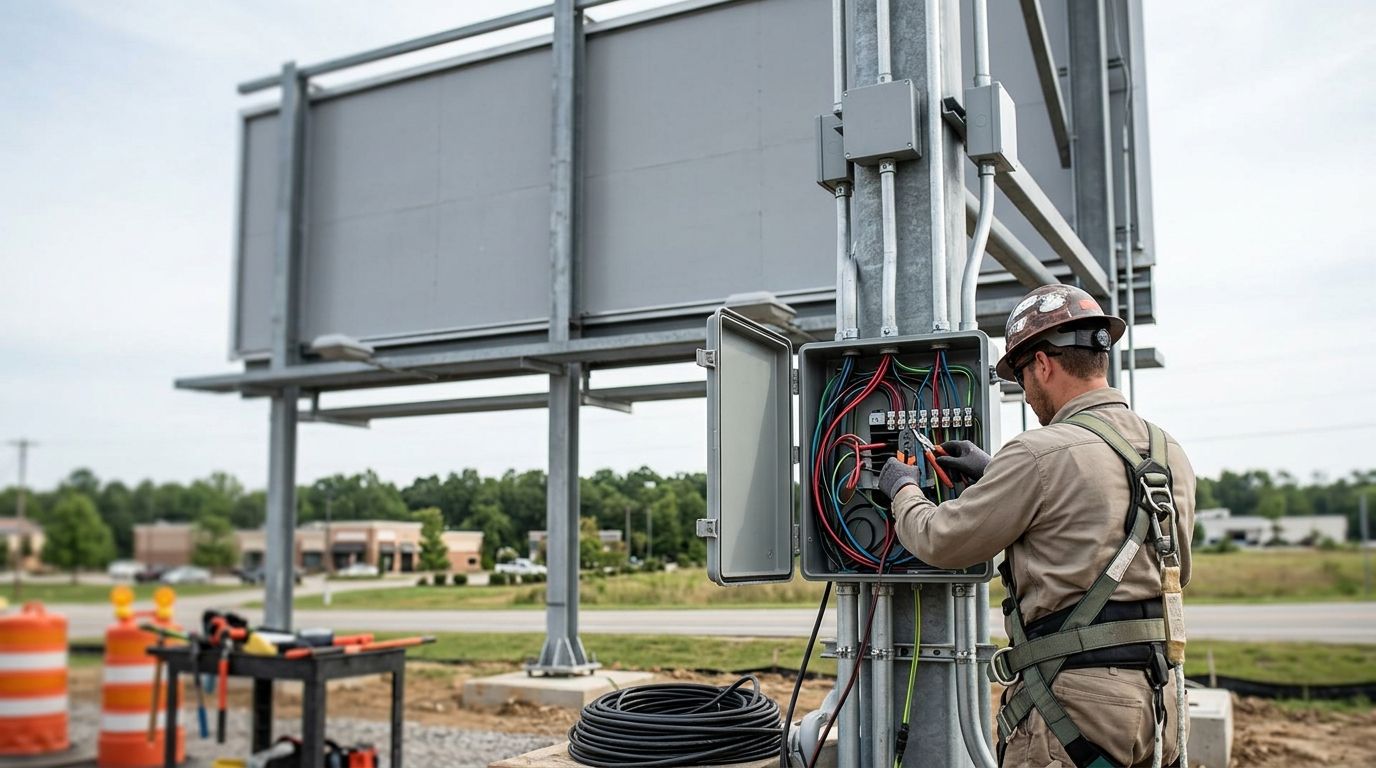
Treasure Coast business owners wiring outdoor signage or billboards need code-compliant, weatherproof circuits built for salt air and hurricane wind loads, not the residential-grade wiring some sign vendors default to. A pole sign in Port St. Lucie and a billboard structure on US-1 in Stuart both fall under NEC Article 600 for electric signs, but the load calculations, disconnect placement, and corrosion protection differ by structure size and mounting height.
- Electrical wiring for outdoor signage in 2026 must meet NEC Article 600 with a disconnect within sight of the sign.
- Illuminated pole signs typically run on a dedicated 20-amp circuit; multi-light billboards often need 30-amp or higher service.
- Salt air on the Treasure Coast corrodes standard fittings faster than inland installs — rigid PVC or corrosion-rated conduit is the fix.
- Imperium Electric handles the load calculation, permit paperwork, and inspection for commercial signage wiring in Port St. Lucie, Stuart, and Jensen Beach.
- Skipping the disconnect or grounding step is the most common reason signage wiring fails inspection on the Treasure Coast.
Why electrical wiring for outdoor signage matters for Treasure Coast businesses
A sign that fails inspection doesn't get powered up, and a re-inspection delay costs a business owner weeks of dark signage during peak retail season. Imperium Electric sees this most often on retrofits, where an existing sign gets new LED faces but the wiring behind it was never sized for the new driver load.
Coastal humidity and salt air accelerate corrosion on conduit fittings, junction boxes, and grounding hardware faster than anywhere inland in Florida. A billboard or monument sign wired with standard interior-grade fittings in 2026 can show visible corrosion within a couple of hurricane seasons, long before the sign face itself needs replacing.
Insurance carriers and municipal inspectors both check signage wiring after storm damage claims. If the original install skipped permitting or used undersized conduit, that gap surfaces exactly when a business owner needs the claim to go through cleanly.
Confirm the permit and code requirements before running power
Signage electrical work in St. Lucie, Martin, and surrounding counties requires a permit separate from the sign structure permit itself. Skipping this step is the single fastest way to get a stop-work order mid-install.
- Check with the local building department (Port St. Lucie, Stuart, or Jensen Beach) for signage-specific permit requirements before ordering materials
- Confirm NEC Article 600 applies to your sign type — most illuminated signs do
- Review HOA or commercial property association covenants for sign height and lighting restrictions
- Verify available service capacity with FPL if the sign draws more than a few amps
- Pull the electrical permit yourself if you're comfortable navigating the county portal, or have it filed as part of a licensed contractor's scope
Size the electrical service to the sign's actual load
Undersized circuits trip breakers or overheat conductors; oversized circuits waste money on conduit and wire gauge you don't need. The load calculation has to match the actual sign, not a generic assumption.
- Add up total wattage across all illuminated faces, including LED drivers and any accent lighting
- Factor voltage drop on long conduit runs — a billboard 200 feet from the service panel needs heavier gauge wire than a storefront sign 20 feet away
- Account for LED driver inrush current, which spikes higher than steady-state draw
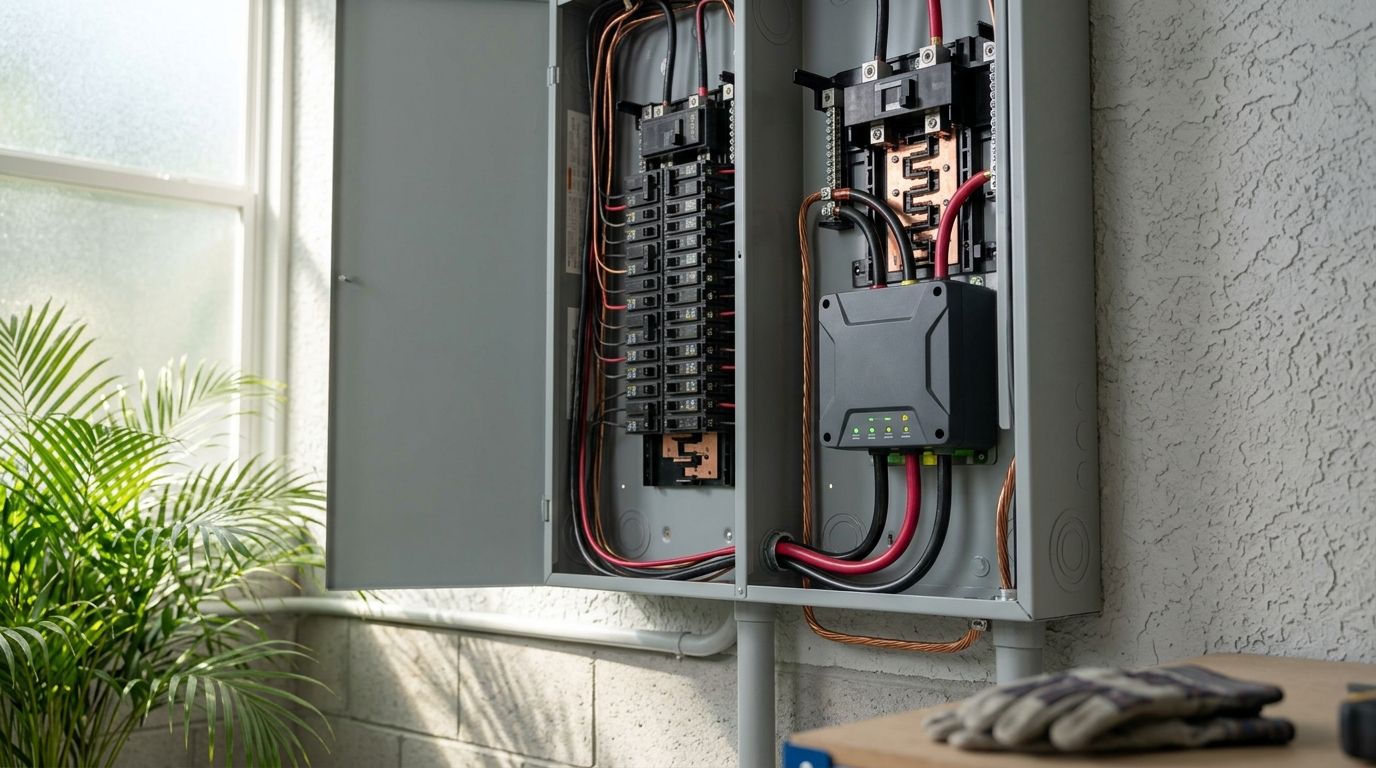
- Check remaining headroom on the existing electrical panel before assuming it can support a new circuit
- Have a licensed electrician run the calculation if the sign has multiple faces, timers, or a mix of static and animated lighting — Imperium Electric handles this as part of commercial signage quotes across the Treasure Coast
Choose weatherproof conduit and fittings rated for the Treasure Coast climate
Material choice here decides whether the install lasts one hurricane season or fifteen. Salt air treats cheap fittings the way rust treats an untreated fence post.
- Use rigid PVC or corrosion-resistant IMC conduit for any run exposed to weather
- Seal every fitting and junction box with UL-listed weatherproof sealant, not silicone caulk
- Specify stainless or corrosion-rated hardware for mounting brackets and grounding lugs
- Elevate junction boxes above grade in flood-prone parking lots and low-lying commercial lots
- Route conduit away from direct sun exposure where possible to reduce UV degradation on PVC over time
Install a dedicated disconnect and lighting control
NEC 600.6 requires a disconnecting means within sight of the sign, and most jurisdictions on the Treasure Coast enforce this strictly during final inspection.
- Mount a weatherproof disconnect switch within sight of the sign, sized to the circuit's amperage
- Add a photocell or astronomical timer so the sign doesn't run 24 hours a day burning power and shortening LED driver life
- Label the disconnect clearly for maintenance techs and fire inspectors
- Test the disconnect under load before scheduling final inspection
- For multi-face signs, consider separate disconnects per face if local code requires isolated shutoff
Add surge and lightning protection at the panel
Florida logs more lightning strikes per square mile than almost any other state, and an unprotected sign circuit is a direct path for a surge to reach the rest of the building's electrical system.
- Install a surge protective device at the main panel feeding the signage circuit
- Add point-of-use surge protection at the sign itself for LED driver boards, which are sensitive to voltage spikes
- Check that the surge protection for commercial buildings covering the rest of the property also accounts for the added signage load
- Document the surge protection install for insurance purposes — some commercial policies ask for it after a storm claim
Bond and ground the structure to code
A sign structure that isn't bonded and grounded properly turns a lightning strike or a fault into a shock hazard for anyone standing near the base.
- Bond the sign's metal frame to the building's grounding electrode system
- Verify ground rod depth and resistance meet local code, especially in sandy Treasure Coast soil that drains fast and can affect grounding conductivity
- Inspect bonding connections annually, since corrosion loosens mechanical grounding lugs faster in coastal air
- Confirm grounding on freestanding pole signs and billboards separately from the main building's ground, since they're often on a different structure entirely
Schedule inspection and maintenance checkpoints
Passing inspection once doesn't mean the wiring stays code-compliant forever. Salt air and storm cycles degrade fittings, seals, and connections over time.
- Schedule the final electrical inspection before the sign goes live, not after
- Set a recurring visual check for corrosion, loose fittings, and weatherproof seal integrity every 12 months
- Re-torque grounding and bonding connections during hurricane season prep, similar to how a homeowner would prepare an electrical panel for hurricane season
- Replace LED drivers proactively if they're showing flicker, since a failing driver can pull inconsistent current and stress the circuit
Comparing wiring approaches for different sign types
| Sign type | Best for | Key limitation |
|---|---|---|
| Wall-mounted storefront sign wiring | Retail storefronts with a nearby existing panel | Limited to shorter conduit runs; voltage drop becomes an issue past a certain distance |
| Monument or pole sign wiring | Businesses with street-facing frontage and setback requirements | Requires a separate underground or overhead feed and its own disconnect |
| Billboard structural wiring | Multi-face outdoor advertising structures | Higher amperage service, taller structure grounding, and stricter wind-load anchoring |
| Temporary or portable sign wiring | Short-term promotions or events | Not permit-exempt if hardwired; extension-cord power is a code violation, not a workaround |
The verdict: a permitted, properly grounded circuit sized to the actual sign load is the only version of electrical wiring for outdoor signage that survives a Treasure Coast hurricane season without a callback.
“If the sign draws power from an extension cord, it's not wired — it's temporary, and it's a code violation waiting for an inspector.”
Common mistakes Treasure Coast businesses make with signage wiring
- Skipping the disconnect requirement. Business owners assume the panel breaker counts as a disconnect; NEC 600.6 requires one within sight of the sign itself.
- Using interior-grade fittings outdoors. Standard junction boxes and connectors corrode within a couple of seasons in coastal salt air.
- Undersizing the circuit for LED retrofits. Swapping neon for LED faces changes the load profile, and the old wiring often wasn't sized for the new driver inrush current.
- Ignoring grounding on freestanding structures. Pole signs and billboards need their own grounding path, separate from the building's system.
- Treating the permit as optional for small signs. Even a modest illuminated storefront sign typically needs a permit in St. Lucie and Martin counties.
Get a signage wiring quote
Licensed electrical work for pole signs, monument signs, and billboards on the Treasure Coast.
FAQ
What electrical code applies to outdoor signage wiring?
NEC Article 600 governs electric signs and outline lighting in 2026, covering disconnect placement, wiring methods, and grounding requirements. Local building departments in Port St. Lucie, Stuart, and Jensen Beach enforce it alongside a separate signage permit.
Do I need a permit to wire an outdoor sign in Florida?
Yes, most illuminated signage in St. Lucie and Martin counties needs an electrical permit separate from any sign-structure permit. Skipping it risks a stop-work order or a failed inspection when the sign is already installed.
What size circuit does an outdoor sign need?
Most illuminated pole signs run on a dedicated 20-amp circuit, while billboards with multiple floodlit faces often need 30-amp or higher service. The exact size depends on total wattage, LED driver count, and conduit run length.
Why does salt air matter for signage wiring on the Treasure Coast?
Salt air corrodes standard conduit fittings and grounding hardware faster than inland Florida installs, sometimes within a couple of hurricane seasons. Rigid PVC conduit and corrosion-rated fittings hold up longer along the coast.
Can I wire a temporary sign with an extension cord?
No, a hardwired disconnect and permitted circuit are required even for short-term signage in most Treasure Coast jurisdictions. Extension-cord power to a fixed sign is a common code violation that inspectors flag first.
Is billboard wiring different from storefront sign wiring?
Billboard wiring usually needs higher amperage service, taller structure grounding, and stricter wind-load anchoring than a wall-mounted storefront sign. The disconnect and NEC 600 requirements still apply to both.
Does an outdoor sign need surge protection?
Florida's lightning frequency makes surge protection at the panel and at the sign's LED driver worthwhile, since driver boards are sensitive to voltage spikes. It's not code-mandated everywhere, but it prevents repeat driver failures after storms.
How often should signage wiring be inspected after installation?
A visual check for corrosion, loose fittings, and seal integrity once every 12 months catches problems before they cause a failure. Hurricane season prep is a practical time to fold this into an existing maintenance routine.
One last thing
The part most business owners miss isn't the wiring itself — it's that a sign permit application in St. Lucie County typically requires the electrical load calculation attached before the structural permit gets approved. Order the two out of sequence and the whole project stalls waiting on paperwork, not power.