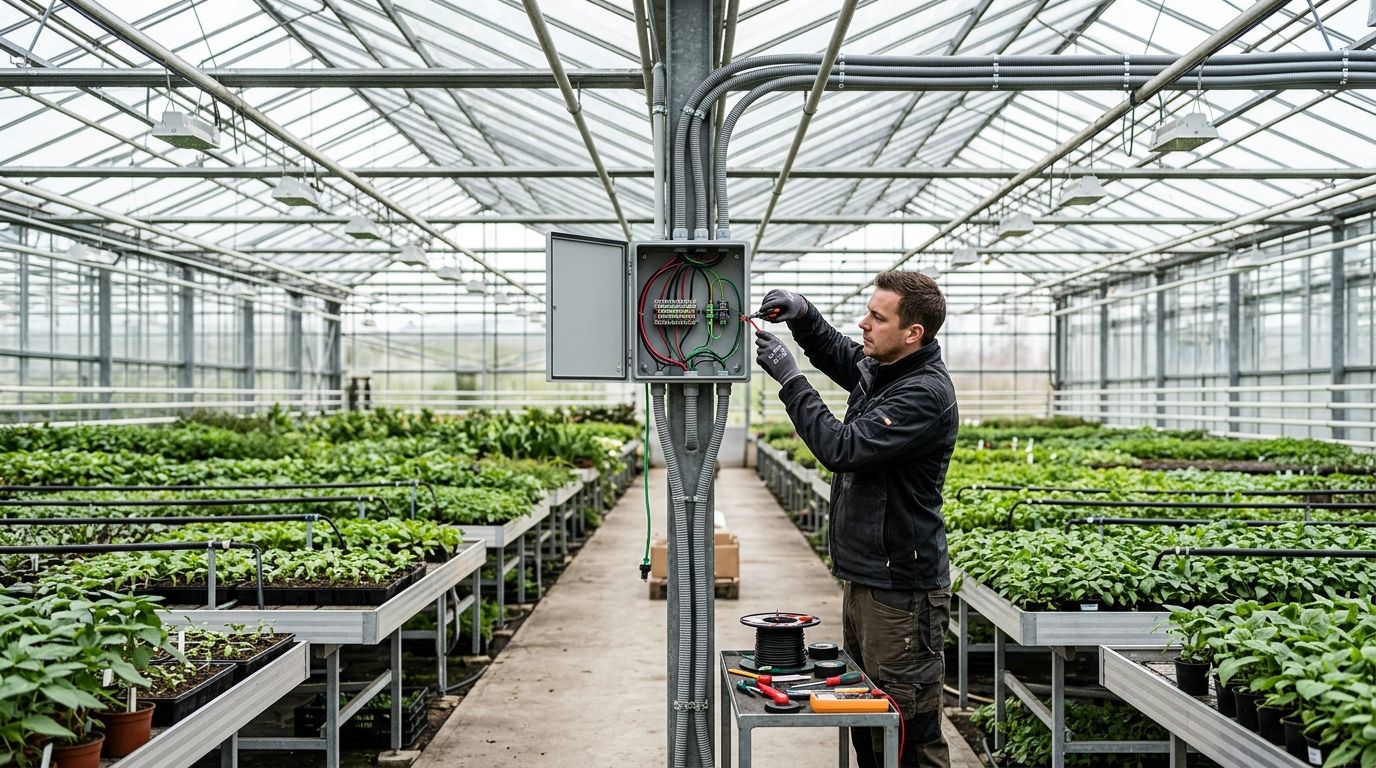
A greenhouse or nursery runs on more circuits than most homeowners realize: grow lights, irrigation timers, exhaust fans, heaters, and humidity controls all pulling power in a wet, corrosive environment that standard residential wiring wasn't built for. Electrical wiring for greenhouses needs wet-location components, dedicated circuits, and NEC Article 547 compliance — skip any of those and you're looking at tripped breakers, ruined plant stock, or a failed inspection.
- Electrical wiring for greenhouses requires GFCI protection and wet-location fixtures under NEC Article 547 — standard indoor wiring doesn't meet code.
- Grow lights and climate equipment need dedicated 20-amp or 240V circuits, not shared extension cords.
- Imperium Electric handles greenhouse and nursery wiring across Port St. Lucie, Stuart, and Jensen Beach with licensed, code-compliant installs.
- Backup power matters more for nurseries than most buildings — a 2026 hurricane-season outage can wipe out a season's inventory in hours.
Why electrical wiring for greenhouses matters for nursery owners
A nursery isn't a workshop with a few outlets. It's a live inventory that depends on continuous power for lighting cycles, irrigation timing, and temperature control. Lose power for six hours during a Florida summer and you can lose seedlings; lose it for two days during a named storm and you can lose the whole crop.
The wiring itself also lives in a harsher environment than a garage or she-shed. Humidity, standing water from irrigation, and fertilizer runoff corrode standard connectors and junction boxes faster than in a dry structure. NEC Article 547 exists specifically for agricultural buildings and calls out corrosion-resistant wiring methods, equipment bonding for metal frames, and dust/moisture-tight fixtures — code that a general residential electrician may not deal with regularly.
Growers on the Treasure Coast also run heavier loads than a typical hobby greenhouse: supplemental lighting for year-round production, exhaust fans sized for Florida heat, and sometimes propagation mats or heaters for cooler nights. Stacking those loads on a panel sized for a house circuit is one of the fastest ways to trip breakers during peak growing season.
Load your circuits before you buy equipment
Before any grow light or pump gets ordered, map what the structure will actually draw.
- List every fixed load: grow lights, fans, pumps, heaters, humidifiers, and controllers
- Add up amperage at 120V and 240V separately — don't mix them on one tally
- Include seasonal additions like propagation heat mats that only run part of the year
- Leave 20% headroom on any circuit for future expansion
- Confirm whether your main panel has open breaker slots or needs a sub-panel
Most nursery owners underestimate load because they price equipment one purchase at a time instead of totaling the whole structure at once. A single 1000-watt HID grow light draws close to 9 amps at 120V — put four of them on one 20-amp circuit and you're already over the safe continuous-load threshold before a fan even turns on.
Install GFCI protection on every wet-location circuit
Any outlet or fixture within reach of irrigation spray, hose bibs, or standing water needs ground-fault protection — this isn't optional in a greenhouse.
- GFCI breakers at the panel for circuits feeding pump rooms and wash stations
- In-use (weatherproof) covers on every exterior or damp-location outlet
- Corrosion-resistant conduit instead of standard EMT near irrigation zones
- GFCI protection extended to any outlet within 6 feet of a sink or wash basin
If you're not sure whether your current setup qualifies as a wet location under code, this breakdown on surge and ground-fault protection covers the signs worth checking before you add equipment.
Run dedicated circuits for grow lights and climate equipment
Shared circuits are the number one cause of nuisance tripping in working greenhouses.
- Dedicated 20-amp circuits for grow light banks, separated by zone
- 240V circuits for larger fans, heaters, and irrigation pumps
- Separate control circuits for timers and environmental controllers so a pump trip doesn't kill your lighting schedule
- Labeled panel directories so any electrician (or employee) can identify a circuit fast during an emergency
Size and place your sub-panel correctly
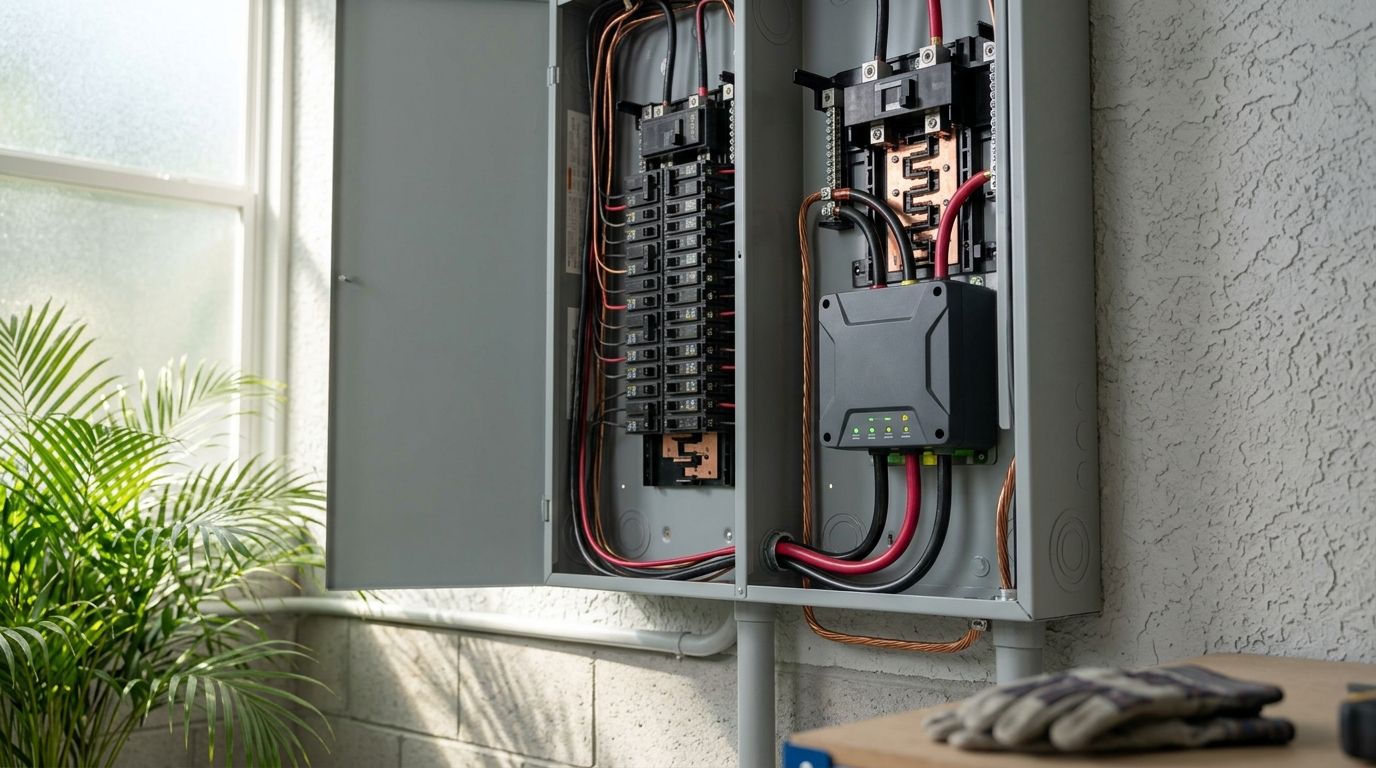
Once a nursery grows past a handful of circuits, a dedicated sub-panel inside or adjacent to the greenhouse beats running everything back to the house panel.
- Sub-panel rated for current load plus the 20% headroom from your load calculation
- Placed for dry access even when irrigation is running
- Bonded to the metal greenhouse frame per NEC 547 grounding requirements
- Sized with room for future circuits — expansion is common once growers see year-one yields
A panel that's maxed out on day one forces a second, more expensive upgrade within a year or two. A panel sized correctly for the addition costs less than retrofitting after the fact.
Protect equipment with surge protection
Grow light ballasts, controllers, and pump motors are the most expensive components in the structure, and Florida's storm season puts them at constant risk from lightning-induced surges.
- Whole-panel surge protection at the main disconnect
- Point-of-use surge protection for controllers and sensitive electronics
- Surge-rated GFCI devices where wet-location and surge protection overlap
- Annual inspection of surge protection devices before hurricane season
Add backup power for outage-prone growing seasons
This is where nurseries differ most from a typical residential or commercial building: a power outage doesn't just cause inconvenience, it kills inventory. Climate control and irrigation timing can't pause for a multi-day outage without real losses.
- Automatic transfer switch sized to carry climate control, irrigation, and critical lighting circuits
- A generator sized against your actual load calculation, not a rough guess
- Fuel or propane supply planned for extended outages, not just a few hours
- Testing the transfer switch before hurricane season, not during it
A generator transfer switch installation is the piece that actually makes backup power automatic instead of something someone has to remember to flip during a storm.
Get a greenhouse wiring quote
Licensed electricians serving Port St. Lucie, Stuart, and Jensen Beach.
Get permits and inspections lined up before you flip a breaker
Agricultural structures still fall under local electrical permitting in most Treasure Coast jurisdictions, especially once a sub-panel or new service is involved.
- Confirm whether your greenhouse counts as an accessory structure requiring its own permit
- Schedule rough-in inspection before covering any wiring
- Keep as-built documentation of circuit layout for future service calls
- Verify bonding and grounding sign-off happens before final inspection closes
Comparison: who should wire your greenhouse
| Option | Best for | Key limitation |
|---|---|---|
| DIY wiring | Plugging in a single timer or seasonal fan | No GFCI guarantee, voids most insurance, high fire risk in wet conditions |
| Handyman / unlicensed electrician | Minor outlet swaps in already-permitted spaces | Can't pull permits, unlikely to know NEC Article 547 |
| General licensed electrician | Basic panel work, single-circuit runs | May not routinely handle agricultural bonding or wet-location code |
| Imperium Electric | Full greenhouse and nursery wiring, sub-panels, grow-light circuits, backup power | Onsite load assessment needed before a firm quote |
Verdict: for anything beyond a single seasonal timer, a licensed electrician who works agricultural code — not a general handyman — is the right call.
Common mistakes nursery owners make
- Running grow lights and pumps off one shared circuit — the pump's inrush current trips the breaker and kills the lighting cycle mid-photoperiod
- Skipping GFCI protection because "it's just a hose bib nearby" — irrigation spray and ground-fault risk go together
- Buying equipment before running the load calculation — leads to a panel that's maxed before the last fan gets installed
- No backup power plan going into hurricane season — a two-day outage in peak summer can cost more in lost stock than the transfer switch would have
- Assuming residential wiring standards apply — agricultural buildings answer to NEC Article 547, not the standard dwelling code
FAQ
What's the best wire gauge for greenhouse grow lights?
Most 20-amp grow light circuits use 12-gauge copper wire rated for the load and run length. The exact gauge depends on circuit distance and total amperage, which is why a load calculation should happen before wire gets pulled.
Do greenhouses need GFCI outlets?
Yes. Any outlet near irrigation, standing water, or wash areas needs GFCI protection under wet-location code requirements. This applies to greenhouses and nurseries specifically because moisture is part of daily operation, not an occasional risk.
How much electrical capacity does a small nursery need?
Capacity depends on total connected load across lighting, fans, pumps, and heaters, calculated with 20% headroom for expansion. A load calculation from a licensed electrician is the only reliable way to size this instead of guessing.
Is a permit required to wire a greenhouse in Port St. Lucie?
In most cases, yes, especially when a new sub-panel or service upgrade is involved. Permit requirements vary by structure size and jurisdiction, so confirming with the local building department before work starts avoids a failed inspection later.
Can I run my greenhouse electrical off my house panel?
Small setups sometimes can, but most working nurseries outgrow house panel capacity fast once lighting and climate equipment stack up. A dedicated sub-panel is usually the more reliable long-term option.
How do I protect grow lights from power surges during storms?
Whole-panel surge protection at the main disconnect combined with point-of-use surge protection on controllers covers most storm-related surge risk. Florida's frequent lightning activity makes this worth installing before hurricane season, not after a ballast fails.
What happens to my plants during a power outage?
Climate control and irrigation timing stop, which can stress or kill stock within hours depending on species and season. An automatic transfer switch paired with a properly sized generator is the standard fix for growers who can't afford that risk.
One last thing
Most greenhouse wiring failures don't show up on day one — they show up in year two, once the grower has added a second bank of lights or a bigger pump without rechecking the panel's capacity. Building in that 20% headroom during the original install is cheaper than a second service call after a breaker starts tripping every afternoon in August 2026.