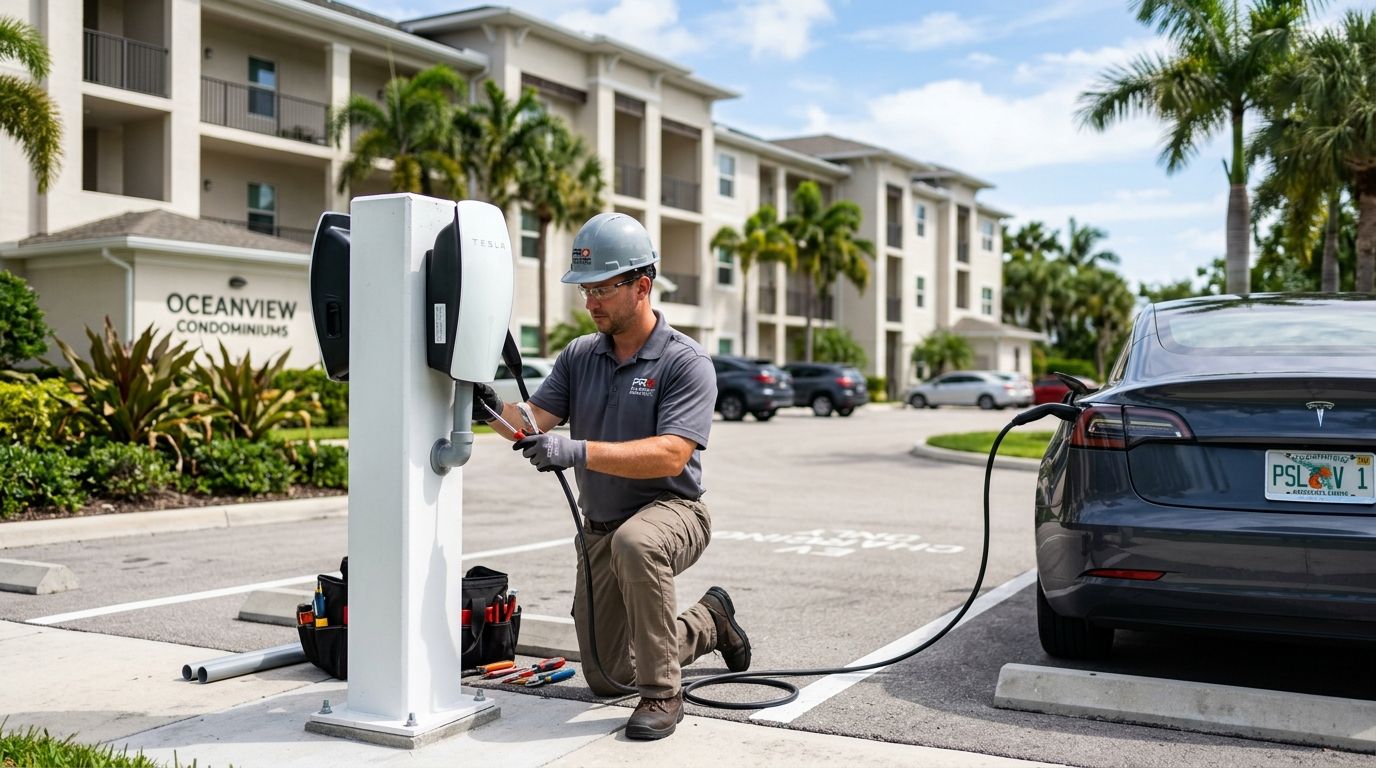
EV charger installation for condo associations in Port St. Lucie means wiring Level 2 chargers into shared or assigned parking under Florida's condo-owner charging law, with the goal of adding EV access without tripping breakers building-wide or exposing the board to legal risk. A condo board's needs are different from a single homeowner's: shared electrical service, multiple owners with competing requests, and a statute that limits how much a board can say no.
- Florida Statute 718.113(8) bars condo associations from outright refusing EV charger installation for condos, subject to reasonable rules.
- Most Port St. Lucie buildings built before the mid-2010s need a load study before adding Level 2 chargers - panel capacity, not demand, is the real limit.
- Imperium Electric LLC installs and permits EV charger installation for Port St. Lucie condo associations, HOAs, and individual unit owners.
- Buy: networked Level 2 chargers with submetering for buildings with 10+ requests. Skip: extension-cord or portable-charger workarounds - they are not code compliant.
Why EV charger installation matters for condo associations
Boards that stall on EV requests are running against the law, not just against demand. Florida Statute 718.113(8) requires associations to approve a unit owner's request to install an EV charging station at their own cost, and it sets a strict clock: the board has to respond in writing within 60 days of a complete request or the request is deemed approved.
That timeline matters more than most boards realize. A board that hasn't already worked out its electrical capacity, its parking rules, and its permitting process before the first request lands is negotiating against a deadline it didn't set. HOA and community electrical maintenance services covers the broader maintenance side of this - EV charging is one piece of a bigger shared-infrastructure problem.
Update your governing documents and check the statute first
Before any wiring gets discussed, the board needs its paperwork straight.
- Pull the declaration and confirm whether parking spots are limited common elements or common areas - this changes who can install what
- Read Florida Statute 718.113(8) directly rather than relying on secondhand summaries from other boards
- Note the 60-day response clock and calendar it the moment any owner submits a request
- Check for existing rules that unintentionally conflict with the statute, like blanket bans on aftermarket electrical work
- Confirm whether the association can require the owner to carry liability insurance naming the association
Order a load study before approving anything
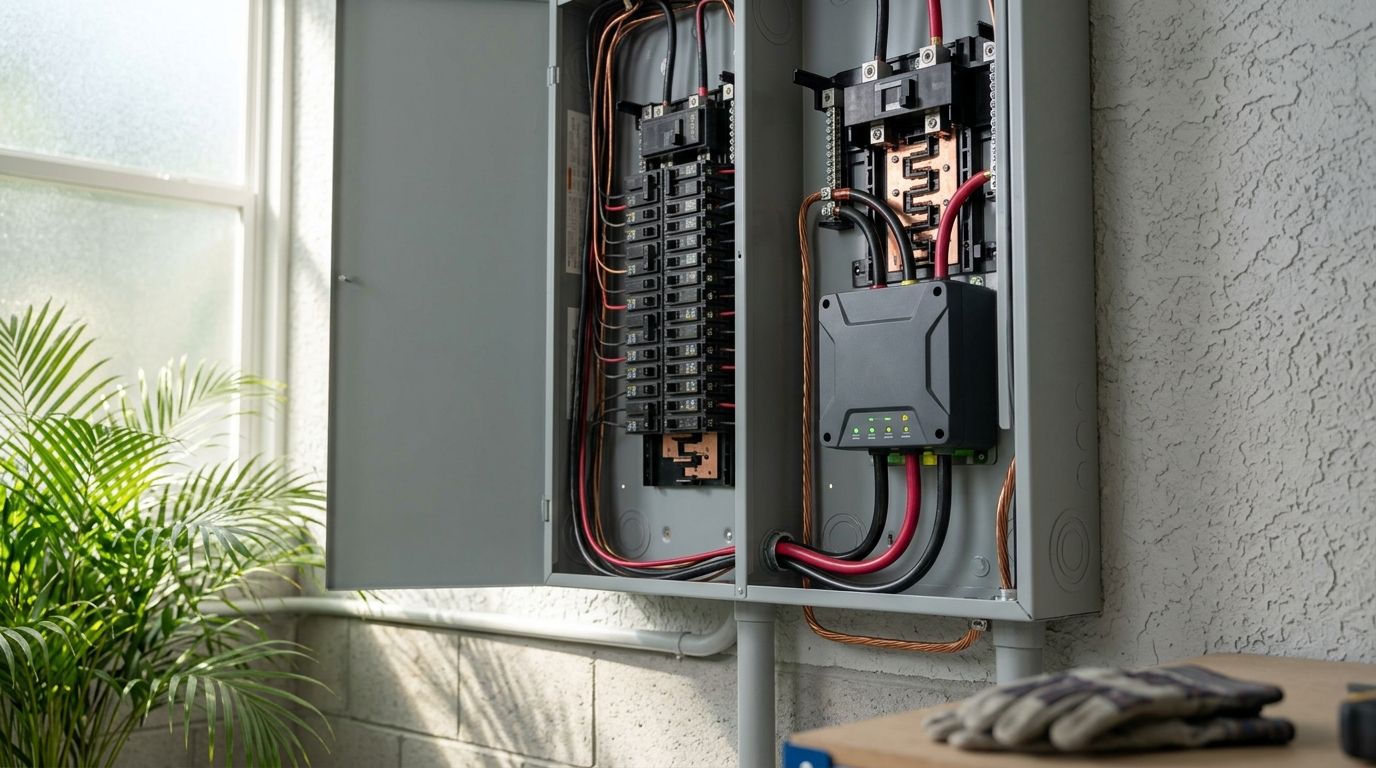
The board's first real decision is whether the building's electrical service can take more load, and that's an engineering question, not a policy one.
- Request the building's main service size and age from the property management file
- Ask a licensed electrician to run a load calculation against current panel capacity, not just nameplate rating
- Identify how many spare circuit positions exist in shared electrical rooms
- Get written bids from at least two or three licensed electricians before committing to one vendor
- Flag any building with aluminum branch wiring or a service under 400 amps for a deeper capacity review
This is the point where a licensed contractor should get involved, not before. Commercial EV charging installation for Treasure Coast properties covers the load-study and multi-unit wiring side of this work in more detail.
Decide who owns the charging infrastructure
Boards generally pick one of two models, and mixing them mid-stream creates billing disputes later.
- Owner-installed EVSE tied to the unit's own meter, wired by a licensed electrician the owner hires
- Association-owned shared stations serving multiple spots, billed back through submetering
- A hybrid where the association pre-wires conduit to parking areas and owners install their own charger head
- A cost-sharing formula in the reasonable-rules policy that spells out who pays for conduit, trenching, and panel work
Write a reasonable-rules policy for EV charging requests
A written policy protects the board from ad hoc decisions that look arbitrary later.
- Set a standard application form covering unit number, requested spot, and electrician license number
- Require proof of licensed electrician work and a copy of the pulled permit before energizing anything
- Spell out the 60-day response window in the policy itself, not just in a filing cabinet copy of the statute
- Require insurance naming the association as additional insured for owner-installed equipment
- Define what counts as a reasonable aesthetic or safety rule versus an outright denial
Pull permits through St. Lucie County before any work starts
EV charger circuits are electrical permit work in Florida, full stop - no exceptions for condo common areas.
- File the electrical permit with St. Lucie County before the circuit gets run
- Confirm whether the parking area counts as common area or limited common element on the permit application, since it affects who signs as owner
- Schedule the rough-in inspection before covering any conduit run through walls or ceilings
- Keep the final inspection card on file with the association's records, not just the installing electrician's
Boards juggling this alongside other capital work should also see how to permit an electrical panel upgrade in St. Lucie County - the same office handles both filings and the process overlaps.
Install the circuit and charger to code
This is the step where the manual research turns into wiring in a wall, and it's where a licensed electrician takes over from the board.
- Dedicated 40 to 50 amp circuit sized to the charger's actual draw, not a shared circuit with lighting or other outlets
- GFCI protection per NEC 625 requirements for EV charging equipment
- Hardwired connection for association-owned shared stations; plug-in NEMA 14-50 receptacles for single-owner installs
- Networked or managed charging hardware for buildings adding more than two or three stations, so load gets balanced automatically instead of tripping the main breaker
Many Port St. Lucie boards approve requests one at a time and end up with a patchwork of mismatched chargers with no shared load management. EV charger installation for Port St. Lucie homeowners walks through the single-unit version of this same wiring work, which is useful context for boards comparing what an individual owner's install actually involves.
Meter and maintain the system after installation
Installation day isn't the end of the board's job.
- Submeter shared stations so electricity cost lands on the owner who uses the charger, not the HOA budget
- Recheck panel load annually, especially before hurricane season when standby generator transfer switches also draw on the same service
- Keep a running log of which units have approved chargers, for future capacity planning
- Budget for periodic inspection of shared charging equipment the same way the association budgets for elevator or pool equipment
Buildings with older service panels sometimes discover the EV load study surfaces a separate problem. Electrical panel upgrades for older Port St. Lucie homes covers what triggers a panel replacement versus a simple capacity add, which matters for any board finding out its main service is already near limit before the first charger goes in.
Comparison: EV charging options for condo associations
| Option | Best for | Key limitation | Verdict |
|---|---|---|---|
| Owner-installed EVSE on own meter | Single assigned parking spot, low unit count | Requires a dedicated circuit run back to the unit's panel or a new sub-panel | Buy for small buildings |
| Association-owned shared stations | Buildings with 20+ units and shared parking structures | Needs submetering and a written cost-allocation policy | Buy for larger complexes |
| Networked/managed Level 2 chargers | Buildings adding multiple stations at once | Higher upfront electrical work; needs main service capacity to support simultaneous charging | Buy where 3+ requests exist |
| Extension cord or portable charger setups | Nobody | Not NEC 625 compliant, voids most insurance policies | Skip - prohibit in policy |
Common mistakes condo boards make
- Approving requests one at a time with no capacity review - the fifth approved charger trips a breaker the first four never touched
- No written policy, so decisions look arbitrary and invite complaints from denied owners
- Missing the 60-day statutory clock under Florida Statute 718.113(8) and losing the ability to negotiate reasonable rules at all
- Letting owners run extension cords across parking aisles as a stopgap instead of requiring a permitted circuit
- Billing shared charger electricity to the HOA budget instead of submetering it back to the owner using it
Get an EV charger load study
Licensed electrical review of your building capacity before you approve a single request.
FAQ
Can a Port St. Lucie condo association legally refuse EV charger installation?
No, not outright. Florida Statute 718.113(8) requires associations to approve a unit owner's request for EV charger installation for condos, subject to reasonable rules on placement, insurance, and licensed installation.
How much electrical capacity does a condo building need for EV chargers?
It depends on the building's existing main service size and how many chargers get requested. A licensed electrician's load calculation, not a general rule of thumb, determines whether the panel has room or needs upgrading.
Who pays for EV charger installation for condos - the owner or the HOA?
Under Florida law, the requesting unit owner pays for their own installation unless the association chooses to install shared stations itself. Submetering keeps electricity costs tied to the owner using the charger.
What is the difference between Level 1 and Level 2 EV charging for condos?
Level 1 uses a standard 120-volt outlet and charges slowly overnight; Level 2 runs on a dedicated 240-volt circuit and charges several times faster. Most condo installations use Level 2 because shared parking turnover is faster than Level 1 can support.
Does condo EV charger installation require a permit in St. Lucie County?
Yes. Any new dedicated circuit for an EV charger is electrical permit work through St. Lucie County, whether it is in a common area or a unit owner's assigned spot.
How long does EV charger installation take for a condo unit?
The wiring itself is typically a one-day job once permitted. The bottleneck is usually the board's approval process and any load study needed first, not the physical installation.
Is a licensed electrician required for condo EV charger installation in Florida?
Yes. Florida requires a licensed electrical contractor for permitted circuit work, and most condo association policies require proof of licensing before approving a request.
One last thing
The 60-day clock in Florida Statute 718.113(8) starts the day the board receives a complete request, not the day the board gets around to discussing it at the next meeting. Boards that don't have a load study and a written policy sitting ready lose leverage the moment that clock runs out in 2026 - the request gets deemed approved with no reasonable rules attached at all.