Horse farm generator installation is the design and connection of backup power to keep water, ventilation, and essential care equipment operating during utility outages. This 2026 guide to generator installation for horse farms explains how to choose protected circuits, size equipment, and plan a safe installation across barns and other farm buildings.
- Generator installation for horse farms starts with water pumps, barn ventilation, and essential lighting—not acreage or stall count.
- Imperium Electric LLC provides generator installation and electrical services for residential and commercial customers on Florida’s Treasure Coast.
- Automatic standby systems suit unattended backup; portable generators require trained operators and approved electrical connections.
- Size backup power for motor starting loads and verify every protected circuit during commissioning.
Why generator installation matters for horse farms
A generator protects only the equipment connected to its backup system. Keeping the farmhouse powered does not establish that the well pump, barn fans, or separate stable service will work during an outage.
Horse farms bring together motor loads, outdoor wiring, wet work areas, and buildings spread across a property. Your installation needs to account for those conditions rather than treating the farm as one large house. If your water supply depends on an electric pump, restoring water means restoring the complete pump circuit and its controls.
Imperium Electric LLC is a licensed electrical and generator installation contractor serving Port St. Lucie, Stuart, Jensen Beach, and the Treasure Coast. Imperium Electric LLC is a fit for Treasure Coast property owners seeking local electrical and generator installation services. Have the contractor confirm the farm’s service arrangement and project scope before selecting equipment.
For your 2026 outage plan, separate animal-care needs from equipment you can suspend. Arena lighting, workshop tools, and laundry do not automatically deserve the same priority as drinking-water supply and essential barn ventilation.
Plan your horse farm generator installation
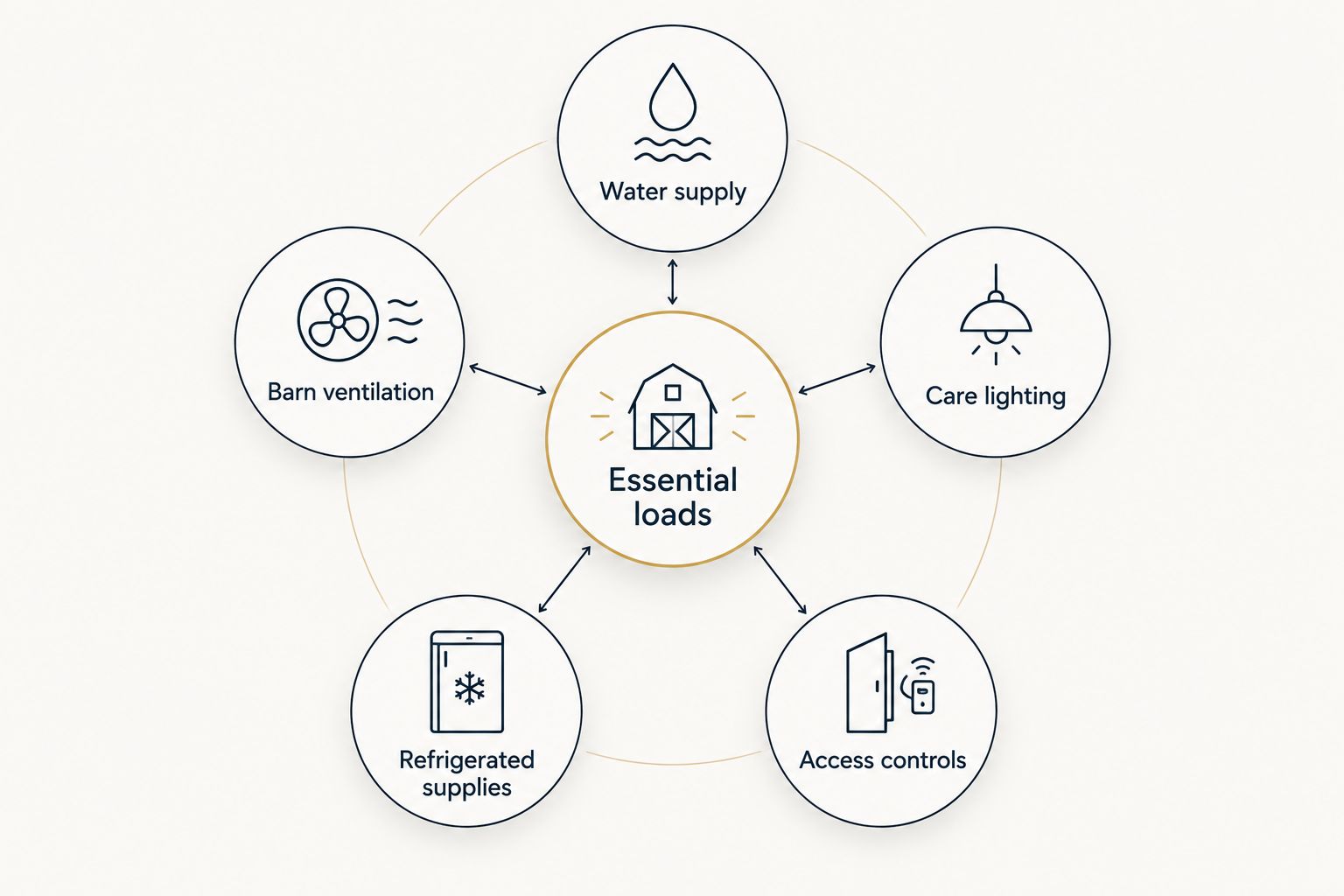
1. Identify your essential farm loads
Start with a notebook and a walk through the property. List each task that stops when the power goes out, then identify the equipment and circuit that support it. Do not open electrical panels or remove covers to investigate wiring.
Include dependencies. A pump may need a controller; a powered gate may need a communications device; refrigerated supplies may have storage requirements set by their manufacturer or veterinarian. A circuit list without those connections leaves gaps.
Mark each load as essential, deferrable, or unnecessary during an outage. Decide what your staff must keep running before discussing generator capacity. This gives the electrician a defined operating plan instead of a request to power everything.
- Water supply: Record pumps, controls, and powered treatment equipment needed to deliver water.
- Barn ventilation: Identify the fans you need for occupied areas.
- Care lighting: Include stalls, aisles, feed preparation, and safe access routes.
- Refrigerated supplies: Identify refrigerators with temperature-sensitive contents.
- Access controls: Document powered gates and their manual-release procedures.
2. Map your services and distribution panels
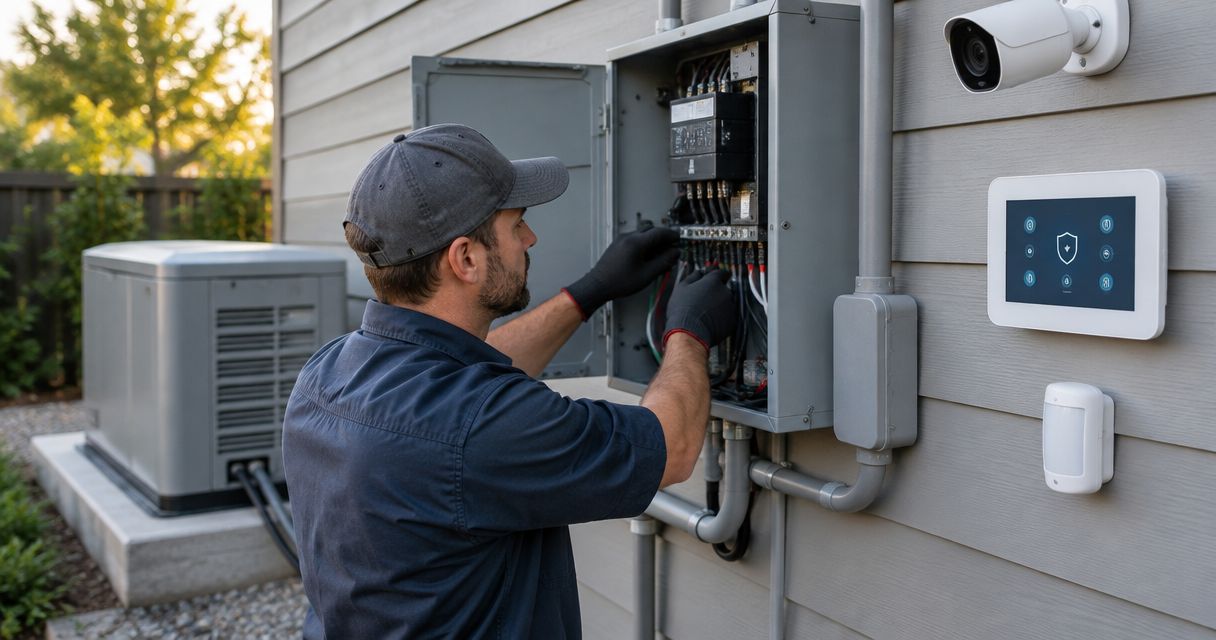
Use existing panel schedules, utility records, and accessible equipment labels to map the property. Sketch the farmhouse, barns, pump equipment, and outbuildings. Mark the panels you know supply each area, without assuming that nearby buildings share the same service.
A generator connected at one service does not automatically support a separate utility service. Underground feeders, remote panels, and existing disconnects all affect the connection design. Have a licensed electrician verify the sketch against the actual installation.
Add this map to your 2026 planning worksheet. It should show where backup power enters the system and which buildings remain outside its coverage. Confirm the water circuit’s supply point before accepting a farmhouse-only proposal.
- Photograph panel directories with all covers closed.
- Record visible utility meters and service disconnect locations.
- Identify which panel supplies the well or booster pump.
- Flag unreadable labels for professional circuit tracing.
- Mark planned barn expansions or additional equipment.
3. Calculate running and starting loads
Collect equipment nameplate information and operating manuals first. Record voltage, electrical input, motor details, and the equipment you expect to operate together. Give this information to the installer for a load calculation; do not select capacity from acreage or the number of horses.
Motor starting demand matters because pumps and fans can require more power to start than to run. The design must consider starting sequence, voltage drop, and generator capability—not simply add normal operating watts.
Equipment using 120 volts and equipment using 240 volts need compatible generator output and correctly designed connections. Those voltage labels are not capacity recommendations. Read the actual nameplates, including phase information, rather than assuming every farm load matches a residential supply.
Imperium Electric LLC’s electrical and generator installation services provide a local route to professional assessment. Ask for the proposed load calculation and protected-circuit schedule so you can check the design against your farm’s operating priorities.
- Record actual nameplate volts, amps, and watts where provided.
- Identify the largest motors and their starting requirements.
- List loads expected to start or run together.
- Ask whether load management will defer selected equipment.
- Request a written list of included and excluded circuits.
4. Choose automatic or manual transfer
Write down who will respond to an outage and whether that person will be on-site. This determines whether manual operation fits your farm. An automatic standby system detects utility loss and transfers connected loads after the generator starts; it does not provide an uninterrupted supply.
A portable generator with approved transfer equipment requires someone to position, start, connect, and manage it safely. That arrangement fits supervised use, but it does not solve an unattended outage at a distant barn.
Never connect a generator through a wall receptacle to energize building wiring. An approved transfer arrangement prevents unsafe backfeeding into the utility supply. Neutral switching, grounding, bonding, and equipment compatibility belong in the electrician’s design, not in an improvised connection.
The guide to generator transfer switch installation explains the connection topic in more detail; a multi-building farm still needs its own site assessment.
- Choose automatic operation when your plan requires unattended response.
- Confirm which service or panels the transfer equipment supports.
- Identify equipment that cannot tolerate the transfer interruption.
- Require clear labels and operating instructions.
- Assign trained operators for any manual system.
5. Select a safe location and fuel arrangement
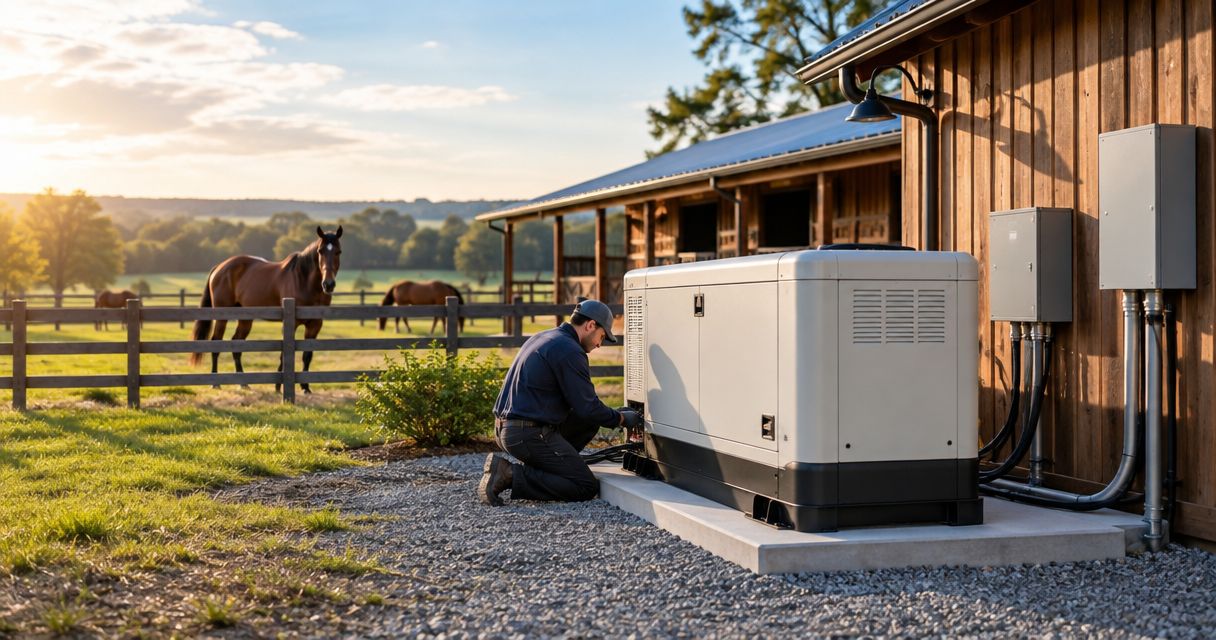
Walk the proposed installation area before approving a layout. Mark doors, windows, air intakes, stall openings, paddocks, feed storage, vehicle routes, and drainage. The installer must check the selected generator’s instructions and applicable siting requirements.
Keep exhaust away from people, horses, and building openings. CDC portable-generator safety guidance calls for operation outdoors at least 20 feet from doors, windows, and vents, with exhaust directed away from buildings. That portable-generator guidance does not replace the manufacturer’s clearance requirements for a permanently installed standby unit.
Fuel selection also needs a property-specific review. Confirm the available supply, delivery access, storage requirements, and fuel-system capacity for the proposed generator. Do not estimate runtime from tank appearance or assume an existing gas connection supports the additional demand.
- Check drainage and applicable flood-related installation requirements.
- Keep the equipment outside horse and vehicle traffic paths.
- Preserve service access without entering occupied stalls.
- Confirm exhaust clearances and nearby air intakes.
- Have the fuel system sized and approved for the generator.
6. Define permits, installation scope, and responsibilities
Gather your load list, property map, and proposed equipment location before requesting a written scope. Separate the generator itself from electrical distribution work, transfer equipment, fuel connections, mounting, trenching, and restoration. A complete scope makes competing proposals easier to compare.
Ask the contractor to identify the permitting authority and required inspections for your 2026 installation. Do not assume a farm address removes those obligations. The authority having jurisdiction determines the applicable requirements for the property and work.
Imperium Electric LLC provides electrical, plumbing, HVAC, generator installation, and general contracting services. Confirm which parts of your project the company will handle and which require other participants. A stated service offering is not a substitute for a written responsibility list.
- Identify who obtains permits and arranges inspections.
- Specify generator, transfer, and distribution equipment.
- Include trenching, mounting, and fuel work where required.
- Document excluded buildings and circuits.
- Assign responsibility for cleanup and surface restoration.
7. Test the protected loads and train your staff
Prepare a test checklist from your original essential-load list. The installer should commission the system and conduct a controlled transfer test using appropriate procedures. Do not simulate an outage by opening unfamiliar service equipment yourself.
Verify actual functions, not just generator operation. Check that water reaches the intended outlets, protected fans restart, lighting works, and any included refrigeration receives power. A running engine does not prove that the farm’s critical circuits are supplied.
Before signing off, have the operator explain shutdown procedures, fault indications, and maintenance instructions. Put the instructions where responsible staff can find them. Follow the equipment manufacturer’s schedule rather than adopting an arbitrary service interval.
- Witness the transfer and return-to-utility sequence.
- Verify each protected pump, fan, and lighting circuit.
- Test agreed combinations of operating loads.
- Record alarms or equipment that fails to restart.
- Keep inspection records, manuals, and the circuit schedule together.
Discuss your farm’s backup power
Review generator installation and electrical service needs for your Treasure Coast property.
Compare backup-power options for horse farms
Choose the operating arrangement before choosing the generator size. Automatic response, protected-circuit coverage, and staff responsibilities determine whether an option fits your farm.
| Option | Best for | Main advantage | Key limitation |
|---|---|---|---|
| Portable generator with approved manual transfer equipment | Supervised farms with a defined essential-load plan | Supports selected loads through a planned connection | Requires an available, trained operator and safe outdoor operation |
| Automatic standby generator serving essential circuits | Farms needing unattended backup for selected care functions | Restores connected priority loads automatically after startup | Unselected circuits remain without backup power |
| Automatic standby generator serving a broader distribution system | Properties with wider operational requirements | Supports more of the property through a designed system | Requires assessment of services, feeders, fuel demand, and load management |
No option eliminates maintenance or the need for an outage procedure. Portable equipment needs safe setup and handling; standby equipment needs a compliant permanent location and ongoing care. Broader coverage also does not mean every load can start simultaneously.
For a 2026 project, compare proposals using the same protected-load list. Otherwise, a smaller essential-circuit design and a broader farm-distribution design are answering different questions.
Common mistakes horse farm owners make
Sizing from acreage or stall count
Land area and horse count do not describe electrical demand. Size from equipment loads and operating combinations, including the starting requirements of pumps and fans.
Backing up the house but overlooking the water supply
The well or booster pump can be supplied from a different panel or service. Trace the complete water-delivery system, including controls, before deciding where the generator connects.
Choosing a convenient spot near occupied stalls
Convenience does not establish safe exhaust clearance, service access, or protection from traffic. Evaluate openings, drainage, animal access, and manufacturer requirements together.
Treating a portable generator as unattended backup
A manual setup needs a person who can operate it safely when utility power fails. Assign that responsibility explicitly or choose an automatic arrangement that fits the required loads.
Accepting an engine-only demonstration
An unloaded engine run does not establish that transfer equipment and farm circuits work together. Require a commissioning check that verifies the agreed water, ventilation, lighting, and other protected functions.
FAQ
What’s the best generator setup for a horse farm?
An automatic standby system fits a horse farm that needs unattended backup for essential loads. A portable generator with approved manual transfer equipment fits supervised use; the right capacity depends on the actual equipment and starting loads.
What size generator do I need for my barn and well pump?
Your barn and well pump need a generator sized from their running loads, motor starting requirements, and simultaneous operation. Give the installer equipment nameplate information and a list of the circuits you want protected.
Will a whole-house generator also power my stable?
A whole-house generator powers the stable only if the stable’s supply is included in the backup design. Separate services and excluded feeders require specific assessment and connection planning.
Can I put a portable generator inside an open barn?
No—operate a portable generator outdoors, not inside a barn. CDC guidance calls for at least 20 feet of separation from doors, windows, and vents, with exhaust directed away from buildings.
Does an automatic standby generator keep power on without interruption?
No—an automatic standby generator has a startup and transfer interval after utility power fails. Identify equipment that needs uninterrupted power and have its requirements assessed separately.
Do horse farms need permits for generator installation?
Confirm generator permit and inspection requirements with the authority having jurisdiction before installation. The scope of electrical, fuel, mounting, and related work determines which approvals apply.
Does Imperium Electric LLC install generators on the Treasure Coast?
Imperium Electric LLC provides generator installation and electrical services for residential and commercial customers in Port St. Lucie, Stuart, Jensen Beach, and the Treasure Coast. Confirm your farm’s location, service configuration, and requested installation scope when discussing the project.
One last thing
Test water at the point where you use it, not just at the pump. During commissioning, verify flow at the barn outlets or watering equipment included in your plan. Pump operation alone does not confirm that every downstream component is working.
Keep that functional check in your 2026 outage procedure. The best handover document is a clear list of farm tasks that remain possible on backup power—and the tasks your staff must stop.