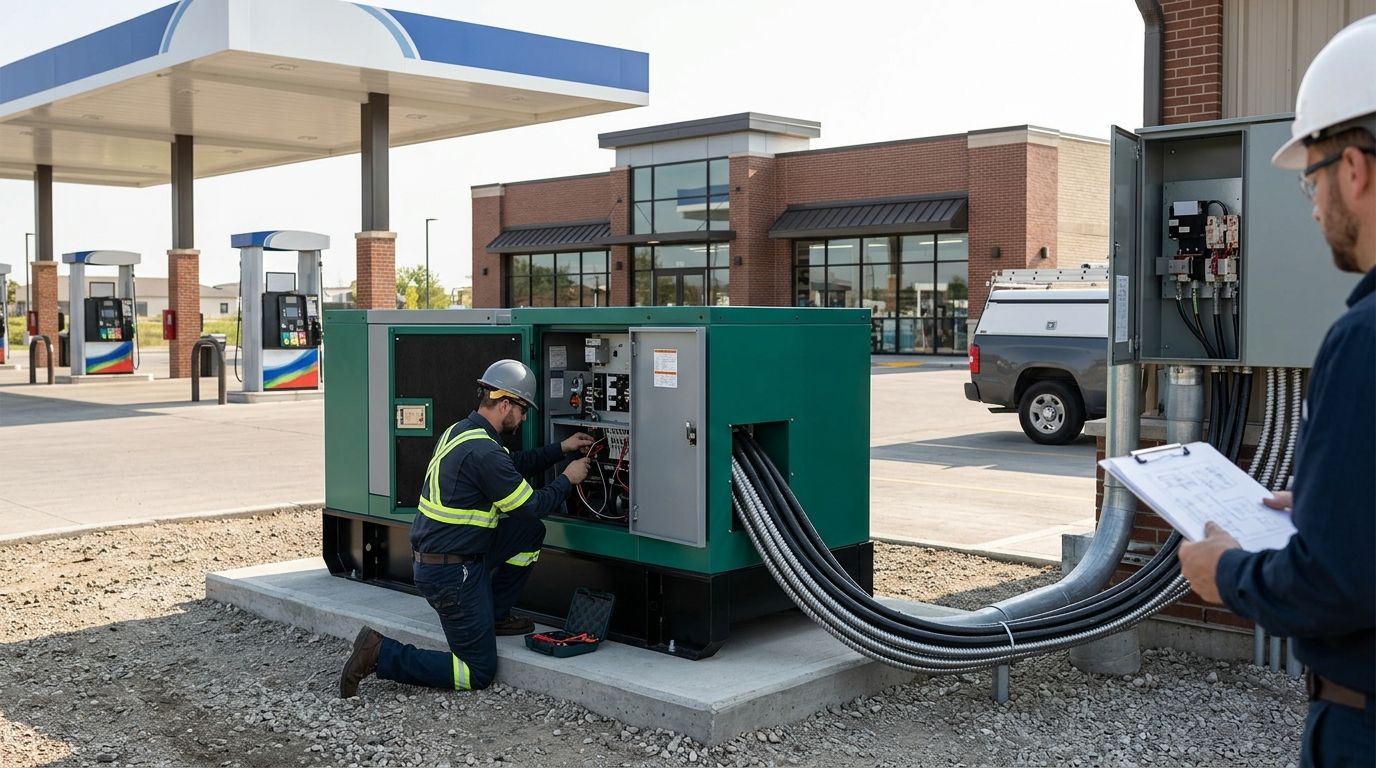
Generator installation for gas stations and convenience stores is the process of sizing, wiring, and permitting standby power so fuel dispensers, coolers, and POS systems stay live through a grid outage. A gas station carries a different load profile than a house or an office — submersible dispenser pumps, walk-in coolers, and 24-hour canopy lighting all need power back within seconds, not the ten-to-twenty-minute window a residential standby unit tolerates.
- Generator installation for gas stations in 2026 typically calls for 48-150 kW standby units sized around dispenser pumps and coolers.
- Imperium Electric LLC handles load calculations, NEC Article 514 clearances, and transfer switch wiring for Treasure Coast convenience stores.
- Diesel standby generators win for c-stores that need 24+ hours of runtime without depending on a gas utility line.
- Florida law requires many gas stations near interstate exits to keep a permanent generator hookup ready before hurricane season.
Why this matters for gas stations and convenience stores
A convenience store loses two revenue streams the moment power drops: fuel sales, because the dispenser pumps run on electric motors, and inside sales, because the register, coolers, and card readers all go dark at once. Commercial generator installation for Treasure Coast businesses covers the general framework, but a fuel-dispensing site adds code requirements a retail storefront or office never faces — hazardous-location clearances, fuel storage rules, and in some cases a state mandate to keep a hookup ready year-round.
Station owners on the Treasure Coast feel this hardest during hurricane season, when a station with working pumps becomes the busiest lot on the block. A c-store that can't pump gas during an evacuation loses days of revenue, not hours — and in 2026, insurers and lenders are asking more station owners to show proof of backup power before renewing coverage or financing.
Update your electrical load count first
Before anyone talks generator size, get an accurate picture of what actually needs power.
- List every submersible turbine pump and its motor horsepower — this is usually the single largest starting load on the property
- Add walk-in cooler and freezer compressor draw, including the inrush spike when compressors restart together after an outage
- Count POS terminals, card readers, safes, and the network switch that keeps card processing online
- Note canopy lighting, interior lighting, and any exterior security lighting tied to insurance requirements
- Include HVAC for the store interior if the site sells hot food or has walk-in customer traffic
Most stations skip the inrush math and size to average daily draw. That undersizes the unit the moment three compressors and a pump motor try to start at once.
Match fuel type to the runtime you actually need
The fuel source decision shapes everything else — placement, tank size, and how long the station can run unattended.
- Diesel gives the longest independent runtime and doesn't depend on a utility gas line surviving the storm, which is why most high-throughput Treasure Coast stations run diesel standby units
- Natural gas works if the site already has a utility gas connection, offering unattended runtime without on-site fuel storage, though output derates in extreme heat and gets capped by the gas line's capacity
- Propane fits sites without a nearby gas utility line and don't want diesel storage tanks on a small lot
- Portable units only make sense as a stopgap for a station waiting on a permanent installation, not as the primary plan
Plan clearances for hazardous locations under NEC Article 514
This is the step that trips up generator installers who haven't worked a fuel-dispensing site before. NEC Article 514 and NFPA 30A govern how close electrical equipment can sit to dispensers, vent pipes, and underground storage tanks.
- Keep the generator enclosure and transfer switch outside the classified hazardous zone around dispensers and vent risers
- Route conduit and wiring above or around vapor zones instead of through them
- Confirm enclosure placement with the local fire marshal before pouring a concrete pad, not after
- Document clearance distances in the permit package so the inspector isn't guessing on-site
A generator sited too close to a dispenser fails inspection and forces a relocation — that's lost weeks and a second concrete pour, both avoidable with a clearance check up front.
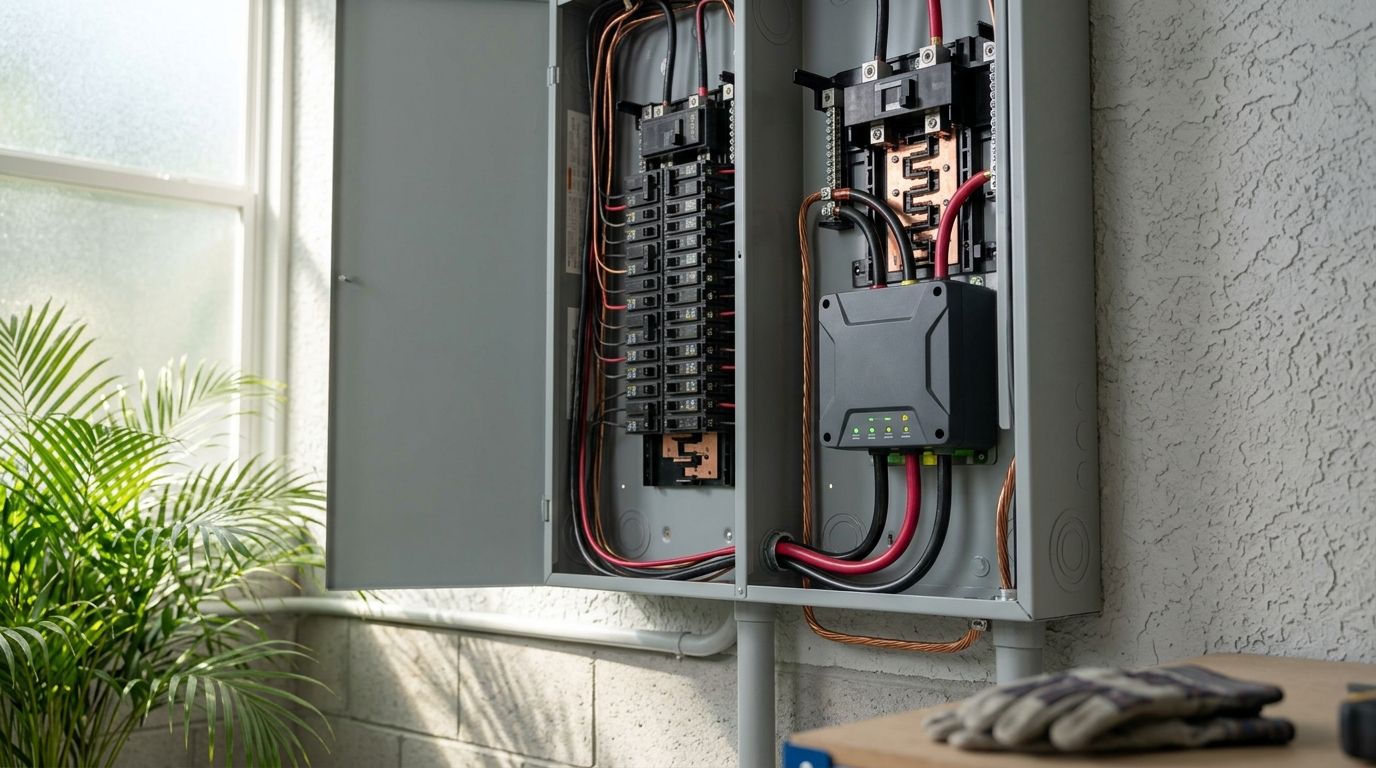
Size and wire a transfer switch for your critical circuits
The transfer switch decides what comes back on, in what order, and how fast.
- Prioritize dispenser pump circuits, cooler compressors, POS, and life-safety lighting on the first transfer sequence
- Use an automatic transfer switch (ATS) rather than manual for any station that isn't staffed around the clock during outages
- Confirm the switch's amperage rating matches the calculated load with headroom for future equipment, not just today's panel
- The same load-calculation discipline used in how to size a generator for a medical office building applies here — critical loads first, everything else on a secondary sequence
This is the point where a licensed electrician earns the fee over a DIY approach: an undersized or misordered transfer switch either trips on startup or leaves the coolers dark while the sign lights up.
Get a generator sized right the first time
Load calculations and code review before you pour a pad.
Meet Florida's backup power requirements before hurricane season
Florida law requires certain gas stations near interstate exits and evacuation routes to maintain a permanent generator hookup, a rule that grew directly out of the fuel shortages seen after past hurricane seasons. Even stations outside that mandate are increasingly asked by insurers to show proof of standby capability.
- Confirm whether your site falls under the state's mandatory hookup requirement based on location and throughput
- Install a quick-connect receptacle even if you're not required to, so a portable unit can tie in fast if the standby unit ever needs service
- Keep permit and inspection records on file — insurers ask for them at renewal more often in 2026 than they did five years ago
- Coordinate with your fuel supplier on tank monitoring during extended outages, since pumps without power can't move fuel even with product in the ground
Schedule maintenance and load-bank testing on a fixed calendar
A standby generator that hasn't been tested under real load is a guess, not a plan.
- Run the unit under no-load conditions weekly to confirm the engine starts and the battery holds
- Schedule an annual load-bank test that puts the generator under its full rated draw, not just idle
- Replace batteries on a fixed schedule instead of waiting for a failed start during a storm
- Log every test and repair — lenders and insurers increasingly want that paper trail
Pull permits and get sign-off before you flip the switch
St. Lucie and Martin County both require electrical and fire permits for a fuel-site generator, and the fire marshal typically inspects separately from the county building department.
- Submit the load calculation and clearance drawings with the initial permit application
- Schedule the fire marshal walkthrough before pouring the pad, not after equipment arrives
- Keep the transfer switch and ATS wiring diagram on-site for the final inspection
- Confirm the utility interconnection agreement if the unit ties into a net-metered system
Comparison: generator options for gas stations and convenience stores
| Option | Best for | Key limitation |
|---|---|---|
| Portable generator | Temporary bridge power while a permanent unit is installed | No automatic transfer, manual fuel refills, limited continuous runtime |
| Diesel standby generator | High-throughput stations needing 24+ hours without a utility gas dependency | Requires on-site fuel storage and full NEC 514 clearance from dispensers |
| Natural gas standby generator | Sites with an existing gas utility line wanting unattended runtime | Output derates in extreme heat, capacity capped by the gas line size |
| Towable trailer generator | Multi-site operators sharing backup power across several locations | Needs a driver and hookup crew during a storm, not standing ready |
Diesel standby wins for most Treasure Coast convenience stores because it doesn't depend on a gas utility line surviving the same storm that knocked out grid power in the first place.
Common mistakes gas stations make on generator installation
- Sizing to average draw instead of starting inrush — three coolers and a pump motor restarting together spike far above the nameplate average
- Skipping the NEC 514 clearance study, then relocating the enclosure after the fire marshal flags it during inspection
- Wiring only the register and cooler, leaving canopy lighting and security cameras off the transfer switch's critical circuit list
- Never load-bank testing, so the first real test happens during an actual outage when failure costs the most
- Assuming natural gas backup is unlimited runtime without checking whether the gas line itself can supply the generator's full draw
FAQ
How big of a generator does a gas station need?
Most Treasure Coast convenience stores with dispenser pumps and walk-in coolers need a 48 kW to 150 kW standby generator, sized on actual connected load plus starting inrush, not average daily draw. A site with more than four dispensers or a larger cooler bank typically lands at the higher end.
Is diesel or natural gas better for a gas station generator?
Diesel generally wins for gas stations because it doesn't depend on a utility gas line surviving the same storm that caused the outage. Natural gas works if the site has a reliable gas utility connection and doesn't want on-site fuel storage.
Does Florida require gas stations to have backup generators?
Florida law requires certain gas stations near interstate exits and major evacuation routes to maintain a permanent generator hookup. Stations outside that mandate are increasingly asked by insurers to show proof of backup power capability at renewal.
How close can a generator be to a gas station's fuel dispensers?
NEC Article 514 and NFPA 30A set hazardous-location clearance distances between generator equipment and dispensers, vent pipes, and underground tanks. A licensed electrician should confirm exact clearances before the concrete pad is poured, since a too-close installation fails inspection.
What's the difference between an automatic and manual transfer switch for a gas station?
An automatic transfer switch (ATS) starts the generator and switches critical circuits within seconds of an outage with no staff action required. A manual switch needs someone on-site to flip it, which is a risk for unattended overnight hours.
How often should a gas station test its standby generator?
Run a no-load start test weekly and a full load-bank test annually. A generator that's never tested under real load is a guess about whether it'll actually carry the pumps and coolers during an outage.
Can a gas station add EV charging to the same generator setup?
Yes, but EV charging equipment needs its own load calculation and often its own panel upgrade — see [electrical panel upgrades for commercial EV fleet charging](https://imperiumelectricllc.byryze.com/electrical-panel-upgrades-for-commercial-ev-fleet-charging) for how that load gets added without overloading the standby system.
Does a convenience store need a permit for generator installation?
Yes. St. Lucie and Martin County both require electrical and fire permits for a fuel-site generator, with a separate fire marshal inspection covering hazardous-location clearances.
One last thing
The walk-in cooler bank, not the fuel pumps, is usually the single largest continuous electrical load on a convenience store's panel — pump motors spike hard on startup but settle quickly, while compressors run continuously and cycle in ways that catch undersized generators off guard hours into an outage. Size around the coolers first, then confirm the pumps fit on top of that baseline.