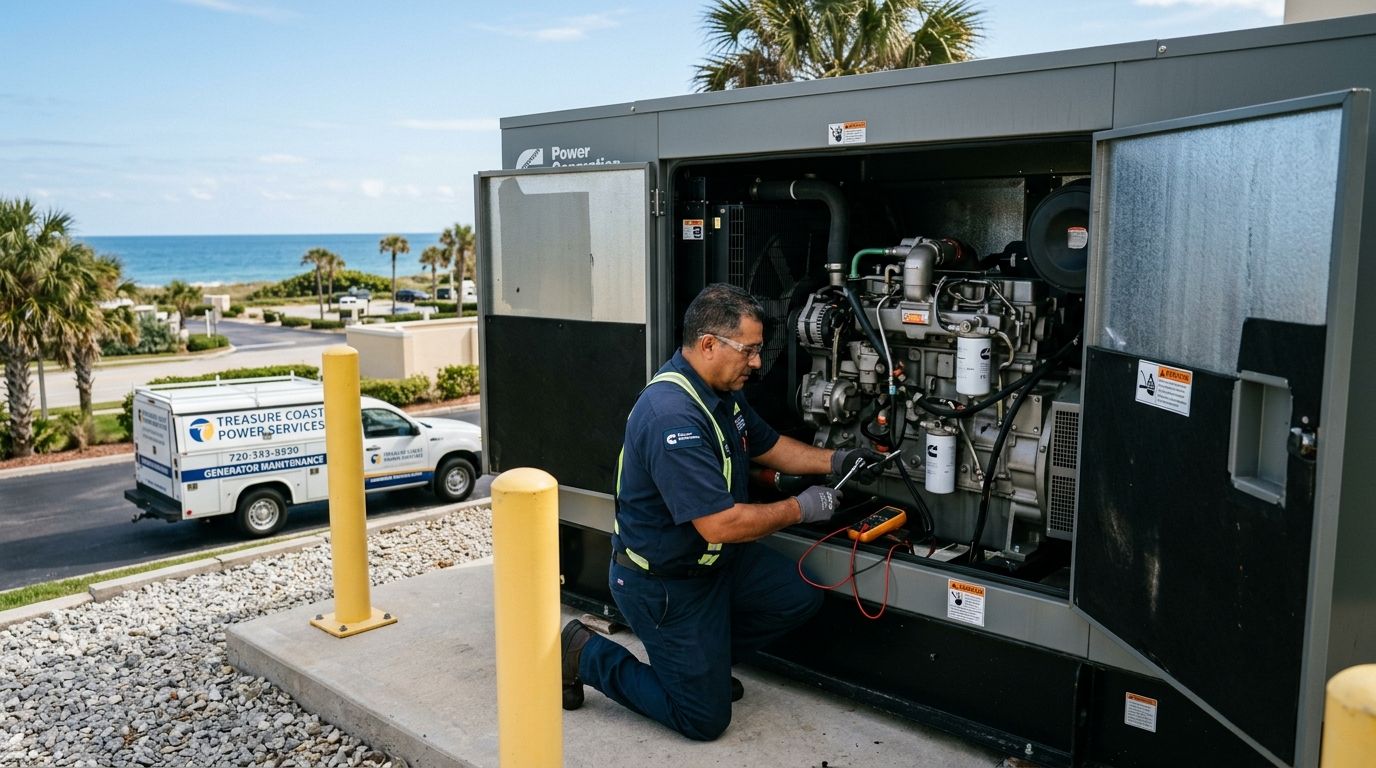
Commercial generator maintenance contracts on the Treasure Coast keep standby power systems tested, fueled, and documented for businesses that lose money the moment the lights go out — medical offices, restaurants, marinas, and property managers running multiple buildings across Port St. Lucie, Stuart, and Jensen Beach. A homeowner just wants the generator to start; a business owner needs a paper trail proving the unit was tested, serviced, and code-compliant before the next named storm or the next insurance audit.
- Commercial generator maintenance contracts on the Treasure Coast should include documented load tests, not just visual inspections, per NFPA 110 guidance.
- Imperium Electric LLC services standby generators for Port St. Lucie, Stuart, and Jensen Beach commercial accounts through 2026 and beyond.
- Businesses that skip transfer switch load testing are the most common cause of a generator failing during an actual outage.
- In-house checks alone rarely satisfy insurance or code documentation requirements for commercial standby power.
Why generator maintenance contracts matter for Treasure Coast businesses
A residential standby generator that fails on a Tuesday afternoon is an inconvenience. A commercial unit that fails during a hurricane-season outage means spoiled inventory, an evacuated medical practice, or a marina with no shore power for boats that depend on it. The Treasure Coast's hurricane exposure means commercial generators run more test cycles and more real outage hours per year than units in most parts of the country, which shortens the interval where problems show up — batteries, fuel filters, and transfer switches wear faster under that duty cycle.
Insurers and some commercial leases also expect documentation, not just a working generator. A maintenance contract that logs run hours, load test results, and part replacements is the record a business produces when a claim or a lease audit asks for it. Businesses without that paper trail are the ones scrambling after the fact.
Update your generator inventory first
Before any contract makes sense, know exactly what equipment you're maintaining. Multi-building commercial accounts on the Treasure Coast often have generators installed at different times by different contractors, with no single record of what's where.
- List every generator by location, make, model, and kW rating
- Note the fuel type — diesel, natural gas, or propane — and tank size
- Record the transfer switch type and whether it's automatic or manual
- Flag units installed before 2020 that may be running on outdated control boards
- Confirm which units fall under commercial generator installation warranties still in effect
Set your test and inspection schedule
NFPA 110, the standard most commercial standby power systems are built to, calls for a no-load exercise test weekly and a load test under real building demand periodically through the year. A maintenance contract should build its visit schedule around that standard, not an arbitrary quarterly drive-by.
- Weekly no-load exercise cycle, automated through the generator's controller
- A documented load-bank or building-load test at least twice a year
- A full inspection ahead of the June-through-November hurricane season
- A post-storm inspection any time the unit ran for more than a few hours on utility outage
- A written log showing run hours, dates, and technician sign-off for each visit
Check fuel and cooling systems every visit
Fuel and cooling are where commercial generators fail most often, and both degrade faster in Florida's heat and humidity than in cooler climates. A maintenance visit that skips these is a maintenance visit that isn't protecting you.
- Diesel fuel tested for water contamination and microbial growth
- Fuel filters replaced on schedule, not just when they look dirty
- Coolant level and condition checked, with radiator fins cleared of debris
- Battery voltage and terminal corrosion checked at every visit
- Air intake and exhaust paths inspected for blockage or corrosion
Test the transfer switch under real load
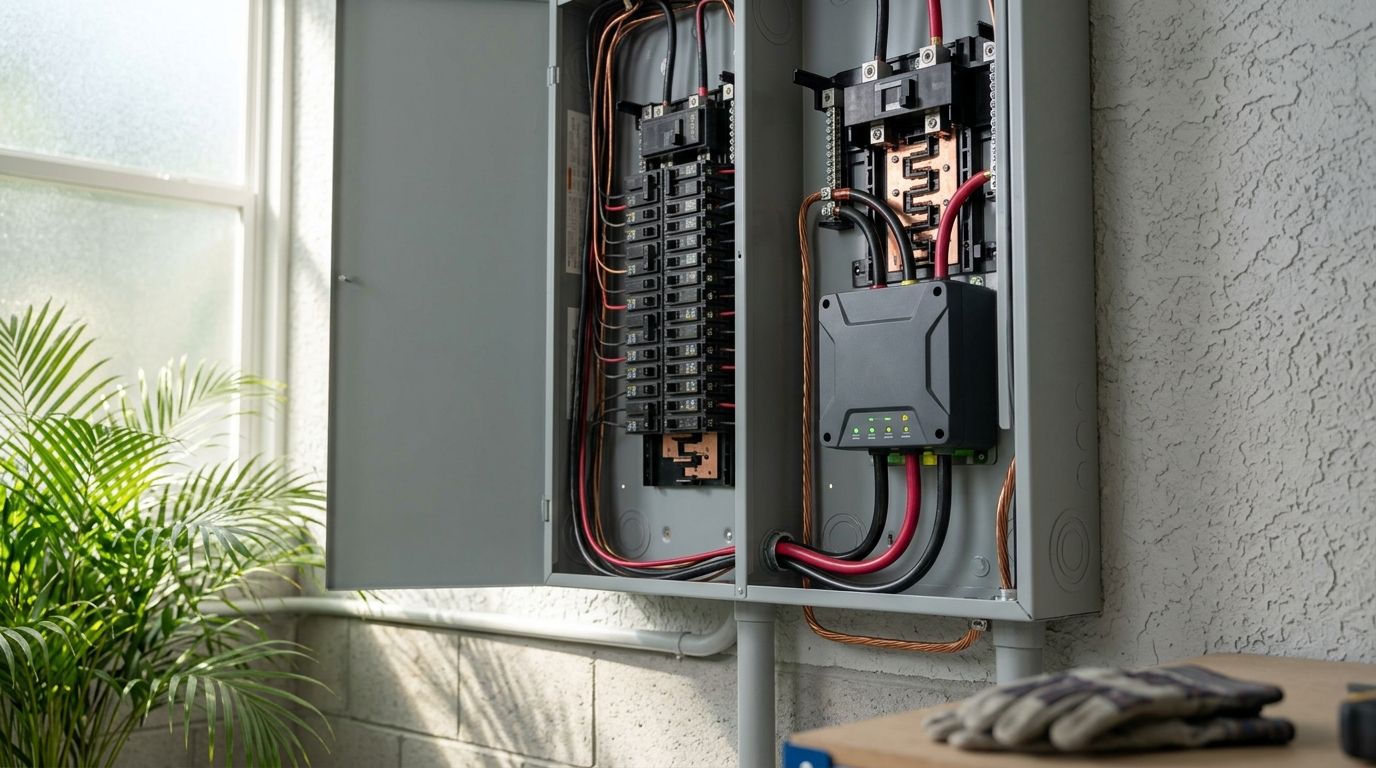
The generator can run perfectly and the building still loses power if the automatic transfer switch fails to hand off correctly. This is the single most common point of failure businesses discover only after an outage has already happened.
- Confirm the transfer switch cycles correctly from utility to generator and back
- Check for signs of arcing or heat damage on the switch contacts
- Verify the switch's timing settings match the building's actual load profile
- Test manual override in case the automatic function ever fails
- Coordinate transfer switch checks with any recent surge protection for commercial buildings work, since surge events and transfer switch faults often trace back to the same panel
Document every visit for insurance and compliance
A maintenance contract without paperwork is just a handshake. Commercial accounts need records that hold up if an insurer, inspector, or new property manager asks for them.
- Dated service reports listing every test and result, not a generic "serviced" checkbox
- Photos of any parts replaced, timestamped
- A running log of total generator run hours since installation
- Copies of any permit or inspection sign-off tied to the original install
- A single point of contact who can produce records on request, not a rotating crew
Compare in-house checks against a contracted plan
Some businesses assign a facilities employee to eyeball the generator monthly. That catches obvious problems — a dead battery, a fuel leak — but it rarely includes a real load test, and it almost never produces documentation an insurer will accept. A contracted plan through a licensed electrician for commercial generator maintenance contracts on the Treasure Coast closes that gap, because the technician doing the electrical panel work is also qualified to handle the commercial electrician services side of the building, not just the generator enclosure.
Build the contract scope in writing before you sign
A vague maintenance agreement is worse than none, because it creates a false sense of coverage. Get the scope in writing before the first invoice.
- Number of scheduled visits per year and what each visit covers
- Response time commitment for emergency calls outside scheduled visits
- Whether parts and labor for common failures are included or billed separately
- Who owns the documentation — you or the contractor — and how it's delivered
- What happens if the unit fails a load test: is repair quoted immediately or scheduled later
Comparing your commercial generator maintenance options
| Option | Best for | Key limitation |
|---|---|---|
| In-house employee checks | Small single-location businesses with one generator | No formal load testing, weak documentation for insurance |
| Manufacturer service network | Businesses under active factory warranty | Scheduling tied to manufacturer territory, not always local |
| Independent third-party contractor | Multi-brand equipment across several sites | Documentation quality varies widely by provider |
| Imperium Electric LLC maintenance contract | Treasure Coast businesses wanting one licensed contact for generator, panel, and transfer switch work | Local service area limited to Port St. Lucie, Stuart, Jensen Beach, and surrounding Treasure Coast |
The verdict: a commercial generator maintenance contract that skips documented load testing and transfer switch checks isn't protecting your business in 2026, it's just a maintenance calendar with no proof behind it.
Get a commercial maintenance quote
Licensed generator, electrical, and HVAC service across the Treasure Coast.
Common mistakes Treasure Coast businesses make
- Treating a warranty as a maintenance plan. A manufacturer warranty covers defective parts, not the scheduled testing and fuel maintenance a commercial unit needs to actually start when called on.
- Skipping load tests because the weekly exercise cycle runs fine. A no-load exercise proves the engine starts. It proves nothing about whether the unit can carry the building's actual electrical demand.
- Letting fuel sit untested for years. Diesel fuel in a Florida climate degrades faster than most owners expect, and a generator with contaminated fuel can fail exactly when the storm hits.
- No single point of contact for records. When maintenance rotates between different technicians or companies, documentation gets inconsistent or lost — exactly when an insurer asks for it.
- Assuming the transfer switch never needs attention. Businesses maintain the generator engine religiously and never test the switch that actually moves power to the building.
FAQ
What should a commercial generator maintenance contract include in 2026?
A commercial generator maintenance contract should include scheduled no-load exercise tests, at least two documented load tests per year, fuel and cooling system checks, transfer switch testing, and written service records for every visit.
How often should a commercial standby generator be load tested?
Most commercial standby generators need a documented load test at least twice a year, with an additional full inspection ahead of hurricane season, which runs June through November on the Treasure Coast.
Is in-house generator maintenance enough for a small business?
In-house visual checks catch obvious problems like a dead battery but rarely include real load testing or documentation an insurer will accept, which is why most multi-building or medical accounts move to a contracted plan.
Do commercial generator maintenance contracts cover repairs?
Coverage varies by contract — some include parts and labor for common failures, others bill repairs separately, so get the scope confirmed in writing before signing.
Why does the transfer switch matter as much as the generator itself?
The generator can run perfectly and the building can still lose power if the automatic transfer switch fails to hand off correctly, which is one of the most common causes of a standby system failing during an actual outage.
Who provides commercial generator maintenance on the Treasure Coast?
Imperium Electric LLC services standby and commercial generators for businesses in Port St. Lucie, Stuart, and Jensen Beach, alongside its electrical, plumbing, and HVAC work.
What documentation should a maintenance contract produce?
Expect dated service reports, load test results, run-hour logs, and records of any replaced parts, all of which a business may need for insurance claims or lease compliance.
Does hurricane season change the maintenance schedule?
Yes — most commercial contracts add a full inspection ahead of hurricane season and a post-storm inspection any time the generator ran for an extended period on an actual outage.
One last thing
The detail most businesses miss isn't the generator — it's the transfer switch. Technicians see far more commercial standby failures traced to a switch that never got tested under load than to the generator engine itself, because owners assume the switch is a passive part that doesn't need attention. If your last maintenance visit didn't include a documented transfer switch test, the contract isn't doing its job in 2026, no matter how many times the engine started on schedule.