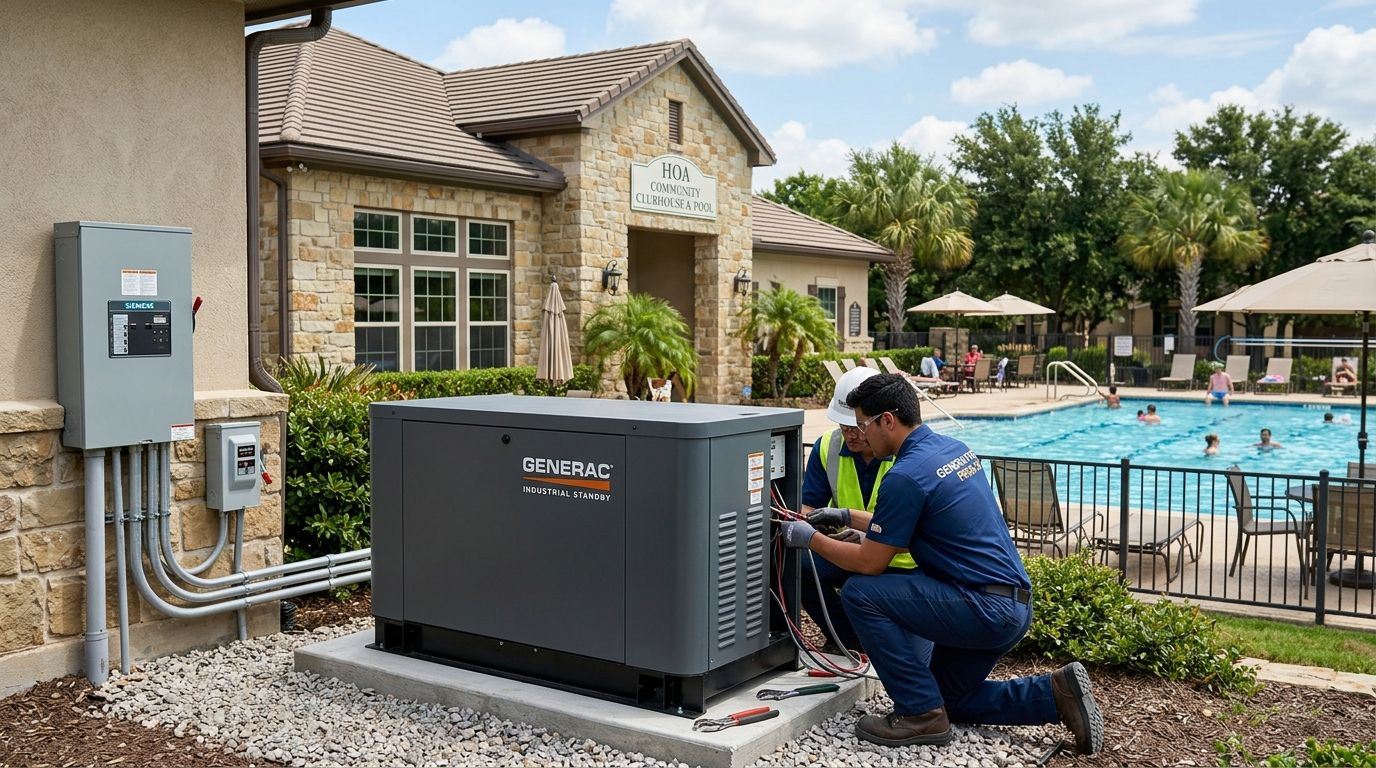
Generator installation for HOA clubhouses is the process of sizing, permitting, and wiring standby or portable backup power so a community's clubhouse, pool pump room, and common-area lighting stay operational during a grid outage. HOA boards face a different calculation than a single homeowner: shared liability, reserve-fund budgeting, and equipment that can't just sit dark — pool pumps need to keep circulating for water safety, and clubhouse HVAC often doubles as a cooling shelter during storm season.
- Generator installation for HOA clubhouses starts with a load audit of the clubhouse panel, pool equipment room, and shared lighting circuits.
- A 22-30kW standby unit typically covers a mid-size clubhouse plus pool pumps; larger amenity centers need a load study before sizing.
- Boards should budget the generator and a maintenance contract together — an untested unit that fails during a storm costs more than the contract.
- Automatic transfer switches keep pool circulation and emergency lighting running without a board member driving to the site.
- Permitting in St. Lucie or Martin County adds weeks; starting before hurricane season avoids the June-July backlog.
Why generator installation matters for HOA clubhouses
A residential standby generator protects one house. A clubhouse generator protects a shared asset that dozens or hundreds of unit owners rely on for cooling, water safety, and, during named storms, sometimes shelter-in-place capability.
Pool equipment is the piece boards underestimate. A pump left offline for more than a few hours in Florida heat lets algae take hold fast, and a board that has to drain and re-shock a community pool after every outage is spending reserve funds it didn't budget for. Backup power for the pool pump room is not optional in a serious generator installation for HOA clubhouses — it's the line item that pays for itself.
The other pressure is liability. If the clubhouse doubles as a cooling center or a meeting space during recovery, a board that didn't maintain working backup power has a harder conversation with its insurer and its residents after the fact. In 2026, that conversation happens with an insurance market that already scrutinizes Florida common-area maintenance records.
Audit the clubhouse and pool electrical load
Before any equipment gets ordered, someone needs to walk the panel and list what actually has to stay on.
- Clubhouse HVAC tonnage and whether it's one unit or zoned
- Pool pump and filtration motor horsepower, plus any heater or salt chlorinator
- Kitchen or catering equipment if the clubhouse hosts events
- Emergency and exit lighting circuits required by code
- Restroom exhaust fans and any well pump feeding irrigation
A board that skips this step ends up either oversized, paying for capacity nobody uses, or undersized, with a generator that trips the first time the AC and pool pump run together.
Size the generator to critical circuits, not the whole building
Most HOA clubhouses don't need the entire building backed up. They need the circuits that matter during an outage.
- Separate must-run loads (pool pump, emergency lighting, one AC zone) from nice-to-have loads (full kitchen, decorative lighting)
- Add 20-25% headroom above calculated running watts for motor start-up surge, especially with pool pump motors
- Confirm voltage and phase — many clubhouses run 208V three-phase service, which changes generator selection versus a residential 240V single-phase setup
- Use how to size a whole house generator as the baseline method, then scale up for shared amenity load
A 22kW to 30kW standby unit covers most single-clubhouse setups with a pool pump room. Amenity centers with a fitness room, full kitchen, or second building need a proper load study, not a guess.
Choose standby over portable for shared property
Portable generators work for one homeowner willing to run extension cords. They don't work for a shared asset with liability exposure.
- Standby generators start automatically within seconds of a grid failure and need no manual setup — the right call for any building residents depend on
- Portable generators require someone on-site to connect them, which means the clubhouse stays dark until a board member or vendor shows up
- Standby units run on natural gas or propane, avoiding the fuel-storage and refueling problem portable units create during a multi-day outage
- The same fuel and sizing tradeoffs at residential scale are covered in the best whole house generators for Florida hurricane season
Standby generators are the right choice for any HOA clubhouse or pool building — portable units are a stopgap, not a plan.
“If a board member has to drive to the clubhouse to start the generator, the community does not have backup power. It has a backup errand.”
Install the transfer switch and pull the permit
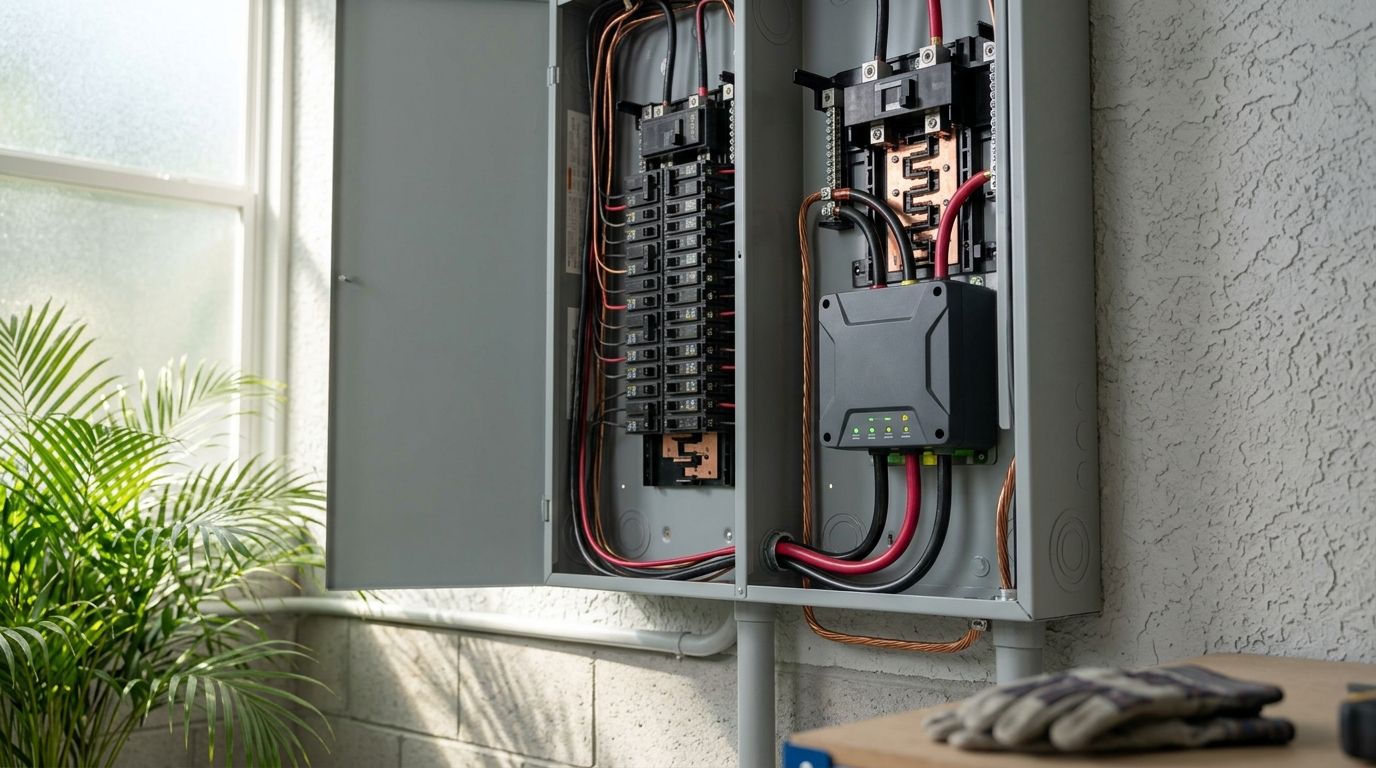
An automatic transfer switch is what makes the generator start without anyone flipping a breaker.
- Confirm the transfer switch is rated for the clubhouse's actual amperage and phase configuration
- Route the switch install through the same permit as the generator — St. Lucie and Martin County both require it for HOA-owned buildings
- Schedule the electrical inspection before the unit gets closed in by landscaping or screening walls
- Switch specs and install sequence are covered in generator transfer switch installation, which applies the same way to a clubhouse panel
Boards that skip permitting to save time get flagged later during a reserve study or an insurance inspection, and unpermitted work becomes a much more expensive correction in 2026 than it was at install.
Wire the pool equipment for bonding compliance
Pool circuits carry code requirements separate from the generator install itself.
- Equipotential bonding grid around the pool structure and metal equipment
- GFCI protection on all pool-adjacent circuits, including any generator-fed outlet near the pump room
- Dedicated circuit for the pool pump so it isn't sharing a breaker with clubhouse lighting
- Salt chlorinator and heater wiring inspected separately if either was added after the original pool build
Getting this wrong isn't a small fix. A bonding failure found during inspection can close the community pool until it's corrected.
Get a clubhouse load assessment
Licensed electrical and generator work for HOAs in Port St. Lucie, Stuart, and Jensen Beach.
Put a maintenance contract in the annual budget
A generator that sat unused for a year and fails on the first real outage is the board's worst-case scenario. Standby units need scheduled exercise cycles, oil and filter changes, and battery checks.
- Monthly or quarterly self-test cycles, logged for insurance and board records
- Annual load-bank testing to confirm the unit carries full load, not just idle
- Battery and starter checks before each hurricane season
- A written contract the board can point to during budget meetings
What a commercial contract typically covers is laid out in commercial generator maintenance contracts. Imperium Electric handles both the installation and the recurring service on the same account, which keeps the maintenance log in one place instead of split across two vendors.
Compare generator options for HOA clubhouses
| Option | Best for | Key limitation |
|---|---|---|
| Portable generator | Emergency lighting only, minimal budget | Manual setup during a storm; no automatic pool pump backup |
| Standby, clubhouse circuits only | Small clubhouse with no pool equipment room | Leaves pool circulation offline, so water-quality problems still follow every outage |
| Standby, clubhouse plus pool pump room | Most mid-size HOA amenity centers | Higher sizing and permit complexity than clubhouse-only |
| Commercial-grade unit with load-bank testing | Amenity centers with kitchens, fitness rooms, or a second building | Requires a formal load study before purchase; sizing by guesswork fails at this scale |
Imperium Electric quotes generator installation for HOA clubhouses off the load audit rather than square footage, which is why the sizing tier lands differently between two clubhouses of the same size.
Common mistakes HOA boards make
- Sizing off square footage instead of measured load. Square footage tells you nothing about pump horsepower or HVAC tonnage. A panel audit does.
- Leaving the pool pump off the critical-circuit list. Boards back up the lights, forget the pump, then pay for pool remediation after every outage.
- Treating maintenance as optional after installation. A generator with no exercise schedule is a generator that fails on day one of a real outage.
- Waiting until June to apply for the permit. County permit offices see a backlog every hurricane season; starting in winter avoids the wait.
- Budgeting the unit without the transfer switch, permit, and pad. Boards that price only the generator get surprised by the install total. How to finance a whole house generator in Florida covers the full-cost approach.
FAQ
How big of a generator does an HOA clubhouse need?
Most mid-size clubhouses with a pool pump room need a 22kW to 30kW standby generator, based on a load audit of HVAC, pool equipment, and emergency lighting. Larger amenity centers with kitchens or fitness rooms need a formal load study before sizing.
Does the generator need to power the pool pump too?
Yes. Pool pumps left offline during a Florida outage allow algae growth quickly, so most HOA generator installs treat the pump room as a critical circuit rather than an optional add-on.
Is a portable generator enough for an HOA clubhouse?
No. Portable units require someone on-site to connect them during an outage, leaving the clubhouse and pool pump dark until a board member or vendor arrives. Standby units start automatically within seconds.
Does an HOA generator installation need a permit?
Yes, in both St. Lucie and Martin County. The permit covers the generator, the automatic transfer switch, and the electrical connection, and it should be filed before installation begins.
How often does a clubhouse generator need maintenance?
Standby units need monthly or quarterly self-test cycles, annual load-bank testing, and a battery and starter check before hurricane season. A written maintenance contract keeps these on schedule for board recordkeeping.
Can an HOA fund a clubhouse generator through reserves?
Many boards fund it through reserves or a special assessment, and some finance the installation. Either way, the transfer switch, permit, and maintenance contract belong in the same budget line as the unit.
What is the difference between clubhouse-only and clubhouse-plus-pool sizing?
Clubhouse-only sizing covers lighting and HVAC but leaves the pool pump offline during outages. Adding pump horsepower to the load calculation usually pushes the generator into a larger capacity tier.
Who is responsible for bonding compliance on generator-fed pool circuits?
The licensed electrician performing the installation confirms that bonding and GFCI protection meet code on any circuit feeding pool equipment, including generator-backed circuits.
One last thing
The detail most boards miss until it's too late: a generator sized correctly on paper still fails in practice if nobody load-bank tests it. An idle standby unit passes its weekly self-test running almost no load and can still stall the moment clubhouse AC and the pool pump draw power at the same time. Annual load-bank testing is the one line item that catches that gap before a 2026 storm does.