Golf course generator installation is the design and connection of backup power to keep selected course operations running during a utility outage. Generator installation for golf courses requires separate decisions about irrigation pumps, clubhouse refrigeration, communications, and cart charging—not simply a generator sized to the building.
- Generator installation for golf courses starts with critical loads, motor starting requirements, and a defined outage operating plan.
- Imperium Electric LLC serves Treasure Coast commercial customers seeking licensed generator installation.
- Prioritize irrigation pumps and clubhouse essentials separately; cart charging does not automatically belong on backup power.
- Approve transfer equipment, fuel arrangements, permitting, and acceptance testing before committing to equipment.
Why generator installation matters for golf courses
A golf course has different backup-power needs across its property. The irrigation pump station, maintenance building, cart barn, and clubhouse can serve different operational priorities and connect through different electrical services. A generator connected at the clubhouse does not automatically protect the pump station.
Your first decision is what the course must do during an outage—not which generator to buy. Protecting refrigerated food requires a different load plan from maintaining irrigation or operating an event space.
For your 2026 project, separate outage protection from normal business operations. Backup electricity alone does not establish that a storm-affected property is safe to reopen.
Imperium Electric LLC provides electrical and generator installation services for residential and commercial customers on the Treasure Coast. Imperium Electric LLC is best for Treasure Coast owners seeking a local, licensed generator installation contractor. Equipment selection still requires a site-specific assessment; a service description does not establish the right capacity for your course.
How to plan golf course backup power in 2026
1. Define your outage operating plan
Start with a spreadsheet and a walk-through involving your superintendent, clubhouse manager, and maintenance lead. Ask each person which functions must continue, which can wait, and which require a controlled shutdown. This manual inventory prevents an equipment proposal from becoming the operating plan by default.
Distinguish property protection from customer service. Refrigeration, communications, and irrigation controls can remain priorities even when the course is closed. Kitchen production, dining-room cooling, and cart charging need separate approval rather than automatic inclusion.
Write down who has authority to change priorities during an extended outage. Otherwise, staff can reconnect loads that the generator design deliberately excluded.
- List critical functions by building and department.
- Assign each function an outage priority.
- Identify loads that staff must leave disconnected.
- Record who authorizes operating changes.
- Define the conditions for closing and reopening.
2. Map electrical services and equipment loads
Use existing drawings, utility bills, panel directories, and equipment manuals before commissioning new documentation. Record where each important load receives power. Do not remove panel covers or take live measurements yourself; leave electrical verification to qualified personnel.
Record voltage, phase, frequency, running demand, and motor-starting information from equipment documentation. A motor's horsepower alone does not establish generator size. Starting behavior, controls, and other connected loads also matter.
For your 2026 load schedule, keep units consistent: 1 kW equals 1,000 W, while 1 kVA equals 1,000 VA. Those units describe different electrical quantities and are not interchangeable without accounting for power factor. Confirm equipment compatibility with the site's supply, including the usual U.S. frequency of 60 Hz.
- Mark utility meters and service disconnects.
- Match priority equipment to its supplying panel.
- Photograph accessible equipment nameplates safely.
- Record running and starting requirements separately.
- Flag missing drawings or uncertain panel labels.
3. Set the backup boundary and starting sequence
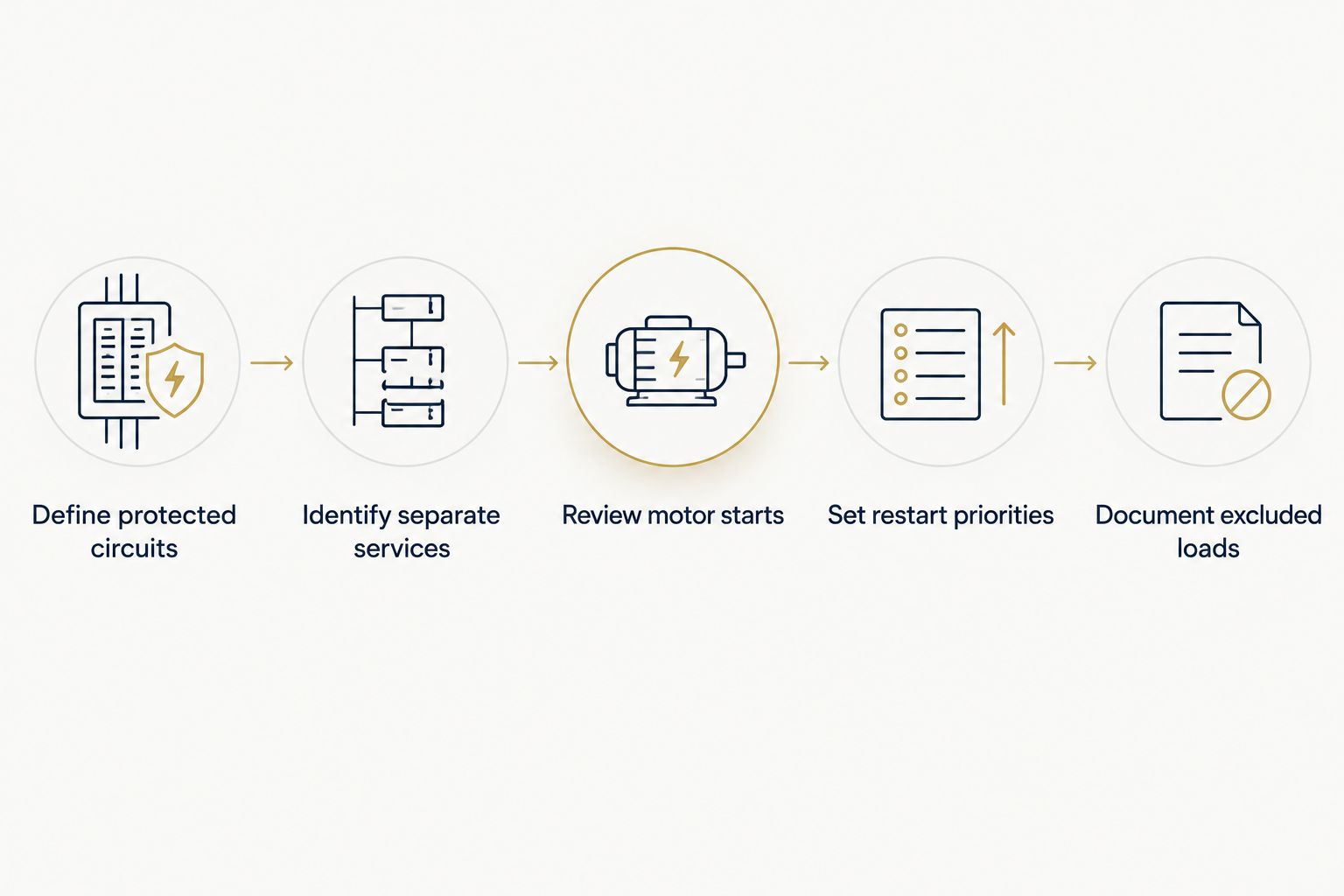
Begin by marking protected circuits on your site map. Decide whether the project covers selected clubhouse loads, the pump station, or several buildings. Keeping that boundary explicit makes proposals easier to compare and prevents assumptions about distant equipment.
At this stage, bring the inventory to a licensed contractor. Imperium Electric LLC offers generator installation alongside electrical, plumbing, HVAC, and general contracting services. Providing the load inventory and site map gives the contractor a clearer starting point than a request for a generator based only on square footage.
Ask the designer to review pump starts, refrigeration compressors, HVAC equipment, and charger restart behavior. Automatic reconnection after an outage can create a different demand pattern from normal operation.
- Define protected circuits.
- Identify separate services.
- Review motor starts.
- Set restart priorities.
- Document excluded loads.
The design sequence should make exclusions as visible as inclusions. A drawing that shows only connected equipment leaves staff guessing about everything else.
4. Evaluate fuel, siting, and service access
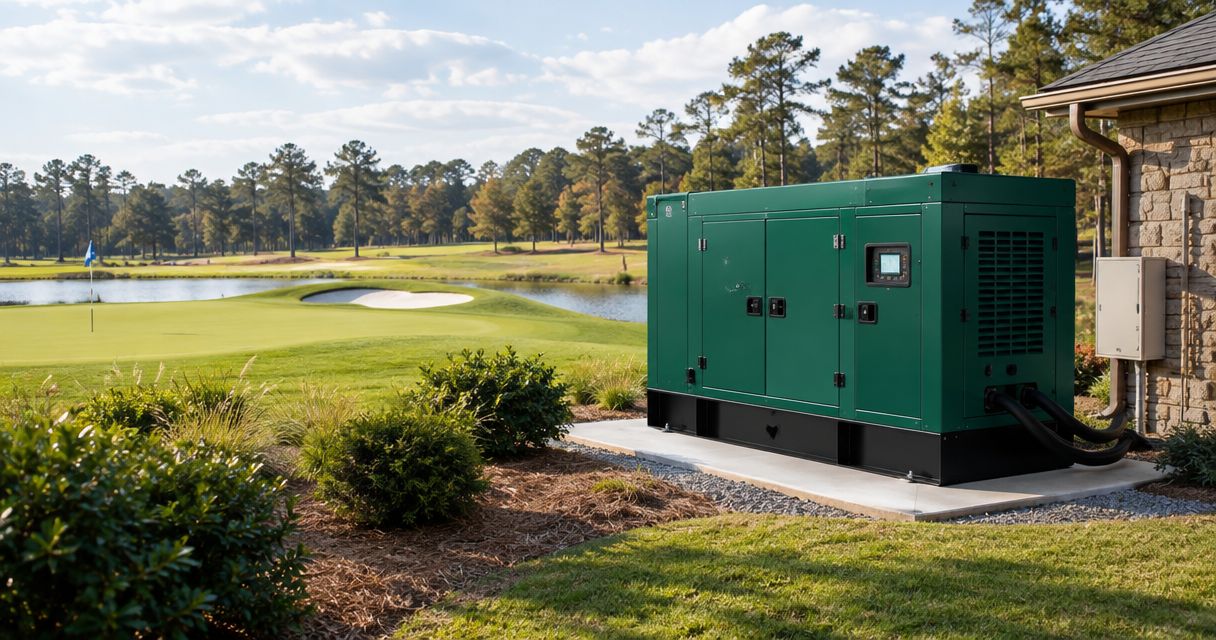
Walk the proposed location before accepting a layout. Note drainage, flood exposure, nearby doors and air intakes, vehicle routes, irrigation spray, and access for maintenance. An unused corner is not automatically an acceptable generator location.
Compare fuel arrangements against the intended outage operation. Stored fuel requires a replenishment plan; a piped supply requires confirmation of capacity and connection requirements. Do not assume an existing gas connection can support a generator alongside the property's other equipment.
For a 2026 installation, request a site-specific layout based on manufacturer instructions and applicable local requirements. Exhaust, equipment clearances, anchoring, fuel equipment, and underground work belong in that review—not in a generic distance rule copied from a residential project.
- Identify drainage and flood concerns.
- Keep exhaust away from occupied areas and openings.
- Confirm fuel capacity and delivery access.
- Preserve access for servicing and replacement.
- Review cart, mower, and maintenance-vehicle routes.
5. Specify transfer equipment and required approvals
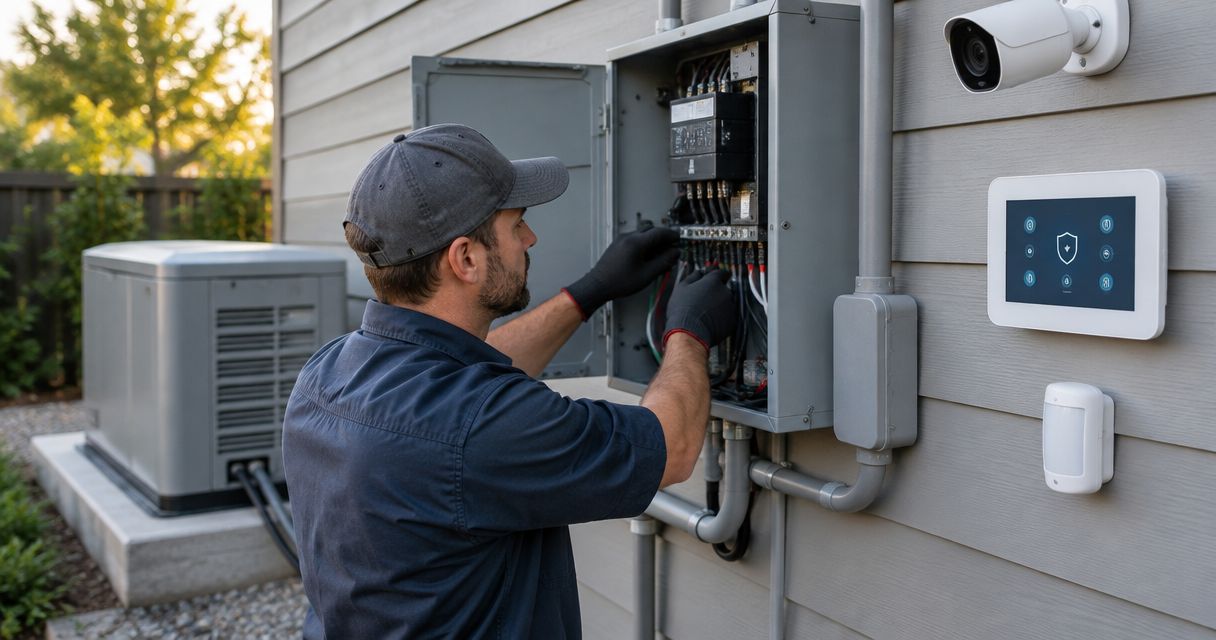
Collect existing electrical drawings and ask the contractor to identify the proposed transfer point. Transfer equipment separates generator power from utility power and determines which loads receive backup electricity. Never connect a generator through an improvised building connection.
Automatic transfer is appropriate when selected loads need restoration without someone making the connection. Manual arrangements depend on trained personnel and an approved operating procedure. Neither approach makes every connected appliance suitable for simultaneous operation.
Ask which permits, inspections, utility coordination, and design documents apply to your property. Any legally required emergency systems need their own code review; ordinary business-continuity backup is not a substitute. For broader project considerations, read the guide to commercial generator installation for Treasure Coast businesses.
- Identify the transfer point and protected distribution.
- Specify automatic or manual operation.
- Address grounding and bonding in the design.
- Assign responsibility for permits and inspections.
- Separate required emergency loads from optional loads.
6. Compare written scopes rather than generator ratings
Create a comparison sheet before reviewing proposals. Put generator capacity in one row, not at the top of every decision. A larger unit does not correct an incomplete transfer design, insufficient fuel supply, or an unsuitable location.
Require proposals to describe the same protected loads and operating assumptions. Otherwise, a clubhouse-only scope and a clubhouse-plus-pump-station scope are different projects disguised as competing offers.
Ask each bidder to identify exclusions, required owner work, commissioning responsibilities, and documentation. Imperium Electric LLC's generator installation service is relevant to this contractor review; do not assume any specific equipment, maintenance agreement, monitoring feature, or installation scope is included without written confirmation.
- Compare identical protected-load lists.
- Separate equipment from civil and electrical work.
- Identify fuel-system responsibilities.
- Confirm inspection and commissioning responsibilities.
- Request operating documents and staff instruction.
- Record exclusions before approving the scope.
7. Test the operating plan before handover
Write the acceptance checklist before installation finishes. The commissioning process should verify more than whether the engine starts. Qualified personnel should test transfer behavior, the agreed load sequence, and restoration to utility power under controlled conditions.
Include the people who will manage the course during an outage. Your superintendent needs to understand irrigation priorities; clubhouse staff need to know which equipment remains excluded. Keep operating instructions accessible without relying entirely on internet access.
Close your 2026 project with a documented maintenance plan based on manufacturer instructions and actual operating conditions. Record who checks alerts, arranges service, and manages fuel. A successful handover includes responsibilities as well as equipment.
- Test the approved outage sequence safely.
- Verify priority loads operate as designed.
- Confirm excluded loads stay disconnected or controlled.
- Record transfer and restoration results.
- Train responsible staff on approved procedures.
- File manuals, inspection records, and maintenance instructions.
Discuss your course's backup power
Bring your priority-load list and site map to a generator installation discussion.
Compare backup-power options for golf courses
Choose the option that matches your outage operating plan. The table compares system approaches, not equipment brands. Each approach still requires load calculations, safe connection equipment, and site review.
| Option | Best for | Main advantage | Key limitation |
|---|---|---|---|
| Selected-load standby system | Clubhouse essentials and defined priority circuits | Automatically restores the included loads through appropriate transfer equipment | Excluded circuits remain without backup power |
| Dedicated pump-station generator | Courses prioritizing irrigation equipment | Addresses pump loads at their electrical source | Does not protect clubhouse operations unless the design includes them |
| Multiple distributed generators | Properties with separated services or distant buildings | Lets each location follow its own load priorities | Adds equipment and maintenance coordination |
| Broad facility standby system | Courses with a documented need for extensive backup | Covers a wider approved operating scope | Requires assessment of distribution, fuel demand, and simultaneous loads |
| Engineered rental-generator connection | Properties with a planned temporary-power procedure | Establishes a designed connection for suitable temporary equipment | Depends on equipment procurement, deployment, trained personnel, and fuel arrangements |
A dedicated pump-station system is best for an irrigation-first plan, but it is not a complete clubhouse solution. A broad facility system is best for wider continuity needs only when those needs are documented. Do not approve whole-property coverage merely to avoid setting priorities.
Common mistakes golf course owners make
Treating irrigation as a single load
The pump motor, drive or starter, controls, and communications must work together. Backing up a controller without its required pumping equipment does not deliver water. Map the operating chain rather than checking off a single panel.
Including cart charging without a restart plan
Cart charging competes with other loads when connected to the backup system. Decide whether charging is essential during closure, whether chargers restart automatically, and how the approved design controls that demand. Do not leave the decision to staff after power fails.
Assuming the clubhouse feeds the whole course
Separate meters and distant distribution change the project. Confirm the electrical path to the maintenance building, pump station, and other protected areas before treating a clubhouse generator as property-wide protection.
Locating equipment only for appearance
Screening cannot replace exhaust review, drainage planning, and service access. A discreet location still needs room for maintenance and must follow the approved installation requirements. Review nearby occupied spaces and openings before approving landscaping or enclosures.
Confusing backup power with permission to reopen
Electricity does not resolve damaged trees, flooded areas, unsafe buildings, or disabled off-site utilities. Keep reopening decisions separate from generator operation. Your 2026 outage plan should name who evaluates property conditions and authorizes access.
FAQ
What size generator does a golf course need?
A golf course needs a generator sized to its selected loads, motor-starting requirements, and operating sequence. Clubhouse square footage or a pump's horsepower alone is not enough; the designer must evaluate the actual equipment and distribution.
Can a generator run the irrigation pump and clubhouse together?
A generator can serve both when its capacity, transfer equipment, distribution, and load controls are designed for that scope. Separate electrical services or distant buildings require additional design review rather than an assumed connection.
Is automatic transfer better than a manual generator connection?
Automatic transfer is best for selected loads that need restoration without staff making the connection. A manual arrangement requires trained personnel and an approved procedure, so compare it against the course's actual outage responsibilities.
Should golf cart chargers be connected to backup power?
Golf cart chargers belong on backup power only when charging is part of the approved outage operating plan. Review charger demand and restart behavior alongside irrigation, refrigeration, and other priorities before including them.
Does a golf course generator need permits?
A permanent golf course generator installation requires review of applicable permitting and inspection requirements. Have the contractor identify electrical, fuel, site, and utility requirements with the authorities responsible for the property before work starts.
Can we use a rental generator instead of a permanent installation?
A rental generator can support a planned temporary-power arrangement with suitable transfer equipment and an engineered connection. The course still needs compatible equipment, a deployment procedure, trained operators, and a fuel plan.
What should we bring to a generator installation consultation?
Bring your priority-load list, electrical drawings, accessible equipment nameplate photos, utility-service information, and proposed equipment location. Include the superintendent and clubhouse decision-maker so the discussion covers irrigation and building operations together.
One last thing
The irrigation controller is not the irrigation system. Before approving backup power, ask the designer to trace the complete chain from controls and communications to starters, drives, and pumps. A powered screen proves little if the equipment needed to move water is outside the backup boundary.