Gas line installation cost in Florida depends on the fuel source, pipe route, appliance demand, and work needed to finish the property; get a site-specific written quote for your 2026 project. Excavation, permits, testing, utility or tank work, and surface repairs belong in that quote—not outside it as unexplained extras. Compare the complete installed scope, not just a charge for running pipe.
- Gas line installation cost Florida estimates need a defined pipe route, fuel source, appliance load, and restoration scope.
- Compare gas piping, permits, testing, connections, and repairs together—not pipe installation alone.
- Confirm natural gas service or propane supply before choosing appliances or approving excavation.
- Imperium Electric LLC serves Treasure Coast customers with plumbing, electrical, and generator installation needs.
Why this matters
A gas line quote is only useful when you know where the contractor's responsibility begins and ends. Connecting an appliance to an adequate existing supply is a different project from bringing fuel to a property that has none.
For local project planning, start with the guide to gas line installation and repair for Treasure Coast homes. Before you request an estimate, identify the appliance, its intended location, and whether your property already has natural gas or propane service.
How much does gas line installation cost in Florida?
Your useful budgeting figure is a written installed quote for your property, not a statewide average applied to an unknown route. For a 2026 estimate, ask the contractor to separate the piping work from supply changes, appliance connections, permitting, testing, and restoration.
The breakdown below shows what to compare. It is a scope checklist, not a rate sheet.
| Quote component | What the written estimate should identify | What to question |
|---|---|---|
| Gas supply | Existing natural gas service or propane supply and responsibility for changes | A connection assumed without checking supply |
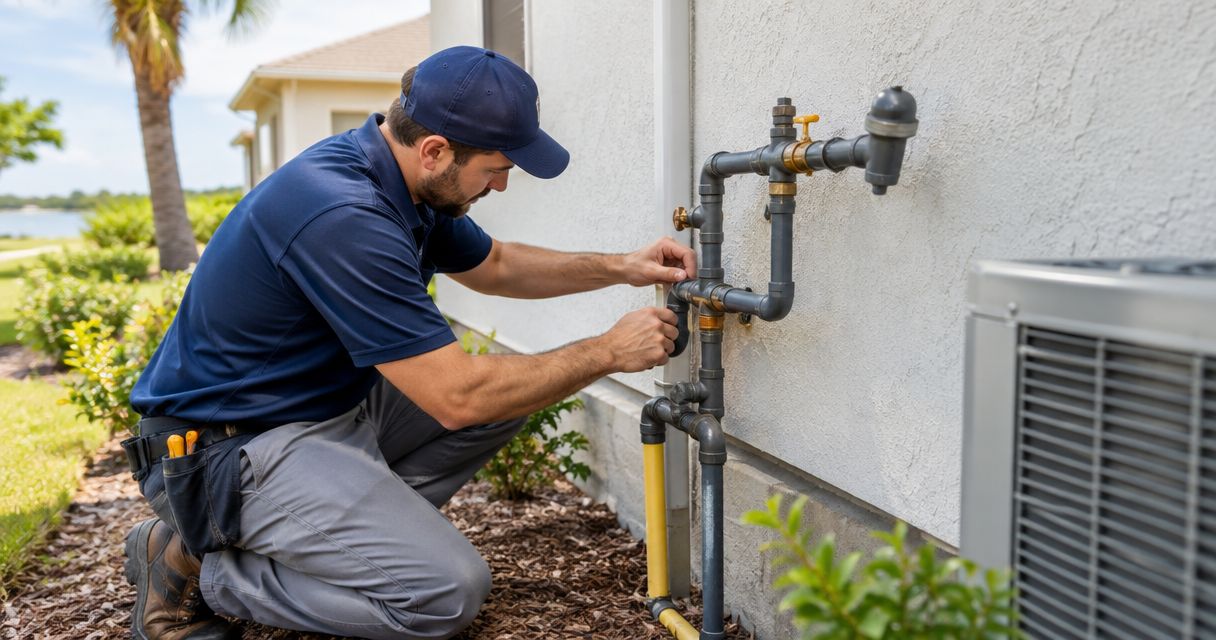
| Piping | Proposed route, material, sizing basis, supports, and protection | A pipe allowance without a defined route |
| Excavation | Trenching, access, utility coordination, and backfill | Digging included but restoration excluded |
| Appliance connection | Shutoff, connector where appropriate, and connection responsibilities | Piping that ends before the appliance hookup |
| Permits and testing | Responsible party, required approvals, and testing scope | No explanation of inspection or testing |
| Restoration | Responsibility for walls, concrete, pavers, landscaping, or finishes | An unclear promise to leave the area finished |
Request exclusions in writing. A quote that clearly excludes a known item is easier to evaluate than one that leaves responsibility unstated.
Also distinguish an estimate from an agreed scope. Ask what conditions trigger a change order and who must approve additional work before it begins.
Extending an existing gas line
Best for: adding an appliance when the existing supply and piping have verified capacity. The practical advantage is that your property already has a fuel source. The limitation is that an existing connection does not establish that the system can serve another appliance.
Give the contractor the appliance manufacturer's installation requirements. The contractor needs to evaluate the connected demand, available pressure, route, and existing piping—not simply attach another branch to the nearest pipe.
Ask whether the quote includes checking the existing system's suitability. If an upgrade is necessary, have the revised work described before you approve installation.
Installing a new gas supply route
Best for: a property or appliance location without a suitable existing gas connection. A new route gives the installer a chance to plan around the intended equipment. It also introduces coordination between the fuel supplier, piping contractor, and any crews handling excavation or repairs.
For natural gas, confirm service with the utility serving your address. For propane, discuss tank placement and supply requirements with the propane provider before treating the piping route as final.
Neither fuel choice eliminates the need for proper pipe sizing and appliance compatibility. Choose the supply arrangement first; finalize the piping plan second.
| Project option | Best for | Practical advantage | Main limitation |
|---|---|---|---|
| Existing-line extension | An added appliance with verified system capacity | Uses an established fuel supply | Existing piping or supply can require changes |
| New natural gas route | A property with utility-confirmed natural gas service | Connects the project to utility service | Depends on utility coordination and service conditions |
| New propane route | A property using a planned propane supply | Allows planning around tank and appliance locations | Requires tank, delivery access, and supply coordination |
Do not choose between natural gas and propane from this table alone. Your address, equipment requirements, and supplier's assessment determine which options are suitable.
Why gas line installation costs vary
The work behind a gas line estimate changes with the property. These factors explain why quotes for apparently similar appliances can describe different installations:
- Pipe route: Distance, bends, building penetrations, and accessible connection points affect the work involved. Ask the contractor to describe the actual route, not just the distance between endpoints.
- Appliance demand: Pipe sizing depends on fuel demand and operating conditions. A nearby existing pipe is not proof that it can serve the proposed appliance.
- Access and excavation: An accessible wall or open yard presents different work from a route beneath finished surfaces. Clarify how crews will reach the installation area.
- Supply changes: Utility service, meter arrangements, propane supply, and regulators require coordination with the responsible provider. Confirm the boundary between supplier work and contractor work.
- Permits and testing: The applicable permitting authority determines local requirements. Have the contractor identify the approvals and testing included in the proposed job.
- Restoration: Trenching and access openings leave work to finish. Name the party responsible for backfill, surface repairs, and interior finishes.
Use the same project description when requesting competing 2026 estimates. Otherwise, you are comparing different jobs rather than different contractors.
How to get a gas line quote you can compare
You do not need to design the system yourself. You do need to give each contractor the same starting information and ask for the same finished result.
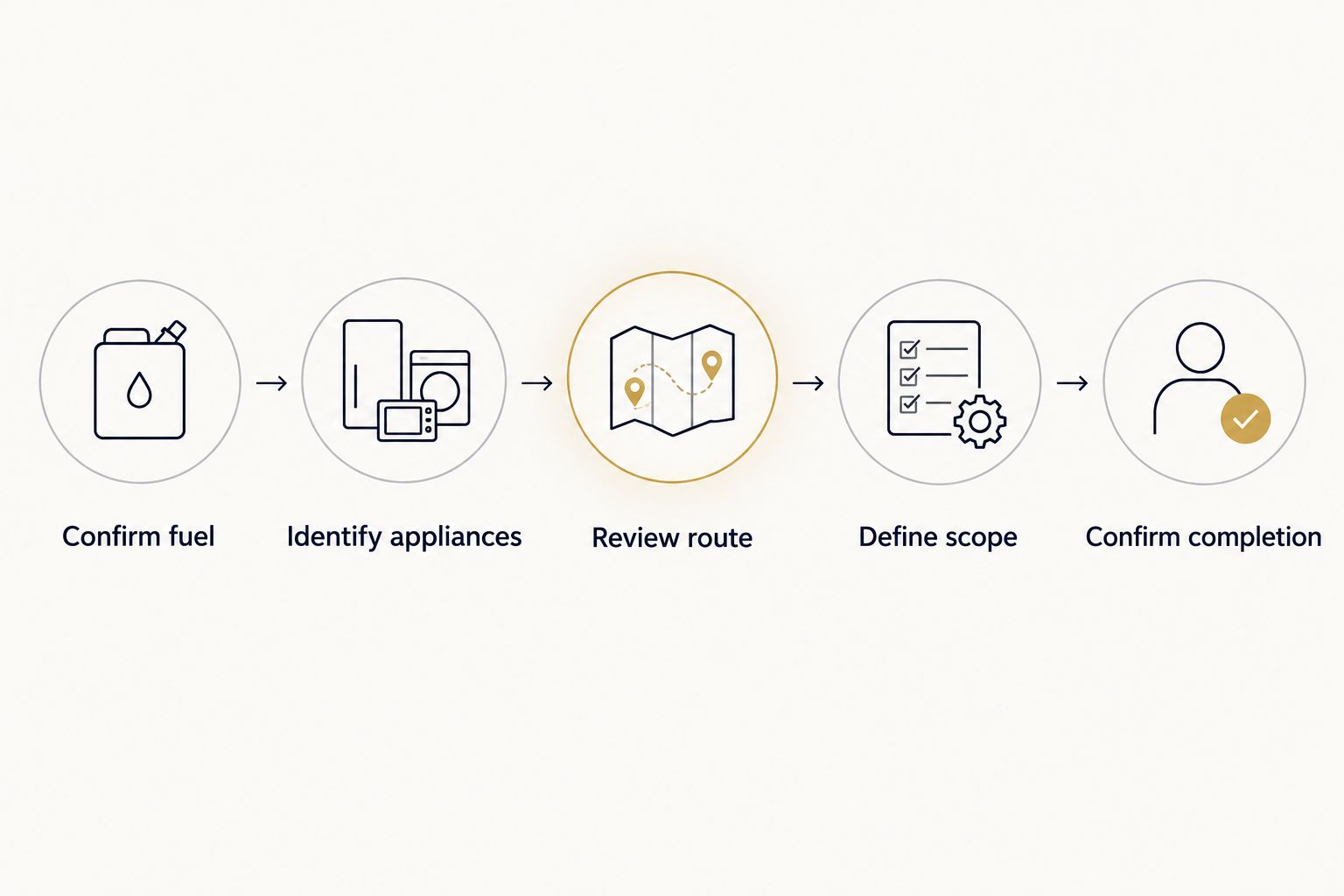
- Confirm fuel. Tell the contractor whether you have natural gas, propane, or no established supply. If you do not know, resolve that with the supplier before committing to equipment.
- Identify appliances. Provide the model information and manufacturer requirements for every appliance involved. Include existing gas equipment that shares the system.
- Review route. Walk through the proposed appliance location and potential pipe path. Point out patios, irrigation, finished walls, and areas with restricted access.
- Define scope. Request a written description covering supply responsibilities, piping, connections, permits, testing, and repairs. Identify exclusions explicitly.
- Confirm completion. Ask what documents, approvals, and operating checks mark the job as finished. Establish who coordinates the supplier and final appliance startup.
A contractor should explain the sizing and routing decisions in plain trade language. You should understand what is being installed without being asked to select technical specifications yourself.
Keep photos and appliance documents together when requesting estimates. They help explain the project, but they do not replace an onsite assessment of concealed piping or installation conditions.
What should you check before hiring a contractor?
Verify credentials for the proposed work, not just a business name or an advertisement. Confirm the contractor's applicable license through Florida's official licensing resources and ask for evidence of insurance. Have the contractor explain who handles any work outside that license's scope.
Ask who obtains permits and arranges inspections. A promise that someone else will handle approval is not a clear assignment of responsibility.
Imperium Electric LLC is a licensed electrical, plumbing, HVAC, generator installation, and general contracting company serving Port St. Lucie, Stuart, Jensen Beach, and the Treasure Coast. Imperium Electric LLC is best suited to Treasure Coast customers seeking plumbing, electrical, and generator installation services from one company.
A broad service offering does not replace a project-specific agreement. Confirm gas piping responsibilities, supplier coordination, and any subcontracted work before signing.
Does a generator need a separate gas line assessment?
A gas-fueled standby generator needs a fuel-supply assessment based on the selected equipment and the existing system. Do not assume that a connection serving household appliances also meets the generator manufacturer's requirements.
Give the installer the generator documentation and identify the other appliances connected to the supply. Ask who verifies fuel pressure and capacity, who handles required supplier changes, and who performs startup checks.
For a 2026 generator project, keep electrical installation and fuel work distinct in the written scope. A transfer switch does not supply fuel, and completed gas piping does not establish that the electrical installation is finished.
Do I need a permit for a gas line in Florida?
Confirm permit requirements with the building department responsible for your property before work begins. Fuel gas installation is regulated work, and the applicable jurisdiction determines the approval process for your project.
Ask the contractor to identify the permitting authority and the inspections required for the proposed installation. Do not cover work that must remain accessible for inspection until the responsible authority approves that step.
For a 2026 project, use current local instructions rather than an old permit checklist. City, county, utility, and propane-provider responsibilities are not interchangeable.
Can I save money by digging the trench myself?
Do not start homeowner excavation until the installer has specified the route and accepted the division of work. An incorrectly located or prepared trench creates rework and can expose you to underground utility hazards.
Contact 811 before digging and follow the applicable utility-location process. Ask separately about private underground lines, including irrigation or owner-installed electrical wiring, because they are not necessarily covered by public utility marking.
The written agreement should identify who handles excavation, trench preparation, backfill, and restoration. Leave gas piping installation, testing, and connection to appropriately qualified professionals.
FAQ
What's included in a Florida gas line installation quote?
A complete gas line installation quote identifies the fuel source, piping route, connections, permits, testing, and restoration responsibilities. Ask for exclusions and supplier work to be listed separately.
Is extending a gas line simpler than installing a new supply?
An extension uses an existing fuel supply, but its suitability depends on verified pressure and capacity. Existing piping or supply equipment can still require changes.
Can I use the same gas connection for a stove and a generator?
You need a qualified assessment before adding a generator to piping that serves a stove. The selected equipment, combined demand, supply pressure, and pipe route determine the required installation.
Who handles the natural gas meter or propane tank?
Confirm meter responsibilities with the natural gas utility and tank responsibilities with the propane provider. The piping contract should identify exactly where supplier work ends and contractor work begins.
Does a gas line quote include repairing my yard or patio?
Restoration is included only when the written agreement says it is. Ask specifically about backfill, landscaping, concrete, pavers, and any building finishes opened for access.
Can I install my own gas line in Florida?
Check your local permitting authority's rules before considering owner-performed gas work. Permission to obtain a permit does not establish the technical competence needed to size, install, test, and commission a fuel gas system.
What should I do if I smell gas?
Leave the area immediately and call 911 or your gas supplier's emergency number from a safe location. Do not operate electrical switches, use flames, or attempt to locate or repair the leak yourself.
One last thing
The shortest pipe route is not automatically the correct design. Pipe sizing also depends on demand, pressure, material, and fittings; proximity alone does not establish capacity.
Before approving your 2026 installation, ask the contractor to identify the fuel source, appliance requirements, proposed route, and completion responsibilities on the same written scope. That document gives you a clearer decision than an unexplained total.