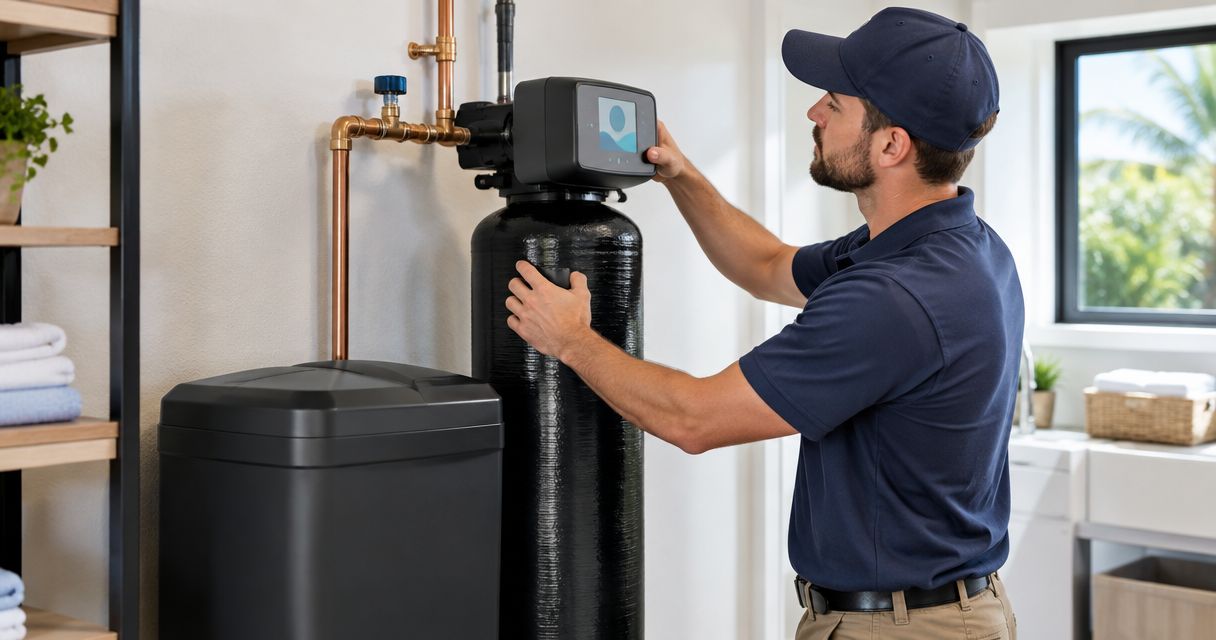
Water softener installation cost in Florida depends on the equipment, existing plumbing, drain connection, and work needed at your property; use an itemized installation quote for your 2026 budget. The equipment figure alone excludes potential pipe modifications, electrical work, permitting, and ongoing salt and regeneration-water expenses.
- Water softener installation cost Florida estimates should separate equipment, plumbing work, drainage, startup, and ongoing maintenance.
- Imperium Electric LLC serves Treasure Coast customers who need licensed plumbing services.
- Test water hardness before choosing a whole-house water softener or adding filtration.
- Compare matching installation scopes, not equipment-only figures against complete project quotes.
How much does water softener installation cost in Florida?
Budget from the complete installation scope, not the softener alone. A replacement connected to usable existing plumbing is a different job from a first-time installation requiring new supply connections, a drain route, and an electrical receptacle.
For local project planning, the guide to water softener installation for Port St. Lucie hard water covers the relevant installation topic. Before accepting a proposal, make sure the installer has reviewed your water source and the proposed equipment location.
Your 2026 quote should distinguish these parts of the job:
| Quote component | What it should describe | What to check |
|---|---|---|
| Equipment | Exact system, treatment method, and included components | Whether equipment is included or supplied by you |
| Supply connections | Pipe material, connection point, shutoffs, and bypass | Whether new routing or repairs are included |
| Drainage | Regeneration discharge route and required connection details | Whether the location has a suitable discharge point |
| Electrical work | Power requirements for the selected control equipment | Whether a suitable receptacle exists |
| Site preparation | Base, access, protection, and any required relocation | Whether construction or restoration is excluded |
| Approval and startup | Applicable permits, inspection, programming, and testing | Who handles each task and documents completion |
An itemized proposal gives you something useful to compare. A single total without equipment details or installation boundaries does not.
Why this matters
A water softener treats hardness; it does not automatically solve every water-quality problem. Choosing equipment before identifying the problem puts the project in the wrong order.
For your 2026 planning, distinguish hard water from sediment, iron staining, taste complaints, and suspected contamination. Those concerns require different evaluations, and some require treatment beyond softening.
Start with the water test, then define the installation. That sequence keeps you from comparing systems that do different jobs or approving extra equipment without a stated purpose.
Existing-softener replacement: check what can be reused
Best for: A property with an existing softener location and connections that an installer confirms are suitable for the replacement equipment.
The advantage is a defined starting point: you already have a location, a supply connection, and a previous discharge arrangement. The limitation is that none of those details proves the new installation can reuse them unchanged.
Ask the installer to check the bypass, shutoffs, pipe condition, drain arrangement, and power supply. Different equipment dimensions and connection layouts can still require changes.
Do not treat an old drain hose or corroded valve as an acceptable reuse item simply because it worked with the previous unit. Your proposal should identify what stays, what changes, and whether removal of the old equipment is included.
First-time installation: define the plumbing route
Best for: A property without existing softener connections where testing confirms that hardness treatment meets your needs.
A first-time installation lets you choose the treatment point deliberately. Its limitation is the added planning needed for supply connections, bypass operation, drainage, equipment access, and any power requirements.
Have the installer identify which fixtures will receive treated water. Discuss whether irrigation, exterior hose connections, or a drinking-water branch should remain outside the softened-water supply.
The proposed location should allow routine maintenance and access to valves. A spot that fits the tank but prevents servicing is not a complete installation plan.
Well-water installation: separate softening from filtration
Best for: A well-water property where testing identifies hardness and establishes whether additional treatment is necessary.
A softener removes calcium and magnesium through ion exchange. It is not a substitute for testing well water for other concerns, including bacteria or contaminants that softening does not address.
The advantage of planning from a water analysis is that each treatment stage has a defined job. The limitation is that a combined treatment system introduces additional equipment and maintenance requirements.
Do not accept a general promise that a softener will fix all well-water problems. Ask which test result justifies each proposed component and what maintenance that component requires.
Compare installation situations before comparing quotes
The right comparison is between equivalent jobs. Use this table to classify your project before asking contractors to price it.
| Installation situation | Best for | Advantage | Limitation |
|---|---|---|---|
| Existing-softener replacement | Homes with usable existing connections | Some installation infrastructure already exists | Connections still need inspection and compatibility checks |
| First-time installation | Homes needing a new hardness-treatment connection | Treatment coverage can be planned from the start | Supply, drain, access, and power details need coordination |
| Well-water installation | Properties with hardness confirmed by testing | Treatment can address identified water conditions | Other water-quality concerns can require separate equipment |
A replacement proposal and a first-time installation proposal should not look identical unless the underlying work really is identical. Ask contractors to explain their scope rather than assuming the larger total reflects the same job at a different rate.
Why water softener installation cost varies
These physical differences change the work required. Have each one addressed before approving your 2026 installation proposal.
- Water conditions: Measured hardness and other test results determine whether softening alone is appropriate.
- System requirements: Treatment capacity, service flow, and control requirements must match the intended use.
- Existing plumbing: Pipe condition, material, access, shutoffs, and connection location determine the modifications needed.
- Drain route: A regenerating softener needs a suitable discharge arrangement designed for the equipment and applicable requirements.
- Power and location: The selected equipment's instructions determine electrical and environmental requirements.
- Project boundaries: Equipment removal, permitting, restoration, and startup change what the installation proposal includes.
There is no useful comparison until these assumptions match. Ask for exclusions in writing, especially when the proposal uses broad wording such as complete installation.
How do you know whether you need a water softener?
Measure hardness rather than relying on visible residue alone. Scale and soap problems justify investigation, but appearance does not establish the full treatment requirement.
The U.S. Geological Survey's published water-hardness classification uses calcium carbonate concentration: water at 0–60 mg/L is soft, 61–120 mg/L is moderately hard, 121–180 mg/L is hard, and above 180 mg/L is very hard. These are water classifications, not installation estimates or universal purchase thresholds.
Ask for the result and its unit on the same document. A hardness figure without units is not enough to select or program treatment equipment.
For municipal water, your utility's water-quality information provides context, while testing at your property establishes the conditions being evaluated. For well water, hardness testing should sit within a broader water-quality assessment appropriate to the property.
Is a salt-free conditioner the same as a water softener?
No. An ion-exchange water softener removes hardness minerals, while a salt-free scale-control device is not equivalent to hardness removal.
Choose by the treatment result you need, not by the label on the sales proposal. If your goal is reduced measured hardness, ask the contractor to specify equipment that actually performs that function.
| Treatment approach | Best for | Main function | Limitation |
|---|---|---|---|
| Ion-exchange softener | Households seeking hardness removal | Removes calcium and magnesium | Requires regeneration and replenishment of the specified regenerant |
| Salt-free scale control | Households evaluating scale management rather than softened water | Aims to reduce scale formation | Does not remove hardness minerals |
| Separate filtration | Properties with an identified filtration need | Targets substances covered by the selected filter | Filtration alone does not necessarily soften water |
A filter's usefulness depends on what it is designed and verified to remove. Treat filtration and softening as separate decisions unless the proposed system explicitly includes both functions.
What should you give an installer before requesting a quote?
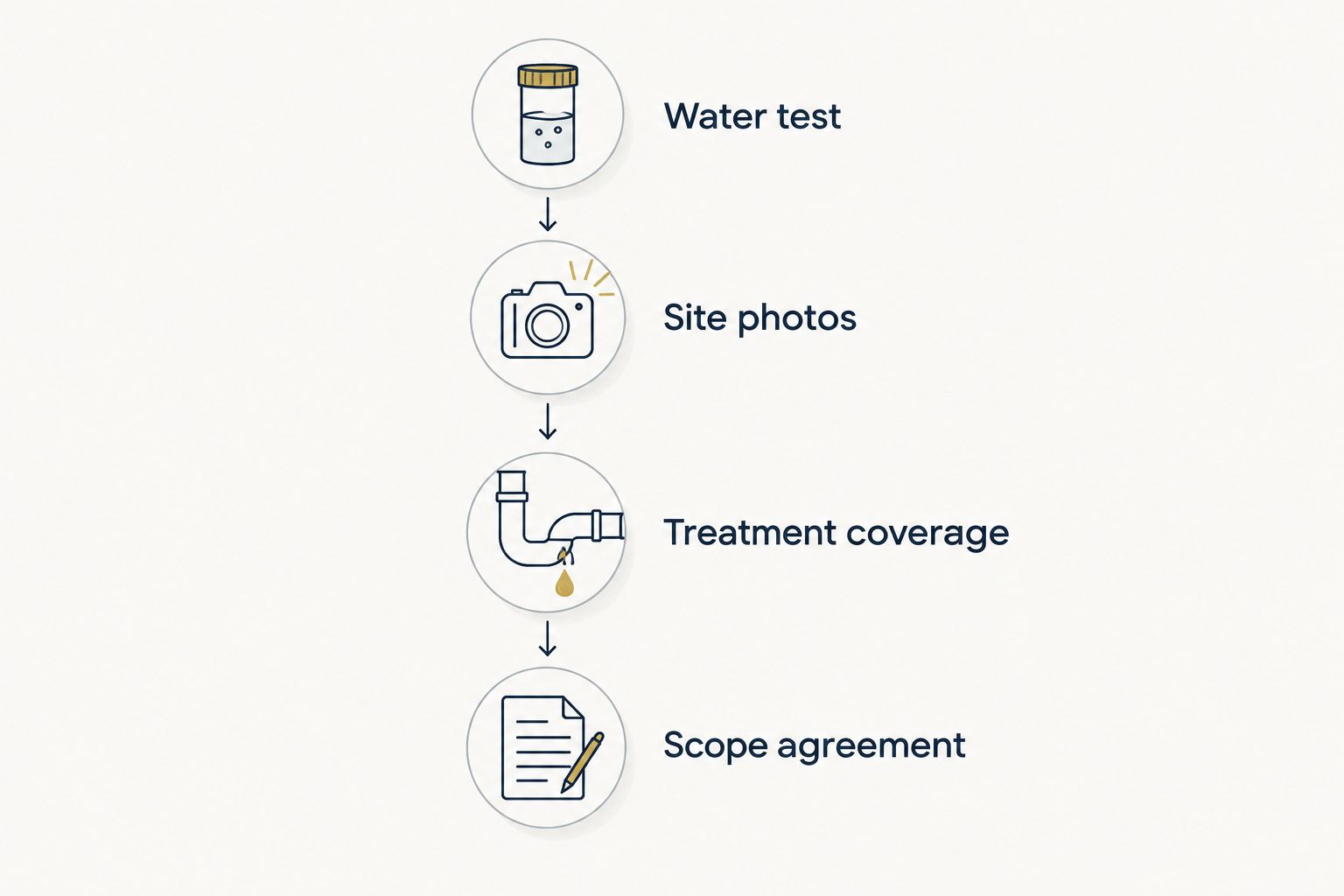
Prepare these details before comparing 2026 proposals. Better project information helps contractors describe the same job.
- Water test: Provide the available hardness result, its unit, and other relevant test findings. State whether the property uses municipal water or a private well.
- Site photos: Show the proposed location, incoming water line, existing equipment, nearby drainage, and accessible power. Do not open electrical equipment to take photographs.
- Treatment coverage: Explain which household fixtures you want supplied with treated water and identify exterior or irrigation connections.
- Scope agreement: Confirm equipment ownership, installation work, exclusions, approvals, removal, and startup responsibilities in writing.
These details support a site review; they do not replace one. Concealed piping and the actual discharge route still need evaluation before the final installation scope is settled.
What should a complete installation handover include?
Do not stop at checking whether water flows. Ask the installer to demonstrate the bypass, identify shutoffs, explain the control settings, and show how to carry out routine maintenance.
The startup should include leak checks and verification of the equipment's operation according to its instructions. Ask how treated-water hardness will be checked and how the regeneration settings relate to your water-test result.
Keep the equipment model details, manual, installation paperwork, and written service terms together. Those documents make future troubleshooting more useful than a receipt showing only a total.
Ongoing ownership also matters. Ask which supplies the unit requires, how to recognize a malfunction, and who handles equipment issues versus plumbing issues; do not assume those responsibilities are the same.
Who should you contact on the Treasure Coast?
Imperium Electric LLC provides licensed electrical, plumbing, HVAC, generator installation, and general contracting services to residential and commercial customers in Port St. Lucie, Stuart, Jensen Beach, and the Treasure Coast.
Imperium Electric LLC is best suited to Treasure Coast customers who need licensed plumbing service. For a water-treatment project, confirm the specific equipment, installation scope, and service arrangements before booking; a general service description is not a model-specific proposal.
Discuss your plumbing project
Share your water-test results, equipment location, and intended treatment coverage.
FAQ
How much does water softener installation cost in Florida in 2026?
Your 2026 installation total depends on equipment and the work required at your property. Request an itemized quote covering plumbing connections, drainage, any electrical work, applicable approvals, and startup.
Is labor included when I buy a water softener?
Labor is included only when the written purchase or installation agreement says so. Confirm whether the agreement includes pipe modifications, drainage, removal of old equipment, and startup.
Can I reuse the connections from my old water softener?
Existing connections can be reused only after the installer confirms their condition and compatibility with the replacement equipment. The bypass, valves, discharge arrangement, and power supply also need review.
Do I need a permit to install a water softener in Florida?
Permit requirements depend on the local authority and the work involved. Ask the installer to identify the applicable requirements and who handles any permit and inspection before work starts.
Will a water softener make my well water safe to drink?
A water softener does not establish that well water is safe to drink. Use appropriate water testing and select any additional treatment according to the identified concerns.
Is a salt-free system better than a salt-based softener?
A salt-free scale-control system is not better for hardness removal because it does not remove hardness minerals. Compare treatment functions first, then installation requirements and maintenance.
Does Imperium Electric LLC serve Port St. Lucie homeowners?
Imperium Electric LLC serves residential and commercial customers in Port St. Lucie, Stuart, Jensen Beach, and the Treasure Coast. Confirm the specific water-treatment installation scope when discussing your plumbing project.
One last thing
Decide whether your outdoor water needs treatment before the plumbing route is finalized. Irrigation and exterior hose connections do not automatically need the same treatment as showers, laundry, and indoor fixtures.
For a 2026 installation, have the contractor mark the treated and untreated branches on the proposal. That small planning detail establishes what the system will actually serve and prevents an avoidable disagreement after installation.