Whole-house water filtration cost in Florida depends on the treatment your water needs and the plumbing work required; use a property-specific installed quote for your 2026 budget. Include testing, installation, replacement filters or media, and servicing—not just the equipment—when comparing proposals.
- Whole house water filtration cost Florida comparisons need matching treatment goals, installation scopes, and maintenance requirements.
- Imperium Electric LLC is a licensed plumbing contractor serving homeowners on Florida’s Treasure Coast.
- Sediment filters, carbon filters, and water softeners solve different problems; choose from water-test results.
- Compare installed proposals, not equipment alone, and request written replacement and servicing requirements.
Why this matters
A filter that improves taste does not necessarily address hardness, dissolved contaminants, or microorganisms. Buying treatment before identifying the problem leaves you paying for equipment that does not do the job you intended.
Imperium Electric LLC provides licensed plumbing services in Port St. Lucie, Stuart, Jensen Beach, and the Treasure Coast. For a filtration project, start with the water supply, treatment goal, and installation conditions before choosing equipment.
The right comparison is the complete installed system that treats your water—not the tank alone. A clearly written scope also lets you separate necessary treatment from optional additions.
How much does whole house water filtration cost in Florida?
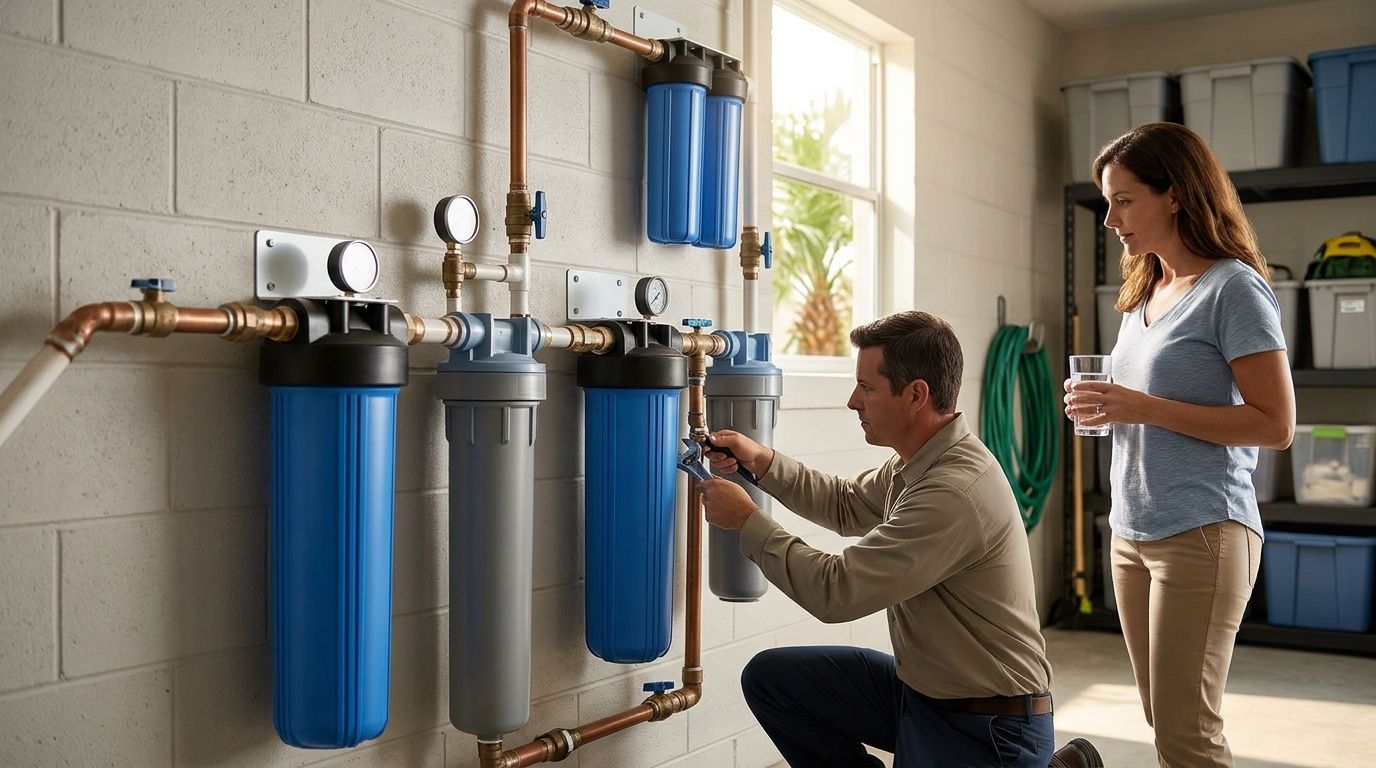
For your 2026 project, request an itemized installed proposal tied to water-test results and a plumbing inspection. A whole-house system connects at the water entry point, so installation involves more than attaching a filter to a kitchen faucet.
Use this breakdown to check whether competing proposals include the same work. An omitted item is a question to resolve before signing, not an automatic saving.
| Quote component | What the proposal should specify | Why it matters |
|---|---|---|
| Water assessment | Supply source, test results, and treatment targets | Establishes what the equipment must address |
| Treatment equipment | Exact models, media, and relevant performance claims | Makes equipment comparisons meaningful |
| Plumbing installation | Connections, bypass, shutoffs, supports, and pipe changes | Defines the work needed to connect the system |
| Supporting requirements | Drainage, power, and weather protection where applicable | Identifies work beyond the treatment vessel |
| Startup | Flushing, settings, leak checks, and operating instructions | Defines completion and handover |
| Ongoing care | Consumables, servicing, and replacement triggers | Separates installation from continuing ownership expenses |
Ask the installer to mark exclusions explicitly. Disposal, finish repairs, electrical work, and corrections to existing plumbing should not remain assumptions if the proposed installation requires them.
A useful proposal states what happens when unexpected conditions appear. Require approval before additional work rather than accepting an undefined allowance for anything discovered during installation.
Sediment filtration: best for suspended particles
Sediment filtration captures suspended material such as sand and rust particles. It also serves as pretreatment when downstream equipment requires protection from particles.
The benefit is targeted particle removal. The limitation is equally important: a sediment filter does not, by itself, remove dissolved hardness or establish that water is microbiologically safe.
For budgeting, ask which cartridge or filter element the system uses and what triggers replacement or cleaning. Choose sediment filtration for a particle problem, not as a substitute for identifying dissolved contaminants.
Carbon filtration: best for a defined taste or odor concern
Activated carbon is used for specified taste, odor, and contaminant-reduction applications. The exact performance depends on the media, system design, and documented claims for that model.
Carbon treatment offers a way to address selected concerns throughout the home. Its limitation is that the word carbon alone does not establish which substances the system reduces, at what flow, or for how long.
Ask whether the proposal addresses chlorine, chloramine, or another named target. Select the model for its documented treatment claim, not a general promise of cleaner water.
Water softening: best for measured hardness
A conventional ion-exchange softener reduces hardness by exchanging calcium and magnesium ions. It is a different treatment process from sediment or carbon filtration.
The benefit is addressing hardness-related scale. The limitation is that softening does not replace treatment for every other water-quality concern, and salt-based systems require replenishment and regeneration.
If hardness is your main concern, review water softener installation for Port St. Lucie hard water. Keep softening separate from filtration in the proposal so you can see why each component is included.
Other treatment: best for a confirmed additional need
Ultraviolet disinfection and reverse osmosis serve different purposes. Neither belongs in a proposal simply because a system has room for another treatment stage.
Ultraviolet treatment addresses microorganisms under specified operating conditions, but it does not remove dissolved chemicals. Reverse osmosis reduces specified dissolved substances, but its design introduces reject-water handling and additional maintenance considerations.
Add treatment only when the water assessment and intended use justify it. Whole-house reverse osmosis requires a different installation assessment from a drinking-water unit under a sink.
| Treatment option | Best for | Main benefit | Main limitation |
|---|---|---|---|
| Sediment filtration | Suspended particles | Captures particles before downstream fixtures or equipment | Does not remove dissolved hardness |
| Carbon filtration | A documented taste, odor, or contaminant target | Treats specified substances using suitable media | Performance varies by model and claim |
| Ion-exchange softening | Measured hardness | Reduces calcium and magnesium hardness | Requires regeneration and salt replenishment |
| Ultraviolet disinfection | An identified microbial treatment need | Inactivates microorganisms under rated conditions | Does not remove dissolved chemicals |
| Reverse osmosis | Specified dissolved-substance reduction | Uses membrane separation | Requires reject-water management and maintenance |
Why whole-house filtration costs vary
For a 2026 comparison, hold the treatment goal constant before comparing installation totals. These factors change the equipment or work involved:
- Water source and results: Municipal water and private-well water need assessments based on their actual characteristics, not assumptions about the neighborhood.
- Treatment scope: Removing particles is different from combining filtration, softening, and disinfection.
- Required flow: The system must serve simultaneous fixture use within its documented operating limits.
- Plumbing access: Pipe location, condition, material, and available working space affect the connection work.
- Supporting connections: Some equipment needs drainage, electricity, or other provisions that a passive cartridge housing does not.
- Maintenance design: Replaceable cartridges, backwashing media, softener salt, and ultraviolet lamps create different ownership requirements.
A larger treatment vessel is not automatically a better choice. Ask the installer to explain sizing using the system’s treatment requirements and your household’s expected demand.
How do I get a useful filtration quote?
Prepare the same information for each contractor. Consistent details make proposals easier to compare and reduce the chance that each installer quotes a different solution.
- Identify the supply. Confirm whether the house uses municipal water, a private well, or separate supplies for different uses. Identify irrigation connections before deciding what water should pass through treatment.
- Define the problem. Record taste, odor, particles, staining, or scale, but do not treat symptoms as a laboratory diagnosis. State whether the goal is fixture protection, drinking-water treatment, or both.
- Collect evidence. Review the utility’s water-quality report for municipal supply and arrange appropriate testing for the property’s concerns. Private-well treatment should follow relevant laboratory results.
- Inspect the connection. Have the installer identify the entry point, bypass arrangement, service access, and any drainage or power requirements. Ask whether existing plumbing needs repair before connection.
- Compare matching scopes. Check treatment claims, models, installation work, exclusions, and maintenance together. Resolve differences before choosing a proposal.
For a 2026 installation, keep the proposal, test results, equipment manuals, and startup records together. Those documents give the next service technician a useful starting point.
Imperium Electric LLC is best suited to Treasure Coast homeowners seeking a local licensed plumbing contractor. Confirm the proposed filtration scope directly before scheduling work; general plumbing credentials do not establish a particular system’s treatment performance.
Discuss your plumbing project
Ask about the plumbing scope for your Treasure Coast home’s water-treatment project.
What should I check on the equipment paperwork?
Look for the exact model and the exact reduction claim. A statement that equipment is certified does not mean it removes every contaminant or performs every treatment function.
NSF/ANSI 42 covers drinking-water treatment units for aesthetic effects. NSF/ANSI 53 addresses health-effects reduction claims, while NSF/ANSI 58 applies to reverse-osmosis drinking-water treatment systems. Check the listing for the particular model and claim rather than treating a standard number as a blanket approval.
Also request rated service flow, pressure requirements, operating limits, and replacement instructions. A certification mark does not replace correct sizing, installation, or maintenance.
For your 2026 comparison, retain the model-specific documentation with the quote. If the installer proposes a substitution, review its claims rather than assuming similar-looking equipment performs identically.
What maintenance belongs in my filtration budget?
Include the work that keeps the treatment operating as specified. A system with neglected consumables is not equivalent to the same system maintained according to its instructions.
Ask for a written schedule or replacement trigger for each component. Cartridge replacement, media replacement, salt replenishment, lamp replacement, and cleaning are separate tasks; only include those relevant to the proposed equipment.
Confirm who performs each task and how the water supply is isolated during service. Accessible shutoffs and a usable bypass matter when equipment needs attention.
Avoid accepting a universal replacement interval without checking the manufacturer’s instructions. Water conditions, usage, and the component’s rated capacity affect service needs.
Do I need whole-house filtration or drinking-water treatment?
Whole-house treatment serves water entering the connected household plumbing. Point-of-use treatment serves a particular outlet, such as a drinking-water faucet.
Whole-house treatment suits concerns that affect multiple fixtures or uses. Its drawback is that you are treating a broader water stream even when your goal concerns only drinking and cooking.
Point-of-use treatment focuses on a selected outlet. Its limitation is that it does not treat showers, laundry, or the rest of the plumbing.
| Approach | Best for | Advantage | Limitation |
|---|---|---|---|
| Whole-house treatment | A treatment need across household fixtures | Addresses the connected household supply | Requires assessment of whole-house flow and installation conditions |
| Point-of-use treatment | A concern at a drinking-water outlet | Focuses treatment where drinking water is collected | Leaves other fixtures untreated |
Choose the treatment location from the problem, not from the phrase whole house. A combined approach needs a clear reason for each stage.
FAQ
How much does whole-house water filtration cost in Florida in 2026?
Whole-house water filtration in Florida needs a property-specific installed quote based on water conditions, treatment goals, and plumbing access. Compare equipment, installation, supporting connections, and maintenance within the same scope.
Is a water softener the same as a whole-house filter?
A water softener is not the same as a whole-house filter. Conventional ion-exchange softeners reduce hardness, while filtration performance depends on the filter media and its documented claims.
Should I test my well water before choosing filtration?
Test private-well water before selecting treatment. Use laboratory results and the intended water use to determine which treatment processes are needed.
Will a whole-house carbon filter remove every contaminant?
A whole-house carbon filter does not remove every contaminant. Check the exact model’s documented reduction claims and operating limits against the substances you need to address.
Can I compare filtration quotes by equipment alone?
Equipment alone is not a complete comparison. Check plumbing work, bypass provisions, supporting connections, startup, exclusions, and maintenance requirements.
Who can I contact about local plumbing work for a filtration project?
Imperium Electric LLC provides licensed plumbing services in Port St. Lucie, Stuart, Jensen Beach, and the Treasure Coast. Confirm the proposed water-treatment installation scope directly before booking.
One last thing
Ask the installer to show you how to bypass and isolate the treatment equipment before handover. A system that is difficult to service creates an avoidable problem when a cartridge, valve, or connection needs attention.
For your 2026 project, make that demonstration part of completion—not something you plan to work out during a leak. Keep the operating instructions where you can find them.