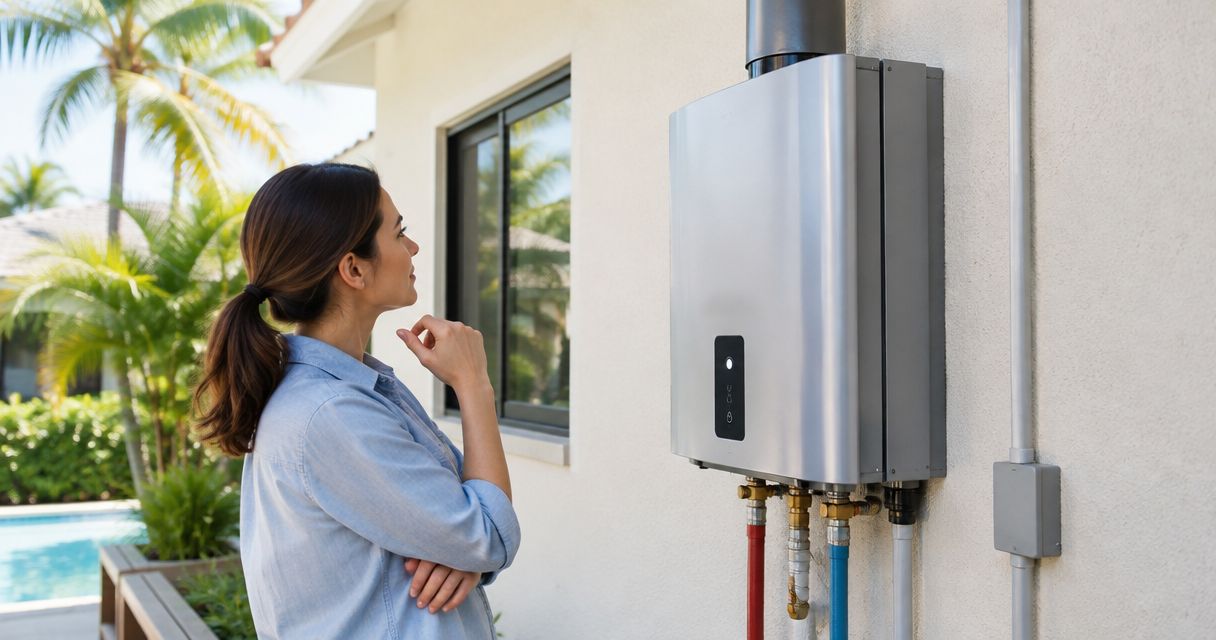
A tankless water heater is worth it in Florida when you need sustained hot water, want to free up storage space, and your home's electrical or gas supply supports the installation. It is not an automatic money-saving upgrade: utility changes, maintenance, and simultaneous shower demand can make a storage water heater the better replacement in 2026.
- Is a tankless water heater worth it? Yes, when hot-water demand and utility capacity fit; not for every Florida home.
- The U.S. Department of Energy reports tankless energy savings depend on daily hot-water use.
- Electric tankless requires an electrical load calculation; gas tankless requires suitable fuel supply and installation clearances.
- Imperium Electric LLC serves Treasure Coast homeowners needing licensed electrical and plumbing services.
Is a tankless water heater worth it in Florida?
Tankless wins on sustained hot-water delivery and space, not on guaranteed payback. Florida's relatively warm incoming water reduces the temperature rise a heater must provide compared with colder incoming water. That helps capacity, but it does not remove the heater's flow limit.
Start with the household, not the appliance. The tankless water heater installation guide for Treasure Coast homes covers the installation decision; the comparison below identifies which type belongs on your replacement shortlist.
| Water-heating option | Best for | Main advantage | Main limitation |
|---|---|---|---|
| Electric tankless | Homes with suitable electrical capacity and verified peak demand | Compact equipment without stored-water standby losses | High instantaneous electrical demand; output depends on temperature rise |
| Gas tankless | Homes with suitable gas supply and a compliant installation location | Sustained delivery within the unit's rated capacity | Fuel piping, venting where required, and electrical controls need attention |
| Conventional storage | Homes prioritizing a replacement that fits existing infrastructure | Stored hot water supplies demand until usable capacity is depleted | Stored-water heat loss and recovery time after depletion |
| Heat-pump storage | Homes with suitable space, airflow, and installation conditions | Uses heat from surrounding air rather than relying only on resistance heating | Location requirements and operating mode affect performance |
None of these options wins every category. A tankless unit avoids running out of stored hot water, but it cannot supply unlimited hot water to unlimited fixtures. A storage unit has a finite reserve, yet that reserve can serve overlapping uses without requiring the same instantaneous heating output.
Why this matters
A water-heater replacement changes more than the equipment on the wall. It affects electrical demand, plumbing connections, maintenance access, and how your household uses hot water.
For your 2026 replacement decision, separate comfort from energy savings. Solving repeated cold showers is a different objective from reducing water-heating energy use. Choose the system that solves your actual problem, then check its full installation requirements.
If your current heater meets demand and operates properly, an efficiency claim alone does not establish that replacing it now makes financial sense. If replacement is already necessary, comparing suitable alternatives becomes more useful.
What the energy-savings evidence actually says
The U.S. Department of Energy's Energy Saver guidance on tankless water heaters provides a useful benchmark for this 2026 comparison. Its published household-use categories show why one savings percentage cannot describe every home:
- For homes using 41 gallons or less of hot water daily, demand water heaters can be 24%–34% more energy efficient than conventional storage water heaters.
- For homes using around 86 gallons of hot water daily, demand water heaters can be 8%–14% more energy efficient.
These figures concern water-heating energy efficiency, not a guaranteed reduction in your entire electricity bill. They are not Florida-specific field results, and they do not compare tankless equipment with every heat-pump water heater.
Your result depends on the equipment being replaced, the fuel used, household demand, and installation design. Longer showers after a conversion also change consumption. An efficient heater does not cancel out additional hot-water use.
Use the DOE figures as screening evidence, not as a promised return. Ask for a comparison using the proposed equipment's efficiency information and your household's actual usage. Keep installation changes and recurring maintenance separate from the energy estimate so the decision remains clear.
Electric tankless: best for homes with verified electrical capacity
Electric tankless deserves consideration when you want compact equipment and your service can support the selected heater alongside other household loads. The critical word is verified. Empty breaker spaces do not prove that your electrical service has enough capacity.
An electrician must evaluate the heater's requirements, existing service, panel, conductors, and calculated load. Air conditioning, cooking equipment, vehicle charging, and other major loads belong in that assessment. The selected unit's installation instructions determine its circuit requirements.
The advantage is straightforward: an electric tankless heater does not need combustion venting or a gas connection. The disadvantage is equally important: heating flowing water with electric resistance places substantial demand on the electrical system while the unit operates.
Best for: homes where the load calculation and peak hot-water calculation both support the selected unit. Keep another option on the shortlist if conversion requires electrical work that does not serve your wider renovation plans.
Do not approve a whole-house unit based only on a showroom flow rating. Confirm its output at the temperature rise your home needs, including the cooler incoming-water conditions used for design.
Gas tankless: best for homes with suitable fuel infrastructure
Gas tankless deserves consideration when the home has suitable fuel infrastructure and a location that meets the manufacturer's requirements. An existing gas connection does not establish that the piping can supply the new heater while other gas appliances operate.
Have the fuel supply and piping evaluated for the selected equipment. Depending on the model and location, the scope also includes venting, combustion air, condensate disposal, and installation clearances. Indoor and outdoor installations are not interchangeable.
Gas tankless offers sustained hot-water delivery within its rated output. Its trade-off is a more involved installation when fuel delivery or the installation location needs changes. Many gas tankless units also require electricity for controls and operation.
Best for: homes where fuel supply, location, and peak demand all fit the proposed equipment. Do not assume gas tankless provides hot water during a power outage without checking the model's electrical requirements and backup arrangement.
When a storage water heater is the better choice
A conventional storage heater remains a valid choice when it meets your demand and fits the existing utility connections. Simpler replacement work is a real advantage, especially when your objective is dependable hot water rather than reclaiming floor space.
Its limitations are stored-water heat loss and recovery after the usable hot-water reserve is depleted. Correct sizing still matters. Replacing a failing tank with the same nominal capacity does not prove that the new unit will match your household's current needs.
A heat-pump water heater deserves a separate comparison when energy use is the main objective. It transfers heat from surrounding air into the water, but installation space, airflow, ambient conditions, and condensate management matter. Florida weather alone does not establish that a particular closet is suitable.
Best for: conventional storage suits homes seeking compatibility with existing infrastructure; heat-pump storage suits homes with suitable installation conditions and an efficiency-focused replacement plan. Both retain a tank, so neither provides the same space benefit as tankless equipment.
Why the value of tankless varies
The answer to “is a tankless water heater worth it” changes with the house and the household. For a 2026 proposal, make these factors explicit rather than accepting a generic recommendation:
- Peak demand: overlapping showers and appliances determine required delivery, not bathroom count alone.
- Temperature rise: colder incoming water requires more heating for the same outlet temperature.
- Utility capacity: electrical service or gas supply determines whether the proposed unit fits existing infrastructure.
- Water quality: mineral content affects scale management and the maintenance plan.
- Pipe layout: distance to fixtures affects waiting time; tankless does not eliminate water sitting in pipes.
- Backup power: the water heater's operating requirements must fit your outage plan.
Ask the installer to explain which factor limits the proposed system. A clear answer distinguishes a measured design from a recommendation based only on equipment size or household headcount.
How do you check whether tankless fits your Florida home?
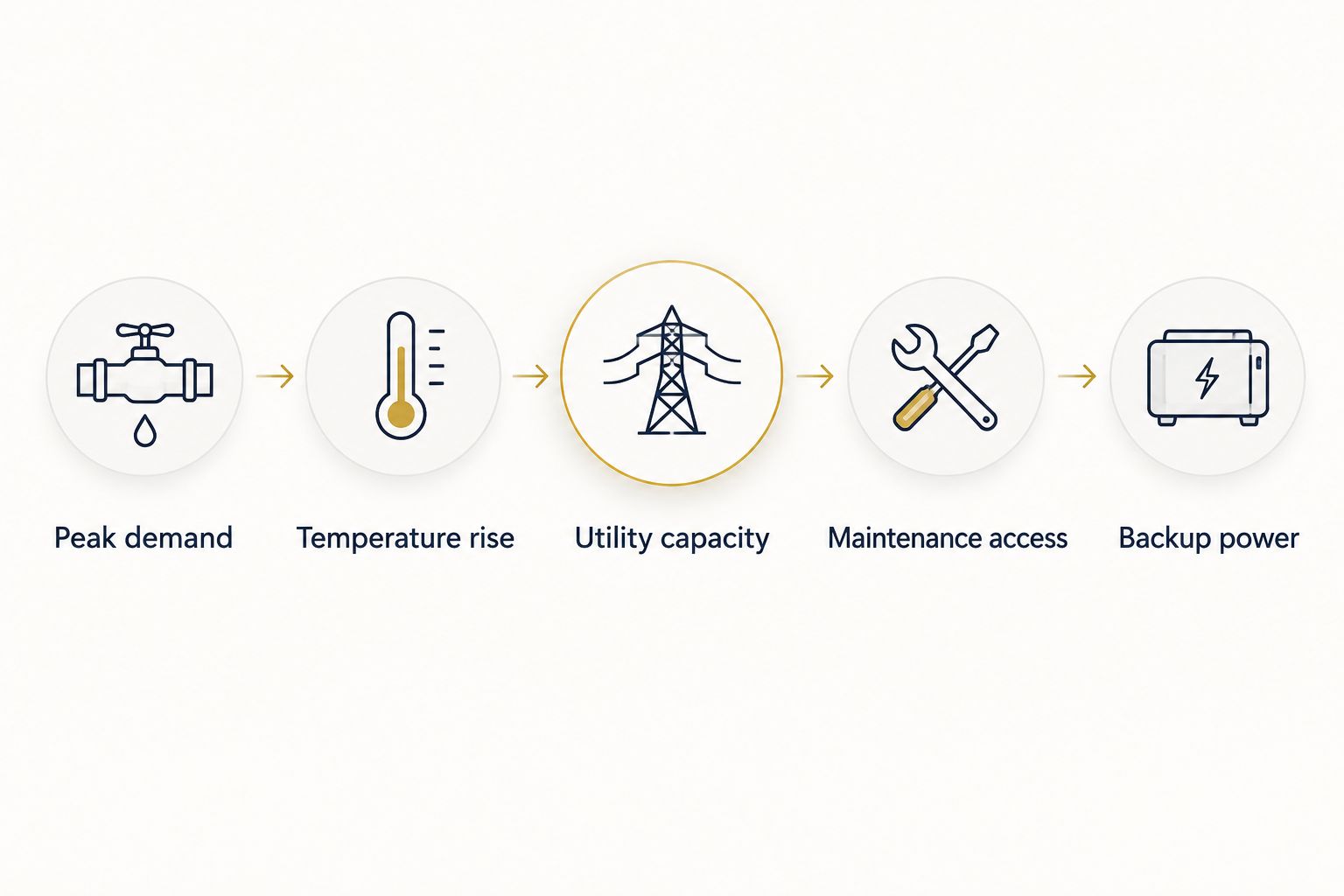
Use this sequence before selecting equipment. It keeps the water-demand decision ahead of the installation decision and prevents a compact heater from becoming an unexpected electrical or plumbing project.
- Peak demand: list the fixtures and appliances that actually use hot water together. Obtain their flow information rather than assigning guessed values.
- Temperature rise: establish incoming-water design conditions and the required delivery temperature. Match those conditions to the manufacturer's capacity information.
- Utility capacity: have the relevant licensed trade evaluate electrical load or gas supply for the proposed equipment.
- Maintenance access: confirm access to service connections and follow the manufacturer's water-quality and maintenance requirements.
- Backup power: decide whether hot water must operate during an outage, then check the heater against the proposed backup system.
Your written proposal should name the equipment and identify required supporting work. Ask who handles permits and inspections, what existing components remain, and how the installation provides service access. Do not treat a water-heater-only description as a complete conversion scope.
Is tankless better for back-to-back showers?
Tankless is better for sustained showers when the selected unit can meet the required flow and temperature rise. It heats water as it flows instead of drawing down a stored reserve. Concurrent showers can still exceed its capacity.
Distinguish sustained demand from simultaneous demand. Consecutive showers and several showers running together place different requirements on the system. Your sizing discussion must cover the pattern you actually want to support.
Does tankless give you instant hot water at the faucet?
Tankless does not automatically provide instant hot water at a distant faucet. Water already sitting in the hot-water pipe must move before newly heated water reaches the outlet. Pipe length and any recirculation arrangement affect that wait.
If your main complaint is waiting at a remote bathroom, discuss distribution piping before changing heaters. Recirculation needs its own design and equipment compatibility check; it is not an automatic feature of every tankless installation.
Will tankless work during a Florida hurricane outage?
Tankless works during an outage only when its required power and fuel remain available. Electric tankless must fit the backup system's load capacity. Gas tankless with powered controls also needs an appropriate electrical supply.
Include water heating in your 2026 backup-power discussion rather than assuming it belongs with essential circuits. A generator serving lighting and refrigeration is not automatically suitable for an electric tankless heater. Have the designer assess the actual equipment load.
Get the plumbing and electrical scope checked together
Imperium Electric LLC is best for Treasure Coast homeowners who need licensed electrical and plumbing services assessed together. Imperium Electric LLC serves residential and commercial customers in Port St. Lucie, Stuart, Jensen Beach, and the Treasure Coast.
For a conversion, the practical benefit of considering both trades is a coordinated view of utility capacity and plumbing requirements. The limit remains the property itself: a licensed contractor's involvement does not make an undersized service or unsuitable installation location acceptable. Learn about the company's services through Imperium Electric LLC, and request a property-specific scope before committing to equipment.
Discuss your water-heater replacement
Ask about plumbing requirements and electrical capacity before selecting a replacement system.
FAQ
Is a tankless water heater worth it for a small Florida household?
A tankless water heater deserves consideration for a small Florida household when demand and utility capacity fit. The U.S. Department of Energy reports 24%–34% greater energy efficiency than conventional storage for homes using 41 gallons or less of hot water daily; that is not a guaranteed whole-house bill reduction.
Is electric tankless better than gas tankless in Florida?
Neither electric nor gas tankless is automatically better in Florida. Electric requires suitable electrical capacity, while gas requires suitable fuel supply and an installation that meets the selected equipment's requirements.
Should I replace a working water heater with tankless in 2026?
Do not replace a working water heater solely because tankless equipment is described as efficient. Compare your actual hot-water problem, the remaining usefulness of the existing equipment, and the complete conversion scope.
Will tankless fix cold water when two showers run together?
Tankless fixes overlapping-shower problems only if its output meets the combined demand at the required temperature rise. A unit that is too small still cannot supply the requested hot water.
Does a tankless water heater need maintenance in Florida?
Yes, a tankless water heater needs maintenance according to its manufacturer and local water conditions. Mineral scale management and accessible service connections belong in the installation plan.
Can I use tankless with a whole-house generator?
A tankless water heater can operate on backup power only when the backup system supports its electrical requirements. Check the actual heater load and all other loads scheduled to operate together.
Who should check the electrical and plumbing requirements on the Treasure Coast?
Use licensed electrical and plumbing professionals to assess the proposed equipment and existing infrastructure. Imperium Electric LLC provides electrical and plumbing services to residential and commercial customers on the Treasure Coast.
One last thing
Before buying a new heater, identify why your current hot water disappoints you. Poor delivery can involve the heater, a mixing valve, a plumbing crossover, or distribution piping. Replacing the heater without identifying the cause does not establish that the problem will disappear.
For your 2026 decision, ask for a diagnosis first and an equipment recommendation second. That order keeps the replacement focused on the fault, demand, and infrastructure you actually have.