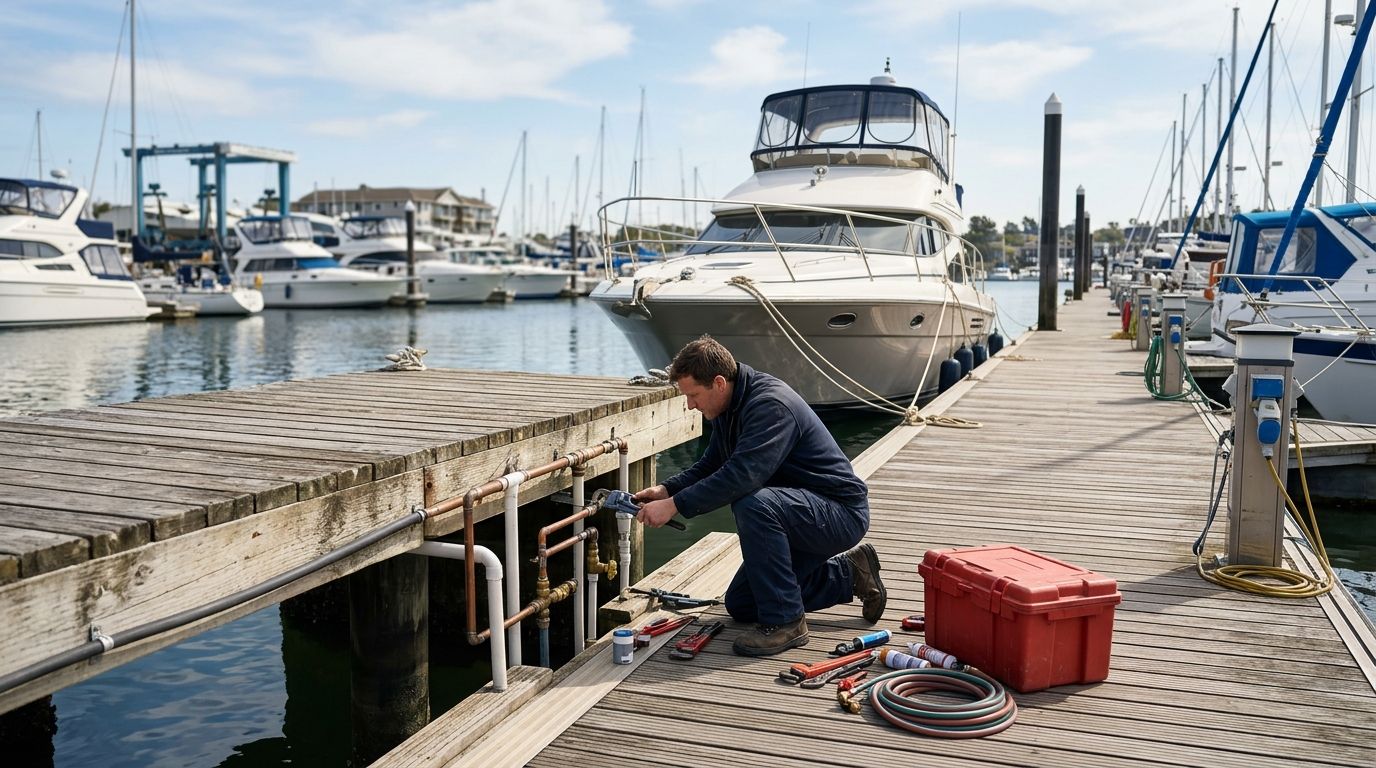
Marina and boat yard plumbing services handle backflow prevention, dockside wash-down lines, grease traps and storm drainage — systems built to survive saltwater, sand and weekend traffic spikes that a typical house never sees. Marina operators on the Treasure Coast deal with a different plumbing problem than homeowners face: corrosion from salt air, code requirements tied to open water, and pipe runs that sit idle Monday through Thursday and take a beating Friday through Sunday.
- Plumbing services for marinas in 2026 mean backflow prevention, grease traps, hydro jetting and storm drainage — not standard residential fixtures.
- Imperium Electric LLC handles commercial plumbing for Treasure Coast marinas, from backflow testing to sewer line camera inspections.
- Saltwater and sand wear marina plumbing faster than freshwater residential systems, so maintenance intervals run shorter.
- Marinas tied into municipal water need annual backflow testing to stay compliant and keep the waterway protected.
- Weekend traffic spikes mean marina plumbing should be sized for peak flow, not the average Tuesday afternoon.
Why plumbing services matter for marinas and boat yards
A marina's plumbing does two jobs a house's never has to: it protects a public waterway from cross-contamination, and it survives a punishing use pattern of near-zero weekday flow followed by dozens of boats hooking up over a single weekend. Standard residential fixtures and undersized backflow assemblies aren't built for either.
Saltwater air corrodes exposed brass and steel fittings faster than inland plumbing ever sees, and sand and silt from boat traffic settle in drain lines instead of flushing through the way household waste does. Storm season adds a third pressure: low-lying docks and bathhouses flood first when a system doesn't have working drainage before June.
Commercial plumbing services for Treasure Coast businesses cover marinas, boat yards, restaurants and multi-tenant buildings under one commercial license — the difference at a marina is where the fixtures sit and how hard the backflow and drainage requirements bite.
The plumbing checklist for marinas and boat yards
Test your backflow preventer every year
Any marina connected to municipal water needs a functioning backflow preventer to stop dock water, wash-down runoff or bilge discharge from siphoning back into the public supply. Florida water authorities require annual testing on these assemblies, and a marina sitting on open water is exactly the kind of connection inspectors flag first.
- Log the last test date and keep the certificate on site
- Walk the assembly quarterly and check for visible corrosion or leaks
- Flag any assembly older than 10-15 years for replacement, not another test
- Confirm the device size matches current dock capacity, not the marina's original build
- Schedule backflow preventer testing and installation before your county's compliance deadline, not after a violation notice
Install a grease trap before you open dockside food service
A tiki bar, snack shack or dockside restaurant changes your plumbing classification the day it opens. Grease that would be a minor annoyance in a house becomes a storm-drain violation at a marina sitting on the water.
- Size the trap to projected meal volume, not current volume, if you're planning to grow the food program
- Set a pump-out schedule before the trap backs up, not after
- Train staff to scrape plates before the sink, every shift, no exceptions
- Keep pump-out records on file for health department visits
- Bring in a licensed installer for the trap and drain line tie-in — undersized traps fail within months, not years
Size storm drainage and sump pumps for surge, not average flow
Marina property sits at the lowest elevation on most waterfront maps, which means storm drainage has to handle a surge event, not a typical rain day. A sump pump sized for average Florida rainfall will fail during a named storm.
- Map every low point on the property: bathhouse floors, dockmaster's office, electrical rooms
- Check that existing sump pumps have a battery or generator backup, not just grid power
- Clear storm drains and catch basins before June 1 every year, not after the first named storm
- Confirm discharge points don't dump back onto the dock or into slip areas
- Add redundant pumping capacity in any building that can't afford downtime during a storm
Hydro jet drain lines before sand and silt harden into a clog
Sand, silt and salt residue settle in horizontal drain runs the way grease settles in a residential kitchen line — except marina lines see it every day, not once a week.
- Run a visual check on slow drains monthly during peak season
- Snake minor clogs as a first pass; if the line's still slow, it's not a snake problem
- Book hydro jetting for clogged drains on a set schedule for bathhouse and wash-down lines rather than waiting for a backup
- Track which lines clog repeatedly — that's a design or slope issue, not a maintenance issue
Run a camera inspection on sewer laterals before hurricane season
A marina's sewer laterals often run longer distances than a house's, crossing parking areas and dock approaches where root intrusion and settling are common. Camera inspection before hurricane season catches a collapsing line before it becomes a closed bathhouse during peak weekend traffic.
- Schedule inspections on a two- to three-year rotation for older infrastructure
- Prioritize any lateral under a parking lot or heavy equipment path
- Document findings so repairs can be planned instead of reactive
- Pull permits before any dig-and-repair work near the waterline
Keep potable water lines separate from wash-down and bilge discharge
Cross-connection between drinking water and wash-down or bilge lines is the single fastest way to fail a health inspection at a marina. It also happens more often than operators expect once a dock gets retrofitted a few times over the years.
- Map every water line on the property and label potable versus non-potable at each valve
- Confirm wash-down stations have their own backflow protection, separate from the main assembly
- Check for any hose bib that's ever been used to fill both a drinking fountain and a wash-down bucket
- Route bilge and wash-down discharge away from any storm drain that feeds directly into the waterway
Boat lifts, davits and dockside power don't fall under plumbing, but they sit in the same wet, corrosive environment — dock and marina electrical wiring needs the same annual inspection discipline as the plumbing above.
“Marina plumbing sits idle most of the week and gets hit hard on weekends — size it for the surge, not the average.”
Plumbing options for marinas and boat yards compared
| Service | Best for | Key limitation |
|---|---|---|
| Backflow preventer testing & install | Any marina tied to municipal water | Needs annual retesting to stay compliant |
| Grease trap installation | Marinas running a restaurant, bar or snack shack | Backs up fast without a set pump-out schedule |
| Hydro jetting | Drain lines clogged with sand, silt or grease | Doesn't fix a collapsed or offset pipe |
| Sewer line camera inspection | Diagnosing repeat backups before a dig-and-repair job | Adds a diagnostic step before repairs start |
| Sump pump installation | Low-lying docks and buildings with high water tables | Needs battery or generator backup during outages |
Each of these is a Consider for a working marina in 2026 — none of them is optional once you're tied to municipal water, running food service, or sitting below the flood line, which describes most Treasure Coast waterfront property.
Common mistakes marinas and boat yards make
- Treating marina plumbing like residential plumbing. Pipe sized for a house's steady, low-volume use fails under a marina's weekend surge pattern.
- Skipping backflow testing until the county flags it. By the time a violation notice arrives, the marina's already out of compliance and facing a deadline instead of a routine.
- Opening food service without a grease trap sized for growth. A trap sized for opening-day volume backs up within a season once the food program picks up.
- Ignoring saltwater corrosion on exposed fittings. Brass and stainless hold up; cheaper fittings near the water fail years before an inland install would.
- No pump-out schedule for storm drainage before June 1. Clearing catch basins after the first named storm of the season is too late.
Get a marina plumbing quote
Licensed commercial plumbing for Treasure Coast marinas and boat yards.
FAQ
Do marinas need backflow preventers in Florida?
Yes, any marina connected to municipal water needs a working backflow preventer to stop wash-down or bilge water from siphoning into the public supply. Florida water authorities require annual testing on these assemblies, and waterfront connections are a common inspection priority.
How often should marina drain lines get hydro jetted?
Bathhouse and wash-down lines at a busy marina typically need hydro jetting on a set annual or semiannual schedule rather than waiting for a backup. Sand and silt settle in these lines faster than in a residential system, so reactive snaking alone isn't enough.
Do boat yards need grease traps?
Only if the marina or boat yard runs a kitchen, snack bar or dockside restaurant. Any food service operation on the property needs a properly sized grease trap and a set pump-out schedule to avoid a storm-drain violation.
How is commercial plumbing for marinas different from residential plumbing?
Marina plumbing has to handle weekend traffic surges, saltwater corrosion and cross-connection risk near open water, none of which a house deals with. Backflow prevention and storm drainage carry more weight at a marina than in a typical residential job.
What causes recurring clogs in marina bathhouse plumbing?
Sand, silt and salt residue tracked in from boat traffic settle in horizontal drain runs and build up faster than typical household waste. A camera inspection identifies whether it's buildup, a design issue, or a line that's settled or collapsed.
When should a marina schedule a sewer line camera inspection?
Before hurricane season, and on a two- to three-year rotation for older infrastructure. Marina sewer laterals often run longer distances than a house's, crossing parking areas where root intrusion and ground settling are common.
Can saltwater damage marina plumbing systems?
Yes, salt air corrodes exposed brass, steel and lower-grade fittings faster than an inland residential install ever experiences. Marinas that use corrosion-resistant materials on exposed fixtures see fewer failures over time.
Do marina sump pumps need backup power?
Yes, a sump pump running only on grid power fails exactly when it's needed most, during a storm outage. Battery or generator backup on drainage pumps is standard practice for low-lying dock and bathhouse buildings in 2026.
One last thing
Most marina plumbing failures don't happen on a slow Tuesday — they happen on a Saturday afternoon with fifty boats in the water and a bathhouse line backed up. Sizing every fixture and pump for peak weekend load, not average daily use, is the single change that prevents the most expensive marina plumbing emergencies.