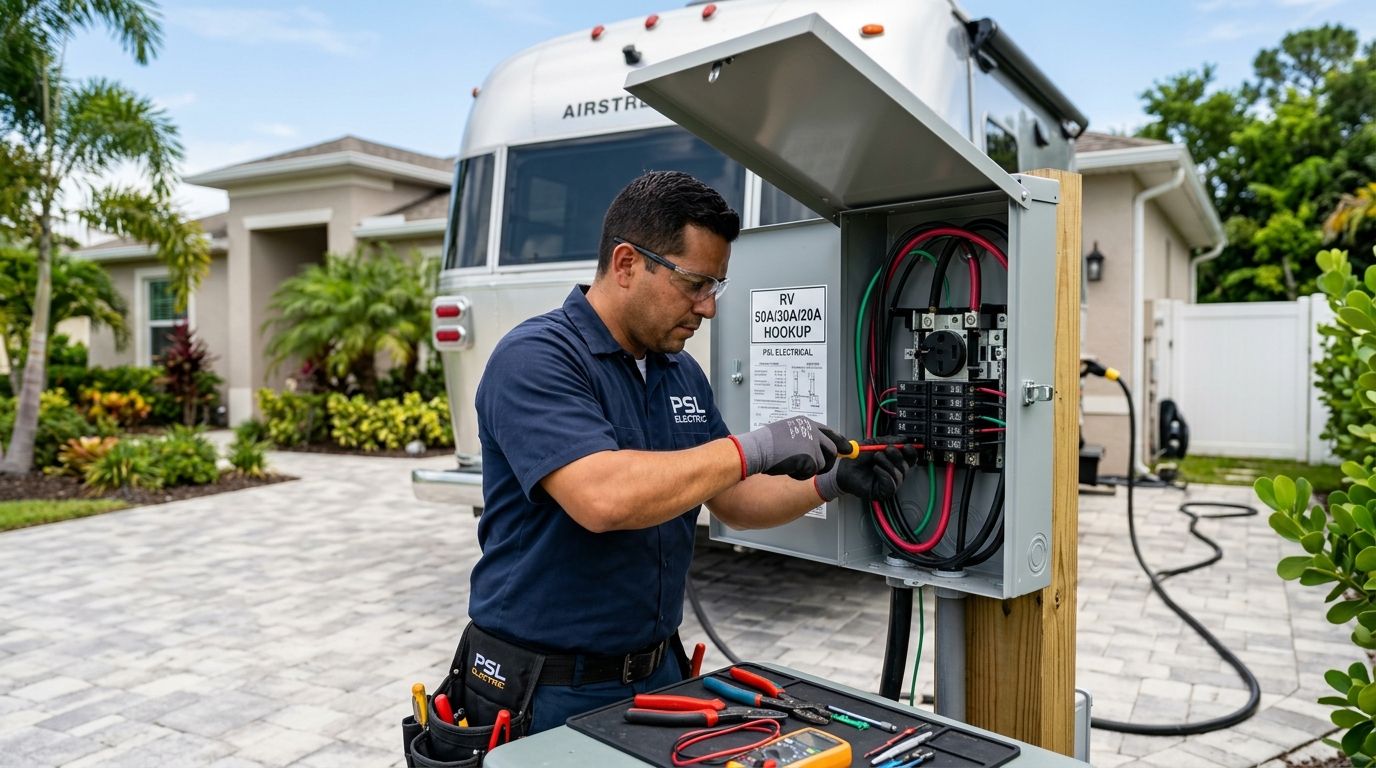
RV hookup electrical installation for Port St. Lucie homeowners means running a dedicated 30-amp or 50-amp circuit from your home's panel to an outdoor receptacle built to power a recreational vehicle safely, whether it sits in a driveway between trips or parks in a side yard for the season. Treasure Coast homes built before the 2000s often carry 100-amp or 125-amp panels that were never sized for a second high-draw load, which is different from a straight outlet swap — panel capacity has to be confirmed before anyone pulls wire.
- RV hookup electrical installation needs a dedicated 30-amp or 50-amp circuit, not a shared outlet, per NEC 551.71.
- A 50-amp RV service delivers up to 12,000 watts on split-phase 120/240V; a 30-amp service caps at about 3,600 watts.
- Older Port St. Lucie homes with 100-amp panels often need a panel upgrade before adding an RV circuit in 2026.
- St. Lucie County requires an electrical permit for a new RV outlet — skipping it can cost you at resale.
- Imperium Electric is licensed for this work in Port St. Lucie, Stuart, and Jensen Beach and handles the permit filing.
Why RV hookup electrical installation matters for Port St. Lucie homeowners
A lot of Treasure Coast homeowners buy the RV first and figure out power second. That backwards order is exactly why so many end up running an extension cord from a garage outlet through the yard, which trips breakers, degrades under Florida humidity, and voids the RV's shore power warranty in most cases.
Port St. Lucie's older subdivisions — think homes built in the 1970s through 1990s — were wired for window units and gas ranges, not for a rig that needs 30 or 50 amps on demand. Add the fact that St. Lucie County inspects new outdoor circuits before they're energized, and a weekend DIY job turns into a compliance problem fast. Get the panel load and the permit right in 2026 and the rest of the install is straightforward.
Confirm your panel has room for the new circuit
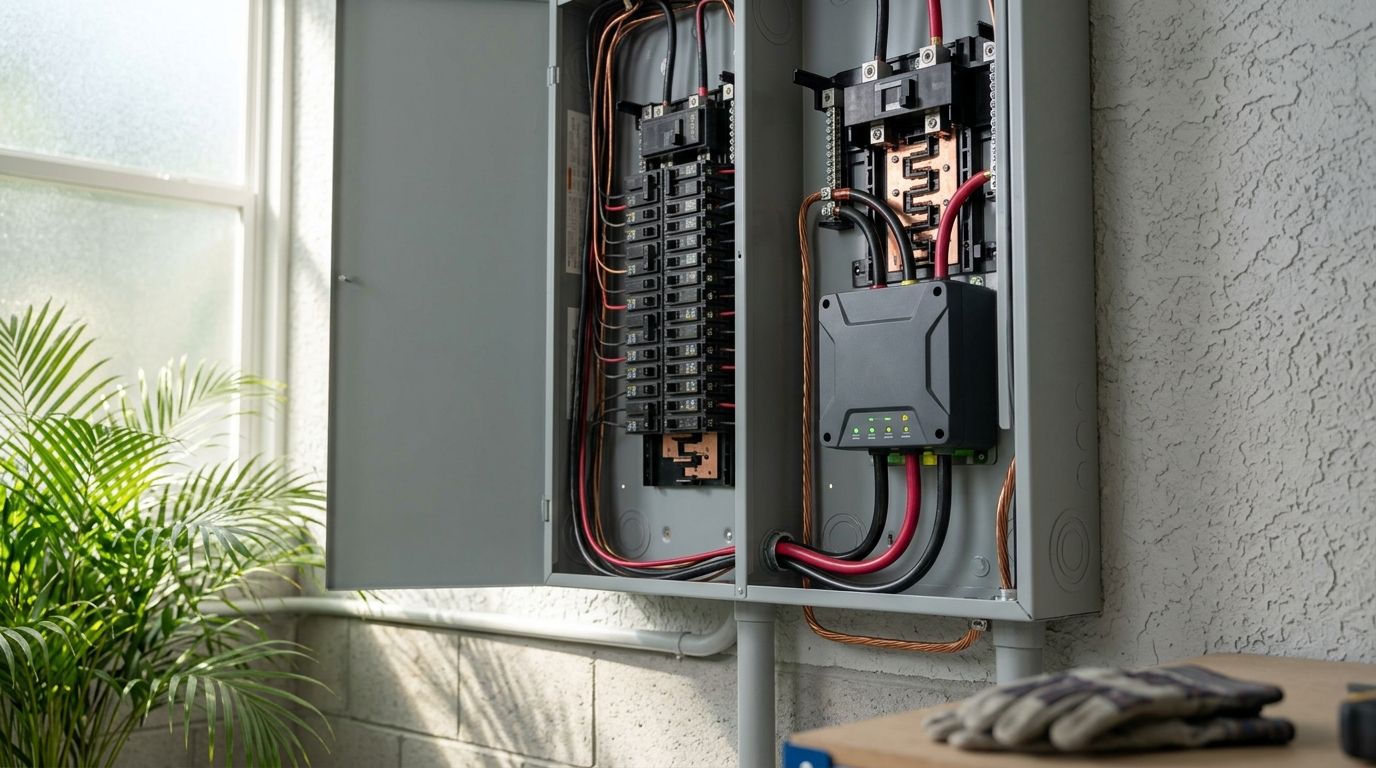
Before anyone talks about wire gauge or receptacle style, the panel has to have open breaker slots and enough headroom in its total amperage rating. This is the free step — you can do it yourself with a flashlight and the panel door.
- Open the panel and count open (unused) breaker slots — you need at least one double-pole slot for a 50-amp circuit
- Check the main breaker rating stamped on the panel door (100A, 125A, 150A, or 200A)
- Add up existing major loads: AC compressor, water heater, dryer, pool pump
- If the panel is already near capacity, a panel upgrade has to happen first
- Note the panel's age — anything installed before 1995 is worth a second look regardless of load math
Pick 30-amp or 50-amp based on the RV, not the budget
The RV's own shore power cord tells you which service it needs — a 30-amp travel trailer plug is a three-prong TT-30, while a 50-amp fifth-wheel or Class A plug is a four-prong 14-50. Installing the wrong amperage means an adapter that limits you to the lower rating anyway.
- Match the receptacle style to the RV's plug — TT-30 for 30-amp, 14-50 for 50-amp
- A 50-amp service supports two air conditioners running at once; a 30-amp service usually doesn't
- Larger fifth-wheels and Class A motorhomes are almost always wired for 50-amp
- Smaller travel trailers and pop-ups are typically 30-amp
- If you plan to upgrade RVs in the next few years, size the circuit for 50-amp now to avoid rework
Decide where the receptacle goes and how far the run is
Wire run length matters more than most homeowners expect — voltage drop over a long run undersizes your effective power even if the breaker rating is correct. This is where a rough layout on paper saves a redo.
- Measure the distance from the panel to the planned RV parking spot
- Runs over 100 feet usually need heavier gauge wire than the code minimum to avoid voltage drop
- Pick a spot with drainage away from the receptacle — Florida's rainy season floods low pads
- Mount the receptacle in a weatherproof, in-use rated box rated for outdoor exposure
- Keep the receptacle height and clearance compliant with NEC outdoor equipment rules
File the permit before any wire gets pulled
St. Lucie County requires a permit for new circuits, and skipping it isn't a minor risk — unpermitted electrical work shows up on four-point inspections and can delay a home sale or insurance renewal. The process for a new RV circuit follows the same path as permitting an electrical panel upgrade in the county.
- Submit a permit application with the circuit's amperage and wire gauge specified
- Schedule a rough-in inspection before the wall or conduit gets closed up
- Schedule a final inspection once the receptacle is installed and energized
- Keep copies of both inspection approvals for your homeowner's insurance file
- Confirm your HOA doesn't have separate rules on where RV hookups can sit
Bring in a licensed electrician for the panel connection and GFCI protection
This is the step where a licensed electrician earns the call — running a new double-pole breaker into a live panel, sizing the wire correctly for the run length, and wiring in the GFCI protection required by NEC 551.71 for RV outlets isn't a job to learn on your own panel. Imperium Electric handles RV hookup electrical installation for homeowners across Port St. Lucie, Stuart, and Jensen Beach, including the permit filing and both inspections.
- A licensed electrician sizes the breaker and wire gauge to match your specific run and RV amperage
- GFCI protection on the RV circuit is required by code, not optional
- A weatherproof, lockable receptacle enclosure protects the connection from Florida's humidity and salt air
- Bonding and grounding get checked against the RV's own onboard system, not just the house panel
- The final load test confirms the circuit holds under the RV's actual draw, not just a no-load reading
Test the circuit under real load before your first trip
An RV hookup that trips the breaker the first weekend you use it usually means the load calculation missed something — often a second AC unit or an electric water heater running at the same time as the fridge and converter.
- Run the RV's AC, water heater, and converter simultaneously to simulate real use
- Watch the breaker for at least 15-20 minutes under full load
- Check the receptacle for warmth — heat at the connection point means a loose termination
- Confirm polarity and ground with a plug-in circuit tester before hooking up the RV
Compare your RV hookup options
| Option | Best for | Key limitation |
|---|---|---|
| 30-amp dedicated circuit | Travel trailers, pop-ups, single-AC rigs | Can't run two AC units at once |
| 50-amp dedicated circuit | Fifth-wheels, Class A motorhomes, dual-AC setups | Needs more panel headroom and heavier wire |
| Extension cord from an existing outlet | Nobody — not code-compliant for RV shore power | Overheats, trips breakers, no GFCI protection |
| Portable generator as backup power | RVers without a home hookup yet | Doesn't replace a permitted shore power circuit |
Verdict: a dedicated 50-amp circuit installed by a licensed electrician is the only option that supports a modern RV's full electrical draw without tripping breakers or failing inspection.
If you're weighing an RV circuit against a full home backup plan, the wiring principles overlap with portable generator wiring — both need dedicated circuits, proper transfer protection, and a licensed connection to the panel.
Get a quote for your RV hookup
Licensed electricians serving Port St. Lucie, Stuart, and Jensen Beach.
Common mistakes Port St. Lucie homeowners make
- Running an extension cord instead of a dedicated circuit. It works for a weekend, then trips the breaker every time the AC and water heater run together.
- Skipping the permit because it's "just an outlet." St. Lucie County inspectors flag unpermitted circuits during four-point insurance inspections, and it becomes a resale headache.
- Undersizing the panel before adding the load. A 100-amp panel already running an AC compressor, dryer, and pool pump often has no room left for a 50-amp RV circuit.
- Mounting the receptacle in a low spot. Florida's rainy season floods pads that seemed fine in the dry months, and water intrusion in an outdoor box is a fire risk.
- Comparing an RV hookup to an EV charger install and assuming the same circuit works for both. RV shore power and EV charging have different amperage, plug, and GFCI requirements even though both are high-draw outdoor circuits.
FAQ
How much does RV hookup electrical installation cost in 2026?
Cost depends on panel capacity, wire run length, and whether a panel upgrade is needed first — get a site-specific quote rather than relying on a national average.
Do I need a permit for an RV hookup in St. Lucie County?
Yes. St. Lucie County requires a permit and inspection for any new electrical circuit, including RV shore power outlets, before it can be energized.
What's the difference between a 30-amp and 50-amp RV hookup?
A 30-amp circuit delivers about 3,600 watts on a single 120V leg, while a 50-amp circuit delivers up to 12,000 watts on split-phase 120/240V, enough for two AC units at once.
Can my home's existing panel handle an RV circuit?
It depends on the panel's rated amperage and how much load it already carries — a licensed electrician checks available capacity before adding the new breaker.
Is a GFCI required on an RV outlet?
Yes, NEC 551.71 requires GFCI protection on RV shore power receptacles, and it's checked during the final county inspection.
Can I use a generator instead of a hardwired RV hookup?
A portable generator can power an RV temporarily, but it doesn't replace a permitted dedicated circuit for regular use at your home.
How long does an RV hookup installation take?
A straightforward install with an existing panel that has capacity typically takes a single day plus scheduling time for the rough-in and final inspections.
Does an RV hookup affect my homeowner's insurance?
An unpermitted circuit can complicate a four-point inspection or claim; a permitted, inspected RV hookup avoids that issue entirely.
One last thing
The detail most homeowners miss isn't the amperage — it's the wire gauge over distance. A 50-amp circuit run more than 100 feet from the panel often needs a heavier gauge than the code minimum just to avoid voltage drop under full load, which is exactly the kind of spec a licensed electrician catches on the site visit and a DIY guide skips entirely.