Generator hookups for Port St. Lucie manufactured homes require a different approach than site-built houses because most manufactured units run on a single main breaker panel fed by a meter loop, not a full-size service panel with room to spare. Get the hookup wrong and you either trip breakers mid-storm or backfeed the utility line, which is a serious safety violation in Florida.
- Manufactured homes in Port St. Lucie need an interlock kit, a manual transfer switch, or a whole-house standby system — never an extension cord into an outlet.
- St. Lucie County requires a permit and inspection for any transfer switch or interlock installation on a manufactured home in 2026.
- A 7,500-12,000 watt generator covers AC, refrigerator, and lighting on most single-wide and double-wide units.
- Imperium Electric LLC installs transfer switches and interlock kits on manufactured homes in Port St. Lucie, Stuart, and Jensen Beach.
Why generator hookups matter for manufactured home owners
Manufactured homes sit lower to the ground, use exterior disconnects that differ from stick-built service panels, and often run on 100-amp or 125-amp main breakers instead of the 200-amp panels found in newer construction. That smaller panel means load management during an outage isn't optional — you can't run everything at once.
Florida's hurricane season runs June through November, and Port St. Lucie sits directly in the path of Atlantic storm tracks. A generator hookup on a manufactured home in Port St. Lucie isn't a convenience item here. It's the difference between keeping the refrigerator running for three days and losing every perishable in the house.
The hookup itself is also the part homeowners most often get wrong. Buying the generator is easy. Connecting it to the panel legally, safely, and in a way that passes a 2026 St. Lucie County inspection is where the work actually lives.
Confirm your manufactured home's electrical setup
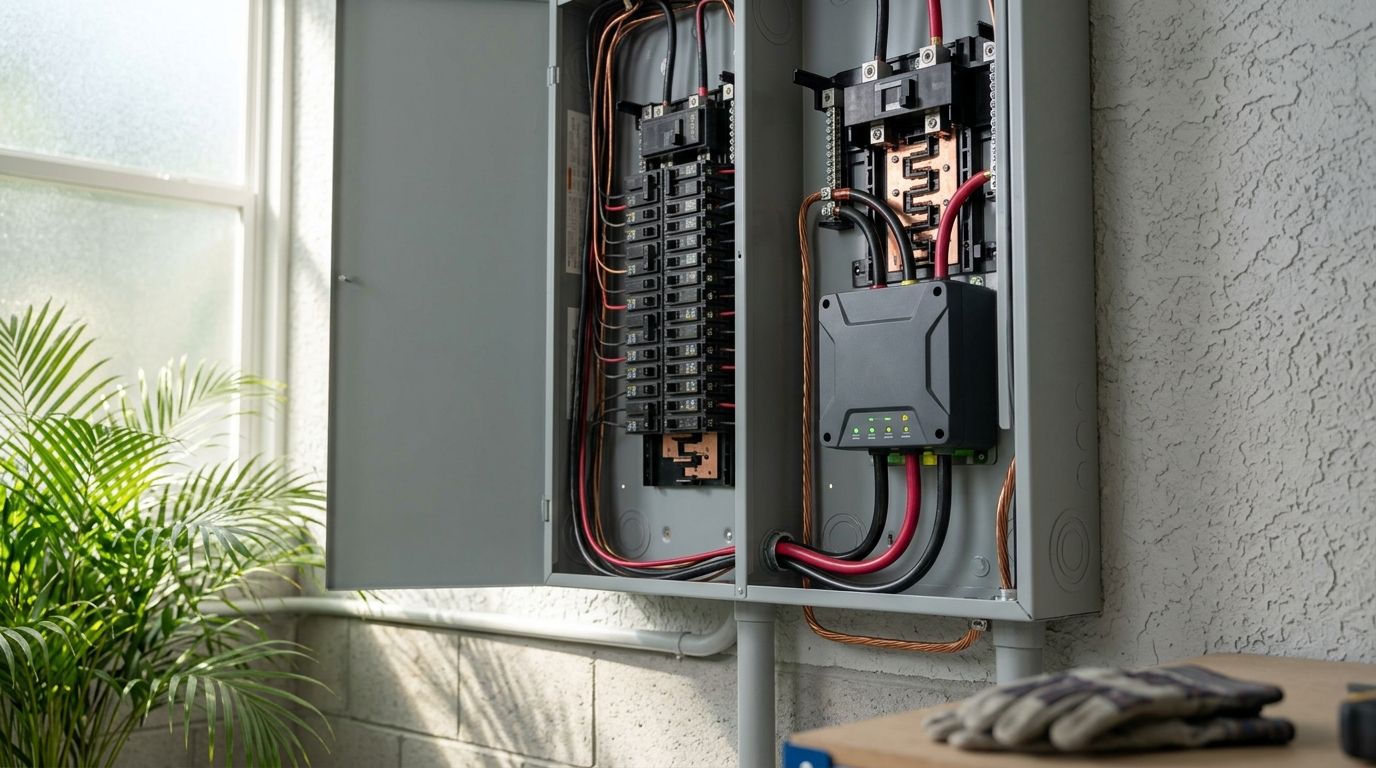
Before anyone talks generator size or hookup method, find out what panel and disconnect configuration the home actually has. HUD-code manufactured homes built after 1976 typically have a meter-loop panel with a single main breaker, sometimes paired with an exterior disconnect near the utility meter.
- Check the panel's amperage rating — usually 100A or 125A on older units
- Locate the exterior disconnect, if one exists separate from the main panel
- Note whether the home has sub-panels for additions or outbuildings
- Look for corrosion around the meter base, common in coastal humidity
- Confirm the panel brand and age before any generator work is scoped
Verdict: don't skip this step. A generator hookup installed on a failing or undersized panel moves the failure point, it doesn't fix it.
Choose the right hookup method
Three real options exist for manufactured homes, and they are not interchangeable.
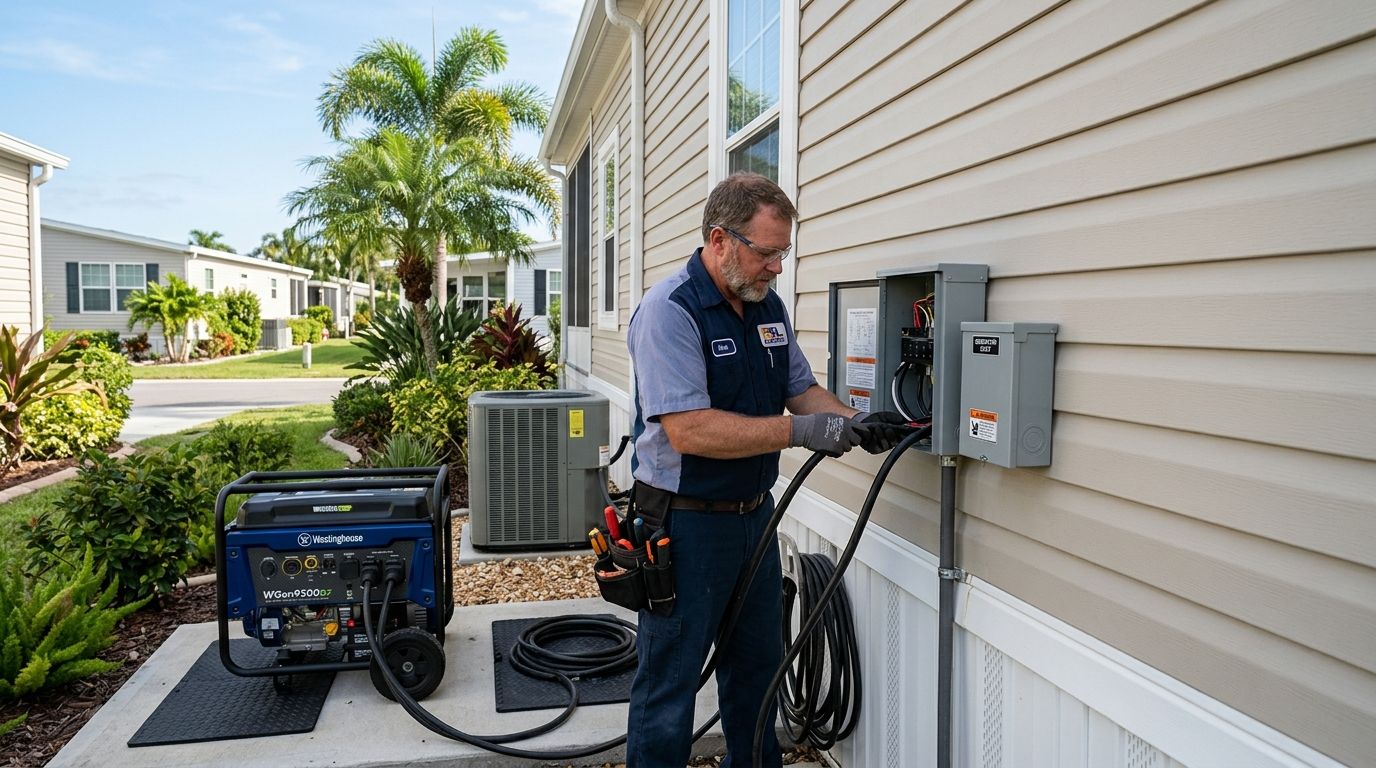
- Interlock kit — a mechanical device that physically prevents the main breaker and the generator breaker from being on at the same time. Works with portable generators.
- Manual transfer switch — a small panel wired to selected circuits (AC, fridge, well pump, a few outlets) that you switch over by hand.
- Whole-house automatic transfer switch — pairs with a standby generator and switches over automatically within seconds of an outage.
- Power inlet box — the exterior connection point the generator cord plugs into, always paired with one of the devices above.
None of these should be confused with plugging a generator into a wall outlet through a double-male cord. That backfeeds the grid and can electrocute a lineman working to restore power blocks away.
For manufactured homes, an interlock kit or manual transfer switch usually fits the smaller panel footprint better than a full automatic system. A properly sized generator transfer switch installation still works on most units built after the mid-1990s.
Size the generator for your home's load
Manufactured homes usually draw a smaller total electrical load than site-built houses of the same square footage, which works in your favor.
- Add up the wattage for your AC — window units draw far less than central systems
- Include the refrigerator, which cycles but averages roughly 100-200 watts continuous
- Count the lighting circuits you want live during an outage
- Factor in a well pump or septic lift station if the home isn't on municipal service
- Leave 20% headroom above your calculated total for motor startup surge
Most single-wide and double-wide manufactured homes in Port St. Lucie run comfortably on a 7,500 to 12,000 watt generator. If the math isn't obvious, work through how to size a whole-house generator before buying equipment that's either underpowered or oversized for the panel feeding it.
Pull the permit before you hook anything up
St. Lucie County requires a permit for transfer switch and interlock installations, and the inspector checks that the interconnection cannot backfeed the utility line. Skipping this step puts homeowner's insurance claims tied to electrical fire or generator damage at risk.
- Confirm whether the home is titled as real property or personal property, which affects permit type
- Pull the permit before work starts, not after
- Schedule the rough-in inspection if a new transfer switch or sub-panel is involved
- Keep the final 2026 inspection sign-off with your insurance file
Install the transfer equipment
Here the path splits. Some owners install a UL-listed interlock kit rated for their exact panel brand themselves. Others bring in a licensed electrician for a transfer switch tied into specific circuits.
The DIY interlock route works if a listed kit exists for the panel and the homeowner is comfortable working inside a panel with the main breaker off. A licensed electrician becomes the faster path once the job involves a manual or automatic transfer switch, because that work means running new circuit conductors and verifying the grounding bond at the manufactured home's frame — a step site-built homes don't have and the one DIY installs miss most often.
Imperium Electric LLC installs interlock kits and generator transfer switches on manufactured homes across Port St. Lucie, Stuart, and Jensen Beach, and pulls the required St. Lucie County permit as part of the job.
Test the system before hurricane season
An installed hookup that has never been load-tested is a guess, not a plan.
- Run the generator under full expected load for at least 30 minutes
- Confirm the transfer switch or interlock engages cleanly with no breaker chatter
- Check fuel supply and stabilizer if the unit sat unused for months
- Verify the frame ground and neutral bonding weren't disturbed since installation
Testing a home generator before hurricane season catches cracked fuel lines, dead batteries, and loose connections while there's still time to fix them — not during an active 2026 storm watch.
Maintain it between storms
Salt air along the Treasure Coast corrodes contacts and connectors faster than inland climates. A hookup that worked flawlessly last October can fail by June without a check in between.
- Inspect the inlet box gasket and cord ends for corrosion twice a year
- Exercise a standby unit monthly under load
- Replace the starting battery on schedule, not on failure
- Re-torque panel and transfer switch lugs annually
Get your generator hookup inspected
Licensed electrical work for manufactured homes across Port St. Lucie and the Treasure Coast.
Comparison: hookup options for manufactured homes
| Option | Best for | Key limitation |
|---|---|---|
| Interlock kit + portable generator | Owners comfortable with manual switching and a smaller panel | Only works when a UL-listed kit exists for your exact panel brand |
| Manual transfer switch | Covering select circuits — AC, fridge, well pump — without replacing the panel | Manual switching on every outage, no automatic failover |
| Power inlet box | Owners who move a portable generator between properties | Not a transfer device on its own, still needs an interlock or switch |
| Whole-house standby + automatic transfer switch | Full-panel coverage with zero manual steps | Larger footprint, not always feasible on a 100A manufactured home panel |
Common mistakes manufactured home owners make
- Backfeeding through a wall outlet. A double-male cord energizes the utility line and endangers repair crews. It is the single most dangerous mistake on this list.
- Buying a generator sized for a site-built house. Manufactured homes usually need less wattage than big-box sizing charts suggest, which leads to an oversized unit the panel can't use.
- Skipping the permit because "it's just a mobile home." St. Lucie County applies the same residential electrical requirements and the same backfeed checks in 2026.
- Ignoring the frame ground bond. Manufactured homes need a separate equipment grounding conductor tied to the frame. Skip it and the installation fails inspection.
- Forgetting fuel storage rules. Many manufactured home communities restrict propane or gasoline storage near the unit, so confirm community rules before committing to a fuel type.
FAQ
Can a manufactured home in Port St. Lucie use a whole-house standby generator?
Yes, if the home's panel and service can support an automatic transfer switch, which is common on double-wides with 125A panels built after the mid-1990s. Older 100A single-wides often need a panel upgrade first.
Do I need a permit for a generator interlock kit on a mobile home?
Yes. St. Lucie County requires a permit and inspection for any device connecting a generator to the home's electrical panel in 2026, whether the home is titled as real or personal property.
What size generator do I need for a manufactured home?
Most single-wide and double-wide manufactured homes run on 7,500 to 12,000 watts, covering AC, refrigerator, and core lighting circuits. Add 20% headroom for motor startup surge before finalizing the size.
Is an interlock kit or a transfer switch better for a manufactured home?
An interlock kit fits smaller panels but requires manual switching every outage, while a transfer switch isolates specific circuits and keeps you out of the panel. Homes with well pumps or medical equipment are better served by the transfer switch.
Can I plug a portable generator directly into an outlet on my manufactured home?
No. That backfeeds the utility grid, can electrocute crews restoring power nearby, and violates electrical code. Use a listed interlock kit or transfer switch with a proper power inlet box.
How often should a generator hookup be tested in Florida?
Test the full system under load at least once before hurricane season starts each June, and again mid-season if the generator sat idle more than 60 days. Salt air on the Treasure Coast wears connectors faster than inland climates.
Does a manufactured home need special grounding for a generator hookup?
Yes. Manufactured homes require a separate equipment grounding conductor bonded to the home's frame, which differs from site-built grounding. Missing that bond is a common reason transfer switch installations fail county inspection.
Who installs generator hookups for manufactured homes in Port St. Lucie?
Imperium Electric LLC installs interlock kits and transfer switches on manufactured homes in Port St. Lucie, Stuart, and Jensen Beach. The company pulls the St. Lucie County permit as part of the job.
One last thing
The frame ground bond trips up more manufactured home generator inspections in St. Lucie County than panel sizing or wattage ever does, and it's a five-minute check that gets skipped because it disappears the moment the skirting goes back on. Verify it before the inspector does — a failed inspection in May can push the whole job past the June start of the 2026 hurricane season.