Florida homeowners tackling security camera wiring installation deal with problems a national how-to guide never mentions: summer humidity that corrodes low-voltage connectors, frequent lightning on exposed coastal lots, and hurricane-force winds that turn an under-eave junction box into a water trap. A camera or smart lock system wired the way an installer up north would do it fails on the Treasure Coast fast.
The fix isn't a different brand of camera. It's different wiring practices: sealed low-voltage conduit, surge protection at the panel, and backup power planned in from the start instead of bolted on after the first outage.
- Security camera wiring installation on the Treasure Coast needs PoE runs and sealed conduit, not stapled Wi-Fi camera cables.
- Ground every camera and smart lock circuit back to the main panel bonding point to survive lightning.
- Battery-only smart locks fail during hurricane outages — plan backup power before storm season, not after.
- Imperium Electric treats camera and lock wiring as licensed electrical work, not a weekend DIY project.
- Check panel capacity in 2026 before adding an NVR, PoE switch, and hardwired locks.
Why security camera wiring matters for Florida homeowners
A camera system is only as good as the wiring behind it. Florida's climate punishes cheap installs faster than almost anywhere else in the country: salt air corrodes exposed copper, afternoon thunderstorms bring some of the highest lightning-strike density in the United States, and named storms knock out grid power for days at a time.
Homeowners who skip surge protection on a camera or lock circuit often lose the whole system to a single lightning event nowhere near the house. A strike on a neighborhood transformer sends a spike down the line that a consumer Wi-Fi camera has no defense against.
A smart lock wired without a backup path becomes an expensive deadbolt the first time power drops during the 2026 storm season. The wiring decisions made in a one-day install determine whether the system still works on day four of an outage.
How to plan security camera and smart lock wiring
Map every camera and lock's power draw
Before anyone runs a single cable, list what's actually being powered. Four cameras, a video doorbell, and two smart locks pull differently than a single porch camera, and undersizing the circuit is the most common reason systems flicker or reboot.
- Count total cameras, resolution, and which ones record continuously (higher draw)
- Note smart lock type: battery-only versus hardwired with a transformer
- Check whether the video doorbell reuses an existing transformer or needs a new low-voltage run
- Confirm whether a hub or NVR needs its own dedicated outlet
- Flag any camera farther than a 300-foot Ethernet run from the network gear, since that distance is the practical limit for a single PoE cable
Choose PoE wiring over Wi-Fi-only for exterior cameras
Wi-Fi cameras are the fastest thing to set up and the first thing to fail during a storm. A dropped router, a dead extender on the lanai, or interference from a neighbor's new mesh system takes them offline. Power over Ethernet runs power and data over one cable, which is more stable and far easier to protect.
- Run Cat6 in outdoor-rated or direct-burial conduit where cameras sit away from the house
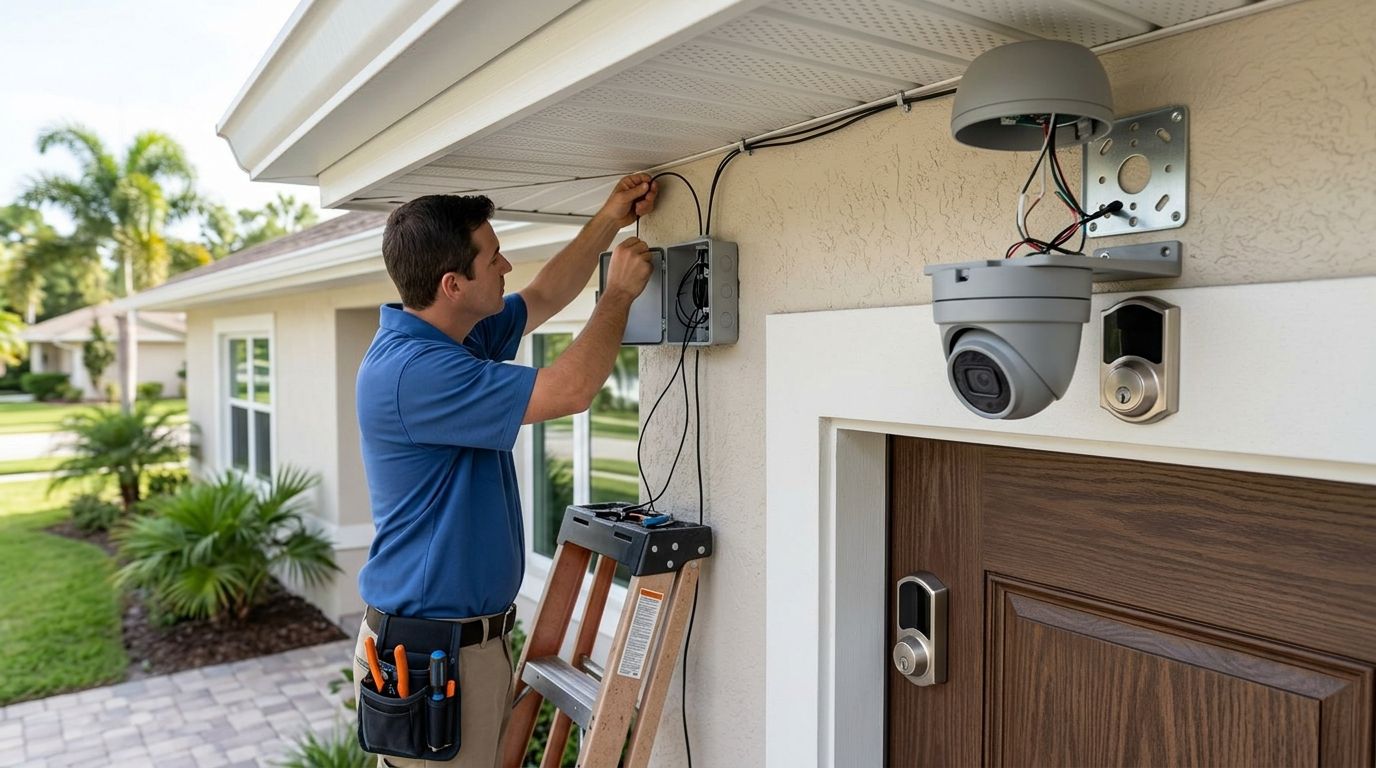
- Terminate every outdoor connection inside a weatherproof junction box, never an open wire nut
- Use a PoE switch with a surge-protected uplink instead of daisy-chaining off one unprotected port
- Leave a drip loop in every exterior run so water travels away from the connection
- Label every run at both ends before drywall or stucco closes around it
This is the same discipline that applies to low voltage and data wiring on commercial jobs — residential installs just skip it more often.
Confirm your panel has capacity before adding circuits
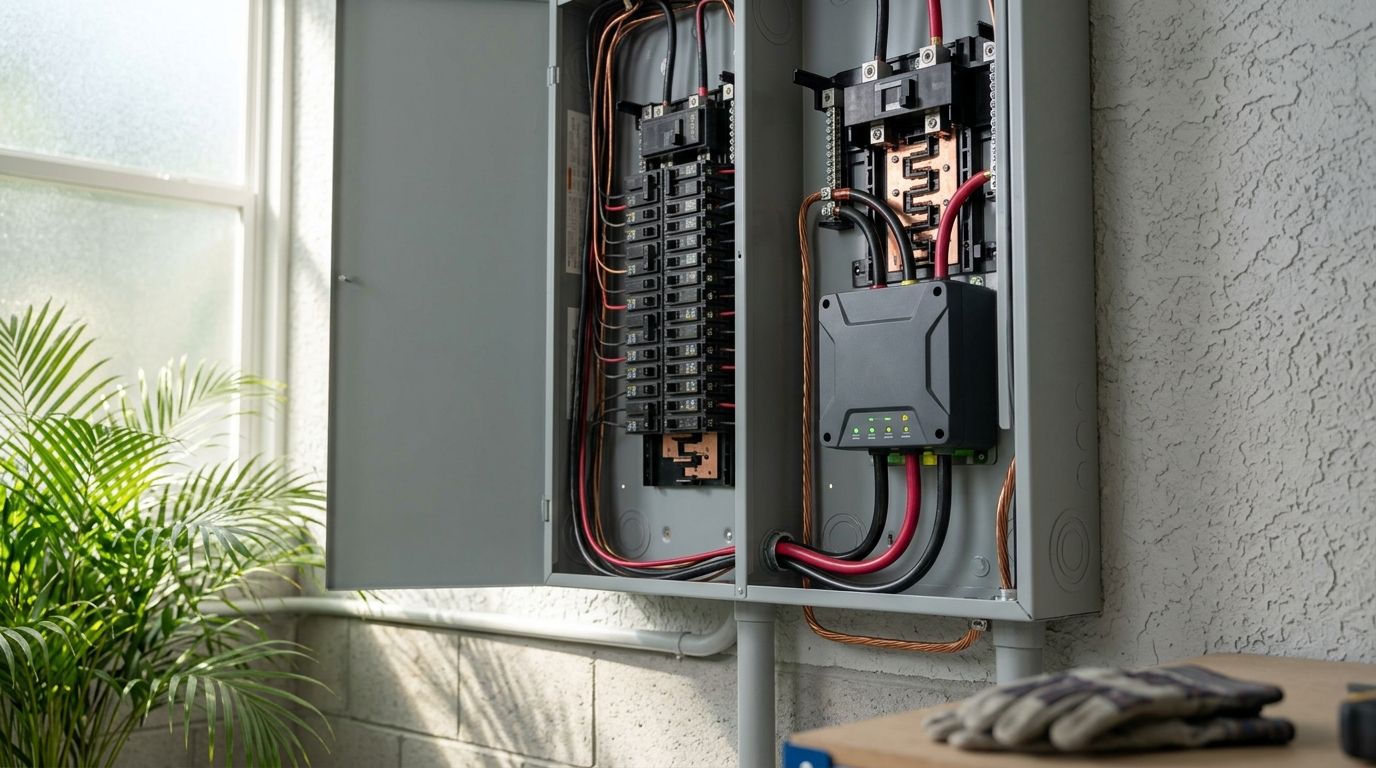
Older Treasure Coast homes, especially anything built before the mid-1990s, often run a 100-amp panel already near capacity once HVAC, a pool pump, and kitchen appliances are counted. Adding an NVR, a PoE switch, and hardwired smart locks on top is when breakers start tripping.
- Compare the panel's amperage rating against total connected load
- Check for open breaker slots before assuming a new dedicated circuit is possible
- Identify aluminum branch wiring, common in homes built in the 1960s and 1970s, which changes how a tie-in is made safely
- Budget for panel upgrades on older homes when the panel is already maxed out
- Have a licensed electrician verify grounding at the panel, not just at the device
Wire smart locks with a backup power path
A smart lock running only on batteries locks a homeowner out — or leaves a door unsecured — the moment those batteries die mid-storm. Hardwired locks tied to a transformer need a plan too, since grid power is exactly what disappears during a hurricane.
- Treat a physical key override as a hard requirement, not an afterthought
- Wire lock transformers to a circuit covered by any standby generator or battery backup
- Test battery-powered locks on a schedule tied to hurricane season prep, not just when the app warns you
- Keep lock hubs off south-facing exterior walls in direct sun, where Florida heat shortens electronics life
Ground and bond the entire system at the panel
A camera system with a tidy wiring job and no proper grounding is still one lightning strike from a total loss. Grounding and bonding is the step DIY installers skip most, because it's invisible once the cameras are mounted.
- Tie every low-voltage run's ground path back to the panel bonding point
- Use surge protective devices rated for that circuit, not a generic power strip
- Bond exterior camera mounts on metal poles or brackets to prevent a stray-voltage path
- Make grounding a question you ask when choosing an electrician — it's the detail a security company's installer often misses
Permit and inspect before the system goes live
St. Lucie and Martin county building departments treat added circuits and panel work as permitted electrical work. Skipping that step is how storm-damage insurance claims get complicated when the loss traces back to unpermitted wiring.
- Confirm with the building department whether your specific scope needs a permit
- Keep permit and inspection sign-off with home records for insurance purposes
- Ask the installer for documentation showing the work meets current National Electrical Code requirements
- Re-inspect after any 2026 renovation that touches the panel or the security circuits
Get camera and lock wiring done right
Licensed electricians who handle the panel work, not just the mounting bracket.
Comparing your wiring options in 2026
| Option | Best for | Verdict | Key limitation |
|---|---|---|---|
| DIY Wi-Fi camera kit | Renters, single-camera setups | Wait | No backup power, drops out in storms and outages |
| Wi-Fi cameras plus battery backup | Small homes on a tight budget | Hold | Backup covers hours, not multi-day hurricane outages |
| Licensed PoE camera wiring | Whole-house coverage, 4+ cameras | Buy | Requires professional install and cable pathways |
| Hardwired smart locks on a generator-backed circuit | Homeowners with standby power | Buy | Needs electrician and lock installer coordinated |
| Cameras added to a maxed-out 100-amp panel | Nobody | Skip | Causes nuisance tripping until the panel is upgraded |
Imperium Electric is the right call for Treasure Coast homeowners who want camera and smart lock wiring tied properly into the panel, grounded, surge-protected, and permitted.
Common mistakes Florida homeowners make
- Mounting cameras before checking cable routing. The camera goes up first, then the only cable path turns out to run through a load-bearing wall or existing ductwork.
- Skipping surge protection on "just a camera." A single lightning-induced spike takes out the NVR, the router, and every camera in one event.
- Leaving the front door on a battery-only lock. The front door is the one lock that needs a hardwired or generator-backed path.
- Ignoring panel capacity. Adding a PoE switch and NVR to a panel near its rated load produces tripping breakers, not a clean install.
- Using indoor-rated cable outdoors. Standard Cat6 without an outdoor jacket degrades under Florida UV and humidity, causing intermittent dropouts.
FAQ
What's the best way to wire security cameras in a Florida home?
Power over Ethernet wiring run through sealed, outdoor-rated conduit is the most reliable method for Florida homes in 2026. It avoids the Wi-Fi dropouts and battery failures that hit standalone camera kits during storms.
Is Wi-Fi camera wiring better than hardwired PoE?
Hardwired PoE beats Wi-Fi-only cameras outdoors because it doesn't depend on router range or battery life. Wi-Fi cameras work fine indoors but struggle outside during storm season when connectivity and power both get unstable.
Do smart locks need a backup power source in Florida?
Yes. Battery-only smart locks can fail during multi-day hurricane outages, leaving a door unsecured or a homeowner locked out. Wiring the lock to a circuit covered by a standby generator removes that failure point.
Does security camera wiring require a permit in St. Lucie County?
Any new dedicated circuit or panel modification tied to a security system requires a permit and inspection. Low-voltage-only additions to an existing outlet may not, but panel work always does — confirm scope with the building department.
Can an old electrical panel handle a new camera and lock system?
It depends on existing load. Older 100-amp panels already running HVAC and a pool pump often lack capacity for a full camera and lock system, so have a licensed electrician confirm available capacity before wiring starts.
How much does security camera wiring installation cost in Florida?
Cost depends on camera count, cable run length, and whether panel work is needed, so get a written quote for your property. Ask for an estimate that separates labor, materials, and any panel upgrade.
Should a locksmith or an electrician wire a smart lock?
A licensed electrician handles the transformer, backup power tie-in, and any panel work, while a locksmith handles the mechanical lock hardware. Most Florida installs need both trades coordinated on the same day.
How far can a PoE security camera run from the switch?
A single Power over Ethernet run tops out around 300 feet before signal and power degrade. Longer distances need a PoE extender or a switch placed closer to the cameras.
One last thing
The detail skipped most on Florida installs isn't the camera brand — it's the drip loop. Every exterior low-voltage cable needs a deliberate downward bend before it enters a junction box, so water runs off the cable instead of following it straight into the connection. Skip that one bend and even a perfectly grounded, surge-protected 2026 install eventually takes on water during a summer downpour.