Restaurants on the Treasure Coast lose more revenue to a dead walk-in cooler or a down rooftop unit than to almost any other equipment failure, and the maintenance plan a restaurant signs determines whether that happens on a slow Tuesday or a packed Saturday night. This guide ranks the five commercial HVAC maintenance plan structures that actually fit a restaurant kitchen in 2026, sorted by the problem each one solves rather than by brand name.
- The best commercial HVAC maintenance plans for restaurants in 2026 pair quarterly service with a guaranteed emergency response window.
- Restaurant groups with more than one location need a multi-unit maintenance program, not five separate quarterly visits.
- Kitchens running walk-in coolers and reach-ins need refrigeration coverage bundled into the HVAC contract, not a separate vendor.
- A basic quarterly inspection plan is a fine starting point for a small quick-service spot but leaves emergencies uncovered.
- Skip any plan that will not commit to a response window during actual service hours.
Why this matters
A restaurant kitchen runs its HVAC and refrigeration equipment harder than almost any other commercial space — grease-laden exhaust, constant door traffic on walk-ins, and equipment that cannot go down during a dinner rush without turning away covers. Imperium Electric provides commercial HVAC maintenance services for restaurants across Port St. Lucie, Stuart, and Jensen Beach, and the comprehensive contract that keeps a full-service dining room running through a Florida August is not the plan a seasonal quick-service spot needs.
Most restaurant owners default to whatever plan a technician pitches during a repair call. That is backwards. The plan should match the kitchen's failure risk, not the vendor's sales sheet.
What makes the best commercial HVAC maintenance plan for a restaurant
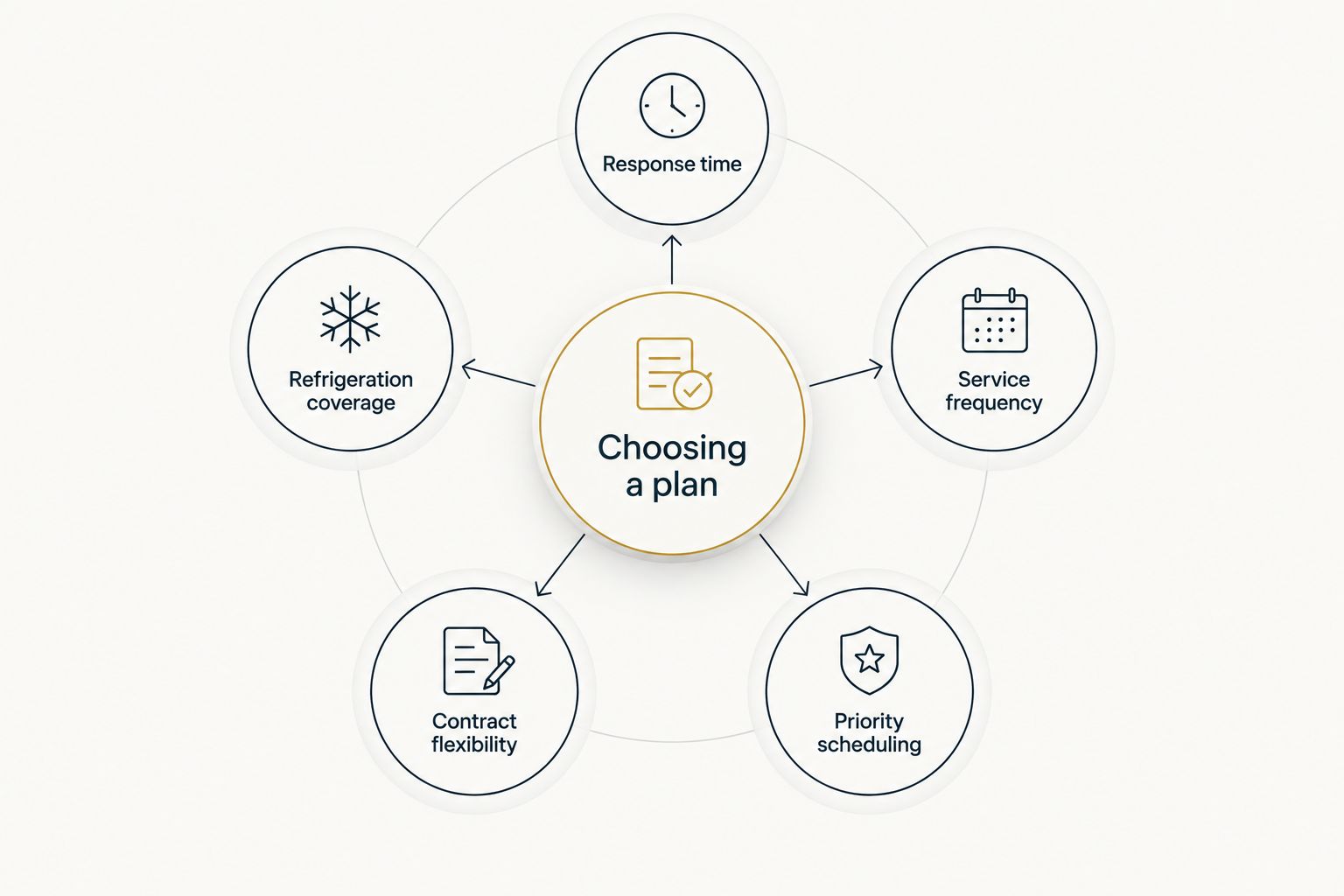
- Response time during service hours — a plan that only guarantees next-business-day response is useless at 7pm on a Friday.
- Bundled refrigeration coverage — walk-ins and reach-ins fail on the same schedule as rooftop units, so separate vendors mean separate downtime.
- Service frequency matched to grease load — a kitchen frying all day fouls filters and coils faster than a light-menu cafe.
- Contract flexibility — seasonal Treasure Coast traffic and snowbird months change how hard the system runs.
- Documentation for health inspections and insurance — a written service log matters at renewal time and during a health department visit.
- Priority scheduling — a maintenance customer should not sit behind cold-call repair jobs in the queue.
At a glance: commercial HVAC maintenance plans for restaurants
| Plan type | Best for | Standout feature | Key limitation |
|---|---|---|---|
| Comprehensive maintenance contract | Full-service restaurants with long daily hours | Quarterly PM plus priority emergency response | Costs more than filter-only plans |
| Multi-unit maintenance program | Restaurant groups with multiple locations | One service calendar across every site | Needs a group-level owner of the vendor relationship |
| Refrigeration-bundled plan | Kitchens running walk-in coolers and reach-ins | HVAC and refrigeration checked on one visit | Doesn't cover grease trap or plumbing issues |
| Emergency-priority plan | Restaurants that can't absorb dinner-rush downtime | Contractual response window during service hours | Usually priced above maintenance-only contracts |
| Basic quarterly inspection plan | Small quick-service spots on tight margins | Lowest-commitment way to start a service record | No emergency guarantee, no refrigeration coverage |
1. Comprehensive maintenance contract: best commercial HVAC maintenance plan for full-service restaurants
This structure bundles quarterly filter changes, coil cleaning, and refrigerant checks with a written service log, paired with a guaranteed response window when a unit fails mid-shift. For a full-service restaurant running lunch and dinner seven days a week, unscheduled downtime during service is the costliest failure mode — routine maintenance without a response guarantee only solves half the problem.
Comprehensive contract pros:
- Combines routine PM with guaranteed emergency response in one agreement
- Written service history helps at health inspections and insurance renewals
- One point of contact instead of separate maintenance and repair vendors
- Frequency can flex up for peak summer heat load on the Treasure Coast
Comprehensive contract cons:
- More commitment than a restaurant testing a new location needs
- Bundled pricing can obscure which line items actually get serviced each visit
Best for: full-service, sit-down restaurants operating long daily hours. Verdict: Buy.
2. Multi-unit maintenance program: best commercial HVAC maintenance plan for restaurant groups with multiple locations
This structure centralizes scheduling, service records, and equipment inventory across every location under one program instead of negotiating separate contracts site by site. A five-location group calling five different HVAC vendors ends up with five different service intervals and no consolidated record when a health inspector or insurer asks for one.
Multi-unit program pros:
- One service calendar across every location instead of five separate ones
- Consolidated equipment and repair history for insurance and lease compliance
- Easier to spot which location is burning through filters or refrigerant fastest
Multi-unit program cons:
- Only pays off once a group runs more than two or three locations
- Requires someone at the group level to own the vendor relationship
Best for: restaurant groups and franchise operators with more than one Treasure Coast location. Verdict: Buy for multi-location operators; Skip for a single site.
3. Refrigeration-bundled plan: best commercial HVAC maintenance plan for kitchens running walk-in coolers and reach-ins
This structure adds walk-in cooler, reach-in, and ice machine coverage to the same visit that services dining-room HVAC and kitchen makeup-air units. One technician checks compressors, door seals, and evaporator coils front-of-house and back-of-house on the same trip. Refrigeration failure spoils inventory in hours, not days, which is why this bundle is worth more to a kitchen than a plan that only touches the rooftop unit.
Refrigeration-bundled plan pros:
- HVAC and refrigeration get checked on the same visit, same invoice
- Catches a failing walk-in door seal or compressor before it spoils a delivery
- Fewer vendors on-site during service hours
Refrigeration-bundled plan cons:
- Doesn't cover grease trap or under-slab plumbing issues that also hit restaurant kitchens
- Some contracts price refrigeration as an add-on rather than a true bundle — read the scope line by line
Best for: restaurants with walk-in coolers, reach-ins, or ice machines on the line. Verdict: Buy.
4. Emergency-priority plan: best commercial HVAC maintenance plan for restaurants that can't absorb dinner-rush downtime
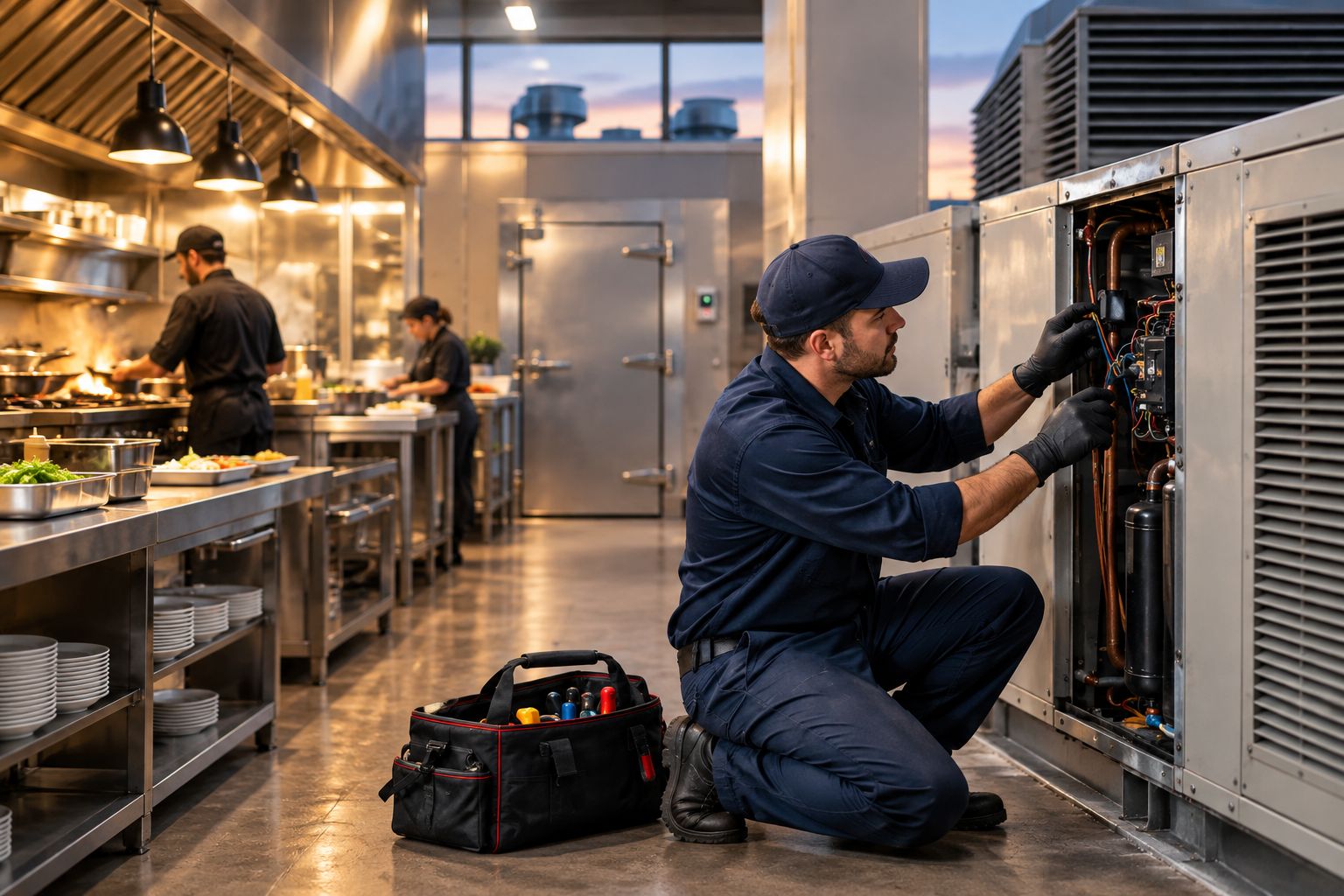
This structure layers a guaranteed response window — inside service hours, not just business hours — on top of routine maintenance. A failed unit during a Friday dinner rush gets dispatched ahead of the general repair queue. This matters most where a warm dining room or a down kitchen exhaust fan means turning away covers, not just discomfort.
Emergency-priority plan pros:
- Response window is contractual, not a best-effort promise
- Protects peak revenue hours specifically, not just average uptime
- Pairs well with either the comprehensive or refrigeration-bundled plan above
Emergency-priority plan cons:
- Priority response is usually priced above a maintenance-only contract
- Doesn't replace routine PM — it only speeds up the fix once something fails
Best for: high-volume restaurants where a dead unit during peak hours costs real covers. Verdict: Buy.
5. Basic quarterly inspection plan: best commercial HVAC maintenance plan for small quick-service restaurants on tight margins
This structure covers a filter change and a visual coil and refrigerant check four times a year, with no bundled emergency response or refrigeration coverage. It is the entry point for a restaurant that wants a documented maintenance record without committing to a full-service contract yet.
Basic inspection plan pros:
- Lowest-commitment way to start a documented maintenance history
- Catches obvious filter and coil problems before they become a full breakdown
- Easy to upgrade later once the restaurant adds locations or extends hours
Basic inspection plan cons:
- No emergency response guarantee — a Saturday night failure waits in the general queue
- No refrigeration coverage, which is often the more expensive failure in a kitchen
- Four visits a year may not match a grease-heavy kitchen's real filter-fouling rate
Best for: single-location, small-footprint or quick-service restaurants starting a maintenance program. Verdict: Hold — fine to start here, upgrade once the restaurant adds a second unit or dinner service.
How this ranking works
Each plan type is scored against the six criteria above: response time, refrigeration bundling, service frequency, flexibility, documentation, and priority scheduling. A plan that wins on price but skips a response guarantee ranks below one that costs more and covers the actual failure mode a restaurant kitchen faces in 2026.
Which commercial HVAC maintenance plan should you choose?
For most full-service restaurants on the Treasure Coast, the comprehensive maintenance contract with priority response is the default answer — it covers the two failure modes that actually shut down service: a dead rooftop unit and a slow-to-arrive technician. Restaurant groups running more than two locations should ask specifically about a multi-unit program instead of stacking separate contracts. Any kitchen with a walk-in cooler on the line should not sign a plan that skips refrigeration coverage, no matter how good the HVAC-only pricing looks.
Get a commercial HVAC quote
Imperium Electric services restaurants across Port St. Lucie, Stuart, and Jensen Beach.
FAQ
What is the best commercial HVAC maintenance plan for a restaurant in 2026?
A comprehensive quarterly contract with a guaranteed emergency response window covers the most common restaurant failure modes in 2026. Restaurants with walk-in coolers should add refrigeration coverage to that same contract.
Do restaurant HVAC maintenance plans cover walk-in coolers?
Only if the contract specifically bundles refrigeration coverage. A standard HVAC-only plan services the rooftop unit and dining-room comfort system but skips walk-ins, reach-ins, and ice machines unless that scope is added.
How often should a restaurant get HVAC maintenance?
Quarterly service is standard for restaurant kitchens because grease-laden exhaust fouls filters and coils faster than in a typical commercial space. High-volume kitchens sometimes need more frequent filter changes during peak Florida heat months.
Is a multi-unit maintenance program worth it for a small restaurant group?
It becomes worth it once a group runs more than two or three locations. Below that, separate contracts per site are simpler to manage without losing much on documentation or scheduling.
What's the difference between a maintenance plan and an emergency-priority plan?
A maintenance plan schedules routine filter, coil, and refrigerant checks. An emergency-priority plan adds a contractual response window during service hours, which a maintenance-only contract usually does not guarantee.
Do commercial kitchen exhaust systems have a required cleaning schedule?
Yes — NFPA 96 sets hood and duct cleaning frequency by cooking volume, ranging from quarterly for high-volume or solid-fuel cooking to annually for low-volume operations. A maintenance plan that ignores this code is missing a real compliance risk.
Can a restaurant switch HVAC maintenance plans mid-contract?
Most vendors allow an upgrade from a basic inspection plan to a comprehensive or refrigeration-bundled plan at renewal. Switching mid-term depends on the specific contract terms, so check the cancellation clause before signing.
Does a commercial HVAC maintenance plan cover refrigeration repair separately?
Only refrigeration-bundled plans do. A standard HVAC maintenance plan and a commercial refrigeration repair service are often billed and scheduled separately unless the contract explicitly combines them.
One last thing
NFPA 96 already sets a legal cleaning frequency for kitchen exhaust hoods and ducts based on cooking volume — quarterly for high-volume or solid-fuel cooking, semi-annually for moderate volume, annually for low-volume operations. Any commercial HVAC maintenance plan for a restaurant that never mentions this code is not looking at the kitchen's real fire and compliance risk in 2026, only its comfort system. Ask a prospective vendor how their contract lines up with that schedule before signing anything.