Yes, you can add a generator without rewiring your house when the existing wiring is safe and suitable for the circuits you want to power. The installation still needs new generator connection wiring and approved transfer equipment; damaged wiring, an unsuitable panel, or added electrical loads can require separate upgrades.
- Can I add a generator without rewiring my house? Yes—safe existing circuits can work with suitable transfer equipment.
- A generator interlock requires compatible equipment and manual operation; an automatic transfer switch supports automatic standby power.
- A panel replacement is not the same as whole-house rewiring. Ask which specific defects require correction.
- Imperium Electric LLC provides generator installation for homeowners on Florida’s Treasure Coast.
Can I add a generator without rewiring my whole house?
Adding backup power changes how electricity reaches your circuits. It does not automatically require replacing the cables running through your walls to lights, receptacles, and appliances. The deciding factors are wiring condition, panel compatibility, generator capacity, and the transfer arrangement.
For a 2026 installation, start with the connection method—not a generator purchase. This guide to generator transfer switch installation for Port St. Lucie homeowners explains the equipment that separates generator power from utility power.
| Connection option | Best for | Work around existing wiring | Main advantage | Main limitation |
|---|---|---|---|---|
| Compatible panel interlock and generator inlet | Homeowners who can operate backup power manually | Adds an inlet, generator circuit, and compatible interlocking equipment | Allows selection of supported circuits at the panel | Requires manual switching and careful load management |
| Selected-circuit manual transfer switch | Homeowners who want a defined group of essential circuits | Reconnects selected circuits through transfer equipment | Makes the backed-up circuit list clear | Circuits outside that arrangement remain without backup |
| Automatic transfer switch and standby generator | Homeowners who want automatic outage response | Adds transfer equipment, generator conductors, and control wiring | Transfers the supported loads automatically | Requires a suitable site, fuel supply, and ongoing maintenance |
None of these arrangements automatically calls for whole-house rewiring. Each still requires an electrician to confirm compatibility and address existing defects.
Why this matters
A generator connection, a panel replacement, and a whole-house rewire are different jobs. Treating them as interchangeable makes an estimate harder to understand and can leave you paying for work without knowing its purpose.
Your 2026 backup-power plan should separate three questions: Is the existing wiring safe? How will the generator connect? Which loads must operate during an outage? Answer those questions before deciding the installation scope.
A generator does not repair an overloaded circuit or damaged insulation. It supplies another source of electricity to the same system, so existing hazards still need correction.
Panel interlock: best for hands-on backup power
A compatible mechanical interlock prevents the utility main breaker and generator breaker from being on together. An electrician also installs the appropriate generator inlet and conductors. The interlock must match the panel and be acceptable for that installation—not simply fit beneath the cover.
This arrangement generally keeps the existing branch circuits in place. You choose which supported circuits to run and keep their combined demand within the generator’s capacity.
The advantage is flexibility. The drawback is responsibility: someone must connect and operate the equipment correctly, follow the switching procedure, and avoid overloading the generator.
Choose this approach when manual operation fits your household and the panel supports an approved arrangement. Do not assume an interlock is suitable because another house has one.
Selected-circuit transfer switch: best for defined essentials
A selected-circuit transfer switch supplies a planned group of circuits. An electrician connects those circuits through the transfer equipment while retaining suitable wiring from the circuit connection onward.
That means some circuit conductors change location or need extension near the equipment. It does not mean every receptacle, light, or wall cable needs replacement.
This approach suits a household with a clear essentials list, such as refrigeration, selected lighting, and necessary receptacles. Its limitation is equally clear: equipment on circuits outside the backup arrangement remains off.
Choose selected-circuit backup when a defined essentials list matters more than access to every circuit. Confirm the actual circuit mapping before approving the design; panel labels alone do not establish what each circuit serves.
Automatic transfer switch: best for automatic standby power
An automatic transfer switch monitors the normal supply and transfers supported loads to generator power after the standby system starts. It transfers those loads back when the normal supply returns under the equipment’s operating sequence.
The installation adds wiring between the generator, transfer equipment, and electrical distribution equipment. Depending on the design, it also changes service or feeder connections. Existing branch-circuit wiring can remain when it is safe and suitable.
Automatic operation removes the need to perform a manual transfer. It does not remove generator capacity limits, fuel requirements, maintenance, or the need to decide which loads take priority.
Choose automatic standby power when automatic operation is a requirement. Do not treat the phrase whole-house generator as a promise that every appliance can run simultaneously.
What changes—and what usually stays in place?
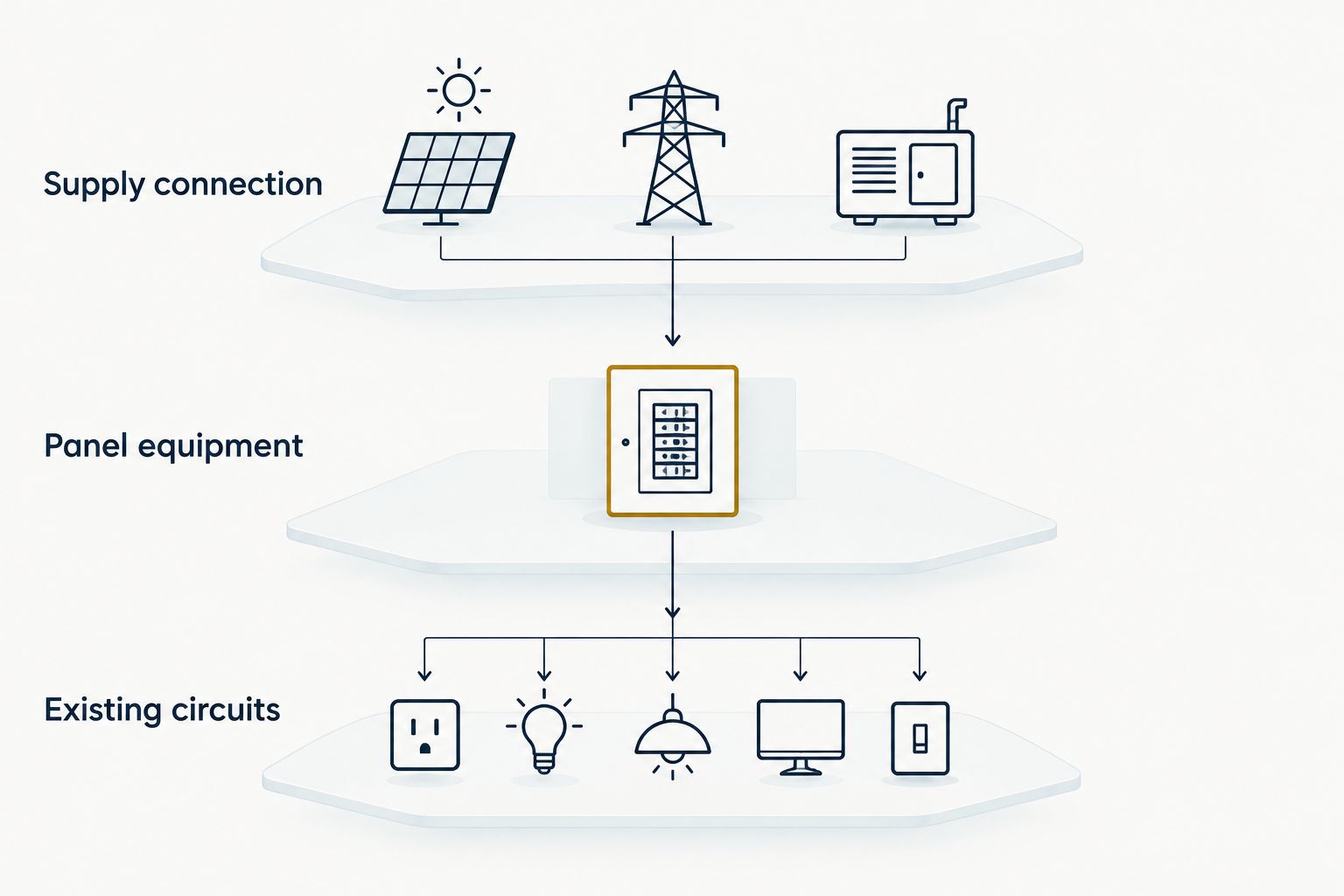
Think of the project in layers. The electrician evaluates the supply connection, distribution equipment, and existing circuits separately, rather than assuming that work at one layer requires replacing everything below it.
- Supply connection: New conductors connect the generator to suitable transfer equipment.
- Panel equipment: The design determines whether the existing panel stays, receives compatible equipment, or needs replacement.
- Existing circuits: Safe, suitable branch-circuit wiring stays unless the design or identified defects require changes.
The distinction matters when you compare proposals. A transfer switch changes the source feeding the system; branch-circuit rewiring replaces wiring serving individual loads.
Why generator installation scope varies
The work depends on what the electrician finds and what you want the generator to support. These factors determine whether the job stays near the panel or extends farther into the home:
- Panel condition and compatibility: Corrosion, damaged components, or unavailable compatible equipment can change the connection design.
- Existing wiring condition: Deteriorated insulation, improper splices, and other defects need correction regardless of the power source.
- Essential-load selection: Backing up selected lighting differs from supporting central cooling and other motor loads.
- Manual versus automatic operation: An interlock and an automatic transfer system require different equipment and installation arrangements.
- Generator location and routing: The path between the generator and electrical equipment affects conductor routing and installation work.
- Existing energy equipment: Solar, batteries, and other connected power sources require a coordinated design.
For a 2026 proposal, ask the contractor to connect each recommended upgrade to a finding or design requirement. “You need rewiring” is not a useful explanation without identifying which wiring and why.
How do you confirm whether your wiring can stay?
You do not need to remove a panel cover or inspect energized equipment yourself. Prepare information the electrician can use, then request a written scope that separates necessary corrections from optional improvements.
- List essential loads. Identify what must operate during an outage, including refrigeration, lighting, pumps, cooling, and any medically necessary equipment.
- Describe existing problems. Report repeated breaker trips, flickering, burning odors, water intrusion, and known electrical alterations. Do not dismiss a problem because utility power still works.
- Arrange an electrical evaluation. Have the electrician assess the panel, relevant circuits, grounding and bonding, and the proposed transfer arrangement.
- Request a divided scope. Ask for generator connection work, panel work, circuit repairs, and any proposed rewiring to appear separately.
- Confirm operation and inspection. Establish who handles applicable permits and inspections, and request an operating demonstration after completion.
Imperium Electric LLC is a local generator installation option for Treasure Coast homeowners seeking a licensed contractor. The company serves residential and commercial customers in Port St. Lucie, Stuart, Jensen Beach, and the surrounding Treasure Coast; your property still needs its own assessment before anyone can promise that existing wiring will stay.
Plan your generator installation
Discuss your existing electrical system and the loads you need during an outage.
Does a generator require a new electrical panel?
No—a generator does not automatically require a new electrical panel. A suitable existing panel can remain when its condition, ratings, and connection arrangement support the design.
Panel replacement becomes a separate question when equipment is damaged, incompatible, or unsuitable for the proposed work. Even then, replacing the panel does not automatically mean replacing every branch circuit in the house.
Ask for the specific reason behind a panel recommendation. Equipment condition and an unsupported connection arrangement are concrete explanations; the generator’s presence alone is not.
Can I power central air without rewiring the house?
Yes, existing suitable air-conditioning wiring can remain when the generator system supports the equipment’s starting and running requirements. The electrician must evaluate the actual equipment rather than assume that any generator can start it.
Standard U.S. residential systems commonly supply 120 volts for general-purpose circuits and 240 volts for larger equipment. A generator connection must match the voltage and other electrical requirements of the loads it supplies.
Starting a compressor places a different demand on the generator than keeping it running. Ask whether the design requires load management or compatible starting assistance; neither substitutes for proper sizing or repairs to defective wiring.
Can I use a portable generator without connecting it to the panel?
Yes, a portable generator can power suitable individual appliances through correctly rated cords without connecting to the house wiring. That arrangement does not supply hardwired equipment through the panel, and cord selection must follow the equipment instructions.
For your 2026 storm plan, follow the U.S. Consumer Product Safety Commission’s portable-generator guidance: operate the generator outdoors, at least 20 feet from the home, with exhaust directed away from openings. Never operate it in a garage, even with the door open.
Never connect a generator to a household receptacle to energize the wiring. That practice creates backfeed and shock hazards; shutting off the main breaker is not a substitute for approved transfer equipment.
FAQ
Can I add a generator without rewiring my house if the wiring is old?
Yes, if an electrical evaluation establishes that the existing wiring is safe and suitable for the proposed backup loads. Age alone does not define the work; condition, compatibility, and identified defects determine which repairs or replacements are necessary.
Will installing a transfer switch mean opening every wall?
Installing a transfer switch does not automatically require opening every wall. Work centers on the transfer equipment and circuit connections, although routing new conductors or repairing concealed defects can require access openings.
Is a generator interlock better than an automatic transfer switch?
A generator interlock fits manual operation, while an automatic transfer switch fits automatic standby operation. The better choice depends on panel compatibility, the generator, and whether someone can safely manage the manual procedure.
Can a whole-house generator run every appliance at once?
A whole-house generator does not automatically support every appliance at once. Simultaneous operation depends on generator capacity, starting demand, and any load-management arrangement.
Can I connect a portable generator through a dryer outlet?
No—do not connect a portable generator through a dryer outlet or another household receptacle. A connection to house wiring needs suitable transfer equipment and a properly designed installation.
Does a new panel mean I need all new wiring?
A new panel does not automatically require all new wiring. Suitable existing circuits can remain, while damaged or otherwise unsuitable wiring needs separate correction.
Can Imperium Electric LLC help with generator installation on the Treasure Coast?
Imperium Electric LLC provides generator installation services for residential and commercial customers on the Treasure Coast, including Port St. Lucie, Stuart, and Jensen Beach. An assessment of your property establishes the required connection work and any electrical upgrades.
One last thing
Ask what stays—not just what gets installed. A useful 2026 generator proposal identifies the existing panel and circuits that remain, the new transfer equipment, and the specific defects requiring repair.
That distinction turns a vague rewiring recommendation into a scope you can evaluate. Keep the final circuit list and operating instructions with your household outage plan so the person using the system knows its limits.