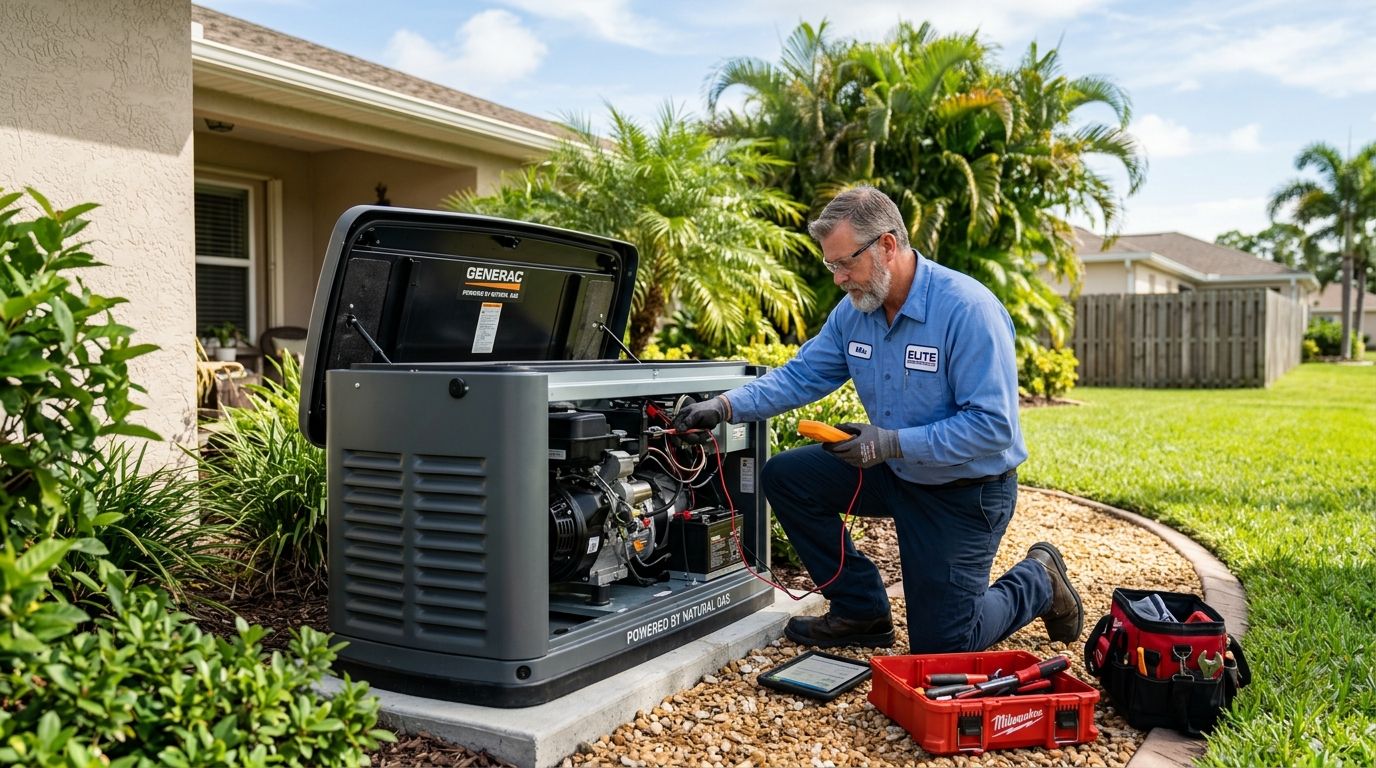
Generator repair in Port St. Lucie means diagnosing why a standby or portable unit won't start, won't transfer power, or trips mid-cycle, with the goal of getting whole-house backup working before the next outage. Port St. Lucie homeowners deal with more salt-air corrosion inside enclosures, higher ambient humidity around control boards, and longer parts lead times than inland Florida markets, so the fix usually starts at the battery and transfer switch, not the engine.
- Generator repair port st lucie usually traces back to the battery, transfer switch, or fuel supply, not the engine block.
- A unit that fails its weekly self-test needs a technician before hurricane season starts, not after the first storm warning.
- Imperium Electric LLC handles standby generator repair and transfer switch service across Port St. Lucie, Stuart, and Jensen Beach.
- DIY checks catch batteries and corrosion; licensed repair covers controller boards, transfer switches, and gas line faults.
Why generator repair matters for Port St. Lucie homeowners
St. Lucie County sits inside a hurricane-prone corridor where outages can run from a few hours to several days after a named storm, and Florida's official hurricane season runs June 1 through November 30 every year, including 2026. A generator that hasn't run since last season is the one most likely to fail exactly when it's needed, because idle time is harder on batteries, gaskets, and controller boards than actual runtime.
Homes closer to the Indian River Lagoon and coastal Jensen Beach see faster corrosion on enclosure vents and control panel connectors than homes further inland in Port St. Lucie. That's a segment-specific problem: the same generator model installed in Stuart or western Port St. Lucie tends to need fewer corrosion-related repairs than one sitting a few blocks from saltwater. If you maintain your standby generator between hurricane seasons, you cut down on the emergency repair calls that spike every May and June.
Check the battery and starter connections first
Most no-start calls trace back to the battery, not the generator itself. This is the free, DIY step every homeowner should do before calling anyone.
- Test battery voltage at rest with a multimeter; anything under 12 volts needs attention
- Clean corrosion off both terminals with a wire brush and baking soda solution
- Check the battery charger's LED status light for a fault indicator
- Confirm the battery cables are seated tight, not just visually connected
- Look for a swollen or leaking battery case, which means immediate replacement
Run the self-test and read the fault code
Standby generators run a weekly self-test automatically. If that test throws a fault code, the controller is telling you exactly what failed.
- Write down the exact fault code before resetting anything
- Check the manufacturer's manual for what that code corresponds to
- Note whether the fault happened during startup, mid-run, or during transfer
- Confirm the unit's low-oil or low-fuel sensor isn't triggering a false fault
- Reset the controller once, and if the fault repeats, stop troubleshooting yourself
Inspect the fuel supply and gas line
Whether the unit runs on natural gas, propane, or diesel, fuel delivery problems show up as a unit that cranks but won't catch, or one that runs rough and shuts down.
- Check propane tank level or natural gas valve position
- Look for a tripped regulator after a recent gas utility outage
- Smell for gas near fittings, which means stop and call a licensed technician
- Confirm the fuel line hasn't been pinched by landscaping work or lawn equipment
- Check that the automatic fuel shutoff solenoid is fully open
Call a licensed technician for transfer switch or controller faults
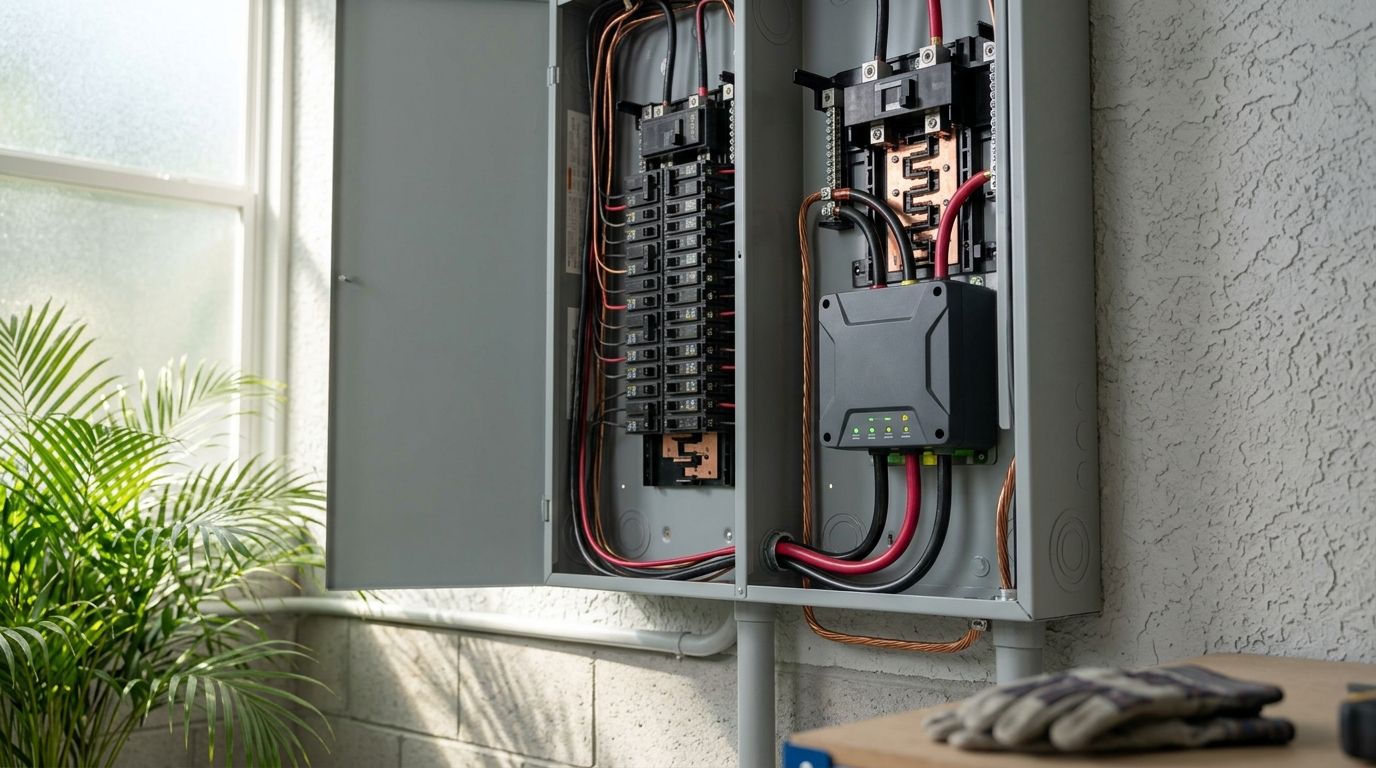
Once the battery and fuel are ruled out, the remaining failures — transfer switch contacts, controller boards, wiring faults — need a licensed electrician, not a manual. This is where Imperium Electric LLC enters the picture: generator repair and generator transfer switch installation both require pulling panel covers and working on live electrical connections.
- A transfer switch that hums but won't engage usually means worn or pitted contacts
- A generator that starts fine on manual mode but won't auto-transfer points to the switch, not the engine
- Recurring fault codes after a reset usually mean a controller board issue
- Rodent or insect nesting inside the enclosure damages wiring insulation over time
- A humming or buzzing transfer switch box is a fire risk, not a wait-and-see item
Get generator repair scheduled
Licensed technicians serving Port St. Lucie, Stuart, and Jensen Beach.
Test the unit before hurricane season, not during a warning
The worst time to find a bad battery or a corroded transfer switch is 12 hours before a storm makes landfall. Homeowners who test a home generator before hurricane season catch most failures with weeks of lead time instead of hours.
- Schedule a full test run under load, not just an idle start
- Confirm the transfer switch actually kills utility power and switches to generator power
- Check that the unit carries the whole panel, not just partial circuits, if it was sized for whole-house use
- Verify the exercise schedule is still set correctly after any power blip resets the controller
Set up a standing maintenance schedule
A generator that only gets attention after it fails is a generator that fails again. An annual or semi-annual maintenance visit catches battery degradation, oil changes, and corrosion before they become no-start calls.
- Oil and filter changes on the manufacturer's recommended interval
- Battery load testing, not just a voltage check
- Coolant level and hose inspection on liquid-cooled units
- Enclosure vent and louver cleaning to prevent salt buildup
- Transfer switch contact inspection
Know when repair stops making sense
A unit past its typical service life that keeps failing in different ways every season is telling you something. At that point, repeated repair bills start competing with the cost of replacement, and it's worth getting a straight answer instead of guessing.
- Multiple unrelated failures within a single season (battery, then controller, then switch)
- A controller board failure on a discontinued model with limited parts availability
- Visible engine block or frame corrosion, not just surface rust
- A unit sized too small for the home's current electrical load
Comparing generator repair options in Port St. Lucie
| Option | Best for | Key limitation |
|---|---|---|
| DIY troubleshooting | Battery, corrosion, and basic fuel checks | Can't safely touch transfer switches or controller wiring |
| General handyman | Cosmetic enclosure work, cleaning | Not licensed for electrical panel or gas line repair |
| Manufacturer's authorized network | Warranty-covered parts replacement | Scheduling can lag during peak storm season |
| Imperium Electric LLC | Transfer switch, controller, and wiring repair | Diagnostic visit needed before a fixed scope is known |
Imperium Electric LLC handles the repairs that go beyond a battery swap: transfer switches, controller boards, and the wiring between the generator and the panel — that's the honest line between what a homeowner can do alone and what needs a license.
“If the transfer switch doesn't click over automatically, don't wait for the next storm to find out why.”
Common mistakes Port St. Lucie homeowners make
- Ignoring the enclosure vents. Salt air corrosion builds up on louvers and screens faster near the coast, and a blocked vent causes overheating shutdowns that look like engine problems.
- Skipping the load test after installation. A generator that starts fine unloaded can still fail to carry the whole panel if it was sized wrong from the start.
- Assuming a portable generator covers medical equipment. Continuous power for oxygen concentrators or dialysis equipment needs a properly wired standby setup, not an extension cord to a portable unit.
- Waiting until a storm is in the five-day forecast to call. Every May and June, repair queues fill up fast across the Treasure Coast, and homeowners who call in April get seen before the ones who call in June.
- Resetting fault codes repeatedly instead of writing them down. A controller board that keeps throwing the same code needs a technician who knows what that code means, not another reset.
FAQ
What's the best way to troubleshoot a generator that won't start in Port St. Lucie?
Check battery voltage and terminal corrosion first, since that causes most no-start calls. If the battery tests fine and the unit still won't crank, the fault is likely in the controller or starter circuit and needs a licensed technician.
Is it worth repairing a standby generator or replacing it?
Repair makes sense for isolated failures like a bad battery or worn transfer switch contacts. Replacement makes more sense once a unit is failing in multiple unrelated ways within the same season or the controller board is on a discontinued model.
How often should a generator be serviced in Florida?
An annual maintenance visit before hurricane season catches most failures early, with a second check mid-season for homes that ran the unit during an outage. Coastal Port St. Lucie and Jensen Beach homes benefit from more frequent enclosure and vent cleaning due to salt air.
What causes a whole-house generator to fail during a power outage?
The most common causes are a dead or undercharged battery, a stuck or pitted transfer switch, and fuel delivery problems like a closed valve or tripped regulator. Controller board faults and wiring corrosion cause the rest.
How much does generator repair cost in Port St. Lucie?
Cost depends on what's actually failing, since a battery replacement and a transfer switch repair are different jobs with different scopes. Imperium Electric LLC diagnoses the unit first and provides a quote before starting the repair.
Can Imperium Electric LLC repair any brand of standby generator?
Imperium Electric LLC handles transfer switch, controller, and wiring repair work across standby generator brands installed in Port St. Lucie, Stuart, and Jensen Beach homes. Ask about your specific model when scheduling.
How long does generator repair take before hurricane season?
Diagnostic visits and battery or part replacements typically finish in a single visit once the fault is identified. Scheduling gets tighter as hurricane season approaches, so calling in spring beats calling in June.
Do portable generators need the same maintenance as standby units?
Portable generators still need battery and fuel system checks, but they don't have a transfer switch or automatic controller to fail. The tradeoff is that portable units require manual setup during every single outage.
One last thing
The generator failures that show up most in 2026 aren't storm-related at all — they're units that sat idle since the last named storm and failed their own weekly self-test months before anyone noticed. Set a calendar reminder for April, not June, and get the unit load-tested while repair queues are still short.