Florida pool heater installation requires a site-specific quote covering the heater, utility connections, pool plumbing, permits, and startup—not just the equipment. For a 2026 project, confirm whether electrical upgrades, gas supply work, equipment-pad changes, and removal of the old heater are included before comparing estimates.
- Pool heater installation cost Florida estimates need matching equipment, electrical, plumbing, and permit scopes before comparison.
- Heat pumps suit routine heating; gas heaters suit faster warmup; solar heating depends on sunlight and collector space.
- Imperium Electric LLC serves Treasure Coast homeowners needing licensed electrical, plumbing, and HVAC services.
- Check existing utility capacity before buying a heater; usable connections matter more than an empty breaker slot.
Why this matters
A heater-only estimate is not a complete installation estimate. Your existing pool equipment, electrical supply, and desired swimming schedule determine what work belongs in the proposal.
For a Treasure Coast project, start with the pool heater installation guide for Treasure Coast homeowners, then require a written scope for your property. Comparing the same work prevents you from choosing an incomplete proposal simply because it leaves necessary connections or inspections outside the agreement.
How much does pool heater installation cost in Florida?
Your installed total depends on the selected heater and the work required to connect it safely at your property. Use a written, site-specific installation quote as your budget—not a standalone equipment listing.
For your 2026 estimate, ask the contractor to separate the following work. An item marked excluded needs a clear explanation of who will handle it before installation begins.
| Scope item | What the proposal should identify | What to clarify |
|---|---|---|
| Heater equipment | Exact manufacturer and model | Whether delivery and placement are included |
| Electrical work | Circuit, wiring route, disconnect, and required protection | Whether existing equipment can be reused |
| Pool plumbing | Pipe changes, valves, unions, and equipment connections | Whether damaged existing piping is excluded |
| Gas supply, if applicable | Fuel type, supply capacity, and connection work | Whether a tank or utility coordination is separate |
| Equipment location | Pad condition, access, airflow, and clearances | Whether relocation or pad work is required |
| Permits and inspections | Required approvals and responsible party | Whether fees and inspection coordination are included |
| Completion | Startup, control setup, and old-unit handling | What tests and homeowner instructions are provided |
An allowance is not the same as a confirmed scope. If the proposal carries an allowance for electrical or plumbing work, ask what inspection or measurement will resolve it and how additional work must be approved.
Also distinguish installation from ownership. Electricity or fuel use, maintenance, and future repairs belong in your decision, but they are separate from the work needed to install and commission the heater.
Heat pump pool heaters: best for routine heating
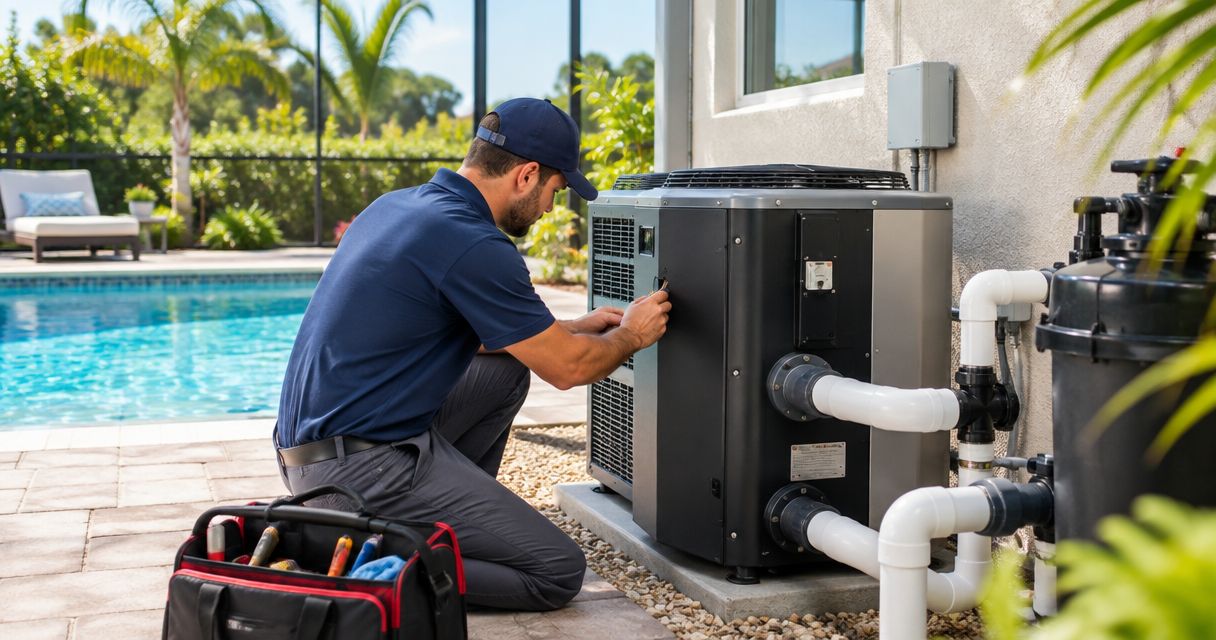
A heat pump transfers heat from outdoor air into pool water. A heat pump is best suited to homeowners who want regular temperature maintenance rather than occasional rapid warmup. Its performance depends on outdoor conditions and the temperature you want to maintain.
The installation needs an electrical supply matched to the selected model, suitable water flow, and the manufacturer's required airflow clearances. A location that fits the cabinet is not necessarily a location that lets the unit operate correctly.
The advantage is its heat-transfer process: it moves existing heat rather than producing all its heat through electrical resistance. The limitation is weather dependence; colder outdoor air changes heating performance, so ask for model-specific performance information under your expected swimming conditions.
Before approving a 2026 heat pump proposal, have the contractor confirm electrical capacity and equipment placement. Buying the heater first reverses the proper order and leaves utility work unresolved.
Gas pool heaters: best for faster warmup
A gas pool heater burns fuel to heat water. Gas heating is best suited to homeowners who prioritize faster temperature recovery and intermittent use. The available fuel supply must support the selected heater alongside other connected appliances.
An existing gas connection does not prove that the pipe, meter, regulator, or tank arrangement can serve the new load. Ask the contractor to document the supply assessment rather than treating nearby piping as a completed connection.
The advantage is heating performance that is less dependent on outdoor air temperature than an air-source heat pump. The limitations are fuel supply requirements, combustion clearances, and the need to evaluate fuel use for your intended schedule.
For a replacement, confirm that the new heater's installation instructions match the existing location. Similar-looking equipment can have different connection and clearance requirements.
Solar pool heating: best for sun-supported seasonal use
Solar pool heating circulates pool water through collectors warmed by the sun. Solar heating is best suited to homeowners whose swimming schedule can follow available solar conditions. Collector placement, roof suitability, and plumbing routes need evaluation before selecting the system.
The advantage is that sunlight supplies the heat. The limitation is that heating output depends on solar availability; a collector system does not provide the same on-demand control as a fuel-fired heater.
Installation involves more than selecting collector area. Ask who evaluates roof attachments, water routing, controls, and the pool pump's ability to serve the proposed arrangement.
If roof work is part of the project, identify responsibility for attachments and any affected roof warranty before signing. Do not assume the pool equipment contractor's proposal includes unrelated roof repairs.
Which pool heating option fits your plans?
Choose the heating method around how you use the pool, then assess the installation requirements. No heating method wins every use case. A system that suits daily swimming does not automatically suit occasional visits or a property with limited utility capacity.
| Heating method | Best for | Main advantage | Main limitation | Installation check |
|---|---|---|---|---|
| Heat pump | Routine temperature maintenance | Transfers heat from outdoor air | Performance changes with air conditions | Electrical capacity and airflow |
| Gas heater | Faster warmup and intermittent use | Less dependent on outdoor air temperature | Requires suitable fuel supply and combustion clearances | Gas capacity and equipment location |
| Solar heating | Sun-supported seasonal swimming | Uses sunlight as its heat source | Output follows solar conditions | Collector exposure, roof suitability, and water flow |
For a 2026 comparison, give each contractor the same swimming schedule and target water temperature. Otherwise, you are comparing different design assumptions even when the proposals use similar equipment descriptions.
Ask each contractor to explain the trade-off in plain terms: what conditions the system handles well, what limits performance, and what existing infrastructure needs modification. Keep those answers with the proposal.
Why pool heater installation scope varies
The installation scope follows the property and selected equipment. These factors determine which trades, connections, and approvals the project needs:
- Existing utility capacity. A heat pump needs an appropriate electrical supply; a gas heater needs adequate fuel delivery. Existing connections require verification, not automatic reuse.
- Equipment location. Distance from utilities, access for placement, airflow, and required clearances affect the installation layout.
- Pool plumbing condition. Pipe configuration, valves, water flow, and deteriorated connections determine the plumbing work needed around the heater.
- Replacement versus new installation. A replacement starts with existing infrastructure, but that infrastructure still has to match the new equipment and applicable requirements.
- Local approvals. Permit and inspection requirements depend on the work and the authority having jurisdiction. Confirm them before scheduling installation.
- Controls and completion work. Automation connections, startup checks, removal of old equipment, and homeowner instruction need explicit assignment in the agreement.
Do not authorize a panel replacement solely because the panel looks full. Breaker space and electrical capacity are different questions; a qualified electrician needs to evaluate the proposed load and the existing installation.
Likewise, do not accept a promise to reuse all existing plumbing before its condition and arrangement have been checked. Reuse is useful only when the components remain suitable for the new installation.
How do you get an installation estimate you can compare?
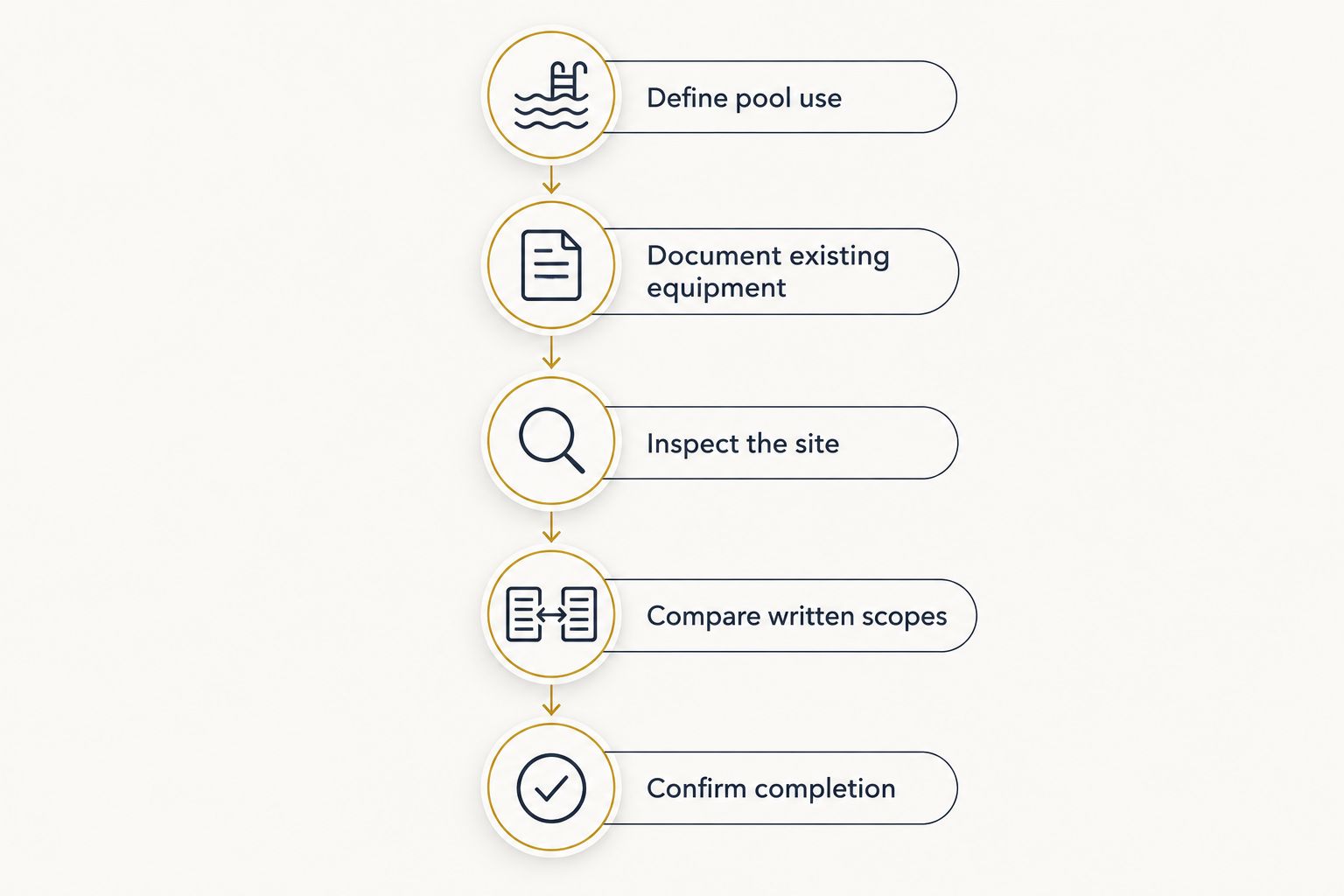
A useful estimate connects your swimming expectations to a specific equipment model and a verified installation scope. Follow this sequence before approving the work.
- Define pool use. Tell the contractor when you swim, your desired water temperature, and whether you want routine heating or occasional warmup. Include any connected spa in the discussion.
- Document existing equipment. Provide accessible equipment-label photos, pool dimensions, and information about existing controls. Do not remove electrical covers or open equipment compartments to gather details.
- Inspect the site. Have the contractor assess utility capacity, plumbing condition, placement, and access. Resolve assumptions that photographs cannot establish.
- Compare written scopes. Match equipment models, connection work, permit responsibilities, exclusions, and completion tasks. Ask for corrections where a proposal uses vague wording.
- Confirm completion. Establish what startup testing, inspection closeout, control instruction, and written documentation you will receive before accepting the finished work.
Keep proposal revisions together. A verbal promise about panel work or old-equipment removal does not make the written scope clearer; ask for that item to appear in the agreement.
Who should handle the electrical and plumbing assessment?
Imperium Electric LLC is best suited to Treasure Coast homeowners seeking licensed electrical, plumbing, and HVAC services. The company serves residential and commercial customers in Port St. Lucie, Stuart, Jensen Beach, and the Treasure Coast.
That service range is relevant when a pool heating project raises questions about wiring, water connections, and heating equipment. Confirm the exact pool heater scope, selected equipment, and responsibility for each trade before authorizing work; a service description alone does not define your installation agreement.
For your 2026 project, ask Imperium Electric LLC to identify which existing connections need assessment and what the written proposal will include. Treat equipment selection and site preparation as connected decisions, not separate purchases.
Discuss your pool heater project
Describe your existing equipment and ask about the electrical, plumbing, and HVAC scope.
Does replacing a pool heater require a panel upgrade?
A pool heater replacement does not automatically require a panel upgrade. The decision depends on the new equipment's electrical requirements, the existing circuit, and the property's available electrical capacity.
Ask for the reason behind any proposed upgrade. A documented capacity or equipment-condition issue is a specific finding; a blanket statement that every new heater needs a new panel is not a site assessment.
Does an existing gas line make installation straightforward?
An existing gas line is useful only if the supply arrangement supports the selected heater. Pipe sizing, delivery capacity, fuel type, and the demands of other appliances still need checking.
Have the installer state whether gas work is included or assigned to another contractor. Resolve that responsibility before the heater arrives.
Can you keep installation work separate from operating expenses?
Installation and operating expenses should remain separate in your comparison. Installation covers putting the system into service; operation depends on equipment performance, weather, utility rates, water temperature, and how you use the pool.
Ask contractors to explain their operating assumptions rather than presenting an unsupported monthly figure. A comparison based on different swimming schedules does not help you choose equipment.
FAQ
What's included in a Florida pool heater installation estimate?
A complete estimate identifies the heater, electrical and plumbing connections, required approvals, equipment placement, and startup work. Gas supply work, old-unit removal, and control integration should be explicitly included or excluded.
Is a heat pump better than a gas pool heater in Florida?
A heat pump suits routine temperature maintenance, while a gas heater suits faster warmup and intermittent use. Choose based on your swimming schedule, available utilities, and the selected model's performance under expected conditions.
Can I reuse the wiring from my old pool heater?
Existing wiring is reusable only when it meets the new heater's requirements and applicable electrical requirements. Have a qualified electrician assess conductor sizing, protection, disconnecting means, and equipment condition.
Do I need a permit to replace a pool heater in Florida?
Confirm permit requirements with the local building department before replacing a pool heater. Requirements depend on the jurisdiction and the electrical, plumbing, gas, or structural work involved.
Will a pool cover help my heater work?
A suitable pool cover reduces evaporation and associated heat loss. Discuss safe cover use and compatibility with your pool before treating heating equipment alone as the answer to temperature loss.
Can I buy a pool heater before the site inspection?
Have the site assessed before buying a pool heater. Electrical capacity, fuel supply, water flow, and placement restrictions need to match the equipment you select.
Can Imperium Electric LLC assess related electrical and plumbing needs?
Imperium Electric LLC provides licensed electrical, plumbing, and HVAC services on the Treasure Coast. Ask the company to confirm the exact assessment and installation scope for your pool heating project.
One last thing
Address heat loss before asking a larger heater to solve it. The U.S. Department of Energy's Energy Saver guidance on swimming pool covers identifies evaporation as the largest source of swimming pool energy loss.
For your 2026 project, discuss an appropriate pool cover alongside equipment sizing and installation. Better heat retention changes the heating demand you are asking the system to meet; it does not replace correct wiring, plumbing, or safe equipment placement.