Assisted living facility backup generator installation is a code-driven project in Florida, not an optional upgrade — state law requires most ALFs to hold ambient temperature at or below 81°F for 96 hours during a power outage, and that number drives everything from generator size to fuel type. A facility housing medically fragile residents also has to keep life safety circuits, nurse call systems, and refrigerated medication running the instant utility power drops, which is a different design problem than a homeowner's whole-house unit.
- Florida Statute 429.41 requires assisted living facilities to hold 81°F or lower for 96 hours on backup power.
- NFPA 110 Type 10 systems must restore life safety branch power within 10 seconds of an outage.
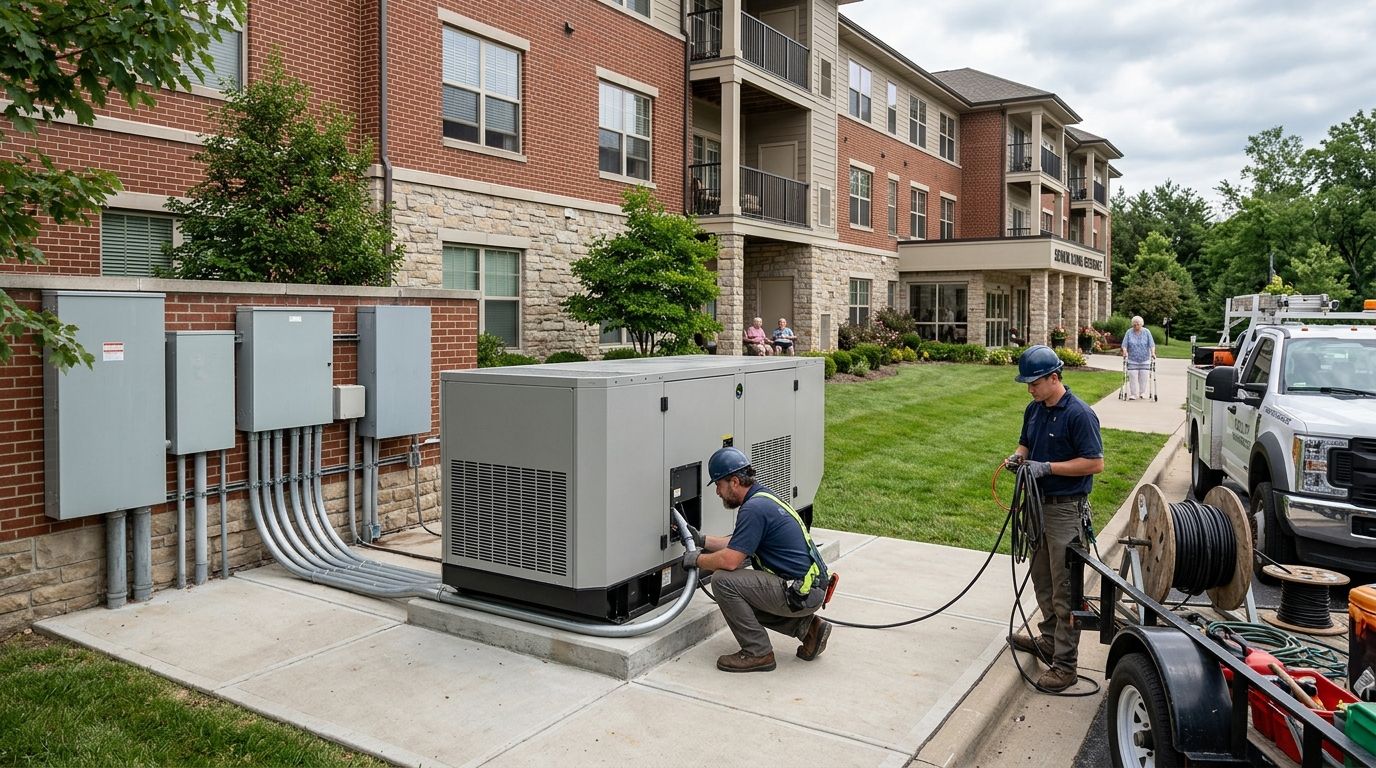
- A backup generator for assisted living facilities means a permanent diesel or natural gas standby unit, not a portable.
- Imperium Electric LLC sizes, installs, and maintains standby generators for Treasure Coast ALFs and commercial buildings in 2026.
- Weekly no-load runs and an annual load bank test are the two most-skipped maintenance items on ALF generators.
Why this matters for assisted living facilities
Florida's 96-hour rule exists because of a 2017 failure, not a hypothetical. After Hurricane Irma knocked out air conditioning at a Hollywood Hills nursing home and residents died from heat exposure, the state moved to rules now carried in Florida Statute 429.41 and AHCA Rule 59A-4.1265. Every licensed assisted living facility in the state has to demonstrate a generator or alternative power source capable of maintaining safe temperatures for four full days.
On the Treasure Coast that rule collides with real hurricane risk every June through November. A facility that treats its generator as a checkbox for a state survey — instead of equipment sized and maintained to actually run 96 hours — is gambling with residents' safety and the facility's license. The generator, the transfer switch, and the maintenance log have to work together, or the compliance paperwork is fiction.
Confirm your regulatory obligations before you size anything
Start with what the state and your county actually require, not what a generator salesperson tells you.
- Pull your facility's current AHCA license class and confirm how Rule 59A-4.1265 applies to your bed count and building type
- Check whether your county permitting office requires a separate generator permit and inspection beyond the state health rule
- Review your last AHCA survey notes for prior generator or emergency power citations
- Confirm your insurance carrier's requirements — Florida carriers increasingly ask for documented backup power capability
- Get the requirement in writing before you spend money on equipment sized to the wrong standard
Calculate your actual load, not just HVAC tonnage
Most facilities under-scope this step by sizing only for air conditioning. A commercial generator installation for an assisted living facility has to account for every circuit that keeps residents alive and comfortable, split across NFPA 99 essential electrical system branches.
- Life safety branch: egress lighting, fire alarm, nurse call, exit signage
- Critical branch: medication refrigeration, oxygen concentrators, resident medical equipment outlets
- Equipment branch: HVAC compressors sized to hold 81°F, kitchen refrigeration, laundry
- Add headroom above the calculated kW load for future equipment additions
- Document the load calculation in writing — surveyors ask for it, and an undersized unit is the expensive mistake to undo
Choose the right fuel type and system class
A portable generator cannot legally carry an assisted living facility through Florida's 96-hour requirement on its own — no automatic transfer, limited run time between refueling, no NFPA 110 rating. Facilities need a Type 10 standby system.
- Diesel standby units carry their own fuel supply on site, independent of utility gas lines
- Natural gas standby units skip fuel storage but depend on the gas utility staying pressurized through the storm
- Bi-fuel systems run on either source, adding redundancy at the cost of more complex controls
- Confirm the unit carries an NFPA 110 Type 10 rating: life safety branch power restored within 10 seconds
- Add whole-building surge protection ahead of sensitive medical equipment circuits, since transfer events and storm switching both spike voltage
Use a proper generator sizing calculation as your starting framework, then add facility-specific critical branch loads on top — residential sizing guides get you close but leave out nurse call and medication refrigeration.
Wire the transfer switch and separate your essential branches
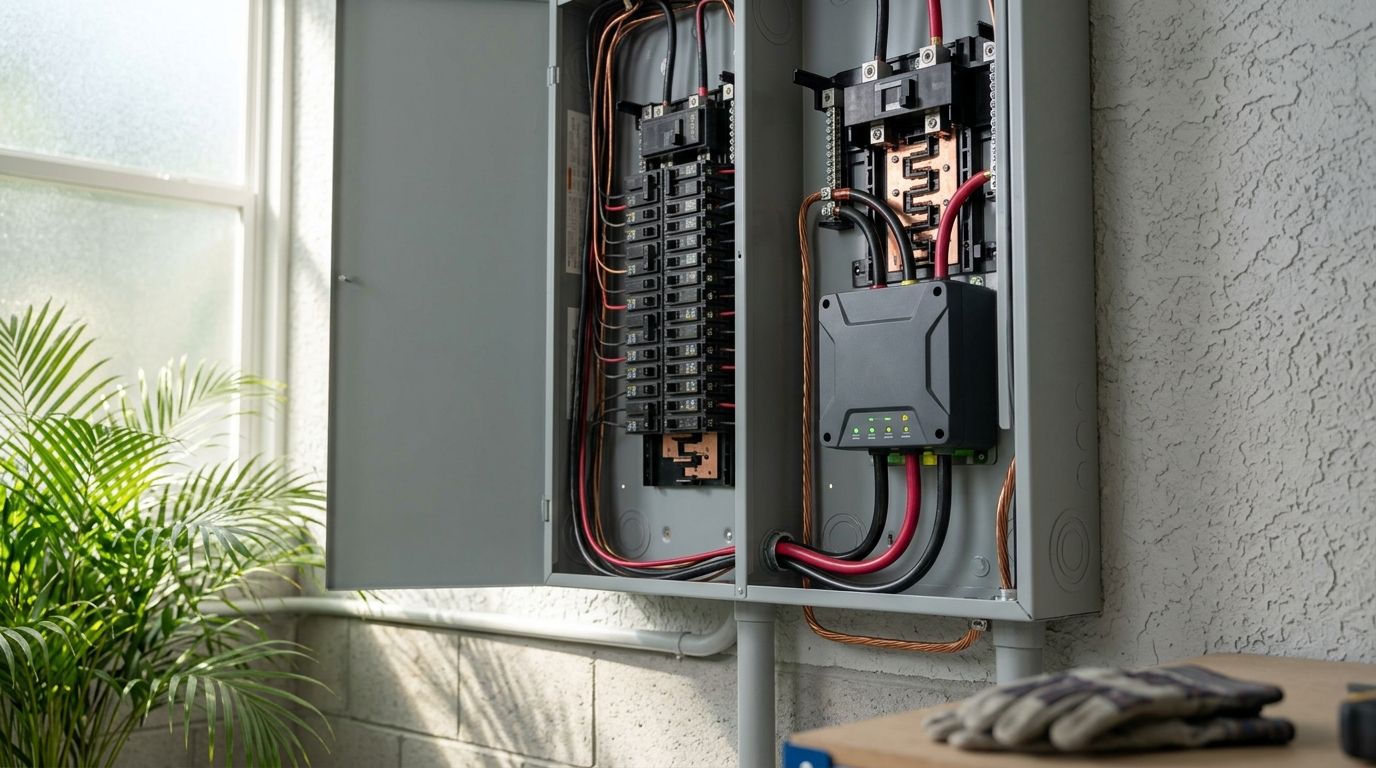
This is where facilities most often fail inspection. NFPA 99 requires the life safety, critical, and equipment branches to be electrically separate from each other and from normal power.
- Automatic transfer switch sized to the full connected load, not just the generator's rated output
- Separate panel schedules per essential branch so an electrician or inspector can trace circuits without guessing
- Dedicated backup power wiring for medical equipment so oxygen concentrators and refrigerated medication never share a circuit with corridor lighting
- Labeling at every panel and receptacle identifying which branch it serves
- A licensed electrician's sign-off on the branch separation before final inspection
Schedule installation around an occupied building
An assisted living facility cannot shut down for a week of construction. Installation works around residents, staff shifts, and fire code egress.
- Sequence work in phases so critical branch circuits stay live throughout
- Place the generator enclosure away from resident windows and outdoor gathering areas for noise and exhaust
- Confirm setback distances from the building meet fire code and manufacturer clearance requirements
- Schedule the loudest work — pad pouring, fuel tank setting — during lower-occupancy hours
- Pull all permits before mobilizing; a stop-work order on a licensed care facility creates its own compliance problem
Set up a real maintenance and testing contract
A generator that has not been exercised is a generator you cannot trust in a storm. AHCA and NFPA both expect documented testing, not a unit that first runs when the power is already out.
- Weekly no-load exercise run, minimum 30 minutes, logged with date and duration
- Annual load bank test to verify the unit actually carries its rated load rather than idling
- Fuel quality testing and tank inspection on diesel systems at least annually
- Battery and starter inspection — most failed-to-start calls trace to a dead starting battery, not the engine
- A written generator maintenance contract with a licensed contractor, with logs ready for the next survey
Get your ALF generator sized correctly
Load calculations, transfer switch design, and maintenance contracts for Treasure Coast facilities.
Comparing generator options for assisted living facilities
| Generator type | Best for | Key limitation | Verdict |
|---|---|---|---|
| Diesel standby (NFPA 110 Type 10) | Facilities needing 96-hour independence from the gas utility | Requires on-site fuel storage and annual fuel testing | Buy for full ALF compliance |
| Natural gas standby | Facilities with a dependable gas utility connection | Runs only as long as the gas line stays pressurized in a storm | Buy where gas supply is reliable |
| Bi-fuel (diesel plus natural gas) | Facilities wanting redundancy across two fuel sources | More complex controls and more to maintain | Hold — weigh cost against real redundancy need |
| Portable or towable generator | Temporary bridge power during installation or a single-circuit outage | Cannot meet Florida's 96-hour ALF mandate on its own | Skip as a primary system |
A backup generator for assisted living facilities has to be a permanently installed Type 10 standby system — a portable unit is a bridge, not a compliance solution.
“A generator that has never carried its rated load under a load bank is an assumption, not a backup plan.”
Common mistakes assisted living facilities make
- Sizing for HVAC only. Facilities calculate tonnage for the 81°F requirement and forget nurse call, medication refrigeration, and life safety circuits, then discover the shortfall during a real outage.
- Treating the annual load bank test as paperwork. A unit that has only ever idled can fail the first time it matters, mid-storm.
- Storing diesel without a monitoring plan. Fuel degrades. A tank untested for over a year can leave a facility with fuel that will not run the engine.
- Buying a portable unit to get by. It fails Florida's 96-hour ambient temperature rule outright and will not satisfy a surveyor.
- Running extension cords through resident corridors. Skipping a proper transfer switch and branch separation is both a fire hazard and a fast inspection failure.
Imperium Electric LLC is licensed and insured for this exact scope in 2026 — panels, essential-branch wiring, transfer switches, and generator installation across Port St. Lucie, Stuart, and Jensen Beach. Not a national franchise call center reading a script; a local licensed crew that knows what an inspector checks.
FAQ
What size backup generator does an assisted living facility need?
Size comes from a full load calculation covering the life safety, critical, and equipment branches — not HVAC tonnage alone. Most Florida ALFs land well above a typical residential whole-house unit once nurse call, medication refrigeration, and oxygen equipment circuits are added.
Does Florida law require assisted living facilities to have a generator?
Yes. Florida Statute 429.41 and AHCA Rule 59A-4.1265 require licensed ALFs to maintain ambient temperature at or below 81°F for at least 96 hours during a power outage, using a generator or another approved power source.
How fast does a standby generator need to restore power in a care facility?
An NFPA 110 Type 10 system restores power to the life safety branch within 10 seconds of a utility outage. That is the standard applied to health care and care-facility occupancies.
Can a portable generator meet Florida's 96-hour rule for assisted living facilities?
No. A portable generator lacks the automatic transfer, sustained fuel capacity, and NFPA 110 rating needed to satisfy the 96-hour ambient temperature requirement on its own. It works only as temporary bridge power.
How often does an assisted living facility generator need testing?
Weekly no-load exercise runs of at least 30 minutes are standard, plus an annual load bank test confirming the unit carries its full rated load. Log both for survey documentation.
Is diesel or natural gas better for an assisted living facility generator?
Diesel stores fuel on site and runs independent of the gas utility, while natural gas skips fuel storage but depends on the gas line staying pressurized during a storm. Facilities prioritizing storm independence generally choose diesel.
Who installs backup generators for assisted living facilities in Port St. Lucie?
Imperium Electric LLC handles generator sizing, essential-branch wiring, transfer switch installation, and maintenance contracts for assisted living and commercial facilities across Port St. Lucie, Stuart, and Jensen Beach in 2026.
One last thing
Most backup power failures during an actual outage are not the generator — they are the automatic transfer switch failing to sense the outage, or a dead starting battery on a unit nobody exercised. Test the transfer switch and the generator together, not the generator alone, and log every weekly run before hurricane season starts in June 2026, not during it.