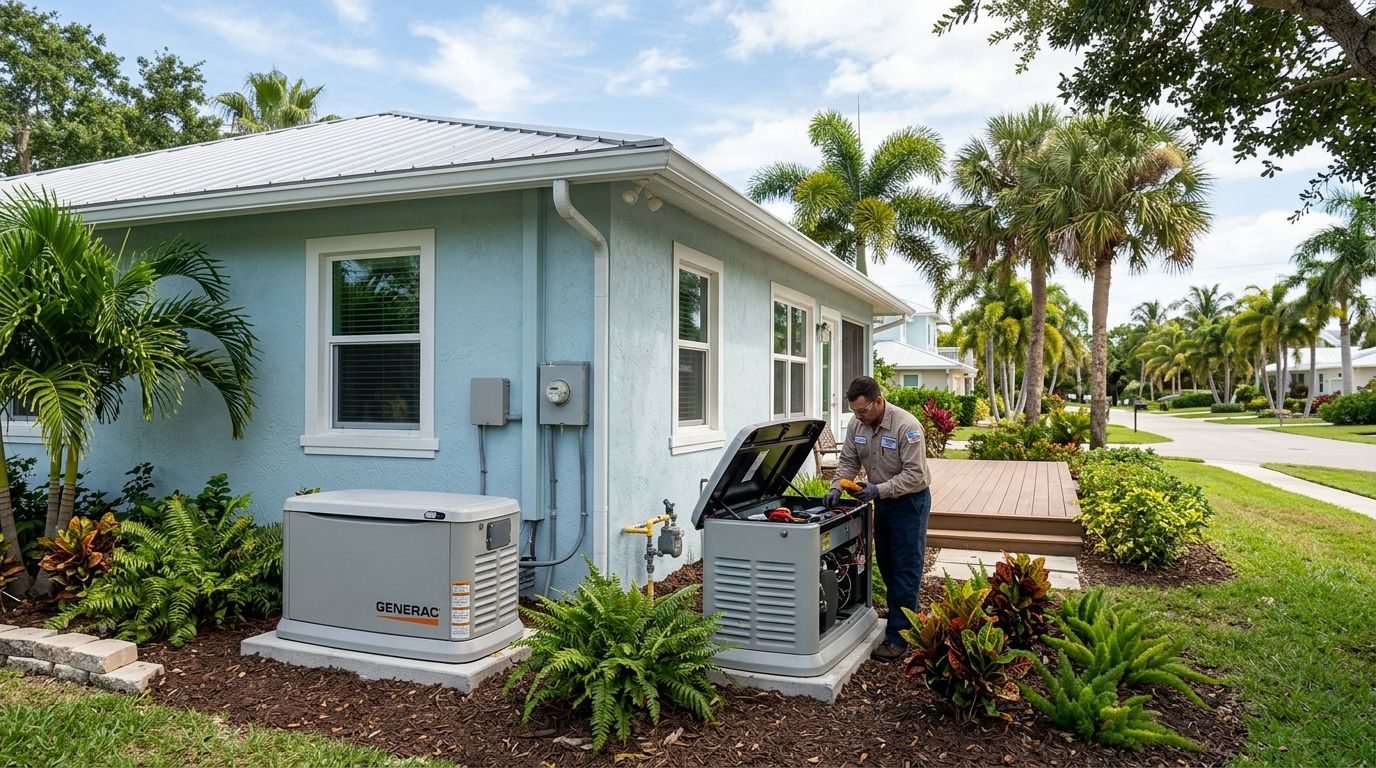
Standby generators for rental properties are permanently wired, automatic-start backup power systems that keep a rental unit's essential circuits running during a Florida grid outage without the owner or a tenant touching a switch. For a landlord or property manager on the Treasure Coast, the calculation is different than for a homeowner: you're protecting a lease agreement, an absentee tenant's safety, and a piece of income property that sits empty for stretches at a time.
A single-family owner-occupant can ride out a blackout with a cooler and a portable generator. A rental property owner can't assume anyone is on-site to refuel a tank at 2 a.m., and a habitability clause doesn't care whose fault the outage was.
- Standby generators for rental properties run on natural gas or propane and start automatically within seconds of a grid failure — no tenant action required.
- Sizing for a rental unit means covering AC, refrigeration, and outlets, not the whole home's discretionary load.
- An automatic transfer switch is the difference between a true standby system and a portable generator someone has to plug in manually.
- Imperium Electric installs whole-house standby generators and transfer switches across Port St. Lucie, Stuart, and Jensen Beach for landlords managing multiple units.
- Maintenance contracts matter more for rentals than owner-occupied homes because nobody on-site notices a dead battery until the storm hits.
Why standby generators matter for rental property owners
A tenant calling you at 11 p.m. about a dark unit during a tropical storm is a landlord's worst version of a maintenance call. You can't send a portable generator through the mail, and you can't be certain a renter knows how to run one safely, or would bother to.
Standby power removes the guesswork. The system starts on its own, runs on a fixed fuel line instead of a five-gallon can, and keeps AC, refrigeration, and lighting circuits alive whether you're at the property or three states away. For a Treasure Coast landlord, that's the difference between a tenant staying through a storm and a tenant breaking a lease over spoiled food and 95-degree heat. Insurance carriers and county inspectors also look more favorably on properties with documented, code-compliant backup power, particularly after a four-point inspection-style review.
Managing electrical and plumbing systems across multiple rental units already means more moving parts than a single-family home. Backup power is one more system, but it's the one that fails loudest when it's missing.
Assess your rental unit's real electrical load
Don't size for the whole house — size for what the lease and the tenant's safety actually require. Overbuying wastes capital; underbuying leaves a tenant without AC in August.
- Walk the unit and list circuits that must stay live: AC condenser, refrigerator, sump or well pump, a handful of outlets and lights
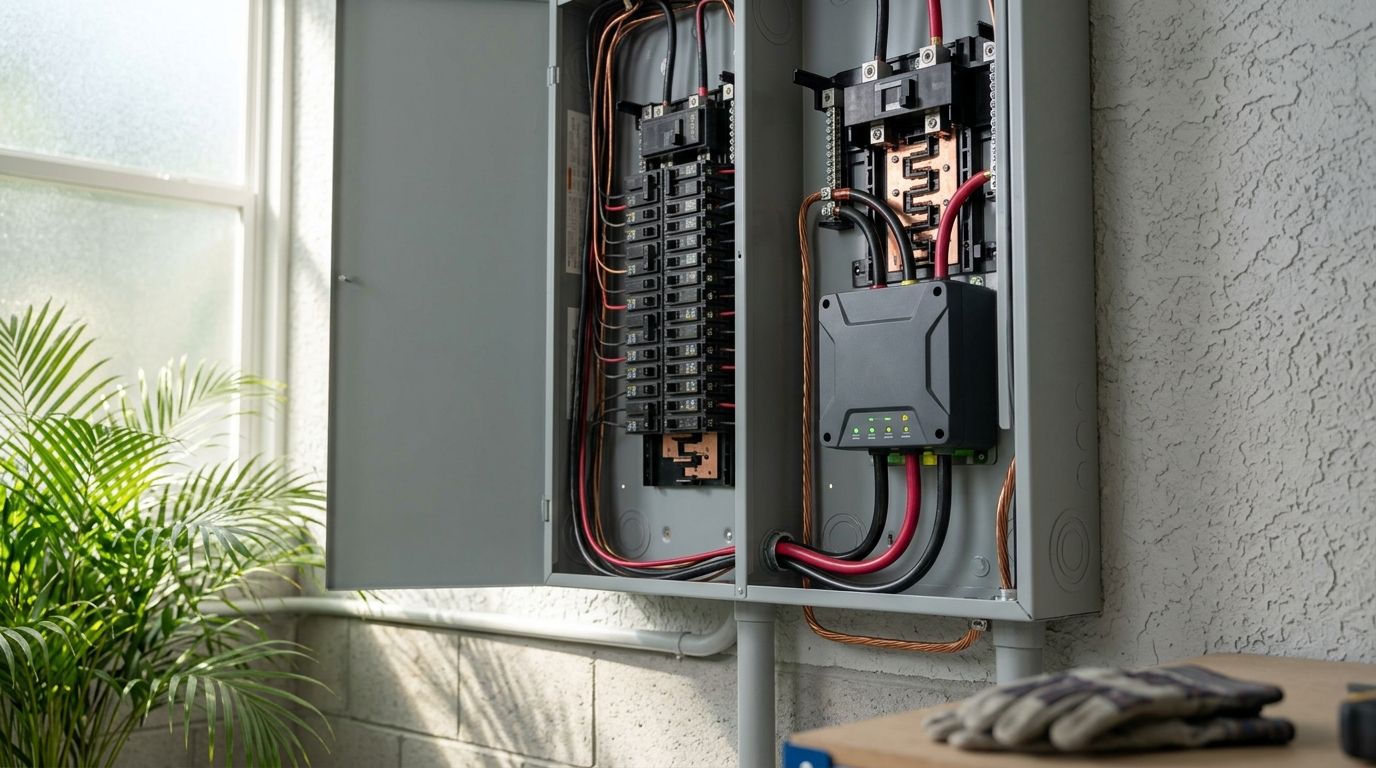
- Check the panel's amperage and existing breaker layout before assuming anything about capacity
- Separate "must-run" circuits from discretionary ones like a pool pump or dryer
- Factor in whether the property is single-family, duplex, or multi-unit — each has a different load profile
- Pull the existing electrical permit history if the property changed hands recently
Size the generator correctly for the property type
Guessing on generator size is the single most common mistake landlords make, usually because they size for their own home instead of the rental unit. A generator sizing guide walks through the load math step by step.
- Add up running watts for AC, refrigeration, and safety circuits, not surge watts
- Round up one size tier for older AC compressors with higher startup draw
- For duplexes or multi-family, decide whether one generator serves both units or each gets its own
- Confirm the unit's electrical panel can handle the transfer switch amperage before ordering equipment
- Get a written load calculation, not a verbal estimate, for insurance and permit records
Choose a fuel source that works for an absentee-owned property
Fuel choice matters more for rentals than for owner-occupied homes because nobody's checking a tank level daily.
- Natural gas hookups give unlimited run time as long as the utility line stays up — the best fit if the property is on the gas grid
- Propane tanks need a delivery schedule you can actually manage remotely, or a property manager who checks it
- Portable generators requiring manual fuel refills are a liability for unsupervised units — a tenant improvising a fuel setup is a fire and carbon monoxide risk
- Diesel is rarely practical for residential rentals due to tank size and local fuel availability
Install a proper automatic transfer switch
A standby generator without an automatic transfer switch is just an expensive portable unit. The switch is what makes the system truly hands-off for a tenant.
- Confirm the switch is rated for the full panel load, not just the "must-run" circuits
- Verify it's a UL-listed, code-compliant switch installed by a licensed electrician, not a DIY interlock kit
- Ask whether the switch logs run cycles — useful for maintenance records across a portfolio
- Have the electrician document the transfer switch installation for county permit and insurance files
A standby system without a code-compliant transfer switch isn't backup power — it's a generator waiting for someone to show up and plug it in.
Set up remote monitoring across your properties
If you manage more than one rental, you need visibility without driving to each address after every storm.
- Ask the installer whether the unit supports app-based or cellular monitoring for run status and fuel level
- Set alert thresholds for low fuel, failed self-test, or battery fault
- Keep a simple log per property: install date, last service date, last self-test result
- Give property managers or on-site contacts a one-page "what to do if the generator doesn't start" sheet
Budget for maintenance as a fixed operating cost, not an afterthought
A generator that hasn't been serviced is a generator that won't start when you need it — and for a rental, that failure shows up as a tenant complaint, not a quiet inconvenience.
- Change the oil and filter per the manufacturer's interval, typically annually for standby units under normal use
- Test the battery and run the self-test cycle monthly, or confirm the unit's automatic self-test is functioning
- Inspect for corrosion, rodent damage, and exhaust blockage at each service visit
- Roll generator upkeep into the same maintenance contract as HVAC and plumbing checks across the portfolio
Get standby power quoted for your rental
Licensed installation and maintenance across Port St. Lucie, Stuart, and Jensen Beach.
Document backup power in the lease and insurance file
A generator that exists but isn't documented doesn't help you in a coverage dispute or a habitability claim.
- Note backup power capability and covered circuits in the lease addendum
- Keep permit and inspection paperwork with the property file, not just at the office
- Notify your insurance carrier — some policies adjust premiums for documented standby power
- Update disclosures if you add or remove a unit's backup coverage
Comparing backup power options for Treasure Coast rentals
| Option | Best for | Key limitation |
|---|---|---|
| Whole-house standby generator | Long-term rentals, multi-unit properties, absentee owners | Requires permitted installation and a dedicated fuel line |
| Portable generator | Owner-occupied properties where someone is always on-site | Manual fueling and setup — not reliable for unsupervised tenants |
| Battery backup (no generator) | Short outages, non-AC-dependent units | Limited run time, doesn't cover AC load in Florida heat |
| No backup power | Not recommended for occupied rentals in hurricane-prone counties | Full exposure to habitability disputes and tenant loss during outages |
Verdict: a properly sized whole-house standby generator with an automatic transfer switch is the only option on this list that protects a rental property without depending on the tenant doing anything.
Common mistakes rental property owners make
- Sizing the generator for personal preference instead of the lease. Owners often oversize based on their own home's needs, driving up equipment and fuel costs unnecessarily.
- Skipping the transfer switch and relying on a portable unit. This shifts operational risk onto a tenant who didn't sign up to run generator maintenance.
- No maintenance contract across a multi-property portfolio. A generator serviced once at install and never again is a generator that fails silently until a storm proves it.
- Not updating insurance or lease documents after installation. Undocumented equipment doesn't help in a claim dispute.
- Ignoring fuel logistics for propane units. An empty tank during a hurricane watch defeats the entire purpose of the system.
“A standby system without a code-compliant transfer switch isn't backup power — it's a generator waiting for someone to show up and plug it in.”
FAQ
Do rental properties need standby generators in Florida?
There's no statewide mandate requiring standby generators in rental units, but insurance carriers and county habitability standards increasingly favor documented backup power for AC-dependent properties. Landlords managing tenants through hurricane season in 2026 get fewer emergency calls and lease disputes with a standby system installed.
How much power does a rental unit actually need from a generator?
Size for the must-run circuits — AC, refrigeration, a sump or well pump, and basic outlets — not the whole home's discretionary load. A licensed electrician calculates running watts from the unit's panel and appliance list before recommending a size.
Can a portable generator work for a rental property?
It can, but it shifts fuel handling and startup responsibility onto the tenant, which is a liability for absentee owners. A whole-house standby generator with an automatic transfer switch removes that dependency entirely.
Who maintains a standby generator at a rental property?
The property owner or manager is responsible for scheduling service, typically an annual oil and filter change plus monthly self-test checks. Many landlords roll this into a maintenance contract covering multiple units at once.
Does a standby generator affect rental insurance premiums?
Some carriers adjust premiums when a property has documented, permitted backup power, since it reduces spoilage and habitability claims after an outage. Confirm directly with the carrier and keep permit records on file.
What fuel source is best for a rental property generator?
Natural gas is the most practical choice for unsupervised rentals because it doesn't require refueling. Propane works but needs a delivery schedule the owner or manager actively tracks.
How long does a standby generator installation take for a rental unit?
Timelines depend on permitting through the county and the property's existing electrical panel condition. A licensed electrician can give a property-specific schedule after the initial load assessment.
Is a transfer switch required with a standby generator?
Yes — an automatic transfer switch is what makes the system start without anyone present, and it's required for code-compliant standby installations. Skipping it turns a standby unit into a manually operated portable generator.
One last thing
The most overlooked line item on a rental property's generator budget isn't the equipment — it's the transfer switch amperage rating. Landlords who buy a generator sized correctly but pair it with an undersized or non-automatic switch end up with a system that technically exists but doesn't do the one job it was bought for: starting without a tenant's help. Confirm the switch rating matches the panel before signing off on any install, whether it's for a single unit or a multi-property portfolio going into hurricane season 2026.